货币宽松

Search documents
强劲反弹近4%,黄金再冲4400美元
Di Yi Cai Jing· 2025-10-21 00:22
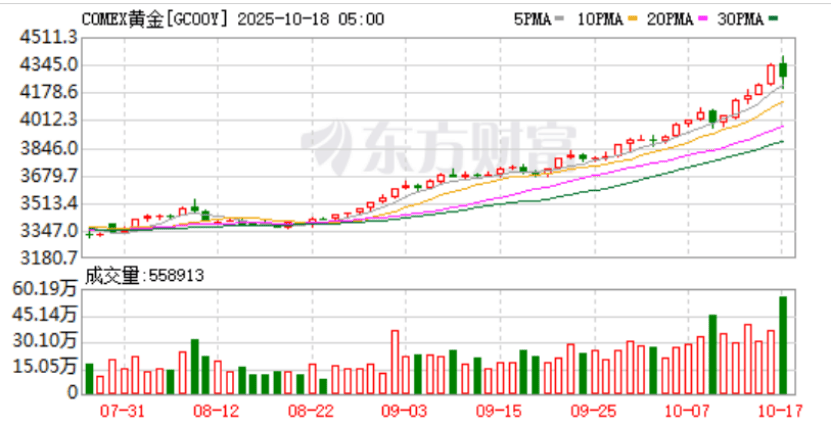
克里斯蒂安称:"若明年某个时候金价突破每盎司5000美元,这一走势的前提是当前存在的政治问题持 续发酵甚至恶化 —— 事实上,目前的局势正朝着这一方向发展。" 因投资者等待近期中美贸易谈判及美国通胀数据发布,叠加市场对美联储进一步降息的预期与避险需求 持续升温,国际金价周一大幅上涨超4%。纽约商品交易所12月交割的COMEX黄金期货日内触及4398美 元/盎司高位,再创历史新高,截至记者发稿时,金价交投于4380美元附近。 V型反转 上周五,金价曾触及每盎司4392美元的历史高点,随后尾盘跳水当日收盘下跌1.8%,创下自5月中旬以 来的最大单日跌幅。消息面上,美国总统特朗普的表态在一定程度上缓解了市场对贸易紧张形势的担 忧,与此同时,地区银行危机降温也打压了避险情绪。 周一,黄金在欧洲交易时段再起升势,CPM集团(CPM Group)管理合伙人克里斯蒂安(Jeffrey Christian)表示,政治与经济层面的担忧正推动金价回升。"我们预计,未来数周乃至数月内金价将进 一步走高,若短期内触及每盎司4500美元,我们也不会感到意外。"他补充道。 美国政府停摆状态进入第20天。上周,参议员们第十次尝试打破僵局, ...
强劲反弹近4%!黄金再冲4400美元
第一财经· 2025-10-21 00:11
2025.10. 21 本文字数:2030,阅读时长大约4分钟 作者 | 第一财经 樊志菁 因投资者等待近期中美贸易谈判及美国通胀数据发布,叠加市场对美联储进一步降息的预期与避险需求 持续升温,国际金价周一大幅上涨超4%。纽约商品交易所12月交割的COMEX黄金期货日内触及4398 美元/盎司高位,再创历史新高,截至记者发稿时,金价交投于4380美元附近。 V型反转 周一,黄金在欧洲交易时段再起升势,CPM集团(CPM Group)管理合伙人克里斯蒂安(Jeffrey Christian)表示,政治与经济层面的担忧正推动金价回升。"我们预计,未来数周乃至数月内金价将进 一步走高,若短期内触及每盎司4500美元,我们也不会感到意外。"他补充道。 美国政府停摆状态进入第20天。上周,参议员们第十次尝试打破僵局,但未能成功。受"停摆"影响,美 国能源部下属国家核安全管理局约1400名员工将于20日开始被迫无薪休假,这是该机构2000年成立以 来首次。 此次停摆还导致关键经济数据发布延迟,使投资者与政策制定者在美联储下周召开政策会议前陷入 "数 据真空"。美联储主席鲍威尔14日在美国商业经济协会年会上表示,美联储想通 ...

【华西大类资产】美欧日政策差异下的弱美元——2025Q4海外经济与资产展望
Sou Hu Cai Jing· 2025-10-20 00:20
Group 1: Economic Overview - The US economy is experiencing marginal slowdown, with both manufacturing and service sectors showing decreased activity, and the labor market showing signs of fatigue [1] - In Europe, the economy is stabilizing under the influence of continuous interest rate cuts, leading to increased credit growth for households and businesses, although structural issues and energy bottlenecks persist [1] - Japan's economy remains relatively stable with rising household income and improved consumer confidence, but faces new challenges from US tariffs and yen appreciation impacting manufacturing and exports [1] Group 2: Asset Outlook - US Treasury yields are expected to decline towards 3.5% as the Federal Reserve continues to cut rates, with European bond yields also expected to decrease due to easing inflation pressures [2] - The US dollar is anticipated to weaken due to the Federal Reserve's rate cuts and the differing monetary policy trajectories among the US, Eurozone, and Japan [2] - Short-term pressures on gold prices are noted due to increased margin requirements and prior price surges, while medium-term support remains strong from fiscal debt, monetary easing, and sovereign gold purchases [2]
黄金冲高回落后上涨动能犹存,后市走向引关注
Sou Hu Cai Jing· 2025-10-18 04:40
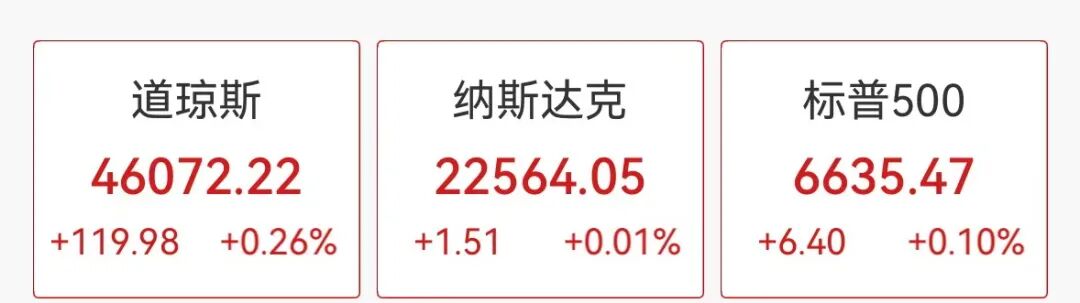
Group 1 - The U.S. stock market indices collectively rose on October 17, indicating a rebound in market risk appetite compared to the previous week [1] - Major U.S. tech stocks mostly increased, while popular Chinese concept stocks showed mixed performance [1] - International precious metal prices experienced a collective decline, with gold prices falling below $4,300 per ounce and briefly dipping below $4,200 per ounce [1] Group 2 - U.S. regional banks showed signs of credit pressure, leading investors to seek safe-haven assets, which pushed international gold prices to briefly exceed $4,380 per ounce, marking a weekly increase of over 8% [3] - The performance of Western Alliance Bancorp and Fifth Third Bancorp indicated a slowdown in risk, contributing to a slight rise in U.S. stock indices [3] Group 3 - Despite a short-term pullback, gold's upward momentum remains strong, driven by geopolitical tensions, interest rate cut expectations, central bank gold purchases, and significant inflows into ETFs [4] - Gold prices have increased by over 66% this year, and it has become the first asset to surpass a total market value of $30 trillion after breaking the $4,300 mark [4] - The SPDR Gold Trust reported a record holding of 1,034.62 tons, the highest level since July 2022, indicating strong ETF inflows supporting gold prices [4] Group 4 - HSBC forecasts that gold's upward momentum may continue until 2026, driven by strong central bank purchases and ongoing fiscal concerns in the U.S., with a target price of $5,000 [5] - The report emphasizes that the U.S. fiscal deficit is a significant factor driving gold demand as investors increasingly view gold as a hedge against debt sustainability risks [5] - Bank of America strategist Hartnett notes that current gold allocations are low, and expectations regarding the new Fed chair and potential monetary devaluation are favorable for gold investments [5][6]
深夜突发!金价,大跳水
第一财经· 2025-10-18 01:09
Core Viewpoint - The article discusses the recent fluctuations in gold prices, highlighting the impact of market sentiment, geopolitical tensions, and economic indicators on gold as a safe-haven asset. It emphasizes that despite short-term volatility, the overall environment remains supportive for gold prices due to ongoing geopolitical risks and expectations of monetary easing [3][4][10]. Market Analysis - Gold prices experienced a significant rise, with a weekly increase of over 8%, reaching a peak near $4380 per ounce before a late-week drop [6][10]. - The recent surge in gold prices is attributed to various factors, including concerns over regional bank credit risks and geopolitical tensions, particularly related to the U.S.-China trade situation and the Russia-Ukraine conflict [7][10]. - The relative strength index (RSI) for gold has surpassed 88, indicating an overbought condition, suggesting a potential need for market correction [8]. Technical Indicators - Historical data shows that gold has not experienced a continuous rise for more than nine weeks since the 1970s, indicating a potential for a market adjustment [8]. - The current gold price movement has deviated significantly from the 200-week moving average, a situation that has historically led to corrections [8]. Investment Trends - Gold has risen over 66% this year, driven by geopolitical tensions, expectations of interest rate cuts, and significant inflows into gold exchange-traded funds (ETFs) [10][11]. - The SPDR Gold Trust reported its highest holdings since July 2022, with 1034.62 tons, reflecting strong investor interest in gold as a hedge against economic uncertainty [11]. - HSBC forecasts that gold's upward momentum may continue until 2026, driven by strong central bank purchases and ongoing fiscal concerns in the U.S., with a target price of $5000 per ounce [11]. Future Projections - Analysts predict that if the Federal Reserve does not meet market expectations for interest rate cuts, gold's upward trajectory may face challenges [11]. - Bank of America strategists suggest that the current low allocation to gold among investors, combined with expectations of monetary easing, could lead to significant price increases, potentially reaching $6000 by next spring [12].

A50深夜拉升 黄金、白银跳水 虚拟货币大跌 29万人爆仓
2 1 Shi Ji Jing Ji Bao Dao· 2025-10-17 15:49
Group 1: Regional Banks Performance - U.S. regional bank stocks rebounded during the trading session after a collective drop due to credit issues, with notable gains including Carver Bancorp up over 5% and Pacific Mercantile Bank up over 4% [2][3] - Other banks also saw significant increases, such as Alliance West Bank up 4.25% and Zion Bank up 3.28% [3] Group 2: Cryptocurrency Market Trends - Cryptocurrency stocks opened lower but slightly recovered, with Bitfarms and Canaan Technology both dropping over 8% [4] - Bitcoin fell over 5% in 24 hours, dropping below $105,000, while Ethereum decreased over 6% to $3,724, with over 290,000 liquidations totaling nearly $1.2 billion in the last 24 hours [4][5] Group 3: Gold Market Insights - International gold prices experienced volatility, reaching a historical high before dropping below $4,300 per ounce, with palladium and silver also seeing significant declines [7] - A recent survey indicated that 43% of investors view "going long on gold" as the most crowded trade, surpassing the 39% for "going long on the seven major U.S. stocks," suggesting a large influx of institutional funds into gold [8] - Despite the crowded trade perception, many fund managers reported low gold positions, indicating potential for further investment as the average allocation remains only 2.4% [8][9] - The influx into gold is driven by factors such as the Federal Reserve's dovish stance and rising geopolitical risks, with Goldman Sachs raising its gold price target significantly to $4,900 per ounce by the end of 2026 [9]
A50深夜拉升,黄金、白银跳水,虚拟货币集体大跌,29万人爆仓
2 1 Shi Ji Jing Ji Bao Dao· 2025-10-17 15:17
Group 1: Regional Banks Performance - U.S. regional bank stocks rebounded during the trading session after a collective drop due to credit issues, with notable gains including Carver Bancorp up over 5% and Pacific Mercantile Bank up over 4% [2][3] - Other banks also saw significant increases, such as Alliance West Bank rising by 4.25% and Zion Bank by 3.28% [3] Group 2: Cryptocurrency Market Trends - Cryptocurrency stocks opened lower but slightly recovered, with Bitfarms and Canaan Technology both dropping over 8% [4] - Bitcoin fell over 5% in 24 hours, dropping below $105,000, while Ethereum decreased over 6% to $3,724, with over 290,000 liquidations totaling nearly $1.2 billion in the last 24 hours [4][5] Group 3: Chinese Concept Stocks - The Nasdaq Golden Dragon China Index fell by 0.62%, with most popular Chinese concept stocks declining, including Kingsoft Cloud and Xunlei dropping over 4% [5][6] - NIO and Zeekr also experienced declines of over 2% [6] Group 4: Precious Metals Market - International gold prices experienced volatility, reaching a new historical high before dropping below $4,300 per ounce, with palladium prices falling by 7% and silver dropping over 4% [7] - The Shanghai Futures Exchange announced adjustments to margin requirements and price limits for gold and silver futures contracts starting from October 21, 2025 [7] Group 5: Investor Sentiment on Gold - A recent Bank of America survey indicated that 43% of investors believe "going long on gold" is the most crowded trade, surpassing the 39% for "going long on the seven major U.S. stocks" [8] - Despite this crowded trade sentiment, 39% of investors reported near-zero gold positions, suggesting potential for further investment in gold [8][9] - The influx of capital into gold is driven by factors such as the Federal Reserve's dovish stance and rising geopolitical risks, with Goldman Sachs raising its gold price target significantly [9]

每日投行/机构观点梳理(2025-10-17)
Jin Shi Shu Ju· 2025-10-17 09:52
Group 1: Gold Market Outlook - HSBC expects the bullish momentum of gold to continue until 2026, driven by strong central bank purchases, ongoing fiscal concerns in the U.S., and expectations of further monetary easing [1] - HSBC highlights that the U.S. fiscal deficit is a significant factor driving gold demand, as investors increasingly view gold as a hedge against debt sustainability risks and potential dollar weakness [1] - ANZ analysts predict that gold prices will rise to $4,400 per ounce by the end of this year and may peak at $4,600 by mid-2026, supported by structural factors [1] Group 2: Emerging Markets and China Stocks - UBS continues to give an overweight rating to Chinese stocks in emerging markets, expressing a more favorable outlook compared to the Indian market [2] Group 3: U.S. Job Market - Analysts from JPMorgan and Goldman Sachs estimate that initial jobless claims in the U.S. may decrease from 235,000 to 217,000, indicating a potential improvement in the job market [3] Group 4: Federal Reserve Independence Concerns - A Deutsche Bank survey reveals that a majority of financial professionals are concerned about the potential erosion of the Federal Reserve's independence, with 41% believing it is "likely" and 21% "very likely" [4] Group 5: UK Economic Outlook - JPMorgan economists predict that the Bank of England may resume interest rate cuts in February 2024 due to signs of economic weakness, with an 82% implied probability of a rate cut [5] Group 6: Eurozone Economic Concerns - Rabobank's analysis indicates that fiscal issues in France and sluggish economic growth in Germany may suppress the euro's short-term upward potential [7] Group 7: Monetary Policy in China - Galaxy Securities suggests that monetary easing in China may exceed expectations in Q4, driven by economic data indicating weakness and the need for policy support [8] Group 8: Financial Products and Market Trends - CITIC Securities reports a decrease in bank wealth management scale by 850 billion yuan in September, but anticipates a recovery in October, projecting a rebound of over 1 trillion yuan [9][10] Group 9: Charging Infrastructure Development - Huatai Securities notes that a new action plan aims to double the charging infrastructure for electric vehicles by 2027, which is expected to accelerate the growth of the charging station industry [12] Group 10: Photovoltaic Industry Dynamics - CITIC Jinpu highlights that the photovoltaic industry is currently facing supply-demand imbalances, with "anti-involution" becoming a core issue, and emphasizes the importance of capacity consolidation and new technology advancements [12]
中线向上基础还在,市场结构进入混沌期
Sou Hu Cai Jing· 2025-10-17 05:52
Group 1 - The three major indices opened lower today, with the Shanghai Composite Index down 0.11%, the Shenzhen Component down 0.20%, and the ChiNext Index down 0.36% [1] - In the industry sectors, liquid metal, HBM, and cultivated diamonds saw significant declines, while lithium mining stocks initially surged, and the steel sector showed unusual strength, with the coal sector continuing its strong performance [1] - The Ministry of Industry and Information Technology is launching a "millisecond computing" initiative to establish a nationwide network by 2027, aiming for comprehensive coverage and efficient operation [1] Group 2 - Recent price increases have been observed in lithium battery anode materials, with overall capacity utilization in the anode industry rising, and leading companies reporting full order books [2] - The price of petroleum coke, a key raw material, has increased significantly, with a rise of approximately 100 CNY/ton in September and over 400 CNY/ton since the second quarter's low, impacting anode production costs by about 1000 CNY/ton [2] - Demand for lithium batteries continues to exceed expectations, with domestic bidding volumes doubling year-on-year in September and strong growth in overseas markets, indicating a positive supply-demand dynamic in the lithium battery material sector [2] Group 3 - The market experienced a pullback after a recent high, with trading volume in the Shanghai and Shenzhen markets at 1.93 trillion CNY, a decrease of 141.7 billion CNY from the previous trading day, marking the lowest volume in over a month [3] - The Shanghai Composite Index closed above 3900 points, supported by dividend stocks, while facing pressure from the 20-day moving average, and the Sci-Tech Innovation 50 Index continued to be pressured by the 5-day moving average [3] - The market is currently in a chaotic phase, with unclear profit-making effects, and if geopolitical headwinds persist, the market may continue to experience high turnover until a new narrative emerges to unify market consensus [3]
刚刚,黄金突然跳水了!
Sou Hu Cai Jing· 2025-10-17 04:50
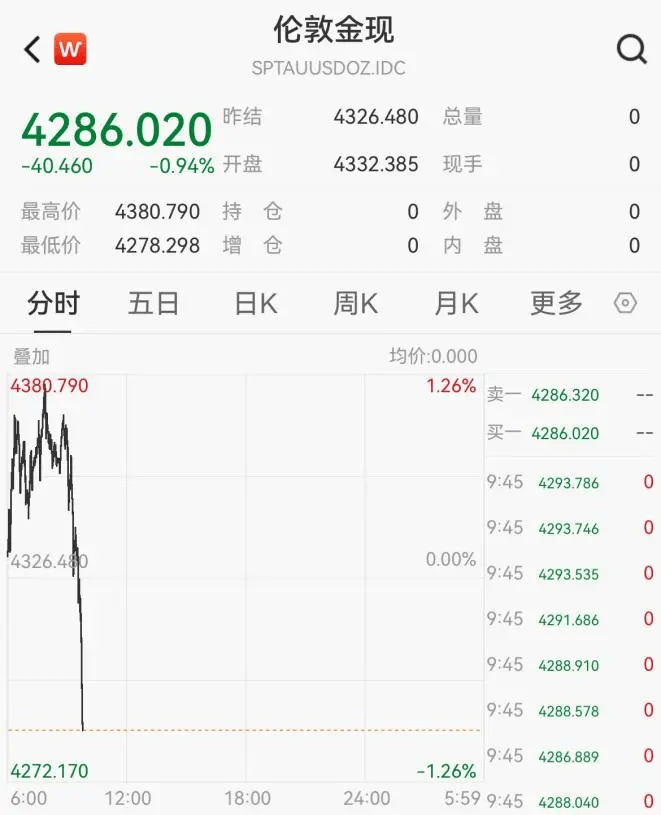
Core Points - On October 17, spot gold prices reached a historic high of $4,380 per ounce before experiencing a sharp decline, dropping $100 to below $4,280 per ounce [1] - As of the report, spot gold was priced at $4,286.02 per ounce, reflecting a daily decrease of 0.94% [1] - This week, gold prices have increased by over 8%, driven by concerns over trade tensions, ongoing U.S. government shutdown, and market expectations of increased monetary easing by the Federal Reserve before the end of the year [2] Gold Jewelry Prices - Domestic gold jewelry prices have approached 1,300 yuan per gram, with notable increases in prices from previous days [3] - Specific price changes include: Lao Miao's gold jewelry at 1,290 yuan per gram (up 42 yuan from the previous day), Zhou Shengsheng at 1,281 yuan per gram (up 36 yuan), and Chow Tai Fook at 1,279 yuan per gram (up 32 yuan) [3] - The Shanghai Gold Exchange issued a notice on October 16, urging members to enhance risk awareness and maintain market stability amid significant fluctuations in international precious metal prices [3]