
产业转型

Search documents
经济U型反弹之后,广州该如何做到“比自己好”
Nan Fang Du Shi Bao· 2025-11-19 17:10
Core Insights - Guangzhou has demonstrated a U-shaped economic rebound, with growth rates recovering from 2.0% in the first three quarters of last year to 4.1% in the same period this year, aligning with provincial growth rates [1] - The city's economic recovery is supported by healthy local debt levels, continuous inflow of external population, and balanced comprehensive functions, reflecting a long-term commitment to development [1] - The transformation of Guangzhou's automotive industry from traditional to new energy vehicles is accelerating, with significant growth in new energy vehicle production observed in recent quarters [3][4] Economic Performance - Guangzhou's economic growth rate has improved from 3.6% to 4.1% over two years, indicating a recovery trajectory [1] - The city's economic performance remains slightly below national averages, but it is approaching a normal state [1] Automotive Industry Transformation - The automotive sector in Guangzhou is undergoing a significant transition, particularly from traditional vehicles to new energy vehicles, with production growth rates of 0.7%, 16.7%, and 41.1% in the first three quarters of this year [3] - Xpeng Motors has emerged as a key player in this transformation, achieving record sales and contributing positively to the local automotive industry's outlook [3] Technological Advancements - Guangzhou is leading in autonomous driving technology, with local companies like WeRide and Pony.ai achieving significant milestones, including public listings [4] - The city is investing heavily in technology and innovation, supported by a robust network of universities and research institutions [5] Urban Renewal and Social Integration - Urban renewal initiatives, particularly the successful transformation of urban villages, have been crucial for Guangzhou's economic transition, supported by sustainable local debt levels and innovative reform policies [8][9] - The introduction of local regulations for urban village transformation has provided a legal framework to facilitate these changes [9] Long-term Vision - Guangzhou's approach to economic and social challenges emphasizes self-reliance and continuous improvement, positioning the city for future growth despite current economic conditions [10]

华夏幸福2025年11月19日涨停分析:债务重组+产业转型+保交楼进展
Xin Lang Cai Jing· 2025-11-19 05:51
Core Points - 华夏幸福's stock reached the daily limit of 3.64 yuan, with a rise of 9.37%, bringing its total market value to 14.168 billion yuan and circulating market value to 14.094 billion yuan, with a total transaction amount of 3.056 billion yuan as of the report date [1] Group 1 - The stock surge is attributed to significant debt restructuring, with 1,926.69 billion yuan of financial debt restructured, accounting for 87.9% of total debt, and interest reduction of 202.03 billion yuan, alleviating debt pressure and boosting market confidence in future development [2] - The "guarantee delivery" initiative is nearly complete, with residential projects delivered and only four apartment projects pending, stabilizing market expectations [2] - The company is advancing its transformation as an industrial new city service provider, with 18 new enterprises entering the park and a signed investment amount of 13.66 billion yuan, aligning with industry development trends supported by recent government policies [2] Group 2 - On November 18, the stock saw a trading volume of 3.466 billion yuan, with a net buying of 284 million yuan and net selling of 215 million yuan, indicating increased attention from funds [2] - Previous net buying by retail and foreign funds on November 13 also suggests growing interest in the stock [2] - Although technical patterns were not mentioned, the participation of substantial funds contributed to the stock's limit-up performance [2]

浙江余杭:智能引擎助力 产业转型加速
Xin Hua Wang· 2025-11-19 02:27
Core Insights - The transformation of Yuhang Economic Development Zone is characterized by a shift towards intelligent manufacturing and a modern industrial system supported by new equipment, materials, and energy [1][2][3] Group 1: Industrial Transformation - Yuhang Economic Development Zone has adopted a strategy of "breaking the old with the new and improving quality with intelligence," leading to a significant change in manufacturing methods and development concepts [1] - The introduction of artificial intelligence companies is seen as a reconstruction of the economic structure, forming a complete industrial chain from technology research and development to equipment manufacturing and application promotion [2] Group 2: Key Developments - BYD established operations in Yuhang Economic Development Zone in 2014, with the first electric bus rolling off the production line in just 18 months, now exporting thousands of vehicles annually [2] - The local supply chain for the new energy vehicle industry is rapidly expanding, with companies like Jingneng Microelectronics and Kaluo Technology emerging in the battery box and charging system sectors [2] - Yuhang Economic Development Zone currently hosts 381 high-tech enterprises, with over half of the industrial enterprises classified as specialized and innovative [2] Group 3: Future Outlook - The focus is on creating a sustainable industrial ecosystem rather than seeking short-term growth, indicating a long-term vision for industrial innovation and transformation [3]

逐绿向新再出发
Jing Ji Ri Bao· 2025-11-19 01:30
Core Insights - Shihezi City is undergoing a transformation in energy structure and industrial form, leading in economic growth within the Xinjiang Production and Construction Corps, but faces challenges such as lagging power grid construction and difficulties in industrial restructuring [1][2] - High-quality transformation requires coordinated efforts in policy guidance, infrastructure development, technological innovation, and talent cultivation [1] Group 1: Energy System Reform - The intermittent and volatile nature of photovoltaic power generation poses significant challenges to grid stability [1] - Shihezi's large photovoltaic bases are mostly located in surrounding counties, with limited existing transmission line capacity and coverage [1] - There is a need to accelerate power grid construction, enhance transmission capacity, upgrade existing transmission lines, and improve line stability [1] - Policies and market mechanisms should be improved to enhance local consumption capacity and encourage enterprises to increase the use of green electricity [1] - Accelerating technological innovation and supporting energy storage facilities are essential for building a more flexible and reliable energy storage system [1] Group 2: Industrial Chain Resilience - Despite having a layout of strategic emerging industries, Shihezi's industrial structure is still heavily weighted and the industrial chain is relatively short [2] - Emphasis should be placed on extending, supplementing, and strengthening the industrial chain through industrial investment and cultivation [2] - Traditional industries should be encouraged to extend upstream and downstream in the industrial chain to enhance product added value [2] - For the new energy industry, precise investment attraction and policy support are needed to introduce key supporting enterprises and technologies [2] - Strengthening overall competitiveness of the industrial chain through technological innovation, brand building, and market expansion is crucial [2] Group 3: Innovation and Talent Development - The fundamental shift towards new industries relies on technological innovation and talent-driven initiatives [2] - Targeted and flexible support policies should be introduced for strategic emerging industries, along with the establishment of more innovation platforms and development funds [2] - A virtuous cycle of "industry attracting talent and talent leading industry" should be constructed, providing guarantees in housing, education, and career development [2] - Collaboration with local universities and research institutions is essential for cultivating high-skilled talent for emerging industries [2] - Joint research and development platforms should be established to promote the local transformation of scientific and technological achievements [2]
花开傲霜枝 菊色满晋阳(一朵花读懂一座城)
Ren Min Ri Bao· 2025-11-18 23:11
图①:游客在花棚内采摘菊花。 刘 聪摄 图②:特色小吃菊花饼。 刘 聪摄 图③:"春日剑山"菊花。 人民网记者 马梦迪摄 图④:"小米黄"菊花。 人民网记者 马梦迪摄 图⑤:绘有太原双塔公园图样的菊花扇。 周博浩摄 本版菊花品种图片均为人民网记者马梦迪摄 赏花 一夜新霜著瓦轻, 芭蕉新折败荷倾。 耐寒唯有东篱菊, 金粟初开晓更清。 ——《咏菊》唐·白居易 每年9、10月份,山西太原城市街头开满菊花,一丛丛,一簇簇,或抱团如球,或垂丝如瀑,大可盈 尺,小则如钱,缤纷绚烂。 菊花是我国原产名花,已有3000多年栽培历史。太原四季分明、日照充足,地理、气候等条件均适宜菊 花生长。"九月里菊花家家有",一首民歌《十二月采花》,唱出当地人对菊花的喜爱。为何花中偏爱 菊?苏轼的名句"荷尽已无擎雨盖,菊残犹有傲霜枝"或许可以回答——菊花凌霜而立的风骨,映照着太 原的城市精神。 菊蕊独盈枝 一种品格,绵延不绝 菊花象征坚韧不拔、刚直高洁的品格,与梅、兰、竹并称"四君子"。《礼记》中有"季秋之月,鞠有黄 华"的记载。菊花隐逸高洁、坚韧不屈的品格,不仅体现在诗词、绘画等艺术形式中,也融进中国人的 生活哲学和精神追求中,成为中华民 ...

进步最快的百强市,慢了?
Mei Ri Jing Ji Xin Wen· 2025-11-17 14:46
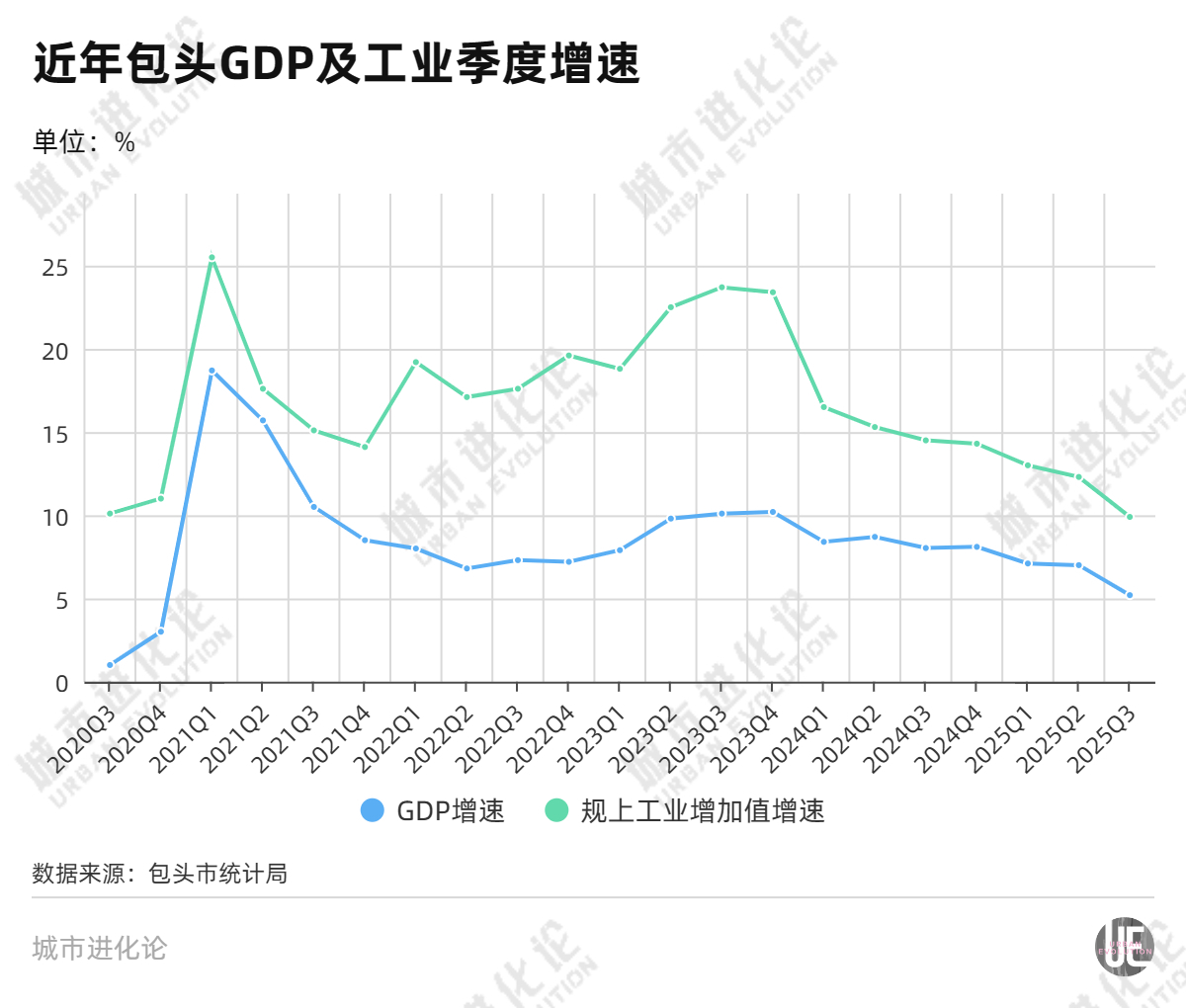
Core Insights - Inner Mongolia has released a significant document titled "Comprehensive Promotion of Beautiful Inner Mongolia Construction to Strengthen the Ecological Security Barrier in Northern China Planning Outline (2025-2035)" which emphasizes the development of Baotou as a key industrial city [1] - Baotou aims to enhance urban development, focusing on the construction of the Hohhot-Baotou-Ordos-Yulin urban cluster and the high-quality development of the Hohhot-Baotou-Ordos-Ulanqab region [1] - The city is set to develop a large-scale wind power base and become the largest rare earth new materials base in China, leveraging its rich resources [1] Economic Performance - In the first three quarters of this year, Baotou's industrial added value growth rate was 9.9%, marking the end of a 60-month streak of double-digit growth [2][5] - Baotou's GDP is projected to reach 457.51 billion yuan in 2024, with an 8.1% growth rate, continuing to lead among China's top 100 cities [2][3] - From 2020 to 2024, Baotou's GDP has increased from 276.97 billion yuan to 457.51 billion yuan, moving up in national rankings from outside the top 100 to 72nd place [2] Industrial Development - Baotou's industrial growth is primarily driven by its traditional heavy industries, including rare earths, polysilicon photovoltaic, steel, and aluminum, which are now valued at over 1 trillion yuan [2][10] - The rare earth industry in Baotou has seen a 19.7% increase in added value in the first three quarters, contributing significantly to overall industrial growth [12] - The city is also focusing on expanding its renewable energy sector, particularly in solar and wind power, to create a comprehensive industrial system [10][11] Infrastructure and Transportation - Baotou is prioritizing transportation infrastructure as part of its development strategy, with plans for high-speed rail connections to enhance regional integration [17][18] - The ongoing construction of the Baotou-Yinchuan high-speed rail is expected to improve connectivity and support industrial upgrades [18] - The establishment of a modern transportation network is seen as crucial for Baotou to leverage its industrial strengths and enhance its position within the urban cluster [18] Strategic Goals - Baotou has set a target to achieve a GDP of around 500 billion yuan by 2025, indicating ambitious growth plans despite current economic challenges [3][6] - The city aims to return to its historical peak GDP ranking, which was 41st in 2010, by addressing structural challenges and enhancing innovation capabilities [7][13] - The local government is focusing on integrating technological innovation with industrial development to strengthen its economic foundation [13]
华联控股:公司目前采取“先进行跨行业布局后进行产业聚焦”战略
Zheng Quan Ri Bao Zhi Sheng· 2025-11-17 11:42
Core Viewpoint - The company is currently implementing a strategy of "first cross-industry layout, then industry focus," which involves making small initial investments in various projects and later concentrating resources on those that show growth potential and are deemed timely for further investment [1] Group 1 - The company is adopting a phased approach to investment, starting with small-scale investments [1] - The strategy aims to cultivate projects until they mature, at which point the company will focus on specific industries and increase investment [1] - The ultimate goal of this strategy is to achieve industrial transformation [1]

地方国资“保壳式卖壳”样本:*ST宝鹰“组合拳式”交易力求多方共赢
Zheng Quan Shi Bao Wang· 2025-11-17 09:15
Core Viewpoint - The article discusses the strategic asset divestiture by *ST Baoying, which aims to improve its financial health and operational efficiency following a change in control from state-owned to private ownership [1][2][4]. Group 1: Asset Divestiture - *ST Baoying plans to sell its investment property in Shenzhen for 86.8725 million yuan to its controlling shareholder's subsidiary, marking a move to "recover" and "reduce burden" [1][2]. - The transaction is expected to positively impact the company's financial status, with an estimated loss of approximately 42 million yuan after accounting for taxes [1][2]. Group 2: Change in Control - The change in control involves a series of transactions that result in a new private entity, Shitong Niu Investment, becoming the largest shareholder with a 25.74% stake, replacing the state-owned Zhuhai State-owned Assets Supervision and Administration Commission [2][3]. - The total consideration for this acquisition exceeds 1.1 billion yuan, indicating a significant investment scale by the new controlling party [2]. Group 3: Historical Context and Challenges - Since the state-owned Zhuhai government took control in 2018, *ST Baoying has faced continuous annual losses, with net assets turning negative by the end of 2024 and a debt ratio exceeding 100% [3]. - The company's operational difficulties stem from broader industry pressures and specific client-related issues, particularly following the Evergrande debt crisis in 2021 [3]. Group 4: Future Strategy and Transformation - The new controlling party plans to pivot *ST Baoying's business focus from traditional construction to the photonics and silicon-based semiconductor sectors, with a commitment to achieve a net profit of 400 million yuan from these new ventures over the next three years [5][6]. - The transaction structure includes a combination of share transfers and voting rights arrangements, allowing the former state-owned entity to retain some influence while enabling the new shareholders to drive the company's transformation [5][6]. Group 5: Market Implications - This case exemplifies a "shell protection" strategy where state-owned assets are divested to private entities to preserve value and stimulate growth, potentially serving as a replicable model for other distressed companies in the market [4][6].

从“卖花”到“卖IP” 窑上古桂香飘全国
Xin Hua Ri Bao· 2025-11-17 05:33
Core Insights - The article highlights the transformation of the traditional agricultural village of Yaoshan in Suzhou, which is known for its ancient osmanthus trees, into a modern cultural and tourism hub, leveraging its historical and ecological resources [1][3][6]. Industry Overview - Yaoshan village, with its 2,500 acres of osmanthus trees, has historically been a significant producer of osmanthus flowers, contributing 70% of the total production in the region [4][5]. - The village faced a decline in osmanthus flower prices, dropping from 18 yuan per jin ten years ago to as low as 2-3 yuan per jin at one point, leading to a significant reduction in income for local farmers [5][6]. Transformation Strategies - The village is adopting a model similar to Hangzhou's Manjuelong, focusing on creating a cultural tourism experience rather than just selling raw materials [6][9]. - The introduction of "osmanthus-loquat intercropping" has been implemented to enhance income, with farmers reporting increased yields and profits from both crops [7][8]. Product Innovation - New products such as "800-year ancient osmanthus limited sugar osmanthus" have been developed, selling for 198 yuan per bottle and demonstrating the commercial value of ancient osmanthus trees [6][9]. - The village has also launched innovative products like "ancient osmanthus loquat jam," which has gained popularity and is part of a strategy to differentiate from competitors [10]. Cultural and Tourism Development - The village has initiated cultural tourism activities, including guided tours and experiences related to osmanthus, which have significantly increased visitor numbers and local income [11]. - The local government has supported these initiatives with financial incentives for the preservation of ancient osmanthus trees and infrastructure improvements [11].
“捷报” 金山书写“逆袭”传奇 统筹推进空间转型和治理转型 为未来开辟“新局”积蓄强大后劲
Jie Fang Ri Bao· 2025-11-16 00:04
Core Insights - The article highlights the recent significant developments in Jinshan, including the inauguration of major projects such as the Syngenta plant protection products technology and engineering laboratory and the Lexus office building, marking a turning point for the region [1][2]. Group 1: Major Projects and Developments - Jinshan has seen a series of major projects over the past five years, including the opening of the Shanghai Lego Resort in November 2021, the commencement of the Ruijin Hospital Jinshan District in June 2023, and the announcement of the Syngenta Global Plant Protection Innovation Center in February 2025 [2]. - The Lexus electric vehicle project is expected to be completed by August 2026 and commence production in 2027, with an initial workforce of approximately 80 employees [1][2]. Group 2: Economic Impact and Community Response - The influx of projects has generated mixed reactions, with some skepticism regarding the economic impact of the Lexus project compared to larger investments in other sectors [2]. - Experts emphasize that while the investment in vehicle manufacturing may not be as substantial as in semiconductor industries, it can significantly boost GDP through local supply chain development [2]. Group 3: Transformation and Strategic Initiatives - Jinshan's transformation from a pollution-heavy industrial base to a greener, high-end chemical materials hub has involved significant investment, totaling around 36 billion yuan over ten years, with 810 environmental projects completed [3][4]. - The region's high-end chemical new materials industry has reached a production value of nearly 170 billion yuan, contributing to its recognition as a key industrial cluster in Shanghai [3][4]. Group 4: Future Directions and Governance - Jinshan is focusing on efficient service delivery for project implementation, adopting measures such as "full-service agency" and "chain-style support" to enhance its business environment [5]. - The region aims to integrate industrial, spatial, and governance transformations, emphasizing innovation in technology, digitalization, and cultural tourism to drive future growth [5][6].