
新旧动能转换

Search documents
如何推动投资止跌回稳?丨落实会议部署 问答中国经济
证券时报· 2025-12-19 04:53
Core Viewpoint - The article emphasizes the importance of stabilizing investment to drive economic growth, highlighting the need for targeted investment strategies to address both immediate and long-term economic challenges [1]. Group 1: Investment Trends - Since 2025, there has been increasing downward pressure on investment, with fixed asset investment growth declining by 2.6% year-on-year from January to November [1]. - Traditional investment engines like real estate and infrastructure are weakening, while investments in high-tech sectors such as clean energy and aerospace are rapidly increasing, indicating a positive shift in investment structure [1][2]. Group 2: Investment Focus Areas - Investment should be directed towards key areas that support national long-term development, including national security, industrial chain resilience, technological innovation, urban renewal, infrastructure, and energy [2]. - The construction of the Shanghai-Chongqing Railway serves as an example of how infrastructure projects can enhance regional economic coordination and improve public convenience, yielding significant indirect investment returns [2]. Group 3: Addressing Social Needs - Investments in public services such as education, healthcare, elderly care, and disaster prevention are crucial for improving people's livelihoods and expanding domestic demand [3]. Group 4: Green Transition - There is significant investment potential in energy-saving, carbon reduction, ecological protection, and clean energy sectors, which are essential for achieving carbon neutrality goals and enhancing China's competitive advantage [4]. Group 5: Investment Sources - Government investment plays a crucial role in guiding overall investment strategies, particularly in areas where the market cannot effectively allocate resources [4]. - Private investment, which accounts for over half of total fixed asset investment, is vital for sustaining investment growth, and its activation requires practical measures to enhance market access and address barriers [5]. Group 6: Policy Recommendations - To stimulate private investment, it is essential to implement concrete measures that improve market conditions, provide stable policy expectations, and ensure fair market environments [5]. - The article suggests that a coordinated policy approach focusing on both immediate stabilization and long-term high-quality development can effectively revitalize investment [5].


今年大宗商品市场总体平稳运行 我国经济结构更健康、更可持续
Yang Shi Wang· 2025-12-19 03:47
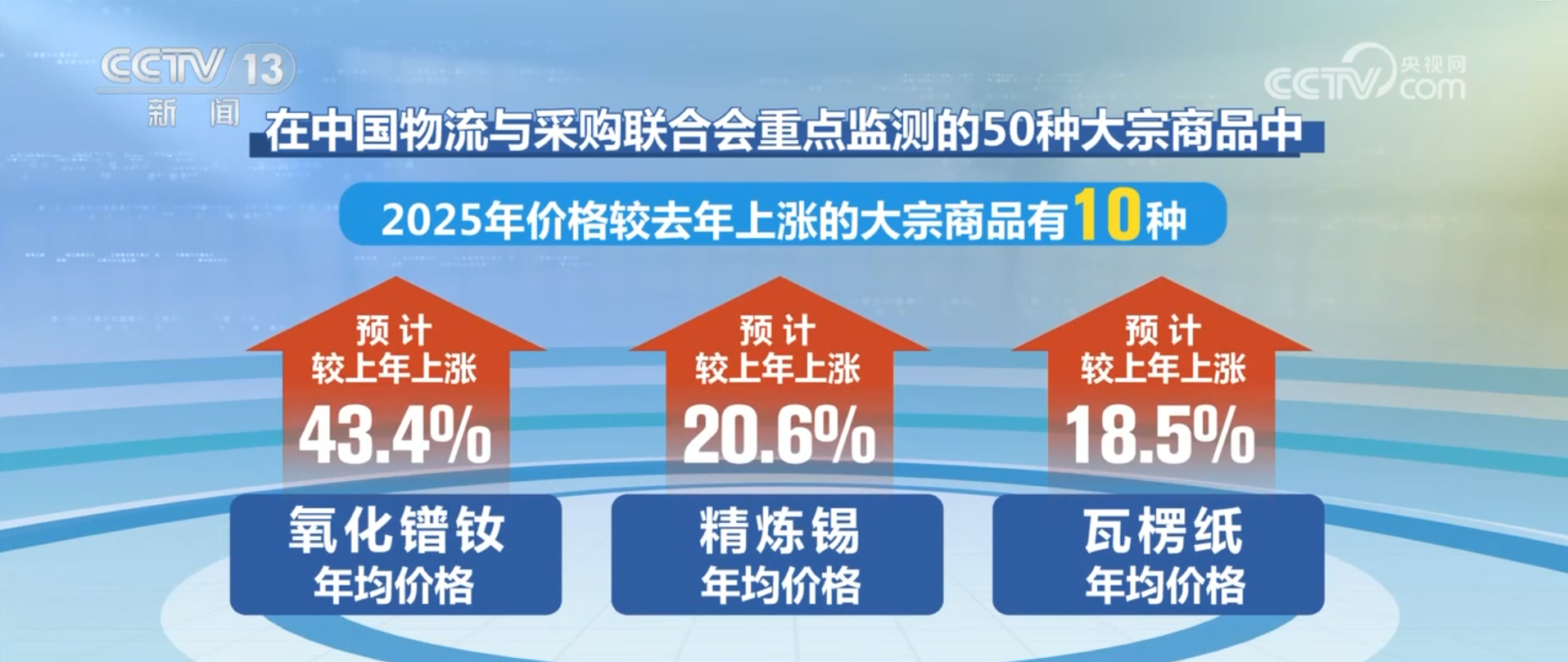
Core Insights - The report indicates that the overall operation of the bulk commodity market in China is stable, with significant characteristics of new and old energy conversion [1] Group 1: Price Index Forecast - The average price index for bulk commodities in China is expected to be 112.1 points in 2025, a decrease of 0.1% compared to the previous year [3] - Among the 50 bulk commodities monitored by the China Logistics and Purchasing Federation, 10 commodities are expected to see price increases compared to last year, including neodymium oxide, refined tin, and corrugated paper, with expected annual price increases of 43.4%, 20.6%, and 18.5% respectively [3] Group 2: Industry Analysis - The non-ferrous metal industry is expected to see a 4.2% increase compared to 2024, driven by the rapid growth of high-tech manufacturing and high-end equipment manufacturing in sectors such as new energy, photovoltaics, and wind power [4] - The average price index for agricultural products is projected to be 96.7 points, reflecting a 0.4% decrease from the previous year, with stable supply and demand for key agricultural products [4] Group 3: Economic Outlook - Experts suggest that the overall trend of the bulk commodity index in 2025 will show a pattern of low at the beginning and high at the end, indicating a stabilization and recovery, which reflects a healthier and more sustainable optimization of China's economic structure [5] - The strong resilience and significant domestic demand potential of the Chinese economy are expected to remain the most solid foundation for the bulk commodity market in 2026 [5]
2025年我国债券市场回顾及2026年前瞻
Sou Hu Cai Jing· 2025-12-19 02:43
Group 1: 2025 Bond Market Review - The bond market in 2025 is characterized by a rational correction of previously overdrawn expectations, with the 10-year government bond yield fluctuating between 1.60% and 1.90% throughout the year [2][3] - The market is divided into five phases, reflecting various economic and policy changes, including adjustments in monetary policy and external trade tensions [2][3][4] Group 2: Phases of the Bond Market in 2025 - Phase 1 (January to March): The bond market starts high with yields around 1.60%, but experiences downward pressure due to disappointing PMI data and cautious market sentiment, leading to a significant adjustment in short-term rates [3][4] - Phase 2 (Late March to Early April): The yield adjusts to around 1.90%, with some recovery as the central bank shifts to net injections, but external trade tensions lead to a drop in yields to 1.63% [4][5] - Phase 3 (Mid-April to June): The market experiences narrow fluctuations around 1.65% as trade tensions ease, but yields rise again due to policy changes and market reactions to economic data [5][6] - Phase 4 (July to September): The bond market faces upward adjustments in yields due to stock market performance and regulatory changes, with significant fluctuations in response to economic data [7][8] - Phase 5 (October to December): The market sees a mix of cautious sentiment and external trade tensions, with yields fluctuating as the central bank resumes bond purchases [9][10] Group 3: 2026 Economic and Bond Market Outlook - The macroeconomic policy for 2026 is expected to remain supportive, with a focus on domestic demand and technological advancements, while external uncertainties persist [11][12] - The fiscal policy is projected to maintain an expansionary stance, with a deficit rate of around 4% and total fiscal expansion estimated at 15.8 trillion yuan, an increase from 2025 [12][13] - The monetary policy is likely to continue its supportive role, with expectations of 1-2 reserve requirement ratio cuts, but less room for interest rate reductions compared to 2025 [14][15] Group 4: Bond Market Characteristics in 2026 - The bond market is anticipated to exhibit "low interest rates + high volatility + a floor and ceiling" characteristic, with the 10-year government bond yield expected to range between 1.60% and 2.10% [17][18] - The market is expected to face challenges from liquidity and regulatory changes, with a potential weakening of the "asset shortage" narrative [16][17] - Investment strategies should focus on short to medium-term bonds and consider leveraging opportunities in the long end of the yield curve [19]

新旧动能转换特征明显 今年我国大宗商品价格指数报告发布
Yang Shi Xin Wen· 2025-12-19 02:24
Core Insights - The China Logistics and Purchasing Federation released the "China Commodity Price Index Report (2025)" indicating a stable overall operation of the commodity market in 2023, with significant characteristics of new and old energy conversion [1] Group 1: Commodity Price Index - The average commodity price index in China for 2025 is expected to be 112.1 points, a decrease of 0.1% compared to the previous year [1] - Among the 50 monitored commodities, 10 are expected to see price increases in 2025, with neodymium oxide, refined tin, and corrugated paper projected to rise by 43.4%, 20.6%, and 18.5% respectively [1] Group 2: Industry Performance - The non-ferrous metal industry is expected to see a 4.2% increase compared to 2024, driven by the rapid growth of high-tech manufacturing and high-end equipment manufacturing sectors such as new energy, photovoltaics, and wind power [1] - The agricultural product price index is projected to average 96.7 points, reflecting a 0.4% decrease from the previous year, with stable supply and demand for key agricultural products [1] Group 3: Economic Outlook - Experts predict that the overall commodity index will show a trend of low to high, stabilizing and recovering, indicating a healthier and more sustainable optimization of China's economic structure [1] - The strong resilience and significant domestic demand potential of the Chinese economy are expected to remain the most solid foundation for the commodity market in 2026 [1]
无锡空港经开区围绕重点产业招大引强攻坚重大项目 提升发展能级
Xin Hua Ri Bao· 2025-12-18 22:59
Core Viewpoint - The cooperation agreement between Wuxi Airport Economic Development Zone and German company WEIDMANN marks a significant investment of approximately €125 million in high-efficiency motor R&D and production, enhancing the competitiveness of the region's high-end intelligent equipment industry [1] Group 1: Investment and Project Development - WEIDMANN's new project in Wuxi is its second investment in the area, following the completion of its first project in May, which had a total investment of €150 million and is expected to generate an annual output value of 1.5 billion RMB [2] - The Wuxi Airport Economic Development Zone has focused on attracting major projects, with 18 significant projects registered this year, totaling over 13 billion RMB in investment, including one project exceeding 5 billion RMB and three projects exceeding 1 billion RMB [2] Group 2: Industry Transformation and Innovation - The development of the titanium large centrifugal compressor project is a key initiative, with an investment of 1 billion RMB aimed at producing 360 units annually, supporting the domestic replacement of energy equipment and promoting the development of the upstream and downstream industrial chain [3] - Wuxi Songyu Technology's new project, with an investment of 500 million RMB, focuses on photovoltaic and semiconductor equipment, expected to produce 740 units annually, addressing the demand for core process equipment in integrated circuits and new energy sectors [4] Group 3: Service Optimization and Project Management - The Wuxi Airport Economic Development Zone emphasizes project management with five key performance indicators to accelerate project construction, including the rate of project registration, commencement, investment completion, and production efficiency [6] - A dedicated service team has been established to listen to enterprise needs and ensure a closed-loop process for addressing concerns, enhancing the overall service efficiency for businesses in the region [6]
2026全球交易者大会收官
Xin Lang Cai Jing· 2025-12-18 20:32
Group 1 - The 2026 capital market ecosystem and funding structure will undergo profound changes, with a clear trend of China's economy transitioning towards high-end manufacturing and technological innovation [1] - Companies that can represent China in the new global industrial and financial order will become the most valuable asset anchors of this era [1] - The Chinese innovative pharmaceutical industry is poised for significant growth supported by technological cycles, policy cycles, and interest rate environments [1] Group 2 - The demand for asset allocation is shifting towards assets that can provide hedging to manage risks and enhance returns [2] - The importance of flexible application of various tools in asset management is emphasized by market participants [2] - The commitment of Ping An Futures to customer-centric risk management services is highlighted, aiming to create value for traders in changing market conditions [2]
如何推动投资止跌回稳?
Zheng Quan Shi Bao· 2025-12-18 18:06
Core Insights - Investment is one of the "three driving forces" for economic growth, crucial for expanding domestic demand and supporting long-term stability and welfare [1] - The Central Economic Work Conference emphasized the need to "stop the decline and stabilize investment," reflecting a deep understanding of the current economic situation and a commitment to growth and transformation [1] Investment Trends - Since 2025, there has been increasing downward pressure on investment, with fixed asset investment growth declining by 2.6% year-on-year from January to November [1] - Traditional engines like real estate and infrastructure are weakening, while investments in high-tech sectors such as clean energy and aerospace are rapidly increasing, indicating a positive shift in investment structure [1] Strategic Focus Areas - Investment should be directed towards key areas such as national security, industrial chain resilience, technological innovation, urban renewal, infrastructure, and energy [2] - Projects like the Shanghai-Chongqing Railway exemplify how infrastructure can enhance regional economic coordination and improve public convenience, yielding significant indirect investment returns [2] Investment Sources - Government investment plays a crucial role as a "navigator," guiding resources to public sectors and key areas where the market cannot effectively allocate resources [3] - Private investment, which accounts for over half of total fixed asset investment, is essential for maintaining investment growth resilience [3] Enhancing Private Investment - To activate private investment, practical measures are needed to expand market access, eliminate policy barriers, and strengthen rights protection [4] - The long-term positive economic fundamentals, potential for industrial upgrades, regional coordination, green transformation opportunities, and demand for public welfare collectively form a substantial potential pool for investment growth [4]

推动中国科技创新,徐洪才提出五点建议
Di Yi Cai Jing Zi Xun· 2025-12-18 12:33
徐洪才指出,未来经济高质量发展,现代化进程的推进离不开新旧动能转换,离不开科技创新,它的战 略意义毫无疑问。 第三,深化人才发展机制改革。建立以创新价值、能力、贡献为导向的评价体系;推动校企联合培养, 推广现代学徒制;破除人才流动障碍,推广柔性引才政策。完善国际人才引进制度,提升人才政策国际 竞争力。 第四,优化创新生态环境。培育耐心资本,发展创业投资、知识产权质押融资等服务;完善首台套、首 批次应用政策,建立创新容错机制。建设全国统一技术市场,促进创新要素高效流动。 第五,扩大高水平开放创新。深化国际科技合作,共建联合实验室、创新中心;积极参与全球创新治 理,牵头国际大科学计划。鼓励企业参与国际标准制定,推动中国技术标准国际化。 对此,徐洪才提出五点建议: 第一,完善国家创新体系。强化战略科技力量布局,优化国家实验室体系;健全新型举国体制,针对不 同技术领域采用"大兵团"攻关与"竞争择优"相结合的模式。增加基础研究投入,建立长期稳定支持机 制,将基础研究经费占比提高到10%以上。 第二,强化企业创新主体地位。完善科技领军企业遴选培育机制,支持企业牵头国家科技项目;发展科 技型中小企业,提供研发费用补贴、创新 ...
徐建伟:科学理解“保持制造业合理比重”
Jing Ji Ri Bao· 2025-12-18 00:08
Core Viewpoint - The article emphasizes the importance of maintaining a reasonable proportion of the manufacturing industry in China's economy, highlighting the need for a balanced approach to achieve both qualitative improvements and reasonable quantitative growth in manufacturing [1][2]. Group 1: Importance of Manufacturing - Manufacturing is a crucial pillar of the national economy, and its reasonable proportion is essential for solidifying the material and technological foundation of Chinese-style modernization [1][2]. - Historical lessons from developed countries show that a premature decline in manufacturing can lead to severe economic and social risks, necessitating a focus on maintaining a robust manufacturing sector [2][3]. Group 2: Current State and Future Potential - China's manufacturing sector has a solid foundation and significant growth potential, with traditional industries transitioning from cost efficiency to quality and brand advantages, while emerging industries are developing new advantages through technological and industrial innovation [3][4]. - The manufacturing proportion reflects changes in industrial structure and competitiveness, with developed countries facing challenges due to a decline in comparative advantages and investment in manufacturing [3][4]. Group 3: Structural Adjustments Needed - It is crucial to balance the development of traditional and emerging industries to maintain a reasonable manufacturing proportion, as a decline in traditional industries without sufficient growth in high-tech sectors can lead to an overall decrease in manufacturing [4][5]. - The transition from old to new growth drivers must be managed carefully, ensuring that investments in new technologies do not neglect the improvement of traditional production factors [5][6]. Group 4: Enterprise and Regional Development - The integration of large, medium, and small enterprises is vital for maintaining a reasonable manufacturing proportion, requiring strong collaboration across different levels of the supply chain [5][6]. - Regional development strategies should leverage local advantages to create a complementary and collaborative industrial landscape, enhancing the overall manufacturing ecosystem [6][7]. Group 5: Dynamic Process of Manufacturing Proportion - The change in manufacturing proportion is a dynamic process that requires continuous monitoring and adjustment of strategic focuses to align with evolving industrial trends [6][7]. - Investment in transformation and development is essential, with a focus on increasing technological innovation and improving traditional production processes to support high-quality growth in manufacturing [6][7].
开源晨会-20251217
KAIYUAN SECURITIES· 2025-12-17 15:27
2025 年 12 月 18 日 美国公布 11 月非农就业数据。新增非农就业 6.4 万,失业率为 4.6%,均高于市场 预期。平均时薪同比增长 3.5%,略低于市场预期。虽然 11 月非农就业数据显示 当前美国就业市场可能仍在缓慢向下,但结合美联储 12 月 FOMC 的表态以及近 期美联储官员们的发言来看,美联储短期内降息的可能性并不高。 开源晨会 1218 ——晨会纪要 沪深300 及创业板指数近1年走势 数据来源:聚源 -40% -20% 0% 20% 40% 60% 2024-12 2025-04 2025-08 沪深300 创业板指 昨日涨跌幅前五行业 | 行业名称 | 涨跌幅(%) | | --- | --- | | 通信 | 5.066 | | 有色金属 | 3.03 | | 电子 | 2.48 | | 基础化工 | 2.15 | | 电力设备 | 2.087 | | 数据来源:聚源 | | 昨日涨跌幅后五行业 | 行业名称 | 涨跌幅(%) | | --- | --- | | 农林牧渔 | -0.543 | | 国防军工 | -0.197 | | 煤炭 | -0.115 | | 房地产 | ...