
GDP增长

Search documents
韩国第二季度GDP环比增长0.7%
Mei Ri Jing Ji Xin Wen· 2025-09-02 23:09
(文章来源:每日经济新闻) 每经AI快讯,9月3日,韩国第二季度GDP环比增长0.7%,预估为0.6%。 ...
法国第二季度GDP终值同比增长0.8%
Xin Lang Cai Jing· 2025-08-29 06:57
Group 1 - The final GDP growth rate for France in the second quarter is 0.8% year-on-year, surpassing the forecast of 0.7% and matching the previous value of 0.7% [1]
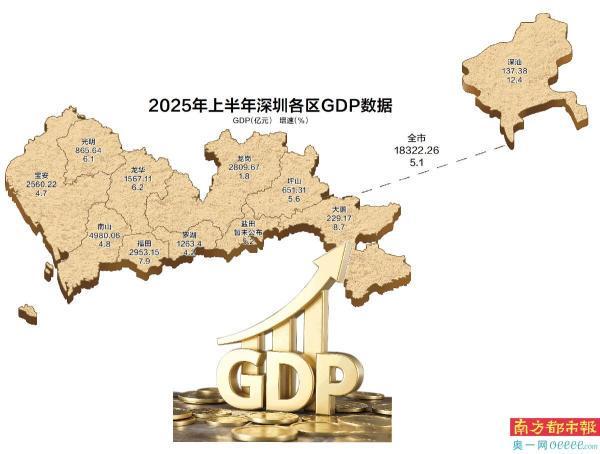
南山总量稳居第一 深汕增速领先
Nan Fang Du Shi Bao· 2025-08-28 23:10
Economic Overview - Shenzhen's GDP for the first half of 2025 reached 18,322.26 billion yuan, with a year-on-year growth of 5.1% [3] - The economic performance of various districts showed stability, with some districts experiencing better growth in Q2 compared to Q1 [2][4] District Performance - The top three districts by GDP in the first half of 2025 are Nanshan District (4,980.06 billion yuan), Futian District (2,953.15 billion yuan), and Longgang District (2,809.67 billion yuan) [3] - Seven districts outperformed the city-wide GDP growth rate, with the highest growth in Shenshan Special Cooperation Zone (12.4%), Dapeng New District (8.7%), and Futian District (7.9%) [3] Industrial Growth - The industrial added value above designated size in Shenzhen grew by 4.3% year-on-year, slightly above the provincial average of 4.0% [5] - The Shenshan Special Cooperation Zone saw a significant industrial growth of 22.0%, driven mainly by the automotive manufacturing sector [5] - Nanshan District's industrial added value increased by 6.5%, reflecting a strong performance in high-tech industries [5] Consumption Trends - The total retail sales of social consumer goods in Shenzhen reached 4,948.68 billion yuan, with a year-on-year growth of 3.5% [7] - Nanshan District led in retail sales growth at 13.1%, while Bao'an District recorded a growth of 7.2% [7] - Various districts are actively promoting consumption through initiatives like issuing consumption vouchers and hosting events [7][8] Investment Insights - Fixed asset investment in Shenzhen decreased by 10.9% year-on-year, with real estate development investment down by 15.1% [8] - Five districts achieved positive growth in fixed asset investment, with Nanshan District leading at 6.5% [8] - Industrial technological transformation investment saw a remarkable increase of 47.1%, indicating a focus on industrial upgrading [8][9]

美二季度GDP增速升至3.3% 商业投资与贸易强劲拉动
Sou Hu Cai Jing· 2025-08-28 21:06
Economic Growth - The US economy shows signs of robust recovery with a revised annualized GDP growth rate of 3.3% in Q2, up from the initial estimate of 3% [1] - Business investment continues to be a significant driver of economic growth, increasing by 5.7% in Q2, significantly higher than the preliminary estimate of 1.9% [1] - Domestic Gross Income (GDI) also saw a 4.8% quarter-over-quarter increase in Q2, compared to just 0.2% in Q1, indicating heightened economic activity [1] Corporate Profits - Corporate profits grew by 1.7% in Q2, reversing the significant decline seen in Q1, with non-financial corporate after-tax profits maintaining a ratio of 15.7% of total value added, above pre-pandemic averages [2] - The pass-through of tariff costs remains a key uncertainty, as companies may choose to raise prices rather than absorb costs, potentially exacerbating inflation [2] Trade and Consumer Spending - Net exports contributed nearly 5 percentage points to GDP, marking a historical high, contrasting with the negative impact on the economy in Q1 [2] - Consumer spending showed a modest recovery with an annualized growth rate of 1.6% in Q2, slightly above the preliminary estimate of 1.4%, but still below long-term trends [2] - The "final sales" metric, which excludes trade and inventory fluctuations, grew by 1.9% in Q2, indicating a need for stronger domestic demand [2] Retail Sector Insights - Retailers exhibit mixed attitudes, with Walmart raising its annual sales forecast, while Home Depot emphasizes healthy customer finances; Target's sales, although down year-over-year, exceeded market expectations [3] - Concerns persist regarding the potential impact of tariffs on sales data, with future cost pass-through effects likely to emerge [3] Inflation and Employment - The core Personal Consumption Expenditures (PCE) price index rose by 2.5% in Q2, consistent with preliminary estimates, with upcoming PCE data expected to provide insights into Q3 economic trends [3] - Recent unemployment claims data shows a decline in continued claims, adding positive signals for upcoming non-farm payroll data [3]
应对旅游热潮,日本多地开征住宿税
Sou Hu Cai Jing· 2025-08-26 04:50
Group 1 - Japanese local governments are beginning or planning to impose accommodation taxes to address infrastructure pressures from an increase in foreign tourists [1] - A survey indicated that 42 local governments have started or plan to implement accommodation taxes, with over 90 more considering it [1] - The accommodation tax rates are set at approximately 200 yen (about 9.8 RMB) per person per night, with some high-end accommodations charging up to 1000 yen (about 48.8 RMB) or more [1] Group 2 - Concerns exist among some local governments regarding the accommodation tax, particularly about the clarity of tax usage and the burden on small accommodation operators [2] - Japan's core Consumer Price Index (CPI) rose by 3.1% year-on-year in July, marking eight consecutive months of inflation above 3% [2] - The increase in food prices is the primary driver of inflation, with significant price hikes in various food categories [2] Group 3 - Japan's real GDP grew by 0.3% quarter-on-quarter in the second quarter, translating to an annualized growth rate of 1.0% [3] - Economic risks remain a concern, especially in light of past economic downturns linked to external factors such as U.S. tariffs [3]
巴西央行预测2025年巴通胀率为4.95%
Shang Wu Bu Wang Zhan· 2025-08-23 16:48
Core Viewpoint - The Central Bank of Brazil has revised its inflation forecasts for 2025 and 2026, indicating a more optimistic outlook for the economy [1] Economic Forecasts - The inflation rate forecast for Brazil in 2025 has been lowered from 5.05% to 4.95% [1] - The inflation rate forecast for 2026 has been adjusted down from 4.41% to 4.4% [1] - The GDP growth forecast for 2025 remains at 2.21% [1] - The GDP growth forecast for 2026 is maintained at 1.87% [1] Interest Rates and Exchange Rates - The market predicts that the benchmark interest rate for Brazil will remain at 15% in 2025 [1] - The interest rate forecast for 2026 is set at 12.5% [1] - The exchange rate forecast for the end of 2025 remains unchanged at 1 USD to 5.6 BRL [1] - The exchange rate forecast for the end of 2026 is also unchanged at 1 USD to 5.7 BRL [1]
瓦加斯基金会预测:巴西三季度GDP环比增长1%
Xin Hua Cai Jing· 2025-08-21 06:36
Economic Growth Forecast - Brazil's GDP is projected to grow by 1% quarter-on-quarter and 4.2% year-on-year in the third quarter of this year [1] - The economic growth rate for September is expected to be 4.1% year-on-year, with a 12-month growth rate of 3.0% as of September [1] Sector Performance - Both the industrial and service sectors are anticipated to expand in the third quarter, with services benefiting from improved employment and a rebound in household consumption [1] - Industrial production is supported by stable energy supply and a rebound in certain manufacturing sectors, while the agricultural sector shows signs of slowing due to a cyclical decline in major crop harvests [1] Economic Drivers - Household consumption is expected to remain the primary driver of economic growth, with investment maintaining a positive outlook [1] - Export growth is anticipated to slow down due to weak global demand [1] Overall Economic Outlook - Despite high interest rates posing challenges for some sectors, the resilience of the labor market and supportive social policies may provide some economic support [1] - The research coordinator predicts that the economic performance in the third quarter reflects a continuous recovery throughout the year, with potential for moderate growth in the second half if external conditions stabilize and interest rates gradually decrease [1]
1-7月阿塞拜疆GDP同比增长0.9%
Shang Wu Bu Wang Zhan· 2025-08-21 03:58
Core Insights - Azerbaijan's GDP reached 72.43 billion manats (approximately 42.61 billion USD) in the first seven months of this year, reflecting a year-on-year growth of 0.9% [1] Economic Structure - The oil and gas sector experienced a decline of 3.3%, while the non-oil sector grew by 7.3% [1] - The per capita GDP stood at 7,077 manats (around 4,162.9 USD) [1] Sector Contributions - Industrial sector accounts for 35% of GDP - Trade and automotive repair contribute 10.1% - Transportation and storage represent 7% - Agriculture, forestry, and fishing make up 6.3% - Construction sector holds 6% - Tourism, accommodation, and public catering contribute 2.8% - Information and communication sector accounts for 1.8% - Other industries collectively represent 21.1% [1] Taxation - Tax revenue constitutes 9.9% of GDP [1]
国元证券每日热点-20250818
Guoyuan Securities2· 2025-08-18 02:23
Economic Indicators - US retail sales increased by 0.5% in July, below the forecast of 0.6%[4] - The Michigan Consumer Sentiment Index for August unexpectedly fell to 58.6[4] - Japan's Q2 GDP grew by 0.3% quarter-on-quarter and 1% year-on-year, marking five consecutive quarters of growth[4] Market Trends - The yield on 2-year US Treasury bonds rose by 1.60 basis points to 3.740%[4] - The yield on 5-year US Treasury bonds increased by 1.90 basis points to 3.834%[4] - The yield on 10-year US Treasury bonds climbed by 3.11 basis points to 4.318%[4] Commodity and Index Performance - The price of Brent crude oil decreased by 1.06% to $66.13[5] - The Baltic Dry Index rose by 0.25% to 2044.00[5] - The Hang Seng Index fell by 0.98% to 25270.07[5] Industry Developments - The US announced an expansion of the 50% tariff on steel and aluminum imports[4] - China's coal consumption ratio decreased from 56.8% in 2020 to an estimated 53.2% in 2024[4] - Photovoltaic component prices are rising, with quotes reaching 0.7 yuan/W for leading manufacturers[4]
2025年第一季度迪拜GDP同比增长4%
Shang Wu Bu Wang Zhan· 2025-08-16 04:10
Core Insights - Dubai's GDP grew by 4% year-on-year in Q1 2025, reaching 119.7 billion dirhams (approximately 32.79 billion USD), indicating the resilience and vitality of the economy [1] Economic Performance by Sector - The healthcare and social work sector experienced the fastest growth at 26%, contributing 1.5% to GDP [1] - The real estate sector followed with a growth rate of 7.8%, accounting for 7.5% of GDP [1] - Wholesale and retail trade remains the largest single contributor to Dubai's economy, with a GDP share of 23% and a year-on-year growth of 4.5% [1] - The financial and insurance sector contributed 13.4% to GDP, growing by 5.9% [1] - The transportation and warehousing sector accounted for 13% of GDP, with a growth of 2% [1] - The manufacturing sector represented 7.3% of GDP, growing by 3.3% [1] - The information and telecommunications sector contributed 4.4% to GDP, with a growth rate of 3.2% [1] - The accommodation and food services sector accounted for 4.1% of GDP, growing by 3.4% [1] - Other activities made up 26% of GDP, with a year-on-year growth of 1.9% [1]