
消费增速

Search documents
1-2月投资消费数据点评:内生动能渐次回归,弱复苏格局深化
金融街证券· 2026-03-18 11:07
Consumption Insights - In January-February 2026, the total retail sales of consumer goods increased by 2.8% year-on-year, a significant rebound from 0.86% in December 2025[1] - Core consumption, excluding automobile sales, grew by 3.7%, returning to levels seen in the second half of 2024[1] - Current potential consumption growth is estimated to be in the range of 4%-5%, with core consumer goods growth nearing the lower bound of this range[5] Investment Trends - Fixed asset investment increased by 1.8% year-on-year in January-February 2026, with infrastructure investment rising by 11.4% and manufacturing investment by 3.1%, while real estate development investment fell by 11.1%[2] - The share of private investment in fixed asset investment has been declining, dropping to 50.1% in 2024, and is expected to fall below 50% in 2025[4] - Private fixed asset investment decreased by 2.6% year-on-year, but the decline is less severe compared to a 6.4% drop in 2025, indicating a gradual accumulation of internal growth momentum[10] Policy and Financial Support - Special bonds for local governments are expected to maintain a high issuance quota of 4.4 trillion yuan in 2026, with 82.42 billion yuan issued in January-February, a 38.1% increase year-on-year[13] - The government is focusing on using special bonds for project investment rather than resolving existing risks, which may alleviate funding constraints for local investments[3] - Policy tools such as long-term special bonds and structural monetary policy are being utilized to support infrastructure and manufacturing investments[11] Risks and Outlook - Risks include potential unexpected declines in consumption, insufficient policy support, and weak recovery of internal growth momentum[20] - The overall investment environment is in a weak recovery phase, with the sustainability of effective investments relying on internal growth dynamics[19]
12月宏观数据分析:2025年预期目标圆满实现,但复苏动能仍不强
Xi Nan Qi Huo· 2026-01-20 02:02
1. Report Industry Investment Rating No relevant content provided. 2. Core Viewpoints of the Report - The GDP growth target of 5% in 2025 was successfully achieved, but the growth rate declined quarter - by - quarter. The macro - economic data in December continued to fall, and the recovery momentum remained weak. Consumption, fixed - asset investment, and the real estate market were sluggish, while exports showed resilience and inflation data improved [3]. - A rational and objective view of the current macro - economy is needed. The transformation, adjustment, and bottoming - out of the real estate market require time, and the domestic economic recovery cannot be achieved overnight. More active macro - policies should be implemented to expand domestic demand and optimize supply [4]. - In the future, "expanding domestic demand and combating cut - throat competition" will remain important long - term policy measures. The financial market is in a state of "weak reality, strong expectation", and the market sentiment is continuously improving. In 2026, the macro - economy and asset prices are expected to continue the upward repair trend, but patience is required [4]. 3. Summary by Directory 3.1 Manufacturing PMI: A Slight Rebound but Still Weak - In December, the manufacturing PMI was 50.1%, up 0.9 percentage points from the previous month, entering the expansion range. Large - scale enterprises' PMI was 50.8%, up 1.5 percentage points; medium - sized enterprises' PMI was 49.8%, up 0.9 percentage points; small - sized enterprises' PMI was 48.6%, down 0.5 percentage points [6]. - Among the five sub - indices of the manufacturing PMI, the production index, new order index, and supplier delivery time index were above the critical point, while the raw material inventory index and employment index were below it. The production and new order indices increased, indicating accelerated production and improved market demand, but the employment index declined slightly [6]. - Overall, although the manufacturing PMI rebounded in December, the manufacturing sector was still weak, and the economic recovery momentum was insufficient [9]. 3.2 CPI and PPI: Inflation Continued to Improve - In December 2025, the national CPI rose 0.8% year - on - year and 0.2% month - on - month. Food and non - food prices both increased, and among the eight major categories of prices, five increased and two decreased year - on - year [10]. - The PPI decreased 1.9% year - on - year in December, with the decline narrowing by 0.3 percentage points, and increased 0.2% month - on - month, with the growth rate expanding by 0.1 percentage points. The anti - cut - throat competition policy has achieved continuous results, and the PPI year - on - year growth rate is expected to turn positive in 2026 [12][15]. 3.3 Import and Export: Maintaining Resilience - In December, China's imports denominated in US dollars increased 5.7% year - on - year, and exports increased 6.6% year - on - year, both exceeding expectations. The trade surplus was 1,141.4 billion US dollars [16]. - Since the second quarter, exports have been stronger than expected, showing strong resilience. The real risk for China's foreign trade lies in the potential economic recession in the US and the slowdown of global economic growth [18]. - In December, China's exports to regions other than the US maintained steady growth, and exports to ASEAN countries continued to replace those to the US [19]. 3.4 Credit: Weak Resident Credit Demand and Declining M1 Growth - At the end of 2025, the stock of social financing scale was 442.12 trillion yuan, a year - on - year increase of 8.3%. The annual increment of social financing scale was 35.6 trillion yuan, 3.34 trillion yuan more than the previous year [20][21]. - In December, resident short - term and long - term loans both decreased significantly, indicating weak resident consumption and housing credit demand. Government bond issuance slowed down, M1 growth declined, but enterprise credit improved and M2 growth rebounded [24][25]. - Overall, the credit demand of the real economy was still weak, and the upward trend of M1 and M2 growth faced resistance [26]. 3.5 Industrial Production, Consumption, and Investment: Industrial Production Rebounded, while Consumption and Investment Growth Continued to Decline - In December 2025, the added value of large - scale industrial enterprises increased 5.2% year - on - year and 0.49% month - on - month. For the whole year of 2025, it increased 5.9% compared with the previous year [27]. - In December, the total retail sales of consumer goods increased 0.9% year - on - year. After excluding the impact of national subsidies, consumption in 2025 was weak, indicating insufficient domestic demand. Further consumption - promotion policies may be introduced in 2026 [27][28]. - In 2025, the national fixed - asset investment (excluding rural households) decreased 3.8% year - on - year. The growth rates of manufacturing investment, infrastructure investment, and real estate development investment all continued to decline [32]. 3.6 Real Estate Market: Continued Downtrend - In 2025, the sales area and sales volume of newly built commercial housing decreased by 8.7% and 12.6% respectively year - on - year. The real estate development investment decreased 17.2% year - on - year [31][32]. - The new construction, construction, and completion of real estate all declined further. The real estate development climate index continued to fall in December [35][36]. - The real estate market is currently at the bottom stage. With the decline of the base, the year - on - year decline of sales area and sales volume is gradually narrowing. The first half of 2026 is expected to be a critical period for the real estate market to stop falling and stabilize [38]. 3.7 Summary and Outlook - In December, the macro - economy was weak, with consumption, fixed - asset investment, and the real estate market remaining sluggish, while exports were resilient and inflation data improved [40]. - The main constraints on macro - economic recovery and asset price repair are insufficient domestic effective demand represented by real estate and consumption, and over - capacity in multiple industries. More policy support is needed [40]. - The financial market is in a state of "weak reality, strong expectation". In 2026, the macro - economy and asset prices are expected to continue the upward repair trend, but one should track policy implementation details and wait for positive macro - economic signals [40].
2025消费之谜:上海反超北京,一线落后,不同城市冰火两重天?
Sou Hu Cai Jing· 2026-01-01 11:41
Group 1 - The core observation is that major cities like Shanghai and Beijing are experiencing contrasting consumer spending patterns, with Shanghai showing a significant increase in spending on clothing and cosmetics, while Beijing consumers are focusing on gold and jewelry, indicating a more conservative spending approach [1][3][5] - In 2025, Shanghai's clothing expenditure is six times that of Beijing, and cosmetics spending is four times higher, with Shanghai accounting for 30% of national cosmetic sales [5][7] - The influx of foreign tourists in Shanghai, driven by relaxed visa policies, has contributed significantly to the city's retail growth, with a nearly 40% increase in inbound tourists compared to the previous year [7][10] Group 2 - The statistical methodology for calculating consumer spending has changed in Shanghai, now focusing on actual business activity locations rather than company registration, which has positively impacted Shanghai's reported consumption figures [12][14] - Despite Shanghai's recovery, both Beijing and Shanghai's overall performance still lags behind the national average, indicating broader economic challenges [14][15] - The shift in consumer behavior in major cities is attributed to changes in corporate logistics, with many companies moving warehousing and logistics operations to more tax-friendly locations, leading to a disconnect in spending statistics [15][17] Group 3 - The decline in property values in major cities has led consumers to be more cautious with large purchases, shifting their spending towards experiences rather than physical goods [19][30] - In contrast, second and third-tier cities are benefiting from lower mortgage rates and government subsidies, which are driving consumer spending and contributing to national consumption growth [22][24] - The consumer landscape in smaller cities is characterized by a more direct and tangible spending approach, with local initiatives like shopping festivals and subsidies effectively boosting local economies [25][27]

外贸顺差破万亿创纪录!消费 35 年第三低,国内潜能才是破局关键!
Sou Hu Cai Jing· 2025-12-18 09:08
Group 1: Foreign Trade Resilience - China's foreign trade demonstrated strong resilience, with a trade surplus exceeding $1 trillion from January to November 2024, marking a year-on-year growth rate of over 20%, reaching a historical high [1] - Companies have diversified their markets, focusing on "Belt and Road" countries and emerging markets, with significant order growth reported, such as a 40% increase in orders from these regions [3] - The demand for external markets remains robust, with exports to ASEAN countries increasing by 50% to 60% due to product innovations [3] Group 2: Weak Consumer Growth - In stark contrast to foreign trade, the retail sales of consumer goods only grew by 1.3% year-on-year from January to November 2024, ranking as the third lowest growth rate in 35 years [1][3] - Local governments are implementing measures to stimulate consumption, including support for the second-hand car market and optimizing public fund withdrawals [3][5] Group 3: Investment Decline - Total fixed asset investment saw a year-on-year decline of 2.6% from January to November 2024, marking the first negative growth in 35 years [5] - The low proportion of foreign investment in total investment limits its impact, with the primary issue being insufficient domestic investment motivation [5][6] - Recent changes in solar project investments highlight the challenges in domestic investment, with specific projects facing delays and terminations [5] Group 4: Policy Measures - The government has introduced measures to encourage private investment in key sectors such as railways and nuclear power, aiming to invigorate the investment market [6][7] - The implementation of these policies is expected to gradually release the potential for domestic consumption and investment, becoming a strong engine for sustainable economic growth [8]

受“双11”促销前置等因素影响,11月消费增速延续回落态势
Sou Hu Cai Jing· 2025-12-15 03:24
Group 1 - The core viewpoint of the article indicates that the retail sales growth in November has slowed down, with a year-on-year increase of 1.3%, down 1.6 percentage points from October. The total retail sales from January to November grew by 4.0% year-on-year [1] - The decline in consumption growth is attributed to tightening consumer subsidy policies and a significant drop in sales of home appliances and automobiles in November [1][3] - Retail sales of goods in November amounted to 37,841 billion yuan, with a year-on-year growth of 1.0%, a decrease of 1.8 percentage points from the previous month. Restaurant income reached 6,057 billion yuan, growing by 3.2%, down 0.6 percentage points from the previous month [1] Group 2 - The forecast for December suggests that retail sales growth will remain low due to high base effects from the previous year and the potential impact of reduced subsidies for new energy vehicle purchases [3] - The overall retail sales growth for the year is expected to reach approximately 3.9%, which would be an increase of 0.4 percentage points compared to the previous year, reflecting the macro policy focus on boosting consumption [4] - Key measures to stimulate consumption include promoting a recovery in the real estate market to enhance consumer confidence, alongside existing policies like trade-in incentives [4]

阶段性调整延续
Qi Huo Ri Bao· 2025-11-24 07:54
Economic Overview - The A-share market has shown a decline in sectors such as energy metals, power equipment, and electronics, while defensive sectors like agriculture, home appliances, and banking have performed relatively better [1] - Fixed asset investment has decreased by 1.7% year-on-year from January to October, with a notable decline in real estate investment by 14.7% [2] - Industrial production has slowed down, with a year-on-year growth of 6.1% for the first ten months, and a drop to 4.9% in October compared to the previous month [2] Financial Data - In October, new RMB loans amounted to 220 billion, a decrease of 280 billion compared to the same month last year, while the social financing scale increased by 816.1 billion, down by 595.9 billion year-on-year [3] - M2 growth has slowed to 8.2%, down from 8.4%, and M1 growth has decreased to 6.2%, reflecting a cautious approach from enterprises towards investment [3] Market Sentiment - The Federal Reserve's hawkish signals have raised concerns about persistent inflation, leading to a decrease in expectations for interest rate cuts in December [4] - The domestic economic data has shown a downward trend, suggesting that the stock index may enter a phase of adjustment in the short term [4]
中信建投:2026年预计GDP增长目标5%左右
Xin Lang Cai Jing· 2025-11-09 12:38
Core Viewpoint - The report from CITIC Securities indicates a strong economic growth in 2025, characterized by high-quality development and stable unemployment rates, alongside a steady increase in residents' income [1] Economic Growth and Structure - Economic growth is expected to be robust in 2025, with a focus on high-quality development [1] - The unemployment rate is projected to remain stable [1] - Residents' income is anticipated to grow steadily [1] Manufacturing and Corporate Profits - Manufacturing sector is expected to see an improvement in business sentiment [1] - Corporate profits are set to recover at an accelerated pace, with high-tech manufacturing playing a significant role [1] Consumer and Production Prices - Consumer prices are expected to remain stable, while the decline in production prices is anticipated to narrow [1] - The M2-M1 spread is showing a significant convergence [1] Financing and Trade - The growth rate of social financing is declining [1] - Foreign trade is expected to accelerate, with ongoing diversification in the market [1] Fiscal Policy and Market Trends - Public budget revenues and expenditures are both expected to increase [1] - After a period of broad market gains, the stock market is expected to stabilize, while the bond market is anticipated to experience a slow upward trend [1] Outlook for 2026 - The GDP growth target for 2026 is projected at around 5% [1] - There will be an optimization of industrial structure and enhancement of new technological momentum [1] - Average consumption growth is expected to be approximately 5% [1] - CPI is likely to return to positive territory, while PPI is expected to remain in negative territory [1] - The real estate market is anticipated to stabilize after hitting a bottom [1] - The fiscal deficit rate is expected to continue expanding, maintaining around 4%, with the broad fiscal deficit rate increasing to approximately 8.3% [1]

南山总量稳居第一 深汕增速领先
Nan Fang Du Shi Bao· 2025-08-28 23:10
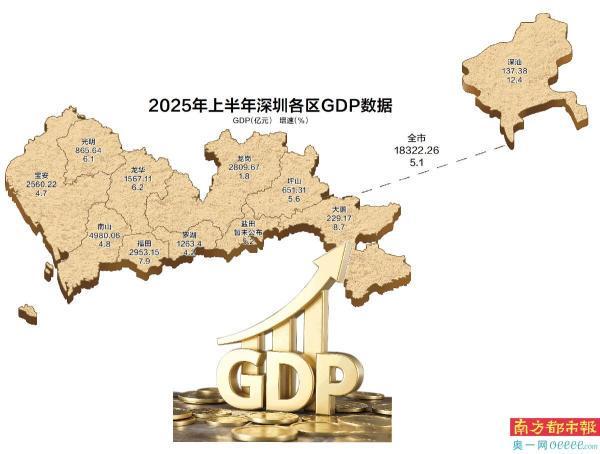
Economic Overview - Shenzhen's GDP for the first half of 2025 reached 18,322.26 billion yuan, with a year-on-year growth of 5.1% [3] - The economic performance of various districts showed stability, with some districts experiencing better growth in Q2 compared to Q1 [2][4] District Performance - The top three districts by GDP in the first half of 2025 are Nanshan District (4,980.06 billion yuan), Futian District (2,953.15 billion yuan), and Longgang District (2,809.67 billion yuan) [3] - Seven districts outperformed the city-wide GDP growth rate, with the highest growth in Shenshan Special Cooperation Zone (12.4%), Dapeng New District (8.7%), and Futian District (7.9%) [3] Industrial Growth - The industrial added value above designated size in Shenzhen grew by 4.3% year-on-year, slightly above the provincial average of 4.0% [5] - The Shenshan Special Cooperation Zone saw a significant industrial growth of 22.0%, driven mainly by the automotive manufacturing sector [5] - Nanshan District's industrial added value increased by 6.5%, reflecting a strong performance in high-tech industries [5] Consumption Trends - The total retail sales of social consumer goods in Shenzhen reached 4,948.68 billion yuan, with a year-on-year growth of 3.5% [7] - Nanshan District led in retail sales growth at 13.1%, while Bao'an District recorded a growth of 7.2% [7] - Various districts are actively promoting consumption through initiatives like issuing consumption vouchers and hosting events [7][8] Investment Insights - Fixed asset investment in Shenzhen decreased by 10.9% year-on-year, with real estate development investment down by 15.1% [8] - Five districts achieved positive growth in fixed asset investment, with Nanshan District leading at 6.5% [8] - Industrial technological transformation investment saw a remarkable increase of 47.1%, indicating a focus on industrial upgrading [8][9]
中国经济透视 _7月国内增长动能明显走弱,未来仍面临更多挑战_ 王
2025-08-22 01:00
Summary of Key Points from the Conference Call Industry Overview - The conference call discusses the **Chinese economy** and its current challenges, particularly focusing on the economic performance in July 2025 and projections for the remainder of the year [1][21]. Core Insights and Arguments 1. **Economic Slowdown**: In July, domestic growth momentum weakened significantly, with retail sales growth slowing to **3.7%** year-on-year, below market expectations [1][5]. 2. **Investment Decline**: Overall fixed asset investment decreased by **5.2%** year-on-year, with both infrastructure and manufacturing investments declining [1][10]. 3. **Real Estate Market**: Real estate activities continued to decline, with sales down **7.8%** year-on-year and new construction area down **15.4%** [6][26]. 4. **Industrial Production**: Industrial production growth fell to **5.7%** year-on-year, indicating a slowdown in manufacturing output [1][12]. 5. **Export Recovery**: Despite a decline in exports to the US, overall export growth improved to **7.2%** year-on-year, supported by lower base effects [1][11]. 6. **Inflation Metrics**: The Consumer Price Index (CPI) growth rate fell to **0%**, while the Producer Price Index (PPI) dropped by **3.6%** year-on-year [1][17]. 7. **Credit Market**: July saw a contraction in new RMB loans for the first time in 20 years, with a reduction of **500 billion RMB**, indicating weak credit demand [1][18]. Additional Important Insights 1. **Policy Measures**: The government has introduced several support measures, including childcare subsidies and consumer loan interest subsidies, but the scale of these measures is expected to be moderate [3][32]. 2. **Future Challenges**: The economic outlook remains cautious, with expectations of continued challenges in the real estate sector and consumer spending due to weak income growth and consumer confidence [2][27]. 3. **Trade Relations**: Ongoing US-China trade negotiations are expected to prolong tariff uncertainties, which may negatively impact export growth in the coming months [22][24]. 4. **Government Stimulus**: Potential fiscal stimulus measures may be introduced in Q3 or Q4, depending on economic data trends, with a baseline GDP growth forecast of **4.7%** for 2025 [3][32]. This summary encapsulates the key points discussed in the conference call, highlighting the current state of the Chinese economy, the challenges it faces, and the government's response to these challenges.
宏观金融数据日报-20250716
Guo Mao Qi Huo· 2025-07-16 05:36
Group 1: Market Interest Rates and Central Bank Operations - The closing prices and changes of various interest rate varieties are presented, such as DR001 closing at 1.53% with a 10.6bp increase, and DR007 closing at 1.57% with a 3.36bp increase [3]. - The central bank conducted 3425 billion yuan of 7 - day reverse repurchase operations yesterday, with 690 billion yuan of reverse repurchases and 1000 billion yuan of MLF maturing, resulting in a net injection of 1735 billion yuan. Also, it will conduct 14000 billion yuan of outright reverse repurchase operations on July 15 [3]. - This week, there are 4257 billion yuan of reverse repurchases maturing in the central bank's open market. Recently, liquidity has slightly tightened, with the overnight inter - bank pledged repo weighted average rate rising 10.6bp to 1.53% and the 7 - day inter - bank pledged repo rate rising 3.36bp to 1.4957% [3]. Group 2: Stock Index Futures and Stock Market Performance - The closing prices and daily changes of major stock indices and their corresponding futures contracts are provided. For example, the CSI 300 closed at 4019 with a 0.03% increase, and the IF current - month contract closed at 4010 with no change [4]. - The trading volume and open interest of stock index futures contracts have significant changes. For instance, the IF trading volume increased by 55.3% to 124297, and the open interest increased by 1.5% to 267331 [4]. - Yesterday, the total turnover of the Shanghai and Shenzhen stock markets was 16121 billion yuan, an increase of 1533 billion yuan from the previous day. Most industry sectors closed down, with the Internet service sector rising [4]. Group 3: Economic Data and Market Outlook - In the first half of 2025, China's GDP reached 660536 billion yuan, a year - on - year increase of 5.3%. The supply side remained strong with a 6.8% year - on - year increase in industrial added value in June, while the demand side weakened, with real estate investment from January to June falling to - 11.2% and the consumer growth rate in June dropping to 4.8% [5]. - After the economic data was released, the stock index initially weakened but then showed a "V" - shaped trend. Recently, the stock index has been less sensitive to negative news, and the market trading volume and sentiment have remained strong. In the short term, the stock index is expected to fluctuate strongly [5]. Group 4: Stock Index Futures Basis Situation - The basis rates of IF, IH, IC, and IM contracts for different delivery months are presented, including the current - month, next - month, current - quarter, and next - quarter contracts [6].