
内卷式竞争

Search documents
法治聚焦丨网络平台经营者应明示平台内公平竞争规则
Ren Min Ri Bao· 2025-10-09 02:36
Core Viewpoint - The newly revised Anti-Unfair Competition Law of the People's Republic of China, effective from October 15, addresses the unique challenges of market competition in the digital economy, focusing on issues such as false transactions, data rights protection, and platform responsibilities, thereby providing a stronger legal foundation for fair competition and high-quality development [1][4]. Group 1: Legal Framework and Provisions - The revised law enhances regulations on online unfair competition behaviors, detailing various forms of malicious transactions and prohibiting operators from abusing platform rules to harm the legitimate rights of other operators [4][5]. - It mandates that platform operators clarify fair competition rules in service agreements and establish mechanisms for reporting and resolving unfair competition disputes [4][5]. - The law aims to establish a fair competition review system and strengthen the review process to ensure equal access to production factors for all operators [5]. Group 2: Industry Implications - The law addresses the rise of "involution" competition, which disrupts the market environment, and emphasizes the need for a systematic governance framework involving administrative, judicial, and corporate collaboration [5][6]. - It specifically prohibits platform operators from forcing or indirectly compelling operators to sell products below cost, which disrupts market order and harms merchants' interests [5][6]. - The law is expected to provide stronger legal protection for merchants' reasonable profit margins and legitimate rights, promoting a healthier business ecosystem [6].

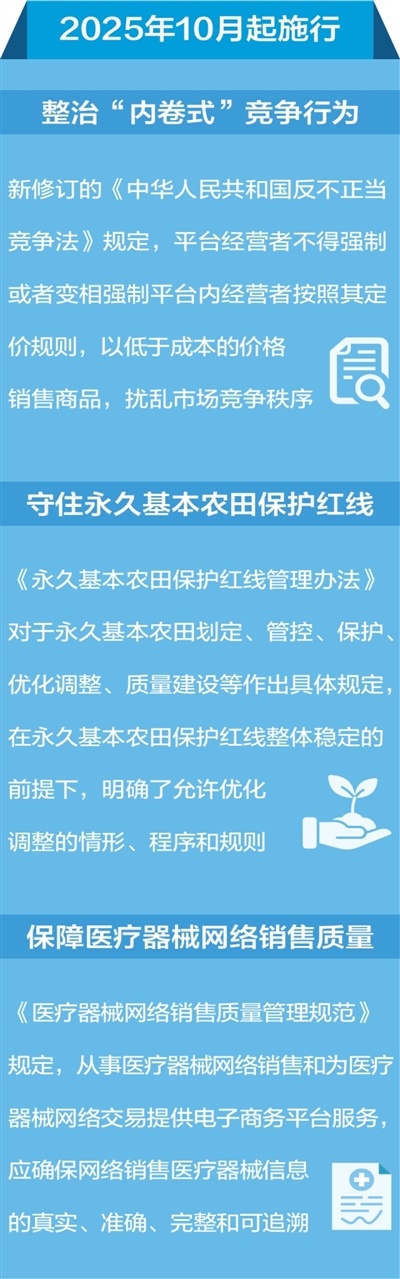
网络平台经营者应明示平台内公平竞争规则
Ren Min Ri Bao· 2025-10-09 02:20
Core Points - The newly revised Anti-Unfair Competition Law of the People's Republic of China will take effect on October 15, 2023, addressing new challenges in market competition in the digital economy era [6] - The law aims to regulate unfair competition behaviors such as false transactions, data rights protection, and platform responsibilities, providing a legal framework to promote high-quality development [6] - The law specifically prohibits platform operators from forcing or indirectly forcing platform operators to sell goods below cost, which disrupts market competition [7][8] Summary by Category Regulatory Changes - The revised law includes specific provisions against various forms of malicious transactions, such as false transactions, false reviews, and malicious returns, which harm the legitimate rights of other operators and disrupt market order [6][7] - It establishes obligations for platform operators to clarify fair competition rules in service agreements and transaction rules, and to create mechanisms for reporting and resolving unfair competition complaints [7] Market Impact - The law addresses the issue of "involution" competition, which has been detrimental to the market environment, and aims to create a healthier competitive ecosystem by promoting innovation and fair competition [7][8] - It highlights the need for collaboration among administrative agencies, judicial bodies, platforms, and related enterprises to effectively implement the law and address the challenges posed by digital economy development [7] Consumer and Business Protection - The law provides stronger legal protection for the reasonable profit margins and legitimate rights of businesses, ensuring that low-price promotions do not lead to a decline in quality control and result in disorderly competition [8]
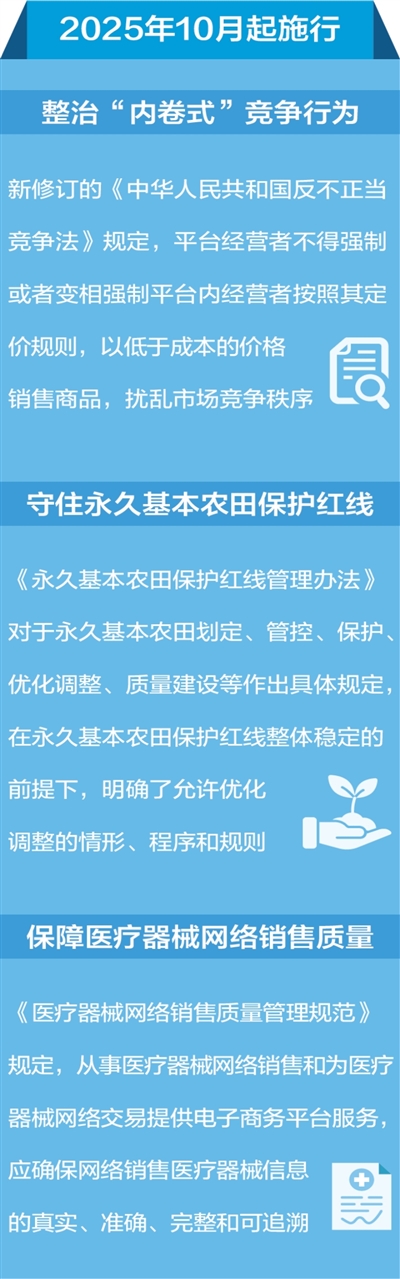
新修订的反不正当竞争法10月15日起施行 网络平台经营者应明示平台内公平竞争规则(法治聚焦) 不得实施虚假交易、恶意退货等行为
Ren Min Ri Bao· 2025-10-09 01:03
Group 1 - The newly revised Anti-Unfair Competition Law of the People's Republic of China will take effect on October 15, addressing new challenges in market competition in the digital economy, including issues related to false transactions, data rights protection, and platform responsibilities [1][2] - The law aims to enhance market order and provide a solid legal foundation for promoting high-quality development by responding to the characteristics of unfair competition in the digital age [1][2] - The law specifies that platform operators must clarify fair competition rules in their service agreements and take necessary measures against unfair competition behaviors, including false transactions and malicious returns [2][3] Group 2 - The law addresses the issue of "involution" competition, which disrupts the market environment, and emphasizes the need for a collaborative governance system involving administrative, judicial, and platform entities [2][3] - It prohibits platform operators from forcing or indirectly forcing merchants to sell products below cost, which can lead to disorderly competition and affect product quality [2][3] - The law provides stronger legal protection for merchants' reasonable profit margins and legitimate rights, encouraging long-term innovation and healthy competition within the industry [3]
网络平台经营者应明示平台内公平竞争规则(法治聚焦)
Ren Min Ri Bao· 2025-10-08 22:11
Core Points - The newly revised Anti-Unfair Competition Law of the People's Republic of China will take effect on October 15, 2025, addressing new challenges in market competition, particularly in the digital economy [3][4] - The law aims to regulate unfair competition behaviors such as false transactions, data rights protection, and platform responsibilities, thereby promoting fair competition and high-quality development [3][4] Group 1: Regulation of Unfair Competition - The law prohibits platform operators from forcing or indirectly forcing platform operators to sell goods below cost, which disrupts market competition [4][5] - It addresses various forms of malicious trading, including false transactions and malicious returns, to protect the legitimate rights of operators [3][4] - The law establishes a system for fair competition review and requires timely reporting of unfair competition behaviors to relevant authorities [4] Group 2: Impact on Market Practices - The law responds to the rise of "involution" competition, which harms the market environment, by including it in the scope of regulation [4][5] - It emphasizes the need for collaboration among administrative agencies, judicial bodies, platforms, and enterprises to create a comprehensive governance system [4] - The law provides stronger legal protection for merchants' reasonable profit margins and legitimate rights, encouraging long-term innovation and healthy competition [5]
低物价、稳就业、振楼市、治内卷的综合方略|宏观经济
清华金融评论· 2025-10-05 08:00
Economic Issues - The current economic hotspots include persistently low prices, employment and income issues, ongoing adjustments in the real estate market, and severe "involution" competition in certain industries [2][3]. Price Trends - The Consumer Price Index (CPI) has been below 1% for consecutive years, while the Producer Price Index (PPI) has experienced 34 months of negative growth. The GDP deflator has also been negative for nine consecutive months [6]. - Factors contributing to low prices include oversupply in certain industries, low capacity utilization, and declining prices in key CPI categories such as pork, fresh vegetables, and fruits. Additionally, the drop in international oil prices has increased downward pressure on PPI [6][7]. Employment and Income - The employment situation faces significant challenges due to structural employment pains from economic transformation and frictional unemployment from emerging technologies. However, stable economic growth and the development of new industries are expected to create new job opportunities [9]. - Wage income remains the primary source of residents' income, accounting for nearly 60% of per capita disposable income in the first half of the year. The government is implementing employment-first strategies to support job creation and income growth [9]. Real Estate Market - Following the Central Political Bureau's decision to stabilize the real estate market, various policies have been implemented, leading to a generally stable market. However, the market is still undergoing adjustments due to significant changes in supply-demand relationships and previous high inventory levels [11][12]. - In the first half of the year, new residential sales decreased by 3.5% in area and 5.5% in value year-on-year, but there are signs of improvement in core cities with high-priced projects [11]. Involution Competition - Industries such as new energy vehicles, photovoltaics, lithium batteries, and petrochemicals are experiencing severe "involution" competition characterized by homogeneous capacity expansion and price wars. For instance, the number of discounted passenger car models reached 227 in 2024, and the price of polysilicon has been below the industry average cost for over a year [14]. - This low-price competition has led to declining profit margins, with the automotive industry's profit rate dropping from 8% in 2017 to 3.9% in the first quarter of 2025, below the manufacturing average of 6% [14][15]. - The government is focusing on comprehensive measures to address "involution" competition, emphasizing the need for collaboration among government, enterprises, and industry associations to maintain fair competition and promote high-quality development [15].

稳物价有待供需两端进一步发力|宏观经济
清华金融评论· 2025-10-04 05:57
Core Viewpoint - The long-term low price levels in China pose a significant challenge to the economy, necessitating both supply-side and demand-side measures to stimulate economic activity and improve price levels [2][5][12]. Supply-Side Measures - The government has implemented a series of "anti-involution" policies aimed at regulating local government behavior, enhancing industry self-discipline, and improving market order to combat excessive competition [9][10][11]. - Key actions include the release of guidelines to standardize local government practices, the promotion of industry standards, and the revision of laws to curb unfair competition and price manipulation [10][11]. - The focus is on optimizing production capacity and encouraging quality competition rather than merely reducing capacity, which is a shift from previous supply-side reforms [11][12]. Demand-Side Initiatives - There is a pressing need for further demand-side efforts to support price recovery, as the current supply-side measures alone may not suffice [12][13]. - Suggestions include increasing government procurement to employ unemployed graduates and relaxing consumption restrictions to stimulate spending [16][17]. - The government aims to enhance service consumption and infrastructure investment to boost overall demand, with a focus on maintaining policy flexibility and responsiveness to economic conditions [15][17]. Economic Indicators - As of August, the Consumer Price Index (CPI) has shown a cumulative year-on-year decline of 0.1%, while the core CPI has increased by 0.5% [4][5]. - The Producer Price Index (PPI) has decreased by 2.9%, indicating ongoing challenges in achieving inflation targets set at around 2% for the year [3][4]. - The government emphasizes the importance of improving the supply-demand relationship through comprehensive policy measures to stabilize price levels [3][4]. Employment and Investment - Employment remains a critical focus, with high youth unemployment rates prompting calls for targeted job creation initiatives [16]. - Investment in infrastructure and private sectors is seen as vital for expanding domestic demand, with recent data indicating a slowdown in investment growth [15][17].

王一鸣:治理“内卷式”竞争要供需两端协同发力
Zhong Guo Xin Wen Wang· 2025-09-30 07:16
Core Viewpoint - The governance of "involutionary" competition requires coordinated efforts from both supply and demand sides, focusing on expanding domestic demand to absorb excess capacity and promoting supply-side structural reforms to eliminate outdated capacity [1] Group 1: Market Exit Mechanism - The primary cause of "involutionary" competition is insufficient effective demand at the macro level and an inadequate market exit mechanism at the micro level [2] - Many enterprises face homogeneous products and services, leading to price competition below cost, exacerbating market issues [2] - The current market entry is easy, but exit is difficult, resulting in "zombie" enterprises remaining in the market, which can engage in extreme low-price strategies [2] Group 2: Comprehensive Measures - Governance of "involutionary" competition requires a comprehensive approach, including creating a healthy competitive industrial ecosystem [3] - Emphasis on technological innovation and industrial upgrading to shift competition from price to quality, fostering high-level competition driven by innovation [3] - Establishing quality standards to guide industrial upgrades and converting recommended national standards into mandatory ones to avoid low-end price competition [3] - Enhancing market regulation by refining standards for identifying ultra-low price competition and strengthening price regulation in key industries [3] - Regulating local government behavior to eliminate local protectionism and market segmentation, focusing on optimizing the business environment [3] Group 3: Industry Self-Regulation and Global Expansion - Strengthening industry self-regulation through industry associations to enhance market self-regulation and facilitate capacity reduction [4] - Encouraging enterprises to expand internationally through overseas investment and capacity cooperation to establish a global production network [5]
如何破解“内卷式”竞争?专家建议更重视长效机制
Zhong Guo Xin Wen Wang· 2025-09-30 02:34
Group 1 - The core issue of the current "involution" competition is the mismatch between supply and demand, characterized by strong supply and weak demand in quantity, as well as structural misalignment [1][2] - To address "involution" competition, it is essential to focus on long-term mechanisms such as legal system, policy system, and fiscal and tax system reforms, in addition to short-term supply-demand balance policies [1][2] - The current structural issues in demand require improvements in the legal framework, including the recent amendments to the Anti-Unfair Competition Law and the ongoing revisions of the Price Law and Bankruptcy Law [2][3] Group 2 - The transition from survival-oriented consumption to development-oriented consumption necessitates new quality, quantity, and structural demands from residents [2] - Strengthening the policy system in key areas is crucial, including the establishment of a unified national market policy framework and regulations to prevent unfair competition [3] - Enhancing the fiscal and tax system is vital to mitigate the "involution" phenomenon, which involves clarifying the responsibilities between central and local governments and reforming tax collection methods [3]
国资委最新发声:要带头坚决抵制“内卷式”竞争
Jing Ji Guan Cha Bao· 2025-09-28 07:48
Group 1 - The State-owned Assets Supervision and Administration Commission (SASAC) is focusing on stabilizing electricity and coal prices, and preventing "involution" style competition among enterprises [1] - SASAC will enhance the regular communication mechanism regarding the economic operations of state-owned enterprises, addressing the concerns and suggestions raised by these enterprises [1] - Emphasis is placed on maintaining strategic determination and improving the "five values" to support stable employment, enterprises, markets, and expectations [1] Group 2 - The focus is on optimizing investment structure, particularly in key areas such as industrial chain strengthening, infrastructure construction, and energy resource security [1] - There is a call for resisting "involution" competition and promoting differentiated development and brand competition, while enhancing industry self-discipline [2] - Strengthening risk prevention measures and establishing a regular risk monitoring and early warning mechanism is highlighted to ensure the bottom line of risk control [2]
快递“反内卷”价格上涨,民航的“票价内卷”怎样了
Di Yi Cai Jing· 2025-09-27 04:53
Group 1: Express Delivery Industry - A nationwide price increase in the express delivery industry has been initiated following notifications received by e-commerce merchants in Shanghai from multiple courier companies [1] - In August, the average revenue per package for major listed express companies showed an increase, with YTO Express at 2.15 yuan, Yunda at 1.92 yuan, Shentong at 2.06 yuan, and SF Express at 13.27 yuan, indicating a general rise compared to July [1] - The price increase is part of a broader "anti-involution" movement in the industry, which was discussed in a meeting held by the State Post Bureau on July 29, aimed at regulating "involutionary" competition among express companies [1] Group 2: Civil Aviation Industry - The civil aviation industry is also facing issues of "ticket price involution," prompting the Civil Aviation Administration to address excessive low pricing and overcapacity in the market [2] - Despite the ongoing efforts, there has not been a significant increase in ticket prices, with average domestic economy class ticket prices in July and August down 6.4% year-on-year and 8.6% compared to 2019 [2] - Some airlines are engaging in price undercutting by releasing low-priced tickets during off-peak times, leading to a competitive cycle of price reductions among carriers [3] Group 3: Challenges in Civil Aviation - The civil aviation sector faces greater challenges in combating "involution" compared to the express delivery industry, as there are 65 passenger airlines competing for market share, leading to overcapacity [4] - The value of airline licenses is high due to the lack of new airline approvals, which complicates the exit mechanism for underperforming airlines [4] - Airlines need to shift from a growth model based on capacity and resource input to one that focuses on meeting diverse passenger needs and innovating their service offerings [4]