
存款搬家

Search documents
银行业2026年经营展望:资产负债篇:期存款流向是资负格局的关键
Guoxin Securities· 2026-01-07 05:15
Investment Rating - The report maintains an "Outperform the Market" rating for the banking sector [4][5]. Core Insights - The banking sector is expected to see a reasonable M2 growth target of approximately 7.5%, with credit growth around 6.0% and social financing growth at about 8.0% for 2026. This aligns with the goal of stabilizing economic growth and ensuring reasonable price recovery [1][21]. - The report highlights that the flow of deposits will be a key factor affecting the asset-liability structure of banks in 2026, with a significant amount of term deposits maturing, estimated at around 57 trillion yuan [3][49]. - The credit allocation is expected to remain strong for corporate lending, contributing approximately 80% to 85% of new loans, while retail lending is anticipated to show marginal improvement, contributing about 10% to 15% [2][36]. Summary by Sections Economic Outlook - The actual GDP growth target for 2026 is estimated at 4.9%, with a nominal GDP growth target of about 5.0%, which corresponds to a reasonable M2 growth target of 7.5% [1][15]. - The projected M2 increment for 2026 is approximately 25.4 trillion yuan, with fiscal net M2 injection around 12.0 trillion yuan and bank credit (including write-offs and ABS) contributing about 16.8 trillion yuan [21][22]. Credit Allocation - Corporate lending is expected to remain the primary support for new loans, while retail lending will experience structural differentiation, with personal operating loans maintaining good growth and housing loans likely showing slight positive growth [2][36]. - The report indicates that the flow of deposits from large banks to smaller banks will be a critical factor in the marginal changes in the asset-liability gap for large banks in 2026 [3][41]. Investment Recommendations - The report suggests focusing on two main lines for investment in 2026: high-quality companies with improving fundamentals, such as Ningbo Bank and Changshu Bank, and stable high-dividend stocks like China Merchants Bank and Industrial and Commercial Bank of China [4][5].






进击的保险:不只是交易“开门红”,长债2%关口与重返1倍P/EV
Hua Er Jie Jian Wen· 2026-01-07 05:08
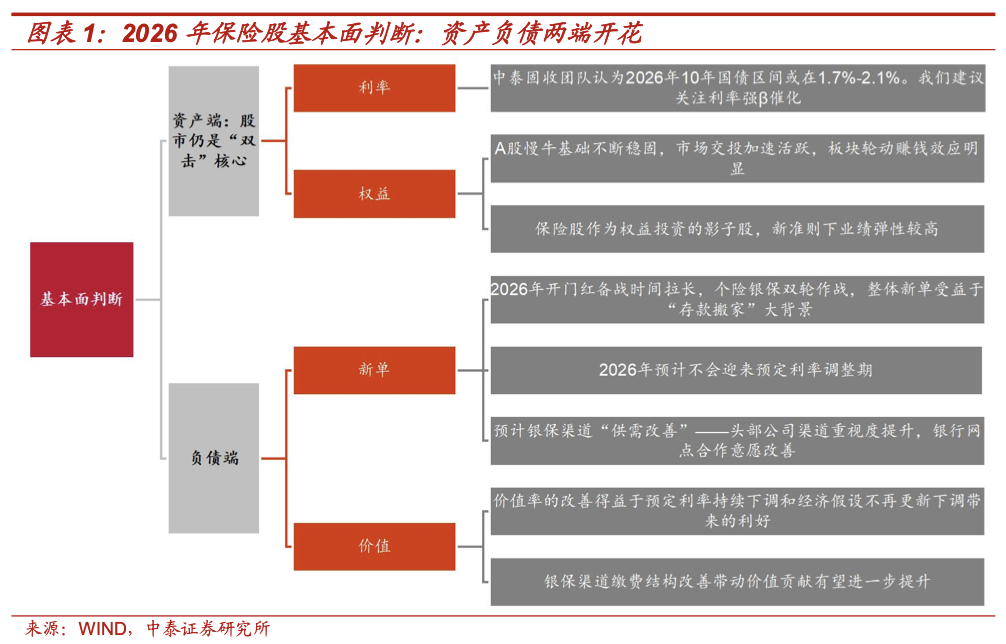
Core Viewpoint - The insurance sector experienced a significant rise of over 6% on January 5, 2026, with Xinhua Insurance and China Pacific Insurance reaching historical highs, driven by a cyclical logic of improved expectations, rising long-term interest rates, and reinforced profit elasticity since December 2025 [1] Group 1: Market Performance and Expectations - The current stock prices reflect an optimistic outlook for the "opening red" period of 2026, with Q1 2026 expected to be a peak for value and profit growth [2] - The average new business growth rate for listed insurance companies in Q1 2026 is projected to be 30%, with bancassurance and individual insurance growth rates at 50% and 20% respectively [2] - The low base from 2025 for individual insurance and the increasing focus on bancassurance channels by leading companies are expected to drive growth in new business [2] Group 2: Interest Rates and Valuation - The significance of long-term interest rates breaking the 2.0% mark is highlighted, with market expectations showing divergence on future trends [3] - If long-term rates exceed 2.0%, it could lead to a gradual approach of P/EV valuations towards 1x, benefiting insurance stock valuations [3] - The 10-year government bond yield is anticipated to range between 1.7% and 2.1% in 2026, with a favorable environment for insurance stock valuations due to improving credit spreads and term spreads [3] Group 3: Business Value and Growth Projections - The internal value (EV) credibility is gradually recovering, with expectations of a return to growth in EV for listed insurance companies from 2025 to 2027, averaging 10.6%, 10.9%, and 10.8% respectively [4] - The new business value (NBV) growth rates are projected at 34.7%, 21.7%, and 10.0% for the same period, indicating a positive outlook for the sector [4] - The insurance companies are expected to improve profitability through refined management of liability costs and benefit from upward catalysts in the asset side [4] Group 4: Strategic Recommendations - Investment in cyclical insurance stocks with strong performance support is recommended, as 2026 is expected to see growth in new business and value alongside continued management of liability costs [4] - The focus on bancassurance channels and the improvement in payment structures are likely to enhance value contributions from these channels [6]




黄仁勋在2026CES上的发言,创新和增量在哪里?|0106
Hu Xiu· 2026-01-06 16:24
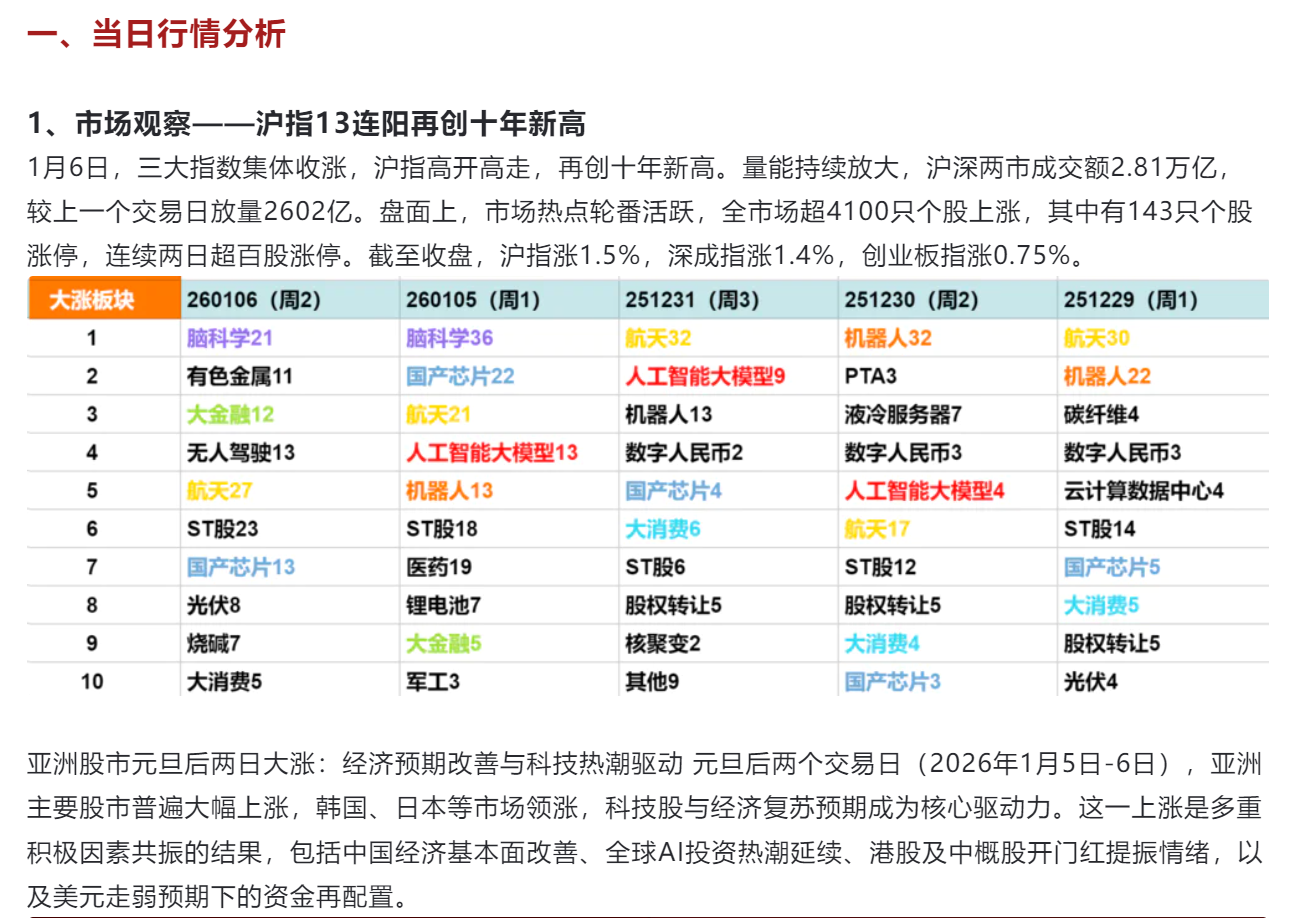
Market Overview - The Shanghai Composite Index achieved a 13-day consecutive rise, reaching a ten-year high on January 6, with a closing increase of 1.5% [1] - The total trading volume in the Shanghai and Shenzhen markets was 260.2 billion, indicating a significant increase in market activity [1] - Over 4,100 stocks in the market rose, with more than 100 stocks hitting the daily limit for two consecutive days [1] Sector Performance - Major sectors that saw significant gains included brain science, non-ferrous metals, and large financial institutions, with respective increases of 21, 11, and 12 stocks [2] - The technology sector, particularly AI and robotics, continued to drive market enthusiasm, with notable performances from companies like Samsung Electronics and TSMC [4][5] Global Market Trends - Asian stock markets experienced substantial gains post-New Year, driven by improved economic expectations and a surge in technology stocks [2] - The KOSPI index in South Korea rose by 5.65%, while Japan's Nikkei 225 increased by 4.33%, reflecting a broader regional trend of recovery [5] Investment Shifts - A significant amount of fixed-term deposits, approximately 32 trillion yuan, is set to mature in 2026, leading to a "deposit migration" phenomenon as investors seek higher returns [6] - Insurance products, particularly dividend insurance, are becoming attractive alternatives for low-risk investors, contributing to a surge in the insurance sector's stock prices [6] Policy Developments - A new policy encouraging large state-owned insurance companies to increase their investments in A-shares is expected to inject thousands of billions into the stock market annually [7] - This policy aims to channel a portion of new insurance premiums into the stock market, providing a crucial source of incremental capital [7] Technological Innovations - At CES 2026, advancements in AI and robotics were highlighted, including the introduction of a household humanoid robot named Neo, which signifies a new era in home automation [8] - The launch of a mass-producible all-solid-state battery by Donut Lab was announced, showcasing significant improvements in energy density and charging speed compared to traditional lithium-ion batteries [10] AI Developments - NVIDIA's CEO Huang Renxun announced breakthroughs in AI technology, emphasizing the transition from digital intelligence to physical AI, supported by new hardware architectures and memory storage solutions [11][12] - The introduction of the Rubin GPU, which significantly enhances processing capabilities and reduces inference costs, marks a pivotal advancement in AI computing [13][20] Industry Applications - The emergence of GPU-native databases is transforming data processing in AI applications, allowing for more efficient handling of high-concurrency requests [26][28] - Companies like Demingli are focusing on full-stack self-research capabilities, enhancing their competitive edge in the storage market through proprietary technology [30][33] Aerospace and Navigation - The company Hezhong Shizhuang is actively participating in the commercial aerospace sector, leveraging its high-precision positioning technology for rocket recovery and satellite applications [34][36] - Their self-developed chips and systems are crucial for providing real-time precise positioning in complex environments, enhancing the reliability of aerospace operations [36]
资产负债双轮驱动,A股保险板块两日累计涨超11%
Mei Ri Jing Ji Xin Wen· 2026-01-06 12:11
Core Viewpoint - The A-share insurance sector has experienced a strong rise since 2025, significantly outperforming other financial sectors and the CSI 300 index, driven by policy benefits, improved fundamentals, and favorable market conditions [1][2]. Group 1: Performance and Growth - The five major listed insurance companies in A-shares have shown substantial annual growth rates, with stock price increases of 21.21% for China Ping An, 10.39% for China Life, 26.60% for China Pacific Insurance, 35.87% for China Re, and 46.03% for New China Life in 2025 [2]. - The insurance sector's performance has outpaced that of banks and securities, indicating a robust upward trend in the market [2]. Group 2: Fundamental Support - The strong performance of insurance stocks is attributed to two main factors: better-than-expected growth in new insurance policies and a recovering equity market, which has led to increased investment from insurance funds [3]. - In the first eleven months of 2025, the insurance industry's original premium income reached 5.76 trillion yuan, reflecting a year-on-year growth of 7.6%, with life insurance companies seeing a 9.1% increase [3]. Group 3: Market Dynamics - The "opening red" phenomenon in 2026 is expected to sustain the high demand for insurance products, further supporting the ongoing bullish trend in the insurance market [4]. - The stability of long-term interest rates and increased equity allocation are anticipated to enhance investment returns, while the return of dividend insurance products is expected to optimize the cost structure for listed insurance companies [5]. Group 4: Regulatory and Policy Environment - Recent regulatory adjustments have lowered risk factors for insurance companies, potentially releasing significant capital for investment in the stock market, estimated to exceed 1 trillion yuan if fully allocated [6]. - The insurance sector is expected to see an influx of approximately 600 billion yuan in new capital entering the market in 2026, driven by favorable policies and market conditions [6].

50万亿存款“洪流”将至,四大去向引关注,谁能接住这场“活水”?
Xin Lang Cai Jing· 2026-01-06 10:49
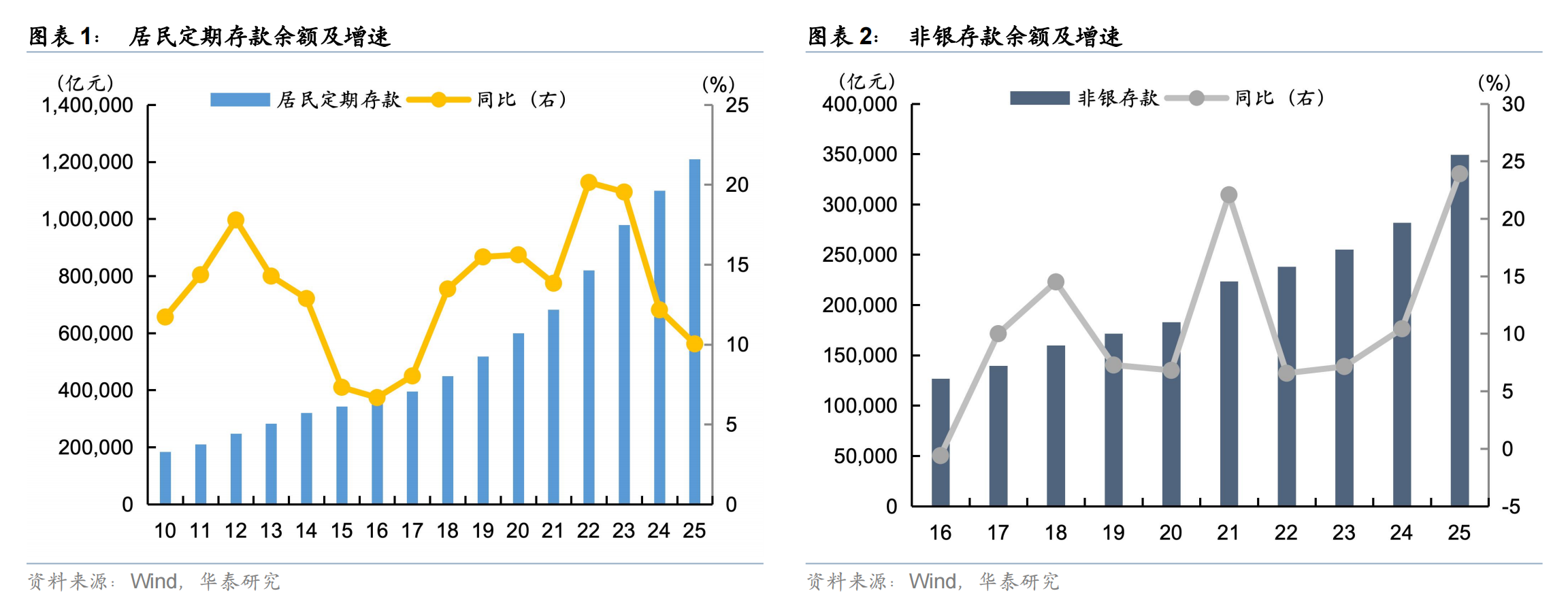
智通财经1月6日讯(编辑 王蔚)进入2026年,存款到期体量大致有多少?这是近期市场颇为关注的问题,目前"开门红"是敏感时期,机构压力颇大。 据相关券商研报测算,今年1Y以上定期存款到期规模约50万亿,较2025年增长10万亿。其中,2年期、3年期存款到期量预计均在20万亿以上,5年期大致在 5-6万亿。 分银行类型来看,预计国有行存款到期规模最大,体量大致在30-40万亿;股份行次之,约10-13万亿;城农商行合计到期规模约5-7万亿(均不考虑1年及以 内新发存款)。 年内到期节奏方面,由于每年初银行存在"开门红"诉求,一季度新增存款往往最多,对应到期规模也可能更大。业内预计上半年全市场定存到期规模约30万 亿,下半年大致在20余万亿。 存款到期后,主要流向四个方向:偿还存量房贷、流向股市、购买理财等产品、以及继续购买更低利率的存款。 业内人士普遍认为,目前,存款搬家尚处于早期阶段,2026年,存款搬家现象会加强。 存款或主要"搬家"至四大方向 随着存款利率持续下行、资本市场回暖,叠加前几年新发的定期存款集中到期,居民存款迎来新一轮"迁徙"。截至2025年11月,居民定期存款增速从22-23 年的20%回落 ...
2026保险投资四问四答
2026-01-05 15:42
Summary of Conference Call on the Insurance Industry Industry Overview - The insurance industry is projected to see a maturity of wealth management products reaching 25 trillion, providing room for premium growth, with recent "New Year" data indicating strong performance across companies, suggesting growth potential in the industry [1][3] - Despite profit pressures, historical data shows that industry market value remains stable or increases even in years of declining profit growth, indicating that asset expectations and changes in investment returns are more critical valuation drivers [1][4] Key Insights - Short-term projections indicate that the life insurance market could reach 4.8 trillion by 2026, representing a 10% year-on-year growth, supported by both savings and protection product demands [1][5] - The regulatory requirement for 30% of new premiums to be invested in A-shares is expected to result in an operational net cash flow of approximately 4.8 trillion for life insurance by 2026, translating to an influx of 300 billion to 760 billion into the market [1][6] - The preference for stable income-generating equity assets, such as value stocks and cyclical bottom stocks, is driven by the need to address duration gaps and investment demands in a low-interest-rate environment [1][6] Profitability and Valuation - Profitability in the insurance sector is influenced by the difference between investment returns and liability costs, with a clear trend of improving liability costs, leading to optimistic market sentiment regarding the widening of interest spreads [1][7] - The insurance sector's current valuation is still significantly below a one-time price-to-value (PV) ratio, indicating substantial room for growth, and it is recommended to maintain a focus on the insurance sector over individual stock selection [2][8] Long-term Growth Drivers - The severe shortfall in retirement savings in China compared to the U.S. presents a significant long-term growth opportunity for the insurance sector, with projections suggesting that the proportion of life insurance in retirement assets could increase from 15% to 20% by 2035, maintaining a compound annual growth rate of 10% [1][5] Conclusion - The insurance industry is positioned for both short-term and long-term growth, with favorable regulatory conditions and market dynamics supporting a positive outlook for investment and profitability [1][2][6]
保险股走强,新华保险、中国太保创历史新高
Ge Long Hui· 2026-01-05 05:55
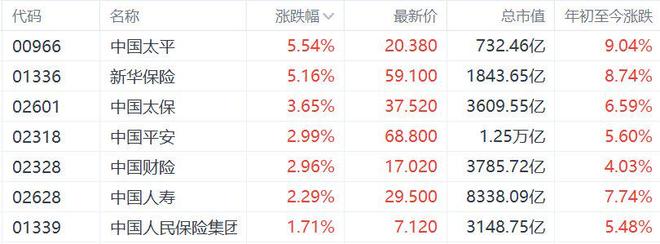
Core Viewpoint - The strong performance of insurance stocks in the A-share market has led to a similar trend in the Hong Kong market, with notable increases in stock prices for major insurance companies [1] Group 1: Stock Performance - China Taiping and New China Life Insurance both rose over 5%, while China Pacific Insurance increased by over 3%, and China Ping An and China Property & Casualty Insurance both saw nearly 3% gains [1] - New China Life Insurance and China Pacific Insurance reached historical highs, while China Ping An achieved a nearly 5-year high [1] Group 2: Industry Trends - The report from China International Capital Corporation (CICC) highlights five key trends in the life insurance industry for 2026: 1. Continued rapid growth of new business, embracing "deposit migration" and a "new era of health insurance" [1] 2. Further decline in the rigid costs of new business, enhancing the persuasive power of new business value [1] 3. Diversification of new business product structures, with superior companies showing more significant optimization in business structure and differentiation in new business quality compared to peers [1] 4. An upward migration of customer tiers in the industry, with opportunities for upgrading and optimizing operational models and talent [1] 5. A competitive landscape concentrating on companies with strong life insurance operational capabilities [1]

港股异动丨保险股走强,新华保险、中国太保创历史新高
Ge Long Hui· 2026-01-05 03:55
Core Viewpoint - The strong performance of insurance stocks in the A-share market has positively influenced the Hong Kong market, with several major insurance companies reaching new highs in stock prices [1]. Group 1: Stock Performance - China Taiping, New China Life, and China Pacific Insurance saw stock increases of over 5%, while China Ping An and China Property & Casualty Insurance rose nearly 3% [1]. - New China Life and China Pacific Insurance reached historical highs, while China Ping An achieved a nearly five-year high [1]. - The year-to-date performance of major insurance stocks includes: - China Taiping: 9.04% increase - New China Life: 8.74% increase - China Pacific Insurance: 6.59% increase - China Ping An: 5.60% increase - China Property & Casualty Insurance: 4.03% increase - China Life: 7.74% increase - People's Insurance Group: 5.48% increase [2]. Group 2: Industry Trends - The report by CICC highlights five key trends in the life insurance industry for 2026: 1. Continued rapid growth of new business, embracing "deposit migration" and a "new era of health insurance" 2. Further decline in the rigid costs of new business, enhancing the persuasive power of new business value 3. Diversification of new business product structures, with quality companies showing more significant optimization in business structure and differentiation in new business quality compared to peers 4. An upward migration of customer tiers in the industry, with opportunities for upgrading and optimizing operational models and talent 5. A competitive landscape concentrating on companies with strong life insurance operational capabilities [1].

超30万亿定期存款将扎堆到期
Qi Lu Wan Bao· 2026-01-04 23:16
记者 尹睿 济南报道 2026年,居民定期存款市场将迎来规模空前的集中到期潮。根据中金公司(601995)货币金融研究数据, 全年合计超过30万亿元的2年期、3年期和5年期居民定期存款将陆续到期,其中2年期20.7万亿元、3年期 9.6万亿元、5年期1.3万亿元。 与存款到期高峰形成鲜明对比的,是定期存款利率的深度下调。上述到期存款在2025年及之前存入时,普 遍享受了相对较高的利率。但根据中金研究测算,它们重定价(即到期后重新存入)后,利率将分别显著下 行72、142和168个基点(bp),普通储户正面临资金重新配置的关键抉择。 数字人民币或成过渡选择 自2026年1月1日起,工商银行、中国银行、农业银行、建设银行、交通银行及邮储银行(601658)六大 国有行同步执行数字人民币计息政策,数字货币正式告别"无息时代"。 根据公告细则,一类、二类、三类个人实名钱包及单位钱包余额,均按照该行公布的活期存款挂牌利率计 付利息,每季度末月20日结息、21日入账,与传统活期存款规则完全一致。记者在六大国有银行官网查询 到,当前各家银行的活期存款挂牌利率均为0.05%。 值得注意的是,此次计息范围明确排除四类非实名钱包 ...
保险基本面梳理 111:2026 保险投资四问四答-20260104
Changjiang Securities· 2026-01-04 11:38
Investment Rating - The investment rating for the insurance industry is "Positive" and maintained [9] Core Viewpoints - The focus should be on the logic of long-term profit improvement rather than short-term valuation changes. The insurance industry's ability and willingness to allocate equity will significantly boost in the foreseeable future, combined with the advantages of improved liability costs, leading to a sustained increase in industry spreads in the medium to long term. This will drive the profitability of policies, with ideal models suggesting profitability could exceed 1 times the effective business value, indicating ample room for valuation recovery [3][8]. Summary by Relevant Sections 1. Why There is No Need to Worry About Base Pressure - The trend of deposit migration is smooth, and both new business and NBV bases are not excessively high, resulting in low pressure on the liability side. The strong performance of the asset side will benefit profits, but short-term valuation is primarily influenced by investment returns, meaning profit growth or decline does not necessarily lead to corresponding changes in valuation [5][18]. 2. How to Assess Premium Space - Short-term perspective: Assuming that the incremental life insurance mainly comes from the maturity of deposits, the forecast for 2026 is a personal insurance scale of CNY 4.8 trillion, with a year-on-year growth rate of about 10% [6][56]. - Long-term perspective: As the proportion of pension asset reserves gradually approaches that of the U.S., the trend of deposit migration to insurance will continue, driven by the multi-level pension system development, maintaining a CAGR of around 10% over the next decade [6][65]. 3. Scale and Direction of Insurance Capital Market Entry - It is estimated that the scale of insurance funds allocated to A-shares in 2026 will be approximately CNY 3,127 to 7,685 billion, based on the initiative to allocate 30% of new premiums to A-shares [7][69]. 4. Why Long-term Valuation Recovery is Promising - The combination of current industry conditions and policy environment will significantly enhance the insurance industry's ability and willingness to allocate equity in the foreseeable future. This, along with improved liability cost advantages, will lead to a sustained increase in industry spreads, driving policy profitability improvement and indicating ample room for valuation recovery [8][47].