
财政赤字

Search documents
美国经济站在悬崖边缘
Sou Hu Cai Jing· 2025-09-21 16:43
Group 1: Economic Overview - The U.S. economy is on the brink of a potential recession, characterized by a widening fiscal deficit, soaring public debt, and increasing financialization, creating a "perfect storm" scenario [1][2] - The Congressional Budget Office (CBO) projects a federal budget deficit of $1.9 trillion for FY 2025, which is 6.2% of GDP, significantly higher than the historical average of 3.8% over the past 50 years [2] - The federal spending as a percentage of GDP has risen from 12% to 23.3% over the past 70 years, with projections indicating it could reach 24.4% by 2035, driven primarily by social security, Medicare, and net interest expenditures [2] Group 2: Structural Weaknesses - The structural issues in U.S. fiscal health are not cyclical but deep-rooted, with federal revenues stagnating between 15% and 17% of GDP while expenditures continue to rise [2] - The anticipated revenue for FY 2024 is $5.2 trillion against expenditures of $7 trillion, leading to a deficit of $1.8 trillion, highlighting a significant structural imbalance [2] Group 3: Financialization and Market Dependency - The increasing reliance on capital gains tax as a revenue source ties government finances closely to stock market performance, with past crises leading to significant drops in tax revenue [3] - The over-dependence on financial markets, coupled with a growing current account deficit and an overvalued dollar, creates a unique risk environment [3] Group 4: Recession Dynamics - In the event of a recession, tax revenues could decline by 15%, reducing expected revenues for 2025 from $4.92 trillion to $4.2 trillion, a loss of approximately $720 billion [4] - Government spending is expected to increase by 29% during a recession, potentially raising expenditures from $6.7 trillion to $8.7 trillion, leading to a projected deficit surge from $2 trillion to $4.5 trillion, or 15.5% of GDP [4] Group 5: Labor Market and Social Pressure - A severe recession could push the unemployment rate from 4.3% to 6%, decreasing personal income tax revenues and increasing social security expenditures [5] - The government's immigration policies may further reduce labor supply, increasing wages and prices while weakening consumer purchasing power, leading to stagflation risks [5] Group 6: Debt Crisis and Market Confidence - Public debt as a percentage of GDP has escalated from 60% in 2007 to an estimated 98% in 2024, with projections suggesting it could reach 535% by the end of the century [6] - The combination of expanding deficits, shrinking GDP, and increased debt issuance creates a "debt vicious cycle," where rising debt leads to higher interest rates, further exacerbating the deficit [7] Group 7: Policy Challenges - The current policy mix may provide short-term relief but could exacerbate structural risks in the long run, with tariffs increasing import prices and inflationary pressures [8] - Immigration policy changes could reduce labor supply, negatively impacting GDP growth, while fiscal policies continue to struggle with the dilemma of increasing revenue versus cutting spending [8] Group 8: Strategic Recommendations - A multi-layered, systemic response strategy is essential, including building emergency reserves and diversifying investments to enhance financial resilience [9] - Policymakers need to balance short-term stimulus with long-term sustainability, focusing on high-return investments rather than merely expanding expenditures [9]
肯政府2025/26财年融资计划
Shang Wu Bu Wang Zhan· 2025-09-20 04:16
Core Insights - The Kenyan Ministry of Finance projects a need to raise 1.55 trillion Kenyan Shillings for the fiscal year 2025/26 to maintain operations and meet debt obligations, which is equivalent to 8% of GDP [1] Summary by Categories Fiscal Deficit and Debt Obligations - Of the total amount needed, 901 billion Kenyan Shillings is allocated to cover the fiscal deficit, while 646.3 billion is designated for repaying maturing domestic and external debts [1] Funding Sources - To address the fiscal deficit, the government plans to source 248.2 billion Kenyan Shillings through external borrowing, accounting for approximately 28% of the deficit funding, and 652.8 billion Kenyan Shillings through internal financing, which represents about 72% [1]
黄金四季报:GOLD IS THE NEW BOND
Zi Jin Tian Feng Qi Huo· 2025-09-19 12:40
1. Report Industry Investment Rating No relevant content provided. 2. Core Views of the Report - Gold has broken through and risen after a four - month consolidation, with a year - to - date increase of nearly 40%. Given the expected consecutive interest rate cuts in September, October, and December 2025, and macro - hedging against concerns about the Fed's independence and the US dollar credit system, there is still room for gold prices to rise [3]. - The "One Big Beautiful Bill Act", soaring tariff revenues, and the postponement of long - term Treasury bond issuance plans seem to improve the US fiscal outlook. However, due to rigid fiscal spending constraints, a 6% deficit rate has become the "new normal", which fundamentally supports the gold price [3]. - The weakening of the Fed's independence is another important factor driving up the gold price. Political intervention in monetary policy has increased, shaking market confidence in the traditional policy framework [3]. - Although global central bank gold purchases have decreased since the second quarter, central banks, especially those of Russia, Turkey, and China, will continue to diversify their reserve assets by reducing US Treasury holdings and increasing gold, and the "Gold is the new bond" logic persists, and the gold - silver ratio will not fall continuously [3]. - As the Fed returns to the interest - rate cut cycle, the inflow of net long positions in the gold ETF and futures markets will create additional demand [3]. - Stablecoins, as derivatives of the US dollar system, cannot alleviate the huge financing gap of US Treasury bonds and thus cannot shake the upward trend of gold prices in this cycle [3]. 3. Summary by Relevant Catalogs 3.1 Recent Market Review - The median projections for real GDP growth, unemployment rate, PCE inflation, core PCE inflation, and the federal funds rate from 2025 to the long - run are presented, showing changes compared to the June projections. For example, the projected real GDP growth in 2025 is 1.6% (June projection: 1.4%) [8]. - Powell's remarks at the press conference were neutral with a hawkish tilt. He did not hint at a series of future interest - rate cuts, and the SEP raised GDP projections for the next two years and the inflation rate for next year while lowering the unemployment rate, indicating that risk - management interest - rate cuts are expected to boost the economy [10]. 3.2 Fiscal Track Seemingly Shows Signs of Recovery - The "One Big Beautiful Bill Act" was signed into law on July 4. It includes tax cuts and spending adjustments. The CBO predicts it will increase the basic deficit by about $3.4 trillion in the next decade, and with additional interest costs, the deficit increase could reach $4.1 trillion. If tariff revenues are lower than expected, the deficit improvement goal will be harder to achieve [15]. - US tariff revenues are rising at an unprecedented slope. In April, the monthly revenue was $17.4 billion, and in August, it soared to $31.4 billion. If the third - quarter momentum continues, the 2026 fiscal - year tariff revenue could approach $380 billion, which may offset most of the costs of the "One Big Beautiful Bill Act" in an optimistic scenario. The average effective tariff rate faced by US consumers has reached 17.4%, the highest since 1935 [18]. - From April to June, the term premium soared nearly 60 bps due to factors such as the deterioration of the fiscal path. In July, the Treasury Department will keep the auction scale of nominal notes and bonds unchanged in the next few quarters and expand the long - term Treasury bond buyback program, relying more on short - term bonds to finance the deficit [22]. 3.3 Structural Problems of Fiscal Deficit Remain Severe - In the 2024 fiscal year, total fiscal expenditure was $6.8 trillion (23.7% of GDP), with mandatory expenditures accounting for a large proportion. By the 2035 fiscal year, the fiscal deficit is expected to surge to $2.7 trillion, mainly driven by increased social security, medical insurance, and net interest expenditures. Any attempt to cut social welfare or net interest expenditures has significant negative impacts [29]. - As of August 2025, the federal fiscal deficit reached $1.97 trillion, a 4% year - on - year increase. Although tariff revenue increases and the "DOGE plan" can partially offset the deficit pressure, they are insignificant compared to the large debt stock. Federal fiscal revenue has returned to the pre - pandemic long - term equilibrium level, but fiscal expenditure far exceeds it, making a 6% deficit rate the new normal [34]. - According to CRFB's prediction, under Trump's leadership, the federal deficit from 2025 - 2035 is expected to be between 5.6% - 6.5% of GDP, much higher than previous levels. This may lead to an increase in the term premium of US Treasury bonds, a sell - off of bonds, and an increase in the demand for gold as a hedging asset [39]. 3.4 Central Bank Gold - Buying Behavior in 2025 Has Not Weakened - High - quality research infers that China's official gold purchases may be completed through the London LBMA. From January to July 2025, UK customs records showed that China imported over 137 tons of gold, much higher than the official figure of 20.8 tons. The scale of China's central bank gold purchases decreased after April, with a 46% quarter - on - quarter reduction in Q2 compared to Q1 [44]. - The research report of the European Central Bank shows that by the end of 2024, the proportion of gold in official foreign exchange reserves reached 20%, exceeding the euro. Central banks such as those of Russia, Turkey, and China are increasing gold holdings while reducing US dollar assets, especially US Treasury bonds [50]. - Since 2022, the gold - silver ratio has broken through the 50 - 80 range of the past 30 years. After April, the slowdown of central bank gold - buying led to a temporary decline in the gold - silver ratio. However, if central bank gold - buying continues and silver performs unstably during the Fed's interest - rate cut cycle, the gold - silver ratio is unlikely to fall in the long term [55]. 3.5 Decline in US Government Agency Credibility: A Strong Catalyst for Gold Prices - Although the personnel structure of the Fed's FOMC has not changed substantially, political intervention has increased significantly. If Cook is removed, there is a risk of replacing the 12 regional Fed presidents. Also, if Powell continues to serve as a Fed governor after his term as chairman ends, it may limit the government's influence on the composition of the monetary policy committee [58][61]. - The Fed's independence is crucial for maintaining the credibility of monetary policy. When the market fears political intervention in monetary policy, investors tend to buy gold as a hedge, driving up the gold price [61]. 3.6 Fed Interest - Rate Cuts: Another Driver of Gold Price Increase - Since April, new non - farm payrolls have declined, and the ratio of job vacancies to the unemployed has reached a new low since the pandemic. In August, core CPI showed resilience, but there was no widespread and continuous price pressure. As a result, the Fed cut the benchmark interest rate by 25 bps on September 18 [66]. - In the four weeks leading up to September 17, global gold ETF holdings increased by 74 tons, and COMEX gold futures non - commercial net long positions increased by about 49,000 contracts. With the Fed's interest - rate cut cycle starting, the decline in yields will drive up gold demand [67]. 3.7 Stablecoins Are Essentially an Extension of the US Dollar System - The "GENIUS Act" aims to establish a regulatory framework for stablecoins, requiring issuers to hold high - liquidity reserve assets. The total market value of USDT and USDC, which account for over 90% of the stablecoin market, is about $250 billion, while the public's US Treasury bond holdings exceed $29 trillion. Currently, stablecoins are not significant enough to impact the US Treasury bond market [78]. - Stablecoins can only absorb part of short - term US Treasury bonds and cannot fill the trillion - level fiscal financing gap. For example, Tether (USDT)'s reserve assets are mainly short - term Treasury bonds, but its overall scale is limited compared to the US Treasury bond market [79].
中国7月减持美债257亿美元 仓位降至16年新低
Xin Hua Cai Jing· 2025-09-19 09:04
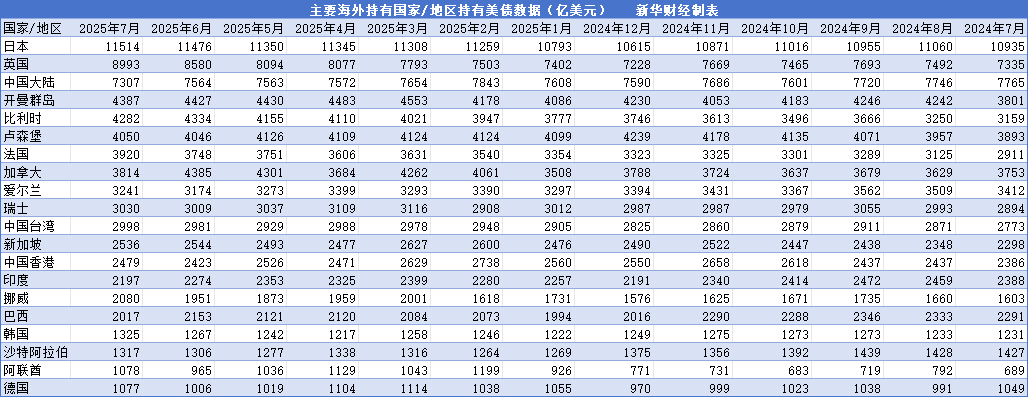
Core Insights - The U.S. Treasury Department reported that foreign investors continued to increase their holdings of U.S. Treasury bonds, with a month-over-month increase of $31.9 billion, bringing the total to $9.16 trillion, marking the fifth consecutive month above $9 trillion [1][3] - Japan and the UK have been the top buyers, with the UK increasing its holdings by over $40 billion for two consecutive months, while Canada and mainland China have significantly reduced their holdings by $57.1 billion and $25.7 billion, respectively [1][3] Summary by Category Foreign Holdings of U.S. Treasury Bonds - As of July 2025, Japan holds $1.1514 trillion, an increase from $1.1476 trillion in June, while the UK holds $899.3 billion, up from $858 billion [2] - Mainland China's holdings decreased to $730.7 billion, the lowest since February 2009, following a reduction of $25.7 billion [3] Market Dynamics - Canada dropped from the fifth to the eighth largest holder of U.S. Treasuries after a significant reduction of $57.1 billion in July, following a volatile pattern of buying and selling in previous months [5] - Concerns over debt levels and tariffs have led to rising yields in the Treasury market, with the 10-year Treasury yield increasing by 13 basis points [5] Legislative Impact - The "Big and Beautiful" tax and spending bill signed by President Trump is projected to increase the U.S. deficit by $3.3 trillion over the next decade, which may further elevate interest rates [6][7] - The bill's extension of tax cuts alone is expected to incur over $4.5 trillion in costs, contradicting IMF recommendations for the U.S. to reduce fiscal deficits [6] Economic Outlook - The uncertainty surrounding U.S. trade, security, and economic policies has shaken confidence in the U.S. dollar as a global reserve currency, with its share in global foreign exchange reserves slightly declining to 57.7% in Q1 2025 [8]

英国8月预算赤字远超预期,财政大臣里夫斯再添新打击
智通财经网· 2025-09-19 07:37
对里夫斯而言,这些数据无疑令人沮丧。她在首次公布预算案时就已引发商界不满,而外界预计,她将 在11月26日的预算案中宣布新增数十亿美元的增税计划。但此举给经济和公共财政带来风险:增税可能 抑制经济增长,进而影响里夫斯迫切需要的税收收入。 目前,英国政府借贷成本攀升、一系列政策出现"180度大转弯",再加上预算责任办公室预计将下调生 产力预期,多重因素可能导致里夫斯无法实现自己设定的财政目标——即在2029-30财年前实现财政收 入覆盖日常支出。彭博经济研究测算,填补这一缺口需350亿英镑资金。 智通财经APP获悉,英国8月政府借贷规模高于预期,这给财政大臣雷切尔·里夫斯(Rachel Reeves)带来 打击,眼下她正为秋季颇具挑战的预算案做准备。英国国家统计局(Office for National Statistics)周五公 布,8月预算赤字达180亿英镑(约合244亿美元)。这一缺口远超英国预算责任办公室(Office for Budget Responsibility)预测的125亿英镑,同时创下五年来同期最高借贷纪录。 至此,英国政府本财年开局五个月的累计赤字已达838亿英镑,较预算责任办公室的预 ...
研究报告分析智利政府今年将再次无法实现财政目标,结构性赤字达GDP的2.5%
Shang Wu Bu Wang Zhan· 2025-09-18 16:41
(原标题:研究报告分析智利政府今年将再次无法实现财政目标,结构性赤字达GDP的2.5%) 智利《三点钟报》9月17日报道,智利政府正面临严峻的财政挑战,2025年极有可 能无法实现其既定的财政目标(结构性赤字占GDP的1.6%)。圣塞巴斯蒂安大学 (USS)分析报告预测,实际赤字率可能高达2.5%,远高于政府自己调整后的预期 (-1.8%),凸显了收入不足和支出压力并存的双重困境。报告指出,截至7月,智利财 政总收入达425.47亿美元,较去年同期实际增长6.3%,累计收入占年度预测值的 55.9%,低于2016-2024年间同期累计收入占全年收入平均比例57.8%。截至7月,中央政 府累计支出达472.76亿美元,较去年同期增长3.3%。 ...
泰国2025财年前10个月财政收入距目标差400亿
Shang Wu Bu Wang Zhan· 2025-09-18 06:48
Group 1 - The Thai Ministry of Finance reported that the government's net fiscal revenue for the first ten months of fiscal year 2025 (October 2024 to July 2025) reached 2.25 trillion Thai Baht, representing a year-on-year increase of 1.8%, but still falling short of the original target by approximately 40 billion Thai Baht [1] - The primary reason for the revenue shortfall is a decline in key tax revenues, particularly the automobile tax, which has been impacted by electric vehicle (EV) policies, resulting in actual tax collections being lower than expected [1] - Other tax revenues, such as import value-added tax and corporate income tax, also fell below targets, reflecting increased use of tax exemptions in free trade zones and changes in the economic landscape [1] Group 2 - As of the end of July 2025, the government had cumulative expenditures of 3.16 trillion Thai Baht, and to maintain liquidity and support policy initiatives, it borrowed 827.8 billion Thai Baht to cover the deficit [1] - The treasury balance stood at 405.7 billion Thai Baht at the end of July 2025 [1]
西班牙央行上调经济与通胀预测 财政赤字及债务率有望持续改善
Xin Hua Cai Jing· 2025-09-16 14:14
Core Viewpoint - The Spanish central bank has released an optimistic economic forecast, indicating steady growth and improvements in fiscal conditions, with adjustments made to GDP and inflation predictions for the coming years [1]. Economic Growth - The Spanish economy is expected to grow by 0.6% to 0.7% quarter-on-quarter in Q3, reflecting a robust expansion trend [1]. - The GDP growth forecast for 2025 has been raised from 2.4% to 2.6% [1]. - The growth predictions for 2026 and 2027 remain unchanged at 1.8% and 1.7%, respectively [1]. Inflation - The inflation rate forecast for 2025 has been slightly increased to 2.5%, up from the previous estimate of 2.4% [1]. - This forecasted inflation rate is still lower than the actual inflation level of 2.9% in 2024, indicating a gradual easing of overall inflationary pressures [1]. Fiscal Conditions - The forecast for the government budget deficit as a percentage of GDP for 2025 has been revised down from 2.8% to 2.5%, suggesting improved fiscal discipline and a more stable fiscal situation [1]. Debt Levels - The government debt-to-GDP ratio is projected to reach 100.7% by the end of 2025, followed by a decline to 100.4% in 2026 and further down to 100% by the end of 2027 [1]. - This trajectory indicates that the government is making progress in controlling the scale of public debt [1].
西班牙央行上调经济与通胀预测,财政赤字及债务率有望持续改善
Sou Hu Cai Jing· 2025-09-16 13:22
Core Insights - The Bank of Spain forecasts a quarter-on-quarter GDP growth of 0.6% to 0.7% for the third quarter, indicating a sustained robust expansion trend [1] - The GDP growth forecast for 2025 has been revised upward from 2.4% to 2.6%, while the forecasts for 2026 and 2027 remain unchanged at 1.8% and 1.7% respectively [1] - The inflation rate forecast for 2025 has been slightly increased to 2.5%, up from the previous estimate of 2.4%, although it remains lower than the actual inflation rate of 2.9% in 2024, suggesting a gradual easing of overall inflationary pressures [1] - The fiscal situation shows positive improvement, with the forecast for the government budget deficit as a percentage of GDP for 2025 revised down from 2.8% to 2.5%, indicating strengthened fiscal discipline and a trend towards a more stable fiscal situation [1]
黄金股延续近期涨势 COMEX黄金站上3700美元 黄金资源股盈利预期增强
Zhi Tong Cai Jing· 2025-09-16 01:58
Core Viewpoint - The recent surge in gold stocks is driven by rising gold prices, with COMEX gold surpassing $3700 per ounce and a projected increase to $4000 per ounce by Q1 2026 due to strong investor demand and potential Federal Reserve rate cuts [1] Gold Stocks Performance - Shandong Gold (01787) increased by 3.65% to HKD 36.34 - China Silver Group (00815) rose by 2% to HKD 0.51 - Zhaojin Mining (01818) gained 1.95% to HKD 30.3 - Chifeng Jilong Gold (06693) went up by 1.16% to HKD 31.4 [1] Market Predictions - Morgan Stanley has raised its gold price forecast, anticipating that gold could exceed $4000 per ounce by Q1 2026, with a potential rise to $5000 if the Federal Reserve's independence is challenged [1] - The increase in gold prices is attributed to concerns over global debt and monetary policies, with the passage of the "Big and Beautiful" bill expected to raise the U.S. fiscal deficit by $3.4 trillion [1] Investment Outlook - Huaxi Securities suggests that the long-term outlook for gold remains positive due to global monetary and debt concerns, indicating that gold stocks are currently undervalued and present a good investment opportunity [1]