
货币政策正常化

Search documents
从日债到美债:全球期限溢价的涟漪
BOCOM International· 2025-06-09 10:00
Global Macro - The rapid rise in Japanese super-long government bond yields since mid-May 2025 has triggered turbulence in the global bond market, with the 40-year bond yield surpassing 3.68%, the highest since its issuance in 2007 [2][6][23] - The increase in yields reflects structural changes in the global bond market amid fiscal expansion and diverging central bank policies, with expectations of further fiscal easing pushing up risk premiums [2][6][23] Japanese Long-term Bond Yield Dynamics - The primary driver of the recent rise in Japanese long-term bond yields is the gradual normalization of the Bank of Japan's monetary policy, which has created conditions for the repricing of super-long government bonds [3][24] - A structural imbalance in supply and demand has exacerbated market volatility, as the absence of the Bank of Japan as a "super buyer" has removed crucial market support [3][30] - The demand side is also under pressure, with rising interest rate expectations leading domestic institutional investors to adopt a wait-and-see approach, further weakening buying power [3][37] Economic Challenges and Policy Dilemmas - Japan's economy faces dual challenges of weak domestic demand and external tariff shocks, with the central bank caught in a policy dilemma [3][52] - The government debt-to-GDP ratio has surpassed 260%, raising concerns about fiscal sustainability as rising long-term bond yields increase borrowing costs [3][60] Spillover Effects on Global Bond Markets - The volatility in Japanese long-term bond yields has significant spillover effects on the U.S. Treasury market, with Japanese insurers and pension funds potentially exerting structural selling pressure on U.S. bonds [3][64] - The global bond market is undergoing a systematic reassessment of risk premiums, with Japan's long-term bond yields acting as a "ballast" in the global interest rate system [3][70] U.S. Treasury Yield Outlook - Short-term risks for U.S. Treasury yields are notable, with expectations of a resolution to the debt ceiling issue leading to substantial net issuance of $300-400 billion within 2-3 months [3][91] - The anticipated fiscal policies under the Trump administration may further pressure U.S. Treasury yields, with a projected range of 4.0-5.0% for the 10-year yield by the end of 2025 [3][105]
日本央行再迎利好数据!4月基本工资增长加速或为加息铺路
智通财经网· 2025-06-05 02:30
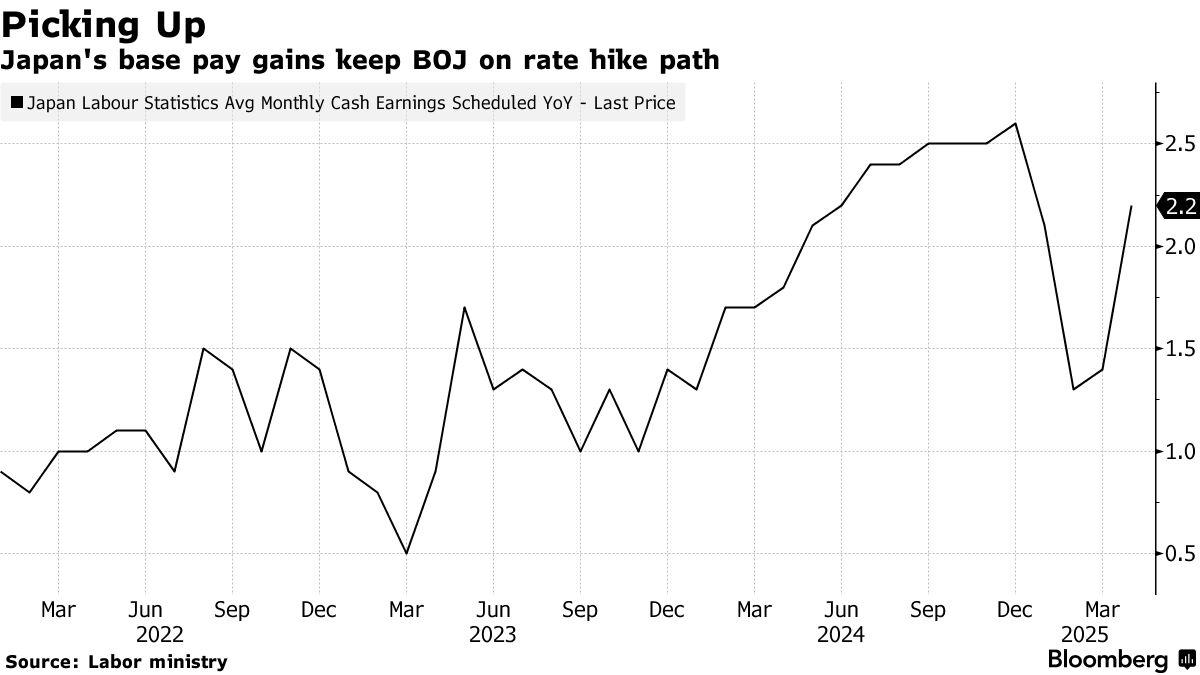
智通财经APP获悉,周四公布的日本最新工资数据对寻求进一步加息以推进货币政策正常化的日本央行而言是一个积极的进展。数据显示,日本4月基本工 资同比增长2.2%,高于3月经修正后的1.4%;名义工资同比增长2.3%,不及经济学家预期的2.6%。一项更稳定的工资趋势指标则显示,全职工人的工资同比 上涨了2.5%,连续第20个月保持在2%或以上(该指标避免了抽样问题,也不包括奖金和加班费)。但不利的一方面是,实际薪资收入同比下降了1.8%,大于 市场预期的1.6%降幅。 在年度劳资谈判之后,工资前景普遍乐观。日本企业连续第二年承诺将工资提高5%以上。据日本最大工会联合会Rengo的最新统计,一些工人获得了30多年 来最大幅度的加薪。根据日本央行以往研究,这些加薪将在6月左右的工资单中更全面地体现出来。 不过,也有一些经济学家警告称,美国总统特朗普的关税可能压缩企业利润,限制部分企业为员工提供更慷慨薪资的能力。日本央行在其最新的展望报告中 指出,名义工资增长的速度可能会因企业利润下降而在未来放缓,但并未进一步说明具体背景。 Bloomberg Economics经济学家Taro Kimura指出,前几个月的数据受到闰 ...

日本4月实际工资连续第四个月下降 通胀压力持续影响家庭购买力
Xin Hua Cai Jing· 2025-06-04 23:57
新华财经北京6月5日电根据日本政府于周四公布的最新数据,日本4月份的实际工资连续第四个月呈现 下滑趋势。这一现象主要归因于持续的通货膨胀,导致工资上涨速度未能跟上物价上涨的步伐,即使企 业已尝试通过加薪来缓解员工生活成本的压力。 在全球经济不确定性增加的大背景下,特别是美国总统特朗普时期全面关税政策的影响下,日本的工资 数据进一步加剧了市场对于该国经济增长前景的担忧。日本的政策制定者和经济学家们普遍担心,全球 贸易紧张局势可能会削弱现有的薪资增长动力,并对日本央行实现货币政策正常化的努力构成挑战。 数据显示,经通胀调整后的实际工资在4月份较上年同期下降了1.8%,与3月份的降幅相同,而2月份则 下降了1.5%。值得注意的是,用于计算实际工资的消费者价格指数(包括新鲜食品但不包括房租)同 比增幅虽从3月份的4.2%轻微降至4月份的4.1%,但已连续五个月保持在约4%的高位。 尽管如此,劳工部的一位官员指出,"虽然工资确实在稳步上升,但物价水平仍然非常高。" 数据显示,4月份的基本工资(常规工资)同比增长2.2%,为四个月以来的最大涨幅;加班费增长 0.8%,逆转了3月份的下降趋势;特殊津贴则增加了4.1%。平均 ...
【申万宏源策略】长端日债利率上行归因与套息交易后续展望——全球资产配置热点聚焦系列之二十九
申万宏源研究· 2025-05-29 01:12
Core Viewpoint - The article discusses the significant rise in long-term Japanese government bond yields, attributing it to factors such as improving employment, rising wages, and inflationary pressures, alongside supply-demand imbalances in the bond market [2][8][15]. Group 1: Long-term Japanese Government Bond Yields - The auction of 1 trillion yen 20-year bonds on May 20, 2025, saw a bid-to-cover ratio drop to 2.5, the lowest since 2012, and a tail difference of 1.14, the highest since 1987, leading to a sharp increase in 30-year bond yields to 2.74% [1][6]. - The yield spread between 30-year and 10-year Japanese bonds increased significantly to 126 basis points, placing it in the 99.3 percentile since 2000, indicating a steepening of the yield curve [1][6]. Group 2: Economic Factors Influencing Yields - The Japanese labor market has shown consistent improvement since 2021, with a declining unemployment rate and rising labor participation, contributing to wage increases and inflation that have exceeded the Bank of Japan's target of 2% for two consecutive years [2][8][12]. - The Bank of Japan is expected to initiate a rate hike cycle in March 2024 to address rising inflation and normalize monetary policy, which has been extremely accommodative for 25 years [12][15]. Group 3: Supply-Demand Imbalances - The supply-demand imbalance in the long-term bond market is a primary driver of the recent yield increases, with the Bank of Japan reducing its bond purchases, leading to liquidity risks in the market [15][22]. - Major Japanese life insurance companies are facing significant unrealized losses on their bond holdings, prompting them to reconsider their long-term bond positions, further exacerbating liquidity issues [22][24]. Group 4: Future Outlook - Upcoming bond auctions from May 28 to June 5, 2025, for 40-year, 10-year, and 30-year bonds are expected to impact the overall bond market, with potential for continued upward pressure on yield spreads [3][24]. - The actions of the Bank of Japan and the Ministry of Finance in mid-June will be crucial in determining the trajectory of Japanese bond yields, as they seek to balance currency appreciation, economic recovery, and market normalization [3][24]. Group 5: Impact on Global Markets - The ongoing rise in Japanese bond yields may influence global bond markets, as the interconnectedness of developed economies means that changes in Japanese yields could lead to similar movements in other countries' long-term bond rates [5][41]. - A reversal in the carry trade, where investors borrow in yen to invest in higher-yielding dollar assets, could lead to capital outflows from U.S. equities, increasing volatility in those markets [5][41].

全球资产配置热点聚焦系列之二十九:长端日债利率上行归因与套息交易后续展望
Shenwan Hongyuan Securities· 2025-05-28 08:15
Group 1 - The core reason for the significant rise in long-term Japanese bond yields is attributed to the recovery of the Japanese labor market and the subsequent increase in wage growth, which has driven inflation upward. The unemployment rate in Japan has been declining rapidly, and the labor participation rate has been increasing, leading to a substantial rise in wage growth since 2023 [14][19][20] - The issuance of 1 trillion yen 20-year government bonds on May 20, 2025, saw a bid-to-cover ratio drop to 2.5 times, the lowest since 2012, and a tail difference that surged to 1.14, the highest since 1987. This resulted in a significant increase in the 30-year Japanese bond yield to 2.74%, causing the 30Y-10Y yield spread to rise sharply to 126 basis points, placing it in the 99.3 percentile since 2000 [3][8][14] Group 2 - The short-term outlook suggests that the upcoming auctions of 40-year, 10-year, and 30-year Japanese government bonds from May 28 to June 5 may lead to further increases in yield spreads due to heightened liquidity risks in the long-term bond market and sustained high inflation levels [30][31] - The Bank of Japan's actions in mid-June will be crucial for the trajectory of Japanese bond yields, as they aim to balance currency appreciation, economic recovery, and normalization of the bond market [31][32] Group 3 - The current state of carry trade is influenced by the ongoing dynamics between Japanese and U.S. bond markets. Despite the significant rise in Japanese bond yields, the 10Y U.S.-Japan yield spread has remained relatively stable, indicating that carry trade opportunities still exist [34][38] - If the 10Y Japanese bond yield rises faster than the 10Y U.S. bond yield, it could lead to increased volatility in global bond and equity markets, as the interconnectedness of developed market yields may trigger a broader rise in rates [48][50]
核心通胀持续高企 日本央行政策转向在即
Jin Tou Wang· 2025-05-26 05:14
Group 1 - The core viewpoint of the articles indicates that the persistent inflation in Japan is likely to prompt the Bank of Japan to consider further interest rate hikes, with potential increases expected in July or October [1] - Japan's April CPI rose by 3.6% year-on-year, exceeding market expectations, while the core CPI (excluding fresh food) increased from 3.2% to 3.5%, also above forecasts [1] - The "core-core CPI" (excluding fresh food and energy) saw a slight increase to 3%, indicating widespread inflationary pressures, which may lead to a "wage-price" spiral as companies pass on rising labor costs to consumers [1] Group 2 - The technical analysis suggests a bearish trend for the USD/JPY pair, with the Relative Strength Index (RSI) below 50 and MACD indicators indicating a downward momentum [2] - Both the 50-day and 200-day moving averages are trending downwards, suggesting that selling on rallies and breakout strategies are preferred [2]
东盟观察丨东南亚多国一季度经济增速放缓,出口预期不稳致亚太股市转跌
Sou Hu Cai Jing· 2025-05-26 00:20
Group 1: Market Overview - The Asia-Pacific stock markets experienced mixed performance, with the Jakarta Composite Index rising by 1.51% while the Kuala Lumpur Composite Index fell by 2.31% [1][3] - The Nikkei 225 Index and KOSPI Index both saw declines of 1.57% and 1.32% respectively, indicating a broader trend of downward movement in major indices [1][3] - Analysts suggest that the recent fluctuations in the Asia-Pacific stock markets are normal market volatility, influenced by global macroeconomic changes and structural adjustments within certain industries [3] Group 2: Economic Growth in Southeast Asia - Five out of six major Southeast Asian economies are experiencing a slowdown in economic growth, with Malaysia, Singapore, and Thailand revising their growth forecasts downward [4][5] - Singapore's GDP growth for Q1 was reported at 3.9%, with a forecasted annual growth rate adjusted to between 0% and 2%, down from a previous estimate of 1% to 3% [4][5] - Other Southeast Asian countries, including Indonesia and Vietnam, also reported lower GDP growth rates compared to previous quarters, indicating a regional trend of economic deceleration [5][6] Group 3: Impact of U.S. Tax Policies - The potential implementation of U.S. tax cuts under President Trump is raising concerns about increasing deficit rates, which could negatively affect investor sentiment towards Asian capital markets [2][6] - The anticipated rise in U.S. deficit rates and the resulting high bond yields may lead to a shift in investment strategies, causing some Asian markets to weaken [2][6] Group 4: Japanese Bond Market Dynamics - The Japanese bond market is facing significant pressure, with a notable decline in demand and a rise in yields, attributed to higher inflation and potential fiscal stimulus measures [7] - The supply-demand imbalance in the Japanese bond market has contributed to upward pressure on global bond yields, particularly affecting U.S. Treasury yields [7]
日债市场起“惊雷”
Shang Hai Zheng Quan Bao· 2025-05-23 19:32
Group 1 - The Japanese 20-year government bond auction experienced its worst results since 2012, with a bid-to-cover ratio dropping to 2.5 times and tail spreads reaching the highest level since 1987, indicating a significant decline in market demand [1][2] - The yield on long-term Japanese government bonds has risen sharply, with the 10-year, 20-year, 30-year, and 40-year bonds yielding 1.573%, 2.566%, 2.999%, and 3.336% respectively, reflecting increases of approximately 0.28, 0.34, 0.35, and 0.39 percentage points since the beginning of the month [1][2] - Japan's government debt stands at over 230% of GDP, the highest in the world, raising concerns about the country's fiscal health compared to Greece, which has a debt-to-GDP ratio of about 150% [3] Group 2 - The Bank of Japan's (BOJ) introduction of yield curve control (YCC) in 2016 has led to the central bank becoming the largest holder of Japanese government bonds, which has implications for market dynamics and pricing [3][4] - The BOJ's decision to end the negative interest rate policy and begin reducing its bond purchases has contributed to a lack of demand for Japanese bonds, leading to a "buyer strike" in the market [4][6] - Analysts suggest that the current situation in the Japanese bond market may reflect broader global liquidity tightening, with potential spillover effects on U.S. financial markets [5][6]

日本央行著名鸽派:没有必要改变缩减购债计划 对未来政策路径持谨慎态度
智通财经网· 2025-05-22 06:48
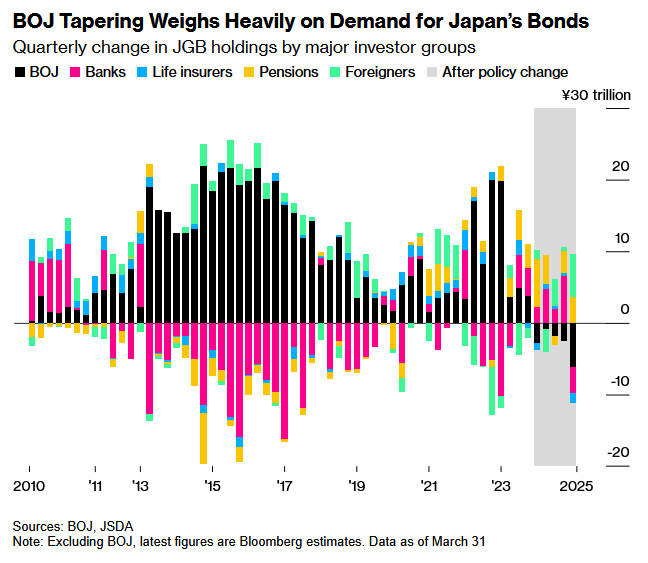
智通财经APP获悉,以鸽派立场而著名的日本央行政策委员会成员野口旭(Asahi Noguchi)周四表示,没 有必要对日本央行缩减债券购买规模的计划做出重大调整。他表示:"目前没有必要对现行计划做出任 何重大改变。央行需要从更长远的角度审视2026年4月以后的计划。" 周三,日本央行结束了与市场参与者的一系列会议。这些会议将帮助日本央行决定以多快的速度缩减购 债规模。日本当局将在一个月后公布2026年4月以后的购债指导方针。 日本央行目前每季度削减4000亿美元(约合28以美元)的债券购买量,到2026年春季,月度债券购买量将 降至2.9万亿日元左右。自2023年11月以来,日本央行持有的债券规模已经下降了21万亿日元。 不过,市场已经开始担忧,日本央行缩减购债规模严重冲击需求,导致日本国债价格大幅下跌。据悉, 在周二的日本政府债券拍卖中,平均投标倍数从上月的2.96降至2.5;其中,20年期日本国债的投标倍数 降至2012年8月以来的最低水平。另一个显示需求疲软的信号是"尾差"(即平均中标价与最低中标价的差 距)达到1.14,为自1987年以来最长。 野口旭称:"我认为,对未来的货币政策采取谨慎乐观的态度是 ...
拍卖异常惨淡,日本国债遭“冷遇”,石破茂:日本财政状况不比希腊好
Huan Qiu Shi Bao· 2025-05-21 22:57
Group 1 - The core issue is the poor auction results for Japan's long-term government bonds, leading to record high yields and concerns over the Bank of Japan's ability to normalize monetary policy amid reduced bond purchases and lack of alternative buyers [1][2][3] - The bid-to-cover ratio for the new 20-year Japanese government bond auction was only 2.5 times, the lowest since 2012, indicating a significant lack of investor interest [1] - The tail difference, which measures the gap between the average price and the lowest accepted price, surged to 1.14, the highest level since 1987, reflecting weak market demand [1] Group 2 - The Bank of Japan currently holds 52% of the Japanese government bond market, making it the largest buyer, but concerns are growing about finding future buyers as the central bank reduces its bond purchases [2] - The rising yields in Japan are influenced by increasing U.S. Treasury yields and worries about how the Japanese government will fund new fiscal stimulus measures ahead of the July upper house elections [2] - The Bank of Japan has been gradually reducing its bond purchases since August 2024, with plans to lower the monthly purchase amount to around 3 trillion yen by early 2026 [3] Group 3 - Prime Minister Kishida's comments regarding Japan's fiscal situation being worse than Greece's have been linked to the recent rise in bond yields, suggesting that political statements can impact market perceptions [3] - Despite a record amount of long-term Japanese government bonds being purchased by foreign investors in April, their overall participation in the market remains low [2]