中美贸易战

Search documents
商品期货早班车-20250520
Zhao Shang Qi Huo· 2025-05-20 02:43
1. Report Industry Investment Ratings No industry investment ratings are provided in the report. 2. Core Views - The report analyzes the market performance, fundamentals, and provides trading strategies for various commodity futures, including basic metals, black industries, agricultural products, and energy chemicals. Market conditions are diverse, with some commodities showing supply - demand imbalances, price fluctuations, and different trends in the short and long term [1][3][5]. 3. Summary by Commodity Category Basic Metals - **Copper**: After Moody's downgraded the US sovereign credit rating, the dollar weakened, supporting copper. The supply of copper ore remains tight, and the spot market is also tight after the contract change. The domestic inventory increased by 0.72 million tons this week. It is recommended to treat it with a wide - range oscillation mindset [1]. - **Aluminum**: The electrolytic aluminum plant maintains high - load production, and the operating capacity increases slightly, while the aluminum product start - up rate decreases slightly. The aluminum price is expected to oscillate weakly in the short term, and it is recommended to wait and see [1]. - **Alumina**: The alumina plant has more phased maintenance and production cuts, and the operating capacity decreases. The electrolytic aluminum plant maintains high - load production. It is in a pattern of strong reality and weak expectation, and it is recommended to buy call options [1]. - **Lead**: The consumption enters the off - season, and it is difficult to improve terminal orders. The lead price has reached a strong resistance level of 17,000 yuan, and it is expected to decline in the short term and oscillate within a range in the medium term [1]. - **Silicon**: The supply is strong and the demand is weak. The short - term production in Sichuan has recovered significantly, and there are production cuts in Xinjiang. It is recommended to wait and see [1]. - **Lithium Carbonate**: The supply is in an oversupply pattern, and the demand growth rate falls short of expectations. The futures price is falling and the position reaches a new high. It is recommended to hold short positions or short on rebounds [2]. - **Polysilicon**: The downstream demand is weak, and the inventory pressure is large. In the short term, it is expected to oscillate at the bottom, and it is recommended to take profit on long positions and consider shorting lightly later [2]. - **Tin**: The supply of tin ore at home and abroad is still tight. It is recommended to treat it with a wide - range oscillation mindset [2]. Black Industry - **Rebar**: The building materials market has weak supply and demand, but the inventory pressure is small due to low production. The plate demand is relatively stable. It is recommended to close short positions, hold short positions on the spread between hot - rolled coil and rebar, and try the reverse spread of rebar 7/10 [3]. - **Iron Ore**: The supply and demand are neutral to strong in the short term, but the medium - term oversupply pattern remains unchanged. It is recommended to close short positions and try long positions [3]. - **Coking Coal**: The overall supply and demand are relatively loose, and the futures are in a premium structure. It is recommended to wait and see [4]. Agricultural Products - **Soybean Meal**: The US soybeans are oscillating, and the domestic soybeans are weak in the short term and follow the international market in the medium term. Pay attention to trade policies and US soybean yields [5]. - **Corn**: The supply and demand are tightening marginally. The spot is weak, and the futures price oscillates and consolidates [5]. - **Sugar**: The market expects an enhanced supply - surplus pattern in the 25/26 sugar - making season. The futures price is expected to be weak after a short - term rebound [5]. - **Cotton**: The international cotton price rebounds slightly, and the domestic cotton price oscillates narrowly. It is recommended to wait and see [5]. - **Palm Oil**: The production area is in the seasonal production - increasing period, and the export improves. It is in a seasonal weak stage, and pay attention to production and biodiesel policies [5]. - **Eggs**: The supply is high, and the demand is weak. The cost provides support, and the futures price is expected to oscillate [6]. - **Pigs**: The supply increases, and the demand is in the off - season. The futures price is expected to oscillate downward [6]. - **Apples**: The new - season apple production is expected to decrease due to weather, and the price is at a high - level oscillation. It is recommended to wait and see [6]. Energy Chemicals - **LLDPE**: In the short term, it will oscillate strongly, and in the long term, it is recommended to short the far - month contracts on rallies as the supply will be loose [7]. - **PVC**: The fundamentals are weak, and it is recommended to close short positions and wait and see [7]. - **PTA**: PX and PTA maintain the de - stocking pattern. It is recommended to take profit on long positions in the spread and be cautious about unilateral trading [8]. - **Rubber**: Affected by the rumored purchase and storage and slight de - stocking of inventory, the price is expected to oscillate weakly in the short term, and it is recommended to short on rallies in the medium term [8]. - **Glass**: It oscillates weakly, and it is recommended to sell call options above 1250 [8]. - **PP**: In the short term, it oscillates, and in the long term, it is recommended to short the far - month contracts on rallies [8]. - **MEG**: The short - term supply and demand are de - stocking, and the price is expected to be strong, but it is recommended to be cautious about long positions [9]. - **Crude Oil**: The trading strategy is to short on rallies. Pay attention to the OPEC meeting and the US - Iran negotiation [9]. - **Styrene**: In the short term, it will oscillate strongly, and it is recommended to do long - spread trading [9]. - **Soda Ash**: The number of maintenance increases, and the downstream demand weakens. It is recommended to sell out - of - the - money call options [9]. - **Caustic Soda**: It is expected to stop falling and stabilize as the downstream alumina price rises [9].
英媒怒斥中国:稀土出口许可制度审批速度太慢,满足不了全球需求
Sou Hu Cai Jing· 2025-05-19 15:32
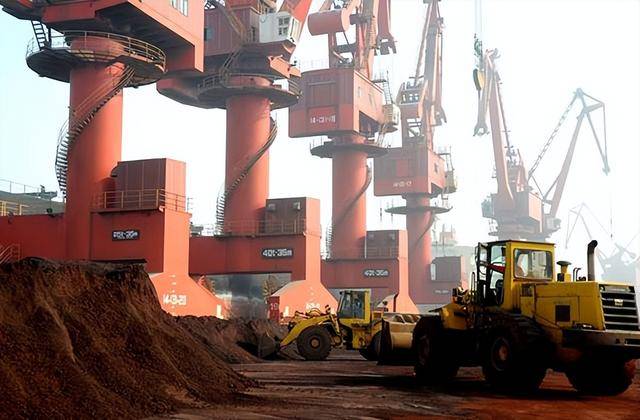
这一政策迅速引发国际关注,而随着审批流程的实际推进,英国《金融时报》等西方媒体近期频繁怒斥"中国审批速度过慢",称其难以满足全球供应链需 求,甚至可能引发"灾难性后果"。 本文内容均引用权威资料结合个人观点进行撰写,具体资料赘述在文中和文末! 2025年4月4日,因特朗普重启全面关税战,为了反制,中国宣布对钐、钆、铽、镝、镥、钪、钇等7类中重稀土实施出口许可制度,要求采购方须通过审批 程序获取许可证。 审批延迟 据《金融时报》的报道,尽管中国已开始向部分欧洲企业发放出口许可证,像德国大众汽车,但整体审批速度仍被欧洲行业高管形容为"无法承受",部分 申请需耗时45个工作日以上。 许多欧洲生产链面临"窗口期迅速关闭"的风险,美国企业同样陷入焦虑,他们的其库存仅能维持至2025年底,若供应链中断还将导致F-35战斗机生产线停 摆。 那英媒为什么要这么报道,难道除了中国,其他国家没有稀土吗? 表面上看,审批延迟源于中国对出口用途的严格审查,像特斯拉就被要求确保稀土磁铁不用于军事用途,而欧洲企业则需提交"终端用途声明",证明稀土 不会转运至美国。 成都银河磁体等中国企业明确表示,涉及军事用途的申请一概拒绝受理,这种审查 ...

关税中的宏观经济与资本市场
2025-05-19 15:20
Summary of Conference Call Records Industry Overview - The records primarily discuss the **China-US trade relations** and its implications on the **Chinese economy** and **capital markets**. The focus is on the ongoing trade negotiations, tariffs, and macroeconomic conditions in China. Key Points and Arguments Trade Negotiations and Tariffs - Initial results from the **China-US trade negotiations** in Geneva indicate a desire from both sides to reach an agreement to avoid shortages in the US and fluctuations in Chinese exports. Currently, China imposes a **10% tariff** on US goods, while the US imposes a **30% tariff** on Chinese goods, highlighting the existing tariff imbalance [1][2][3] - The negotiations are ongoing, with both parties aiming to address tariff inequalities and potentially lower tariffs on Chinese goods in the future [4][5] - The trade war has created economic pressures for both countries, with the US facing inflationary pressures and China experiencing supply chain challenges [6][8] Economic Conditions in China - China's macroeconomic situation remains unstable, with a declining real estate market and sluggish consumer demand. The first quarter saw a **4.6% growth** in consumption, which is below GDP growth rates, indicating weak domestic demand [9][10] - The government has implemented measures to stimulate domestic demand, such as increasing the **old-for-new** subsidy for durable goods from **1,500 yuan** to **3,000 yuan**, but the impact has been limited [14][15] - The government is focusing on infrastructure projects to boost economic growth, including major projects like the **Western Land-Sea New Corridor** and the **Tibet Railway** [16] Export Performance - China's export situation has improved recently, with companies actively shipping goods, particularly daily necessities and Christmas items, taking advantage of a **90-day grace period**. Exports in April and May exceeded expectations [11] - Despite the positive export performance, domestic demand has not shown significant recovery, and employment pressures remain high [11][12] Financial Market Stability - The Chinese government has taken proactive measures to stabilize the stock and financial markets amid the trade war, demonstrating a structured approach to policy-making [7] - The stock market has shown resilience, with a **10% increase** since early April, while the real estate market remains under pressure [20] Future Outlook - The outlook for the Chinese economy in the second half of the year is cautiously optimistic, with expectations of maintaining a **5% GDP growth target**. However, significant challenges remain, including employment and income issues that need to be addressed to stimulate domestic consumption [17][19] - The capital market is expected to experience structural investment opportunities, particularly in technology and high-end manufacturing sectors [25] Global Economic Context - The records also touch on the broader implications of the trade war on global markets, with the US economy facing potential downturns and the need for strategic adjustments in fiscal and monetary policies [26][27] Additional Important Content - The records highlight the importance of addressing income and employment issues in major cities like Beijing and Shanghai, where consumption patterns are influenced by financial sector employment and government policies [12][13] - The potential for future trade negotiations to include non-tariff barriers and sanctions is noted, indicating that the trade relationship remains complex and evolving [5][6] This summary encapsulates the key discussions and insights from the conference call records, providing a comprehensive overview of the current state of the China-US trade relations and its impact on the Chinese economy and capital markets.
一尘:中美经济,到底谁更需要谁?
Guan Cha Zhe Wang· 2025-05-19 00:59
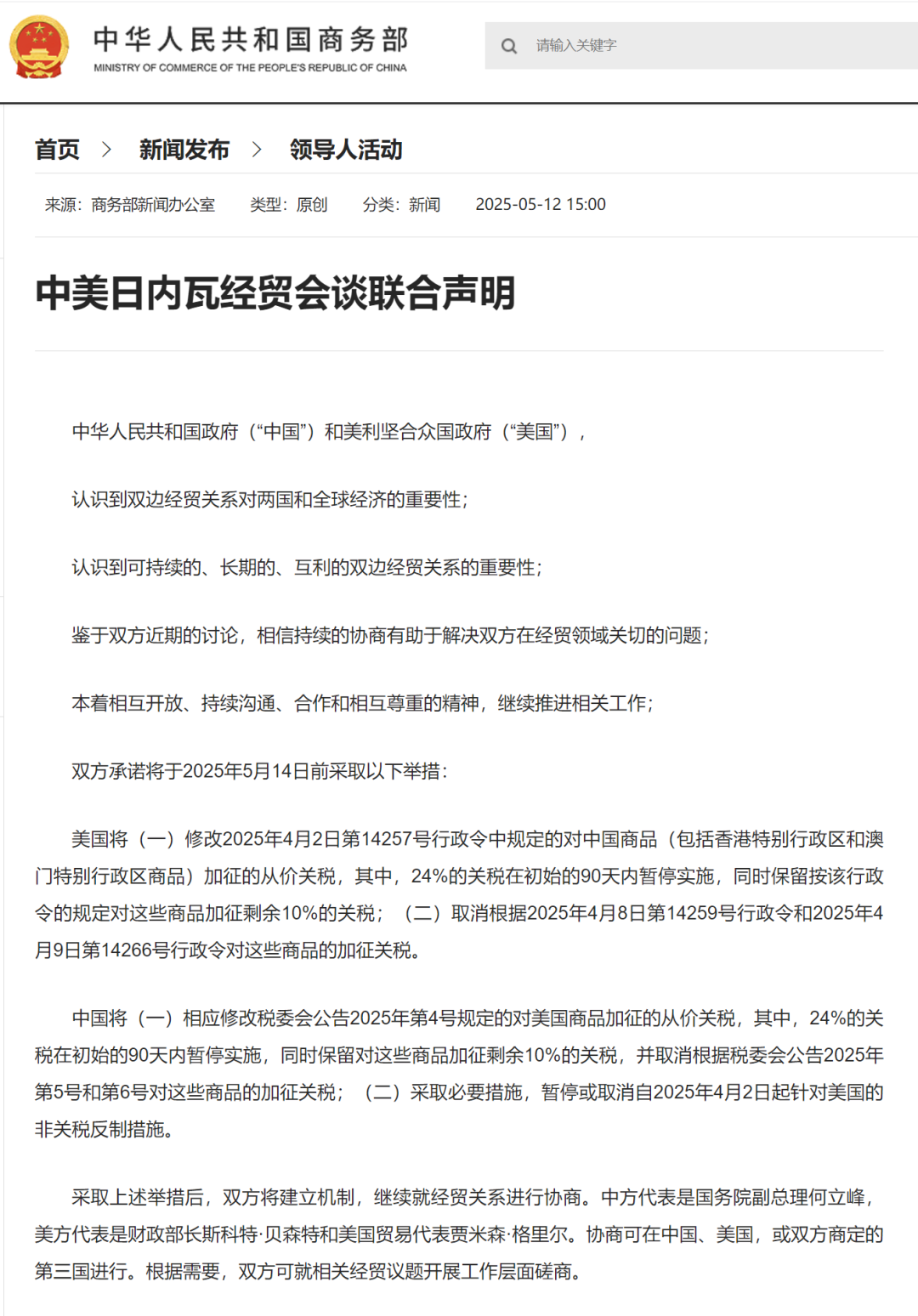
Core Points - The joint statement from the US and China emphasizes the importance of bilateral economic relations for both countries and the global economy [1][2] - Both parties agreed to cancel tariffs imposed since April 2, 2025, due to unilateral tariff increases by the US [1][2] - The US will modify tariffs on Chinese goods, suspending 24% of the tariffs for the first 90 days while retaining 10% [2][3] - China will also adjust its tariffs on US goods similarly, suspending 24% for 90 days and retaining 10% [3] Group 1 - The joint statement highlights the significance of sustainable, long-term, and mutually beneficial economic relations [2] - Both countries believe that ongoing consultations will help address concerns in the economic and trade sectors [2][3] - A mechanism will be established for continued negotiations on economic relations, with representatives from both sides [3] Group 2 - The recent tariff disputes reflect a broader context of US-China economic relations, raising questions about which country is more dependent on the other [4][5] - The complexity of US-China relations leads to differing perspectives on their economic interdependence [5] - Historical context shows that previous trade wars have not significantly reduced trade deficits for the US, and in some cases, have even increased them [9][10] Group 3 - The economic costs of trade tensions have been significant for the US, with estimates indicating a loss of 0.5% of GDP and job losses during peak periods [10][12] - The expectation of a manufacturing return to the US has not materialized, with many US companies continuing to invest in China [12][13] - The notion of "decoupling" from China has been criticized, suggesting it could harm the US's international standing and economic interests [13]
赵兴言:黄金又要重现跌幅趋势?欧盘或许还能再多一次!
Sou Hu Cai Jing· 2025-05-16 09:55
Group 1 - The core viewpoint is that gold prices have experienced a significant decline due to a stronger dollar and reduced trade war concerns, potentially leading to the largest weekly drop in six months [1] - The market sentiment regarding the de-escalation of the US-China trade war has resulted in substantial selling pressure on gold prices this week [1] Group 2 - The early morning drop in gold prices aligns with the anticipated strategy, with a focus on the key level of 3200, where the price fell to 3206 before rebounding to around 3230 [2] - There is an expectation for a second test of the 3200 level, which will be crucial in determining whether a reversal pattern occurs on Friday [2] - The analysis suggests that if the price breaks below 3200, it could indicate a washout of both long and short positions [2] Group 3 - A recommendation is made to consider buying near the 3194 level with a stop loss of 8 points and a target of around 3235, while aggressive traders may enter at 3200 directly [4] - The analysis emphasizes the importance of providing useful insights to investors and maintaining a consistent approach to market analysis [4]

中美大战第一回合结束,发现风向不对的李嘉诚,这回倒是机灵得很
Sou Hu Cai Jing· 2025-05-16 09:35
Group 1 - The statement from Cheung Kong Group emphasizes that the sale of its global port business will not occur under "illegal" circumstances, indicating a proactive stance in response to recent geopolitical developments [3] - The rapid progress in US-China negotiations has led to a significant reduction in trade tensions, with both sides making concessions, but China is perceived to have gained the upper hand in this round [5][7] - The potential sale of 43 ports by Cheung Kong, which accounts for 10% of global container throughput, raises concerns about foreign control over critical infrastructure and its implications for China's Belt and Road Initiative [9] Group 2 - The recent US-China agreement is seen as a strategic victory for China, as it aligns with its core demands while minimizing losses, contrasting with other countries that have made concessions to the US [5][7] - Cheung Kong's quick response to the geopolitical climate reflects a commitment to national interests, suggesting that companies should align with state policies to protect their interests [9] - The ongoing nature of US-China trade negotiations indicates that while a temporary resolution has been reached, the potential for future conflicts remains, necessitating vigilance from companies like Cheung Kong [9]


关税下调后,美线如何演绎?
2025-05-15 15:05
Summary of Conference Call Records Industry Overview - The records primarily discuss the impact of tariffs on the shipping industry, particularly focusing on the China-US shipping routes following the implementation of high tariffs in April 2025 [1][2][3][26]. Key Points and Arguments 1. **Tariff Impact on Shipping Volume and Rates** - Following the announcement of high tariffs in April 2025, shipping volumes on the China-US route dropped significantly, with an average decline of approximately 30%-50%. However, shipping rates remained stable, fluctuating between $2,400 and $3,500 due to shipping companies maintaining long-term contract prices as a baseline [1][4][26]. 2. **Preemptive Stockpiling by Companies** - Companies had stockpiled goods in anticipation of tariff increases, leading to a 15%-20% decline in shipping volumes by early February 2025. Low-value products like building materials and furniture were most affected, while automotive parts and e-commerce products showed resilience due to exemptions and pricing power [1][5][6][7]. 3. **Shift in Production to Southeast Asia** - The trade war has prompted companies to shift production to Southeast Asia, but local policies and capacity constraints hinder a complete transition. In April 2025, China's exports to the US decreased by 20%, while Southeast Asia only saw a 5%-7% increase [1][8][11]. 4. **Differences in Trade Terms** - Under traditional trade terms (CFR), shippers are more affected by tariffs, while under FOB terms, consignees bear less impact. E-commerce models exhibit greater resilience due to exporters having pricing power and the ability to declare lower values for customs [1][10][26]. 5. **Upcoming Price Increases** - Shipping companies plan to implement price increases in mid to late May 2025, with expectations that rates could rise significantly due to increased demand and seasonal surcharges. Predictions suggest rates could reach $6,000 by June 1 and potentially $8,000 by June 15 [3][14][17][20][27]. 6. **Long-term Contract Negotiations** - Long-term contract negotiations for 2025 have been completed, with prices increasing by $200-$500 compared to the previous year, reflecting rising operational costs due to fuel price hikes and regulatory requirements [19][20]. 7. **Market Demand and Inventory Levels** - As of early May 2025, there has been a notable increase in booking volumes driven by freight forwarders anticipating a drop in US inventory levels. Major retailers like Walmart and Amazon are expected to increase their order forecasts by late May or early June [13][21]. 8. **Challenges in Southeast Asia** - Southeast Asian countries face limitations in fully absorbing production shifts from China due to policy restrictions and capacity issues. The production speed and quality in these regions also lag behind China, complicating the transition [8][12][11]. Other Important but Overlooked Content - The records highlight the significant role of freight forwarders in driving booking volumes and the strategic adjustments shipping companies are making in response to market conditions and tariff changes [13][14][20]. - The anticipated volatility in shipping rates and volumes due to the evolving trade landscape and potential changes in US-China relations is a critical factor for stakeholders in the shipping industry [2][21][27].
海外重稀土暴涨250%,后续走势如何看?
2025-05-14 15:19
海外重稀土暴涨 250%,后续走势如何看?20240514 摘要 • 中国工信部拟将稀土进口矿纳入配额管理,虽细则未定,但政策导向已显。 中美贸易战背景下,中国对中重稀土实施出口管制,直接冲击海外供应链, 可能加速海外"去中国化"进程,倒逼技术升级和替代方案。 • 韩国氧化镝进口量激增,引发中国政府警惕,或加强出口管制并严控第三 国转移,维护国家安全。与此同时,中国严打战略矿产走私,进一步收紧 稀土出口。 • 受出口管制影响,欧洲稀土价格飙升,与中国国内价格差距扩大,但实际 成交量有限。若中美贸易关系缓和,海外虚高价格或将缓解,但政策调整 仍是关键变量。 • 中国稀土储量全球第一,产量占比近七成,分离冶炼和磁材制造环节市场 占有率高达 90%。中国政策变化对国际市场供需和价格具有重要影响。 • 中国轻稀土矿配额增加以满足下游需求,离子型稀土配额保持平稳,重稀 土开采配额增速放缓。缅甸、老挝等国政局及政策调整影响离子型稀土供 应,美国对华基础金属出口量下降。 Q&A 全球稀土市场的供需状况及未来展望如何? 2024 年 7 月 1 日,中国国务院公布了稀土管理条例,旨在规范稀土行业管理, 保障稀土资源合理开发利 ...
中美关税战重大转折:日内瓦会谈撕开美国纸老虎真面目
Sou Hu Cai Jing· 2025-05-12 19:56
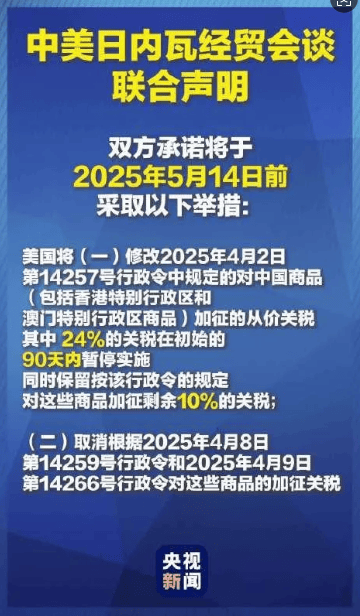
这场日内瓦会谈彻底撕破了特朗普"美国优先"的画皮,是美国历史性的关税大溃败,是特朗普被现实打 脸打到清醒的体现。 根据联合声明,美方被迫取消91%的对华关税,暂停24%的对等关税90天,仅保留10%的象征性关税。 这相当于特朗普4月发动的"超级关税战"被中方一拳打回原形。 特朗普4月发起的关税突袭,本质是其"交易艺术"的升级版,试图通过短期高压迫使中国在科技、市场 准入等核心领域让步。 但中国以"你打你的,我打我的"战术,用稀土管制卡住美国军工供应链,以对等关税反制民生商品,最 终让美国财政部长贝森特不得不低头谈判。 这种"边打边谈"的模式,既非全面和解,也非彻底脱钩,而是双方在实力较量后的战术调整。 美国的这次狼狈退让暴露出现三大致命伤: 一是暴露出美国的经济脆弱性,中国商品占美国进口总额的20%,高关税直接推高通胀,引发民众抢购 囤积。加州州长甚至公开反对特朗普政策,称其将导致300万人失业。 二是暴露出美国的政治分裂,共和党内部对关税政策的不满与日俱增,民主党借机攻击特朗普"外交混 乱",迫使白宫在中期选举前寻求缓和。 美国对中国商品的综合税率从145%暴跌至30%,中国则以对等力度反制,让美方尝到了搬 ...
中方用15个字,描述中美经贸会谈成果,美国人掩饰不住内心的喜悦
Sou Hu Cai Jing· 2025-05-12 17:40
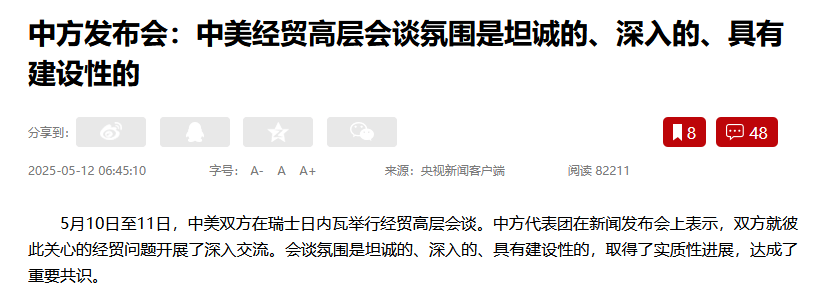
同样参与会谈的美国贸易代表格里尔则表示,中美双方能够如此迅速地"达成协议",说明双方的分歧可能并没有想象中的那么大。 格里尔接着说道,美国对华加征关税,是对中美贸易不平衡的回应,美国政府认为这是紧急状态,但是随着与中国达成的协议,将有助于美国解决这一国家 紧急状态。 经过连续2天的长谈,中美经贸会谈终于结束了。在会谈结束之后,中美双方都传递出了积极的信号,指出会谈取得了实质性进展,并宣称将在5月12日发表 一份联合声明。 在会谈后的新闻发布会上,中方代表团透露,双方就彼此关心的经贸问题开展了深入交流。随后,中方代表团介绍说,会谈"取得了实质性进展,达成了重 要共识"。 中方用15个字描述中美经贸会谈成果 | 分享到: | | | | 8 ■ 8 ■ 円 48 | | --- | --- | --- | --- | --- | | 2025-05-12 06:45:10 | 字号: A- A A+ | 来源:央视新闻客户端 | 阅读 82211 | | 千万别小瞧这15个字,分量可不一般,这意味着中美在贸易和关税问题上,找到了解决分歧的办法,为两国贸易关系正常化和深化合作打下了基础。 代表美国参加会谈的美国财长 ...