AI商业化

Search documents
2025世界人工智能大会在沪登场 见证AI商业化更上一层楼
Zhong Guo Xin Wen Wang· 2025-07-26 04:12
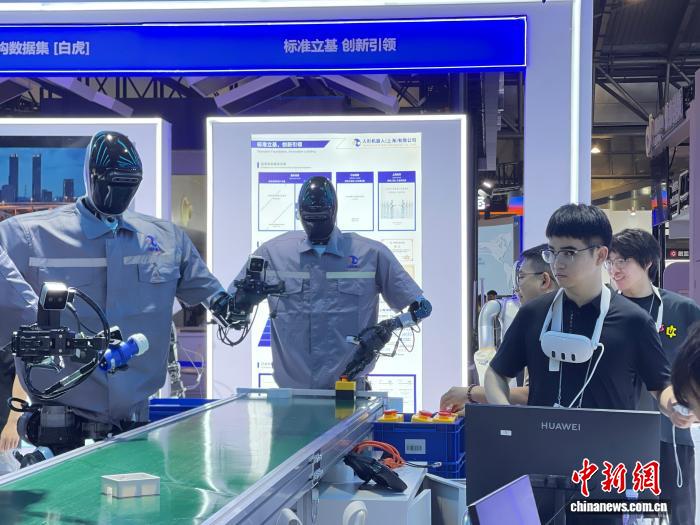
Group 1 - The 2025 World Artificial Intelligence Conference highlights the commercialization of AI, with companies like Tesla and Zhiyuan showcasing innovative products [1][3] - Zhiyuan's CMO emphasizes that 2025 is expected to be the commercial year for humanoid robots, with applications in various sectors such as industry, logistics, and education [1][3] - The rapid development of AI products is noted, with increased user acceptance compared to the previous year [1][5] Group 2 - DeepSeek's popularity in early 2025 has sparked a surge in the application of AI large models in China [3] - Companies like SenseTime are launching platforms that integrate perception, visual navigation, and multimodal interaction capabilities for smart devices [3][4] - The demand for robust AI infrastructure is growing, with companies like Xinghuan Technology addressing data challenges in AI deployment [4] Group 3 - Shanghai's AI industry has seen significant growth, with a scale exceeding 118 billion yuan in Q1 2025, marking a 29% year-on-year increase [5] - The application of AI spans various sectors including finance, retail, transportation, and healthcare, indicating a rapidly forming commercialization path [5] - New leasing areas for AI-related companies in Shanghai's industrial parks have surpassed 30% of total new leasing area in the past year [5] Group 4 - Shanghai has established a development pattern for AI innovation, with communities like Mosu Space and Moli Community fostering AI entrepreneurship [7][8] - The first heterogeneous humanoid robot training ground in China has been launched, capable of training over 100 humanoid robots simultaneously [8] - Shanghai is home to nearly 300,000 AI talents, accounting for about one-third of the national total, creating a thriving ecosystem for AI companies [8]

从“炼丹”到“开店”:大模型应用商店,能否解开国产AI的“商业化焦虑”?
3 6 Ke· 2025-07-24 10:40
Core Insights - The article discusses the transition of AI technology from exploration to commercialization, highlighting the emergence of "large model application stores" as a solution to the industry's commercialization anxiety [2][10] - It emphasizes the importance of practical performance of AI models in real-world applications, addressing the gap between technical capabilities and user needs [3][4] Group 1: Application Store Concept - The concept of an application store allows users to select and utilize various AI models for diverse tasks, aiming to convert AI capabilities into tangible business value [2][3] - The performance of different models varies significantly, with some excelling in understanding cultural nuances while others struggle with practical applications [3][4] Group 2: Developer Challenges - Developers face challenges in selecting the right AI model API, considering factors like cost, speed, and reliability, especially in a competitive pricing environment [8][10] - The low-cost model API pricing strategy, with some reductions exceeding 95%, provides developers with more opportunities for experimentation [8][10] Group 3: Market Dynamics - The competition among platforms to attract users and developers is likened to the app market battles of the mobile internet era, with the goal of establishing a "super entrance" for AI applications [11][13] - Two development paths are emerging: a unified platform model led by giants like Alibaba and Baidu, and a niche approach focusing on high-quality applications from smaller companies [13]

大模型商业化进入淘汰赛,赢家正在变少
3 6 Ke· 2025-07-17 10:15
Group 1 - The core viewpoint emphasizes that AI value must be realized through commercialization, as highlighted by the statement from Baidu's CEO, Li Yanhong, indicating that without applications, chips and models cannot deliver value [1] - The AI industry is experiencing a deep differentiation, with major players like Baidu, Alibaba, Tencent, and ByteDance investing heavily to integrate AI into their existing ecosystems, while smaller startups struggle to establish revenue models [1][2] - Major companies are embedding AI capabilities into their products and services, creating a diversified revenue stream and enhancing their existing offerings, as seen with Baidu's Wenxin model and Tencent's integration of AI into its social and office ecosystems [2][3] Group 2 - ByteDance and Kuaishou are finding success in AI commercialization through different strategies, with ByteDance leveraging its product matrix to penetrate various scenarios and Kuaishou enhancing its content ecosystem and commercial efficiency [3][4] - Smaller companies face significant challenges in monetization due to limited resources and market presence, often relying on government contracts or niche markets to survive [5][6] - The commercialization process for startups is slow, with many struggling to convert technology into sustainable revenue, highlighting the importance of finding a balance between technical innovation and market needs [7][9] Group 3 - Establishing a healthy cash flow loop is crucial for both large and small companies in the AI sector, as many face difficulties in user retention and monetization despite a large potential user base [9][10] - The ToB market offers stable customer bases but presents challenges such as high customer education costs and long delivery cycles, making it difficult for startups to compete against established players [10][11] - The focus is shifting from merely having advanced technology to effectively embedding AI into real business applications that generate sustainable cash flow, as seen in the strategies of major companies [12][13] Group 4 - The future of AI commercialization will depend on companies' abilities to integrate their models into business processes and create value, rather than just focusing on technical parameters [13][14] - The remaining players in the AI space will likely be those who can quickly find customers, generate revenue, and adapt to market changes, emphasizing the need for a pragmatic approach to building value [14]



字节携小荷AI医生杀到,但AI医疗如何挣钱?
Di Yi Cai Jing· 2025-07-16 08:31
Core Insights - ByteDance has launched its independent app "Xiaohe AI Doctor," focusing on health consultations, disease self-checks, medication references, and health advice, amidst a growing interest in AI healthcare products from major companies like JD Health, Ant Group, and Tencent Health [1][2] - The core challenge in the AI healthcare sector remains the monetization strategy, with various companies exploring different approaches to generate revenue [1][2] - The commercialization of AI healthcare is evolving, with B2B applications showing more promise compared to B2C, where the monetization remains uncertain [6][7] B2B Commercialization - Companies like ZuoShou Doctor and Fuxin Technology are leveraging large models to enhance their existing healthcare products, reducing labor costs while increasing computational costs [4][6] - The introduction of medical AI integrated machines has created a new business opportunity, combining hardware and software solutions for hospitals, with prices ranging from hundreds of thousands to millions [5][6] - Major players in the medical AI space are focusing on applications such as pre-consultation, electronic medical records, and patient management, primarily targeting healthcare institutions as their main customers [4][6] B2C Commercialization - Current B2C applications of medical AI are primarily positioned as "health assistants," offering basic health education and disease consultation, but often lack depth in addressing serious medical issues [7][8] - The monetization of B2C applications is challenging, with low willingness to pay from users, although potential exists for third-party companies, like insurance firms, to subsidize these services [8][10] - Companies are exploring innovative solutions, such as specialized AI doctors trained on clinical data, which can provide reliable consultations and potentially reduce the need for in-person visits [9][10]
三星重申Galaxy AI核心功能继续免费 付费策略或聚焦高级服务
Huan Qiu Wang Zi Xun· 2025-07-15 03:10
Group 1 - Samsung confirms that all core Galaxy AI features on Galaxy smartphones will remain free, contrasting previous market speculation about potential charges after 2025 [1][3] - Starting from 2024 with the Galaxy S24 series, over 20 basic AI functions, including instant translation and AI photo editing, will be available for free to eligible Galaxy devices until July 2025 [3][4] - Samsung's free strategy differentiates it from competitors like Apple and Google, aiming to attract more mid-range users and expand market share [3][5] Group 2 - Despite offering basic features for free, Samsung is exploring a paid model for resource-intensive advanced AI functions, with details expected to be announced in Q3 2025 [4] - Advanced features such as AI video generation and 3D modeling will require a subscription to "Galaxy AI Pro," with pricing potentially starting at 118 yuan per year [4] - Samsung's AI strategy has shifted from "technology showcase" to "ecosystem building," aiming to create a closed-loop ecosystem of hardware, software, and services to compete with Apple and Huawei [5]
美股新高苹果特斯拉却掉队,只因违逆特朗普?
3 6 Ke· 2025-07-02 06:24
Group 1 - The S&P 500 and Nasdaq Composite indices reached new highs recently, but major tech stocks like Apple and Tesla are underperforming [1] - From early June, the S&P 500 rose by 5% and the Nasdaq by 6%, while Apple increased by only 2% and Tesla decreased by 7%, indicating a significant gap compared to other tech giants like Nvidia and Meta [1] - Apple's business model, which relies on low-cost production in Asia, is at odds with Trump's push for "bringing production back to America," leading to potential operational challenges [2] Group 2 - iPhones account for 50% of Apple's revenue, and producing them in the U.S. could raise prices to $3,500, more than three times the current price, threatening Apple's growth foundation [2] - Tesla faces significant challenges as CEO Elon Musk criticized Trump's policies, which he believes negatively impact the company, particularly regarding the EV market [3] - Tesla's Shanghai factory serves as a major production and export hub, leveraging local supply chains for critical materials, but Trump's disapproval of reliance on China complicates its strategy [3]


散户导演美股情绪市
SINOLINK SECURITIES· 2025-06-26 09:24
Group 1: Market Sentiment - Retail investors are optimistic, with a bullish sentiment ratio rising to 33.2%, the highest since January[7] - The trading volume of small-cap stocks (priced under $1) has rebounded to 36.6%, reflecting increased retail speculation in tech stocks[2] - Institutional investors are becoming increasingly pessimistic, with 57% preferring non-US stocks and only 24% optimistic about US equities[27] Group 2: Economic Drivers - Optimism among retail investors is driven by expectations of policy easing, weakened fiscal tightening, and the unique position of US tech stocks as alternatives[2] - The US fiscal deficit remains high, with a projected $1 trillion in interest payments, limiting the effectiveness of tariff revenues[15] - The potential for a preemptive rate cut by the Federal Reserve could provide liquidity benefits, but may also confirm economic weakness[3] Group 3: Investment Risks - The high concentration and leverage of retail investments make them unstable, with a low probability of accurate market predictions[27] - Historical data shows that when retail bullish sentiment rises, the market often weakens in the following month[27] - Risks include unexpectedly strong US economic performance, fluctuations in tax policy, and accelerated AI commercialization impacting tech stock valuations[4]
英伟达新高!AI算力依然高景气!28只重仓算力的基金底部反弹超30%!
私募排排网· 2025-06-26 03:49
Core Viewpoint - The article highlights the strong performance of Nvidia and its related stocks, driven by high demand for AI computing power and significant capital expenditures from major tech companies [2][4][6]. Group 1: Nvidia's Stock Performance - Nvidia's stock price reached $147.9 per share as of June 24, nearing its historical high, with a rebound of over 70% since April 7 [2]. - A-share Nvidia concept stocks, such as Shenghong Technology and Xinyi Sheng, have also performed well, with some stocks rebounding over 100% from their lows [3]. Group 2: Tech Giants' Performance and Capital Expenditure - Major tech companies reported better-than-expected earnings, with a collective capital expenditure of approximately $76.6 billion in Q1, a year-on-year increase of 64%, primarily for server and data center investments [4][5]. - Meta raised its full-year capital expenditure guidance from $60-65 billion to $64-72 billion, indicating an expansion in data center investments [5]. Group 3: AI Infrastructure and Demand - Nvidia is actively promoting AI infrastructure projects globally, which is expected to significantly increase demand for its chips [7]. - The rapid iteration of large models, such as Google's Gemini 2.5 Pro, has led to a 50-fold increase in monthly token consumption, indicating a surge in inference demand and a new wave of computing power requirements [7]. Group 4: Fund Performance Related to Computing Stocks - As of June 23, 28 funds heavily invested in computing concept stocks have seen cumulative returns exceeding 30% since April 9 [8]. - The top-performing fund, E Fund Pioneer Growth Mixed A, achieved over 38% returns in the past year and over 44% since the rebound began on April 9 [10].


北森控股(09669.HK):经营性现金流转正 AI商业化稳步推进
Ge Long Hui· 2025-06-22 18:25
Core Insights - The company reported FY2025 results that met market expectations, with revenue increasing by 10.6% to 945 million yuan and adjusted net loss narrowing from 105 million yuan to 29.1 million yuan, falling within the previously announced profit warning range [1][2] - The company announced the acquisition of 100% equity in KuXueYuan on January 15, 2025, to strengthen its position in the eLearning market [1] Revenue and Growth Trends - Product revenue remained robust, with cloud HCM solutions revenue growing by 14.2% year-on-year, accounting for 76.4% of total revenue, an increase of 2.4 percentage points [1] - Annual recurring revenue (ARR) increased by 20.1% to 908 million yuan, with average revenue per user (ARPU) rising by 8% [1] - Subscription revenue retention rate (NDR) reached 106%, and customer retention rate stood at 81% [1] - Core HCM solutions ARR grew by 29%, contributing 59% to total ARR [1] - AI-related products ARR exceeded 6 million yuan by the end of March 2025, covering over 300 enterprise clients, with 10 AI Agent products launched and over 200 AI features available [1] Profitability and Cash Flow - Adjusted gross margin reached 66.2%, an increase of 2.2 percentage points, driven by improved gross margins in subscription services [2] - Adjusted net loss margin narrowed to 3.1%, a reduction of 9.2 percentage points, due to margin improvement and effective cost control [2] - The company achieved positive operating cash flow with a net inflow of 76.93 million yuan [2] Future Outlook and Valuation - For FY2026, the company is expected to turn a profit at the adjusted net profit level, supported by ongoing business scale effects [2] - Revenue forecast for FY2026 remains unchanged, while adjusted net profit forecast has been revised from a loss of 18.11 million yuan to a profit of 22.51 million yuan [2] - FY2027 revenue forecast is set at 1.269 billion yuan, with an adjusted net profit forecast of 100 million yuan [2] - The target price has been raised by 130% to 11.5 HKD, reflecting an upward adjustment in valuation multiples from 3.4 times to 7.0 times based on FY26 [2]
美股科技巨头走势分化:Alphabet市值蒸发近千亿,微软、苹果逆势上涨
Huan Qiu Wang· 2025-06-22 02:15
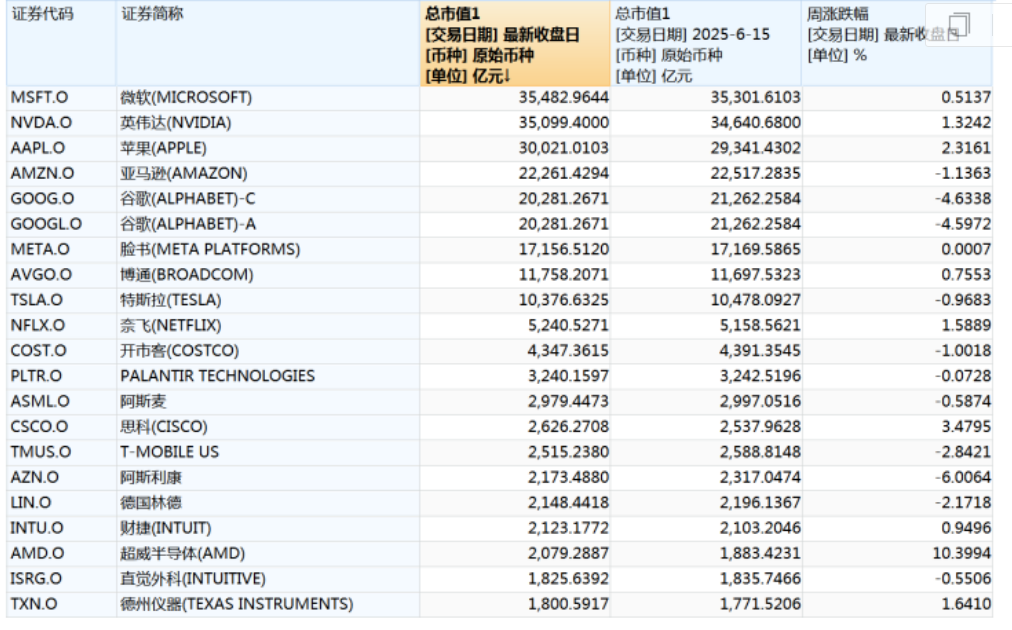
Core Viewpoint - The U.S. stock market has shown significant divergence this week, particularly among the top 20 stocks in the Nasdaq index, with mixed performances from major tech companies, highlighting investor concerns over specific firms' fundamentals and market conditions [1][3]. Group 1: Performance of Major Tech Companies - Among the "Big Seven" tech giants, Microsoft (+0.51%), Nvidia (+1.32%), and Apple (+2.32%) continued their upward trends, while Amazon (-1.14%), Alphabet (-4.63%), and Tesla (-4.60%) experienced declines [2][3]. - Alphabet's market capitalization decreased by $98.1 billion this week, making it the worst-performing tech giant, while Amazon and Tesla saw reductions of $25.6 billion and $10.1 billion, respectively [2][3]. Group 2: Market Sentiment and Trends - Alphabet's significant stock price drop may reflect investor concerns regarding its core advertising business and AI strategy, amid increasing market competition and regulatory pressures that could impact long-term profitability [3]. - Tesla's decline is attributed to slowing electric vehicle demand and pricing pressures, indicating broader challenges in the EV market [3]. - Approximately half of the top 20 stocks in the Nasdaq index recorded declines, suggesting a shift in market preference towards companies with more predictable earnings, such as Microsoft and Apple, while high-valuation firms facing growth bottlenecks are being sold off [3]. Group 3: Future Outlook - As the Federal Reserve's monetary policy and corporate earnings season approach, volatility in tech stocks may increase, with market participants closely monitoring earnings guidance and advancements in AI commercialization to assess the sector's potential for recovery [3].