存款搬家

Search documents
广发证券所长助理、首席策略刘晨明:超高净值资金正加速通过私募进入权益市场
Xin Lang Cai Jing· 2025-12-22 07:06
广发证券所长助理、首席策略刘晨明表示,虽然主动权益公募基金发行低迷,但存款搬家在超高净值人 群中已显著发生。由于固收产品收益率下行至2%以下,追求5%-10%年化收益且波动可控的资金正通过 私募全天候、对冲及指增策略加速入场,这将是2025年市场最确定的增量资金池。 ...

券商晨会精华 | 预计上市险企2026年核心期缴和价值增长有望保持两位数增长
智通财经网· 2025-12-22 00:34
Group 1: Market Overview - The Shanghai Composite Index experienced a rebound last Friday, with a trading volume of 1.73 trillion yuan, an increase of 70.4 billion yuan compared to the previous trading day [1] - By the close of last Friday, the Shanghai Composite Index rose by 0.36%, the Shenzhen Component Index increased by 0.66%, and the ChiNext Index gained 0.49% [1] Group 2: Insurance Industry Outlook - Zhongtai Securities forecasts that the core premium income and value growth of listed insurance companies are expected to maintain double-digit growth by 2026, driven by asset reallocation and a favorable equity market [2] - The insurance sector is anticipated to benefit from the growth in the number of cooperative outlets and improved production capacity, with individual insurance channels supported by a strong workforce structure [2] Group 3: Fiber Optic Industry Insights - CITIC Construction Investment reports that since Q3 of this year, fiber optic prices in the Chinese market have been rising, indicating strong demand and tight overall supply [3] - The strong overseas demand and robust export performance reflect a thriving global fiber optic market, with leading companies in the industry likely to see both profit and valuation increases [3] Group 4: Real Estate Market Trends - Guojin Securities notes that the new housing market is experiencing a year-end surge, with an increase in quality projects in key cities contributing to an overall market recovery [4] - This week, new housing sales area significantly rebounded, with 434,000 square meters sold across 47 cities, marking a new weekly high since October [4]



转向中证A500,资金岁末“高低切换”,释放什么信号?
证券时报· 2025-12-21 12:38
Core Viewpoint - The market is witnessing a significant inflow of funds into the CSI A500 ETF, indicating a shift in institutional investment strategies towards lower valuation sectors as the year-end approaches [1][5][7]. Group 1: Fund Inflows and Market Activity - As of December 19, the CSI A500 ETF has surpassed the CSI 300 in net inflows since December, with a total inflow exceeding 460 billion yuan, including a single-day inflow of over 100 billion yuan on December 17 [2][4]. - The trading volume of the CSI A500 ETF has been notably active since December 10, with daily transaction amounts exceeding 300 billion yuan, reaching a peak of 525.76 billion yuan on December 19 [3][4]. - The total scale of the CSI A500 ETF has surpassed 240 billion yuan, with significant contributions from major funds such as Huatai-PB and Southern Asset Management [4]. Group 2: Investment Trends and Strategies - Institutional investors are shifting their focus from high-valuation technology sectors to lower-valuation areas, indicating a "high-low switch" in investment strategies as they enter a "yield protection battle" phase [5][7]. - The low interest rate environment is driving a trend of "funds moving" from savings to equity markets, with average returns on equity funds reaching 28.18% year-to-date [6][7]. - Analysts predict that 2026 will see a more balanced market, with opportunities in cyclical industries and high-return sectors, as well as continued interest in technology and innovation [9].


广发证券:2026年更像是加强版的2025年 居民存款搬家与外资入市更值得期待
Xin Lang Cai Jing· 2025-12-21 11:30
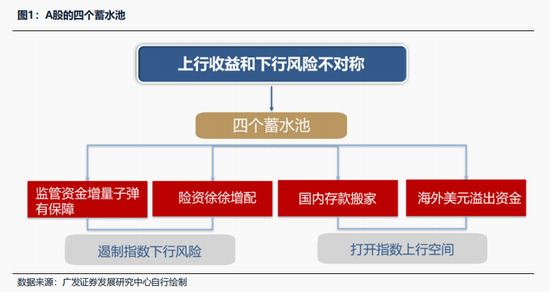
Group 1 - The core narrative for A-share incremental funds in 2025 is "asymmetric upside returns and limited downside risks," supported by regulatory measures and insurance capital to curb index declines, while domestic deposit migration and overseas dollar inflows create upward potential for indices [1][47][169] - Insurance capital's allocation demand for A-shares has increased, with insurance positions reaching 15.5% in Q3 2025, the second highest on record [9][127] - The market's expectation for deposit migration is high, but residents are still in the early stage of risk appetite recovery, showing more willingness to invest in fixed income and index products rather than stocks [11][59][129] Group 2 - Looking ahead to 2026, the trend of deposit migration is expected to strengthen, particularly among high-net-worth individuals, with foreign capital also anticipated to become a significant incremental source [24][188] - Factors supporting resident capital inflow include regulatory and insurance backing that reduces market volatility, a gradual easing of household balance sheet pressures, and a higher degree of liquidity in deposits [25][145][189] - The competition for deposits from high-yield assets is diminishing, which indirectly enhances the attractiveness of the stock market [34][199] Group 3 - The current A-share market is at a turning point in its profit cycle, with expectations for fundamental improvements in 2026, which could attract more foreign capital [42][207] - Global capital availability is expected to increase, driven by downward pressure on the dollar, which will enhance demand for non-dollar asset allocations [40][203] - The recent trend shows that high-net-worth individuals are accelerating their deposit migration, with private equity fund registrations reaching 386 billion yuan from January to October 2025, indicating a return to levels seen in 2021 [38][201]
2026年A股增量资金展望:中高净值的存款搬家很可能已形成趋势
GF SECURITIES· 2025-12-21 07:22
Group 1 - The core narrative for A-shares in 2025 is "asymmetric upside returns and limited downside risks," supported by regulatory measures and insurance capital to curb index declines, while domestic deposit migration and overseas dollar inflows create upward potential for indices [10][11][18] - In 2025, the inflow of external funds remains in the early stages, with limited participation from residents and foreign investors, despite a recovery in risk appetite [10][11][13] - The report highlights that the investment willingness of urban depositors has improved since Q3 2024, but remains at low absolute levels, indicating a gradual recovery in risk appetite [10][25][40] Group 2 - Looking ahead to 2026, the report anticipates a continuation of the supportive role of insurance capital and regulation, with a more pronounced migration of deposits, particularly among high-net-worth individuals, and increased foreign investment [10][36] - Factors supporting resident capital inflow include reduced market volatility due to insurance and regulatory backing, easing pressure on household balance sheets, and a higher degree of liquidity in deposits [10][36][40] - The report notes that the current environment offers limited high-yield alternatives to stocks, enhancing the attractiveness of the equity market [10][58] Group 3 - The report indicates that the migration of deposits among high-net-worth individuals is accelerating, with significant new registrations in private equity funds, reaching 386 billion yuan from January to October 2025 [10][61] - External factors include a potential increase in global capital allocation to non-US assets due to downward pressure on the dollar, alongside expectations of improving fundamentals in A-shares [10][68] - The report emphasizes that A-shares are at a turning point in the profit cycle, with expectations for fundamental improvements in 2026, which could attract more foreign capital [10][75][82]
为什么利率这么低,人们反而更爱存钱了?这背后的真相是什么?
Sou Hu Cai Jing· 2025-12-21 04:36
Core Insights - Despite declining deposit interest rates, household savings in China have continued to grow, reflecting a cautious approach to wealth management amid economic uncertainty [1][3][5] Group 1: Household Savings Trends - As of the end of Q3 2025, household deposits reached 164.03 trillion yuan, a year-on-year increase of 10.2%, with new deposits in the first three quarters exceeding 12.73 trillion yuan, accounting for over 56% of the total increase in RMB deposits [1] - From 2022 to 2024, new household deposits approached 50 trillion yuan, surpassing the total from the previous six years (2016-2021) [3] - The average per capita deposit balance reached 130,000 yuan by the end of 2024, with an annual increase of 12,000 yuan, indicating that savings have become the primary strategy for most families to cope with uncertainty [3] Group 2: Changes in Deposit Structure - The proportion of fixed-term deposits has risen significantly, reaching 72.7% by 2024, compared to a historical average of 60% for fixed versus current deposits, indicating a preference for locking funds in long-term deposits despite lower liquidity [3][5] - Deposit interest rates have been declining, with one-year fixed deposit rates dropping from 1.65% in 2022 to 0.95% in 2025, and three-year rates falling from 2.6% to 1.25% during the same period [3][5] Group 3: Behavioral and Economic Factors - The increase in savings is attributed to a long-term "scar effect" from the pandemic, leading to reduced consumer spending and a shift towards preventive savings due to concerns over income stability and employment [5] - The narrowing of investment channels has also contributed to the return of funds to banks, as high-yield trust and real estate products have declined, and the real estate market has faced significant adjustments [5] Group 4: Global Comparisons and Lessons - Japan's experience in the 1990s, where savings rates increased despite low or negative interest rates, serves as a reference point, highlighting a shift in public trust towards cash and deposits amid economic uncertainty [6] - The aging population and incomplete social security systems in China are similar to Japan's challenges, further motivating residents to save [6] Group 5: Financial Market Developments - In the latter half of 2025, a noticeable "deposit migration" occurred, with a decrease of 1.34 trillion yuan in household deposits in October, while non-bank financial institutions saw an increase of 1.85 trillion yuan, indicating a shift towards stable assets like bank wealth management and insurance products [8] - The scale of the bank wealth management market reached 32.13 trillion yuan by the end of Q3 2025, growing by 7.28% since the beginning of the year, with R2-level (medium-low risk) fixed-income products becoming the mainstay [8][9] Group 6: Evolution of Wealth Management - Wealth management companies have become dominant players, with their product scale reaching 29.28 trillion yuan, accounting for 91.13% of the market, reflecting growing trust in their expertise and product design [9] - The number of accounts holding wealth management products reached 139 million, a year-on-year increase of 12.7%, indicating a shift from a niche choice to a more widespread investment strategy [9]

每周推荐 | 流动性“顺风”(申万宏观·赵伟团队)
赵伟宏观探索· 2025-12-20 16:04
Core Viewpoint - The article discusses the concept of "deposit migration" and highlights three common misconceptions in the market regarding excess savings and their implications for investment behavior [2][3][4]. Group 1: Misunderstandings about Excess Savings - Misunderstanding 1: The market may underestimate excess savings; "deposit migration" involves more than just deposits. The total excess savings, when considering various funds, approaches 10 trillion yuan, contrary to the less than 4 trillion yuan estimated based solely on deposits [2]. - Misunderstanding 2: The speed of market entry may be underestimated; non-bank deposits are not an accurate measure of "migration." The "non-bank net liabilities" metric, which excludes disturbances from interbank business, shows two rounds of high growth since September 24, indicating a more pronounced "deposit migration" in the second half of this year [3]. - Misunderstanding 3: The investment sensitivity of excess savings is potentially underestimated. Since 2021, residents have overly allocated excess savings to fixed-income assets, which have seen declining excess returns, making it difficult to meet reinvestment intentions amid accelerating housing price declines. The process of "rebalancing" funds may continue as nominal GDP gradually recovers by 2026 [4].

每周推荐 | 流动性“顺风”(申万宏观·赵伟团队)
申万宏源宏观· 2025-12-20 04:29
Core Viewpoint - The article discusses the concept of "deposit migration" and highlights three common misconceptions in the market regarding excess savings and their implications for investment behavior [2][3][4]. Summary by Sections Misunderstanding One: Underestimating Excess Savings - The market's discussion on "excess savings" often focuses on fixed deposits while neglecting the scale of wealth management funds. The excess savings calculated based on deposits is less than 4 trillion, but when considering all types of funds, the total excess savings approaches 10 trillion, indicating that the market may underestimate the funds available for investment [2]. Misunderstanding Two: Underestimating the Speed of Investment - "Non-bank deposits" are commonly tracked to gauge the scale of "migration," but this metric includes interbank business disturbances. By using "non-bank net liabilities," which excludes such disturbances, two rounds of high growth have been observed since September 24, suggesting that residents are experiencing two rounds of "deposit migration," with a more pronounced effect expected in the second half of this year [3]. Misunderstanding Three: Underestimating Investment Sensitivity - Since 2021, residents have excessively allocated their excess savings to fixed-income assets, which have seen a significant decline in excess returns. This situation makes it challenging to meet residents' reinvestment intentions amid a backdrop of accelerating declines in housing prices. The process of "rebalancing" funds may continue into 2026 as nominal GDP gradually recovers [4].

高息大额存单迎到期“洪峰”:年轻的储户选择去冒险
Di Yi Cai Jing Zi Xun· 2025-12-19 05:53
本文字数:3384,阅读时长大约5分钟 作者 |第一财经 王方然 "五年前买的开门红大额存单就要到期了,现在真不知道该买什么。"在深圳从事设计工作的王延,最近 正在各种渠道里寻找"高息"存款的身影。 2020年底,他在某股份制银行存了一笔30万元的五年期定期存款,年化利率为3.5%。最近客户经理通 知他,这笔存单即将到期。然而眼下,五年期大额存单已经基本消失,两年期的利率也仅为1.4%左 右。简单算一笔账:过去每年能带来约1.05万元利息,如今只能获得约4200元——减少过半。 2025.12.19 款利率"显得更有优势"。实际上,这种以"保本"为吸引点引导客户了解保险的做法,已推行了一段时 间。由于当前存款利率偏低、吸引力减弱,不少网点选择在年底主动邀约客户,将到期的大额存单资金 引导至保险等新产品中。 犹豫之后,王延将一半资金放进了保险,另一半继续存入银行定期。"总觉得不太踏实",他走出网点时 想,但好像也没有更好的选择。 李安是在2022年抓住高息存款"尾巴"的人。2022年,当存款利率开始滑坡时,他像侦探一样搜寻高息存 款,最终在某城商行找到年化3.25%的"拼团存款"。三年里,他每月都会看一眼账户里 ...

高息大额存单迎到期“洪峰”:年轻的储户选择去冒险
第一财经· 2025-12-19 05:47
2025.12. 19 本文字数:3384,阅读时长大约5分钟 作者 | 第一财经 王方然 "五年前买的开门红大额存单就要到期了,现在真不知道该买什么。"在深圳从事设计工作的王延,最 近正在各种渠道里寻找"高息"存款的身影。 2020年底,他在某股份制银行存了一笔30万元的五年期定期存款,年化利率为3.5%。最近客户经理 通知他,这笔存单即将到期。然而眼下,五年期大额存单已经基本消失,两年期的利率也仅为1.4% 左右。简单算一笔账:过去每年能带来约1.05万元利息,如今只能获得约4200元——减少过半。 面对这样的变化,储户们不得不重新思考资金去向——有人转向保底收益略高的保险产品,有人试探 股息率超过5%的银行股,也有人开始配置黄金、债券,试图在低利率环境中,尽力守住那一点收益 空间。 今明两年到期定存超百万亿 三年期定存利率已跌破1.5%,五年期大额存单几近绝迹——随着银行存款利率持续走低,曾把银行 当作"财富保险箱"的年轻人,逐渐意识到一个现实:钱,不能再只存在银行里了。 王延最近发现,手机银行里曾经琳琅满目的大额存单产品,如今大多显示"已售罄"。五年期大额存单 已普遍"缺货",利率水平也全面回落至1. ...