智能体

Search documents
Kimi K2 Thinking突袭!智能体&推理能力超GPT-5,网友:再次缩小开源闭源差距
量子位· 2025-11-07 01:09
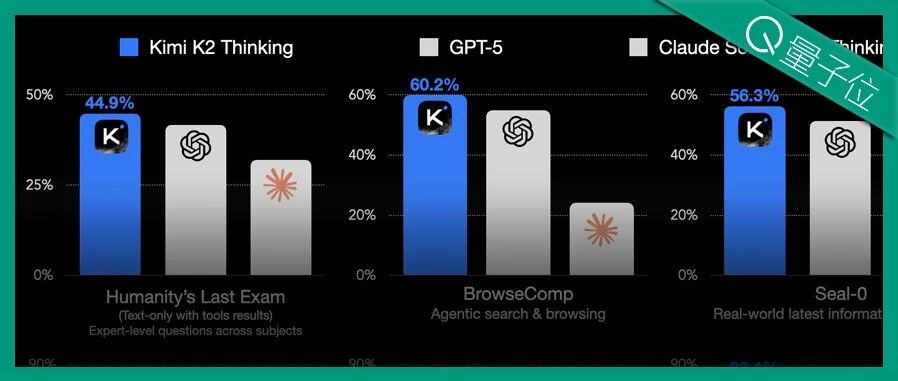
Core Insights - Kimi K2 Thinking is the most powerful open-source thinking model to date, capable of executing 200-300 consecutive tool calls without human intervention [1][3] - The model significantly narrows the gap between open-source and closed-source models, generating considerable discussion upon its release [3] Technical Details - Kimi K2 Thinking features 1TB of parameters, with 32 billion active parameters, and utilizes INT4 precision instead of FP8 [5][30] - It has a context window of 256K, allowing for enhanced reasoning capabilities [5] - The model has achieved state-of-the-art (SOTA) results in various benchmarks, surpassing closed-source models like GPT-5 and Claude Sonnet 4.5 [8][12] Performance Metrics - In the Human Last Exam (HLE), Kimi K2 Thinking achieved a SOTA score of 44.9% while using tools such as search and Python [12] - The model demonstrated a significant improvement in agent capabilities, increasing performance from 73% to 93% in the Artificial Analysis benchmark [15] - In the BrowseComp benchmark, Kimi K2 Thinking scored 60.2%, showcasing its advanced search and browsing abilities [18] Agentic Programming Capabilities - Kimi K2 Thinking shows enhanced programming capabilities, performing competitively against top closed-source models in various coding benchmarks [22] - The model can effectively handle complex front-end tasks, converting creative ideas into functional products [24] General Capabilities Upgrade - The model exhibits improved creative writing skills, producing clear and engaging narratives while maintaining stylistic coherence [28] - In academic and research contexts, Kimi K2 Thinking demonstrates significant advancements in analytical depth and logical structure [28] - The model's responses to personal or emotional queries are more empathetic and nuanced, providing actionable insights [28] Quantization and Performance - Kimi K2 Thinking employs native INT4 quantization, enhancing reasoning speed by approximately 2 times and improving compatibility with various hardware [30][31] - The model's design allows for effective handling of long decoding lengths without significant performance loss [30] Testing and Real-World Applications - Initial tests indicate that Kimi K2 Thinking can solve complex problems, such as programming tasks, efficiently [41][42] - The model's ability to break down ambiguous questions into clear, executable sub-tasks enhances its practical utility [21]

批量上新,科大讯飞兑现AI红利
Bei Jing Shang Bao· 2025-11-06 13:16
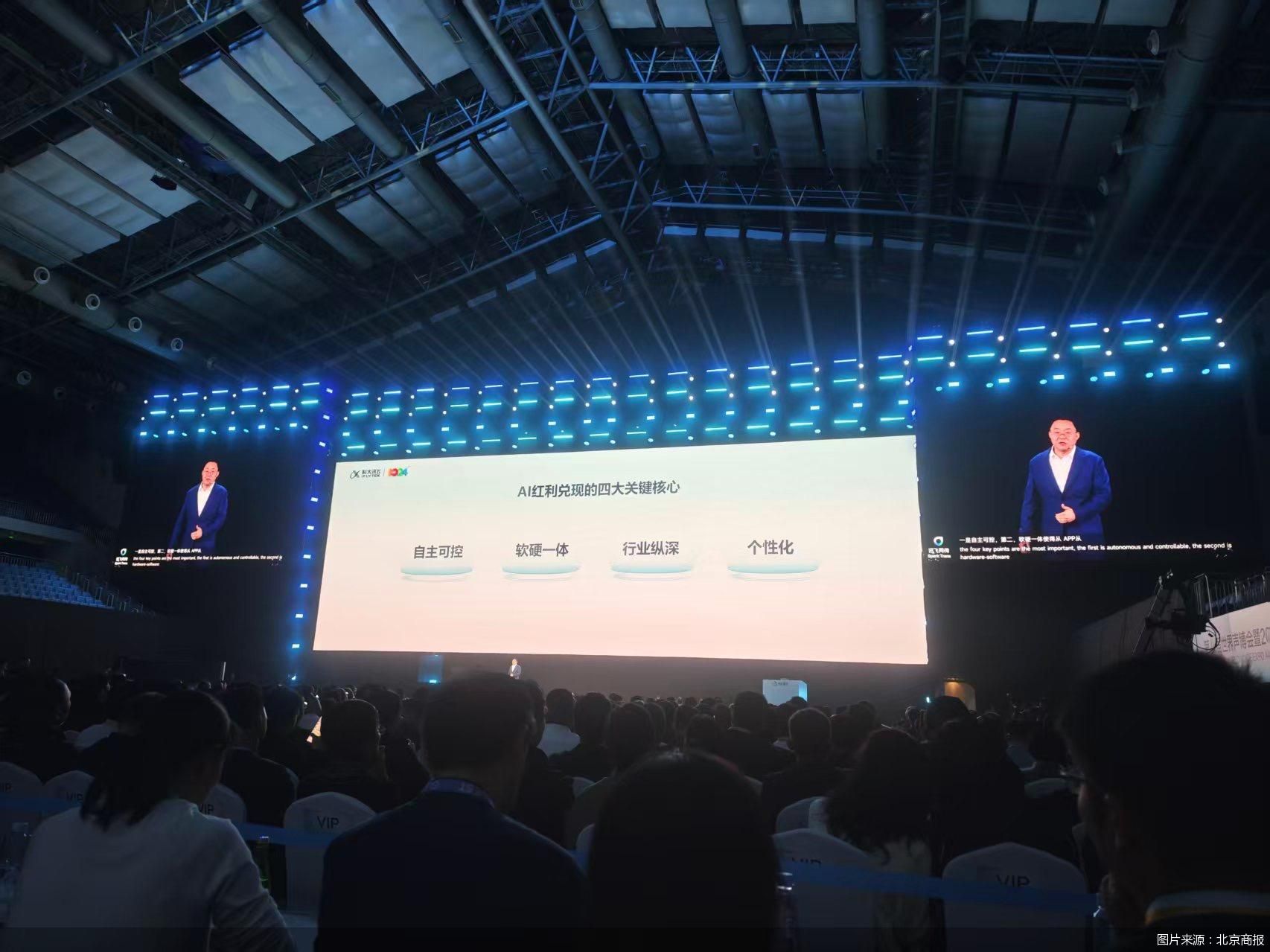
Core Insights - Keda Xunfei has released the Xunfei Spark X1.5 and a series of AI hardware-software integrated solutions, marking a significant advancement in AI technology and applications [1] - The company reported a revenue growth of 10.02% year-on-year in Q3 2025, achieving a net profit of 172 million yuan, indicating a successful transition from loss to profitability [1][6] - The focus of Keda Xunfei's products is on personalization and understanding user needs, as emphasized by Chairman Liu Qingfeng [1][3] Financial Performance - Keda Xunfei ended its losses in Q1 and H1 of 2025, achieving a revenue of 6.078 billion yuan in Q3, with a net profit of 172 million yuan [6] - The company has successfully transitioned to a profitable model, showcasing its ability to convert technology into financial success [1][6] Product Development - The Xunfei Spark X1.5 model demonstrates advanced capabilities in language understanding, text generation, and multi-language support, achieving over 93% efficiency compared to international competitors [4] - The company showcased various applications of AI in education, healthcare, automotive, and emotional companionship, highlighting the versatility of its technology [3][4] Market Positioning - Keda Xunfei aims to capitalize on the growing demand for practical AI applications, focusing on four key areas: autonomy, hardware-software integration, industry depth, and personalization [1] - The company is positioned within a broader AI ecosystem that includes large language models (LLM), autonomous driving, and embodied intelligence, each with distinct development paths [6]

阿里云通义千问:AgentScope1.0上新 新增开源智能体
智通财经网· 2025-11-05 11:51
Core Insights - Alibaba Cloud Tongyi Qianwen announced the launch of AgentScope 1.0, introducing open-source intelligent agents, including Alias-Agent and Data-Juicer Agent, enhancing task planning and processing capabilities [1] - AgentScope now integrates ReMe's long-term memory implementation, supporting management at personal, task, and tool levels [2] Group 1: New Features - Alias-Agent offers task planning and processing capabilities, capable of intelligent switching between four professional modes: ReAct, Planner-Executor, Deep Research, and Browser-Use, aiming to provide out-of-the-box solutions [1] - Data-Juicer Agent is a multi-agent system that seamlessly integrates AgentScope's multi-agent orchestration capabilities with Data-Juicer's data processing operators, enabling data processing driven by natural language [1] Group 2: Core Capability Expansion - AgentScope supports Agentic RL, allowing intelligent agent workflows to be trained with minimal code adaptation using the Trinity-RFT framework, providing advanced users with rich configuration options [2] - The integration of ReMe's long-term memory enhances the management of long-term memory at personal, task, and tool levels [2] Group 3: Additional Developments - AgentScope-Samples has been launched to create a collection of "out-of-the-box" intelligent agent implementations and full-stack applications, showcasing practical applications of AgentScope across various fields [3] - AgentScope-Runtime has been upgraded to support consistent behavior from local development to production environments, with support for Docker, Kubernetes, and Alibaba Cloud Function Computing [4] - A Python SDK is now available for programmatic interaction with deployed intelligent agents, along with a GUI and desktop sandbox based on VNC for graphical control [4]

金蝶云升级金蝶AI,徐少春提出七个转型策略
Zhong Guo Jing Ying Bao· 2025-11-05 09:11
Core Insights - Kingdee is transitioning from cloud services to AI, with a goal to complete "seven transformations" across various dimensions of the business [1][2] - The company has successfully achieved a cloud transformation, with cloud service revenue projected to reach 82% by 2024 and a compound annual growth rate of 31% [1] Group 1: Seven Transformations - The operational shift focuses on moving from daily operations to strategic execution, where intelligent agents will replace repetitive tasks [2] - Product transformation aims to evolve from traditional products to intelligent systems with self-perception and decision-making capabilities [2] - The business model will transition from selling products to subscription or outcome-based pricing, fostering ongoing service relationships [2] - The ecosystem will shift from transaction-oriented to a sustainable intelligent symbiosis [2] - Organizational structure will transform into a neural network model, breaking down departmental boundaries to enhance decision-making efficiency [2] - Talent acquisition will focus on high-density competition for young professionals who understand AI and can innovate [2] - Leadership will evolve from tangible management to intangible influence, where leaders motivate and provide emotional value rather than control [2] Group 2: AI Product Offerings and Market Position - Kingdee has launched an enterprise-level AI platform called Kingdee XiaoK, which serves as an entry point for intelligent agents and includes nearly 20 ready-to-use intelligent agents [3] - The company is exploring pricing models based on organizational size and usage, similar to cloud services, while also considering prepaid options [3] - Kingdee's AI strategy aims to create new business models that focus on delivering continuous intelligent value to customers rather than just selling products [4] Group 3: Financial Performance and Future Outlook - In the first half of 2025, Kingdee reported total revenue of 3.192 billion yuan, an 11% year-on-year increase, with cloud subscription revenue contributing 1.684 billion yuan, up 22% [4] - The company aims to achieve profitability in 2025, with a target for AI revenue to reach or exceed 30% by 2030 [4]

金蝶全面转向AI 徐少春称要完成“七个转型”
Zhong Guo Jing Ying Bao· 2025-11-05 08:36
Core Viewpoint - Kingdee has successfully completed its cloud transformation, with cloud services projected to account for 82% of its business by 2024, achieving a compound annual growth rate of 31% over the past decade. The company is now transitioning into the AI era of enterprise management software, officially rebranding "Kingdee Cloud" to "Kingdee AI" [1]. Group 1: Transformation Strategy - Kingdee's CEO Xu Shaochun outlined a strategy involving seven transformations: 1. Operations shifting from daily tasks to strategic execution, focusing on urgent strategic priorities 2. Products evolving from traditional functionalities to intelligent systems with self-perception and decision-making capabilities 3. Business models transitioning from product sales to subscription or outcome-based pricing 4. Ecosystems moving from transaction-oriented to continuous intelligent symbiosis 5. Organizational structures transforming into neural network types to enhance decision-making efficiency 6. Talent competition shifting from quantity to high-density, focusing on young talents skilled in AI and innovation 7. Leadership evolving from tangible to intangible, emphasizing emotional value and motivation over control [2]. Group 2: AI Product Development - Kingdee has launched several AI products, including the enterprise-level AI native entry "Kingdee Xiao K," which serves as a platform for interconnected intelligent agents. Currently, nearly 20 intelligent agents are available, such as gross profit analysis and ESG agents, which are ready for immediate use [3]. - The company is exploring pricing models for AI applications, currently favoring organization size and usage-based pricing, similar to its cloud services, while also considering prepaid options. The overall cost for businesses is expected to decrease as AI applications become more integrated [3]. Group 3: Financial Performance and Future Outlook - Kingdee reported total revenue of 3.192 billion yuan, an 11% year-on-year increase, with cloud subscription revenue contributing 1.684 billion yuan, up 22%. The net loss narrowed by 55% to approximately 98 million yuan [4]. - The company aims to achieve profitability in 2025, with a target for AI revenue to reach or exceed 30% by 2030, indicating a significant focus on AI and SaaS integration in the coming decade [4].
昆仑万维单季扭亏毛利率达69.9% 深化全球布局海外收入占超九成
Chang Jiang Shang Bao· 2025-11-04 00:14
Core Insights - Kunlun Wanwei's AI-driven business has led to significant growth, with a third-quarter revenue of 2.072 billion yuan, a year-on-year increase of 56.16%, and a net profit of 190 million yuan, compared to a loss of 237 million yuan in the same period last year [1][2] AI Business Growth - The company has focused on AGI and AIGC, achieving substantial progress in technology development, product innovation, and commercialization, resulting in a strong overall performance [1][2] - For the first three quarters of 2025, the company reported total revenue of 5.805 billion yuan, a year-on-year increase of 51.63% [1] Globalization Strategy - Kunlun Wanwei has deepened its global strategy, achieving overseas revenue of 5.41 billion yuan in the first three quarters, a 58% increase, with overseas revenue accounting for 93.3% of total revenue, up 3.6 percentage points year-on-year [3] - The company has established a solid user base in over 100 countries, with nearly 400 million monthly active users globally, enhancing its international competitiveness [3] R&D Investment and Technological Advancements - The company has significantly increased its R&D investment, with expenditures reaching 1.211 billion yuan in the first three quarters of 2025, a year-on-year increase of 5.83% [3] - Kunlun Wanwei's "Tiangong" model has evolved to version 4.0, featuring a parameter scale of 400 billion, making it one of the largest open-source MoE models globally [4] Industry Positioning - The company is transitioning from a gaming company to a leading global AI enterprise, leveraging its global layout and deep integration of AI technology as core competitive advantages [4]

大模型专题:2025年中国大模型行业发展研究报告
Sou Hu Cai Jing· 2025-11-03 16:20
Core Insights - The report highlights the rapid growth and strategic importance of the large model industry in China, projecting a market size of approximately 294.16 billion yuan in 2024, with expectations to exceed 700 billion yuan by 2026 [1][25][28] - The CBDG four-dimensional model (Consumer, Business, Device, Government) is identified as a new paradigm for understanding the ecosystem and competitive dynamics of the large model industry in China [5][40] - Key players such as iFlytek, ByteDance, and Alibaba are leveraging their unique strengths to build competitive advantages in the large model space, focusing on different market segments and user engagement strategies [7][10][30] Industry Overview - The large model industry is positioned as a strategic core of AI development, driving innovation and transformation across various sectors [14][21] - The industry is characterized by a shift from single-point algorithm innovation to a comprehensive intelligent ecosystem, with a focus on multi-modal capabilities and intelligent agents [16][25] - The competitive landscape is evolving from technology and product-centric competition to a more holistic, ecosystem-based competition, emphasizing capabilities in ecological construction, technological research, industry empowerment, commercial monetization, and innovation expansion [22][40] Market Dynamics - The multi-modal large model market in China is projected to reach 156.3 billion yuan in 2024, with significant applications in digital humans, gaming, and advertising [26][30] - The report indicates a growing trend towards the integration of multi-modal capabilities, moving from traditional text processing to interactions involving images, voice, and video [25][30] - The commercialization of large models is entering a systematic phase, with companies exploring diverse monetization strategies such as API calls, model licensing, and industry-specific solutions [28][30] Competitive Landscape - iFlytek is focusing on deepening its engagement in the government and business sectors, establishing a leading market share in large model solutions for state-owned enterprises [7][10] - ByteDance is leveraging its consumer traffic and data to create a closed-loop ecosystem, enhancing user engagement and retention [7][10] - Alibaba is transforming its Quark platform into an AI toolset to improve user stickiness and differentiate itself in the market [7][10] Future Trends - The future of large models is expected to drive AI from multi-modal cognition towards embodied intelligence, becoming a key link between the virtual and physical worlds [17][25] - The industry is anticipated to witness a shift towards ecological collaboration, with value increasingly concentrated in application service layers [22][25] - Governance will focus on safety, trustworthiness, and a uniquely Chinese path to international competition and cooperation [22][25]

安永荣获微软合作伙伴智能体创新大赛创新突破奖
Sou Hu Cai Jing· 2025-11-03 10:09
Core Insights - Ernst & Young (EY) China won the "Innovation Breakthrough Award" at Microsoft's "Partner Enterprise Intelligent Agent Innovation Competition" for its customer feedback analysis intelligent agent solution, which stands out for its unique AI operational approach and customer experience design [1] - The solution represents a benchmark practice in reconstructing enterprise service models and unlocking data asset value through intelligent agent technology [1] - EY aims to deepen its collaboration with Microsoft in the Chinese market, focusing on enterprise-level AI applications, intelligent agent construction, and trustworthy AI to drive digital transformation for businesses [1] Group 1: Customer Feedback Analysis Intelligent Agent - The deployment of AI agents at scale faces challenges such as low usage rates and slow iteration due to ineffective feedback analysis and insufficient manual analysis efficiency [2] - EY's intelligent agent supports universal, efficient, and flexible feedback analysis by integrating external feedback collection tools, providing deeper insights [2] - The innovative solution offers personalized feedback analysis reports based on user preferences, facilitating autonomous analysis and supporting efficient iteration of intelligent agents [2] Group 2: Comprehensive AI Consulting Services - EY provides a full range of AI consulting services from strategy formulation to implementation, helping enterprises achieve intelligent transformation [6] - The company builds a robust AI governance and operational framework, ensuring the reliability, safety, and ethical compliance of AI systems through standardized processes and compliance mechanisms [7] - EY offers end-to-end AI technology implementation services, covering demand analysis, data preparation, model development, system integration, testing, and continuous optimization [8] - Customized AI organizational transformation plans and capability enhancement programs are provided to improve employee AI skills and promote a data-driven and intelligent organizational culture [9]


“你们尽管做空 OpenAI!”奥特曼霸气喊话,纳德拉亲述微软百亿投资内幕 | 巨头对话
AI科技大本营· 2025-11-03 06:51
Core Insights - The conversation between Satya Nadella and Sam Altman highlights the significant partnership between Microsoft and OpenAI, focusing on their collaboration and future plans in AI technology [3][4][5] - OpenAI's ambitious commitment to invest $1.4 trillion in computing power over the next few years raises questions about its revenue model and growth potential [4][20][19] - The structure of OpenAI as a nonprofit organization with a for-profit subsidiary is designed to ensure that advancements in AGI benefit humanity while also generating substantial financial returns [13][12] Investment and Financial Structure - Microsoft has invested approximately $130 to $140 billion in OpenAI since 2019, acquiring a 27% stake in the company [11][12] - The partnership includes a revenue-sharing agreement where OpenAI pays Microsoft a portion of its income, which is expected to continue until AGI is achieved [16][21] - OpenAI's revenue is projected to grow significantly, with Altman asserting that the company is not limited to its current income figures [20][21] Computing Power and Infrastructure - The discussion emphasizes the critical need for computing power, with Nadella stating that the biggest challenge is not a surplus of computing resources but rather the availability of electricity and data center construction [24][26] - OpenAI plans to allocate $500 billion to NVIDIA, $300 billion to AMD and Oracle, and $250 billion to Azure for computing resources [19][20] - The conversation suggests that the demand for computing power will continue to grow, and the ability to scale effectively will be crucial for both companies [22][23] AGI and Future Prospects - The partnership aims to ensure that AGI is developed responsibly and benefits all of humanity, with a focus on health and AI resilience [13][14] - Altman expresses confidence in the future development of consumer-grade devices capable of running advanced AI models locally [28][20] - The potential for AI to revolutionize various sectors, including healthcare and scientific research, is highlighted as a key area of focus for both companies [35][36] Regulatory Environment - Concerns are raised about the fragmented regulatory landscape in the U.S., with both leaders advocating for a unified federal approach to AI regulation [31][32] - The potential impact of state-level regulations on innovation and competition is discussed, emphasizing the need for coherent policies [32][33] Market Position and Competitive Landscape - The partnership between Microsoft and OpenAI positions them as leaders in the AI space, with Nadella noting that OpenAI's growth is comparable to the emergence of a new Google [19][21] - The exclusive distribution of OpenAI's models on Azure is expected to attract customers who might have otherwise chosen AWS [45][46]

手机AI助手有新变化
2 1 Shi Ji Jing Ji Bao Dao· 2025-11-03 04:53
Core Insights - The penetration rate of AI assistants in smartphones is lower than expected, with users still waiting for a truly powerful and reliable AI assistant [1] - The upcoming flagship phone releases have made AI capabilities a central marketing focus for major manufacturers [1] Group 1: Evolution Trends of AI Assistants - **Deeper Understanding**: AI can recognize more screen information, but this raises privacy concerns, prompting regulatory attention [2] - **Stronger Actionability**: AI is beginning to participate in local life by recognizing restaurants, comparing prices across platforms, and writing reviews [3] - **Higher Interoperability**: There is increased communication and collaboration between different AI assistants [4] Group 2: Key Features and Upgrades - **Screen Content Understanding**: AI assistants are expected to interact more with users' screen content, such as identifying unknown callers and providing alerts for sensitive applications [5] - **Memory Functionality**: New features like "AI one-click flash memory" allow users to summarize and save screen content automatically [6] - **Privacy Measures**: OPPO is addressing privacy concerns by processing sensitive data locally on the device [7] Group 3: AI in Offline Life - **Real-time Interaction**: AI assistants can now use cameras for real-time conversations, enhancing user experience in physical environments [8] - **Price Comparison**: New AI features allow users to compare prices across multiple e-commerce platforms in real-time [8] - **Voice Recognition**: AI assistants are incorporating voice recognition to improve usability in noisy environments [8] Group 4: Challenges and Future Directions - **Complex Task Execution**: Current mobile AI assistants struggle with executing complex multi-step tasks due to a lack of mainstream protocols for communication [12] - **Third-party App Integration**: The reliance on "accessibility features" for AI to control third-party apps raises privacy concerns [12] - **Collaborative AI Models**: The emergence of "smart agents" and A2A protocols may facilitate better task delegation among AI systems [12][13]