
碳中和

Search documents
萧旭岑一行结束北京行程:期待两岸交流让更多产业、民众受惠
Xin Lang Cai Jing· 2026-02-04 13:20
Core Viewpoint - The forum between the Kuomintang (KMT) and the Communist Party of China (CPC) aims to enhance cross-strait tourism and cooperation, with a focus on benefiting industries and the public [1] Group 1: Forum Outcomes - The KMT announced the resumption of travel for Shanghai residents to Kinmen and Matsu, indicating a step towards increased tourism exchanges [1] - The forum facilitated discussions on practical cooperation in tourism, healthcare, and disaster prevention, aiming to build bridges between the two sides [1] Group 2: Participants' Perspectives - KMT Vice Chairman Hsiao Hsu-tsen emphasized the importance of regular dialogue on significant issues to benefit more industries and the public [1] - Li Hongyuan, Vice Chairman of the National Policy Research Foundation, described the visit as "pragmatic," focusing on actionable areas that are beneficial to the public [1] - Experts from Taiwan expressed hopes for enhanced scientific cooperation and industry connections through such exchanges [1]
高能环境(603588):进军矿业开采、赴港上市,资源化龙头扬帆起航
Xinda Securities· 2026-02-04 12:55
Investment Rating - The investment rating for the company is "Buy" [2]. Core Insights - The company is transitioning into the mining sector and plans to list in Hong Kong, aiming to enhance its position as a leader in resource utilization [4][18]. - The company has a clear and robust strategic layout focusing on resource recycling, having expanded its operations into hazardous waste and metal processing through acquisitions [4][18]. - The company is expected to benefit from rising metal prices, which will enhance profit margins and revenue from its resource recycling business [6][17]. Summary by Sections Company Overview - The company originated from the Institute of High Energy Physics of the Chinese Academy of Sciences and is one of the earliest firms in China to engage in solid waste pollution prevention [18]. - It has expanded its business scope significantly since its establishment in 1992, focusing on environmental remediation and resource recycling [18]. Business Transformation - The company has made substantial progress in its strategic layout, including plans to acquire stakes in three mining companies to extend its resource recycling chain [4][18]. - The company’s resource recycling business has seen significant growth, with revenue from this segment increasing by 72.17% year-on-year in 2024 [27]. Financial Performance - The company is projected to achieve revenues of 163.55 billion, 203.36 billion, and 215.22 billion yuan for the years 2025 to 2027, reflecting growth rates of 12.8%, 24.3%, and 5.8% respectively [10]. - The net profit attributable to the parent company is expected to reach 8.23 billion, 11.09 billion, and 12.03 billion yuan for the same years, with growth rates of 70.8%, 34.8%, and 8.5% respectively [10]. Market Dynamics - The company is positioned to benefit from favorable policies promoting circular economy and resource recycling, with significant growth potential in the recycling industry [34]. - The rising prices of metals such as gold, silver, and copper are expected to enhance the profitability of the company's resource recycling operations [6][17]. Future Outlook - The company is actively pursuing an H-share listing to support its international expansion and enhance its competitive edge [7][18]. - The integration of mining operations with resource recycling is anticipated to create synergies and open new avenues for growth [17].

《分布式能源规划员》(综合能源服务方向)培训通知丨系列培训
中国能源报· 2026-02-04 10:42
Core Viewpoint - The article emphasizes the importance of developing distributed energy and integrated energy services as a crucial path towards carbon neutrality, highlighting the need for interdisciplinary talent in energy planning and management [1] Group 1: Training Overview - The training titled "Distributed Energy Planner (Integrated Energy Services Direction)" is organized to address the shortage of professionals skilled in energy planning, conversion, and intelligent control [1] - The training will be conducted online from February 10 to February 13, 2026 [2] - The training is hosted by the Human Resources and Social Security Ministry's Social Security Capacity Building Center and organized by China Energy News Co., Ltd [2] Group 2: Target Audience - The training targets various stakeholders including provincial and municipal power companies, energy groups, and enterprises in the oil and gas sector [2] - It also includes new energy companies (wind, solar, storage), energy service companies, equipment manufacturers, and research institutions [2] - Individuals interested in the fields of new energy, distributed energy, and integrated energy services are encouraged to participate [2] Group 3: Course Outline - The course covers an overview of integrated energy services, including its driving forces and current development status both domestically and internationally [3] - It includes modules on planning comprehensive energy solutions, distributed photovoltaic projects, natural gas distributed energy applications, and smart microgrids [4] - Additional topics include hydrogen energy applications, new energy storage projects, and zero-carbon factory assessments [4] Group 4: Training Costs - The training fee is set at 3600 yuan per person, which includes training materials and certification costs [5] Group 5: Contact Information - For inquiries, contact Yang at 15801248899 or Wang at 15201547047 [6]


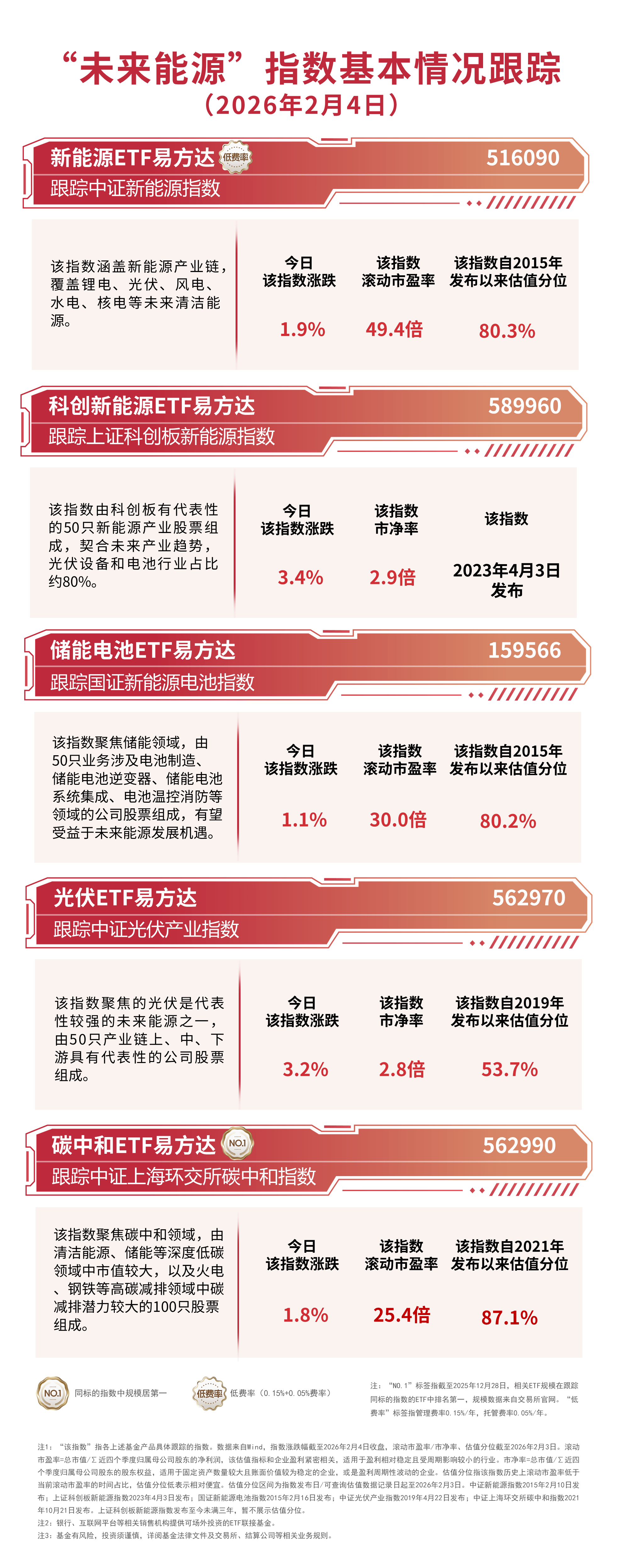
新能源板块延续涨势,关注科创新能源ETF易方达(589960)、储能电池ETF易方达(159566)等产品投资价值
Sou Hu Cai Jing· 2026-02-04 10:36
Core Insights - The Shanghai Stock Exchange's Sci-Tech Innovation Board New Energy Index rose by 3.4%, while the China Securities Photovoltaic Industry Index increased by 3.2%, indicating strong market interest in the new energy sector [1][12]. Group 1: Market Performance - The China Securities New Energy Index saw a rise of 1.9%, and the China Securities Shanghai Environmental Exchange Carbon Neutrality Index increased by 1.8% [1][16]. - The National Securities New Energy Battery Index rose by 1.1%, reflecting positive sentiment in the battery sector [1][12]. - The E Fund Energy Storage Battery ETF (159566) recorded a net subscription of 18 million units, with a total of 97 million yuan invested over the past two days [1]. Group 2: Industry Trends - Elon Musk has been actively researching domestic photovoltaic equipment manufacturers, focusing on HJT and perovskite technology, which aligns with his previously announced goal of expanding production capacity to 200 GW [1]. - The solid-state battery technology, characterized by higher energy density and smaller size, is expected to benefit from developments in space computing, making it suitable for satellite applications [1]. Group 3: Index Composition - The New Energy Index comprises 50 representative stocks from the new energy industry, with approximately 80% of its composition focused on photovoltaic equipment and battery sectors [3]. - The Energy Storage Battery Index focuses on companies involved in battery manufacturing, energy storage inverters, and battery system integration, positioning it to benefit from future energy development opportunities [7]. - The Photovoltaic ETF tracks an index that includes 50 representative companies across the photovoltaic industry chain, highlighting its significance as a future energy source [10]. - The Carbon Neutrality ETF tracks an index composed of 100 stocks from clean energy and high-carbon reduction potential sectors, indicating a strong focus on carbon neutrality initiatives [14].
斯里兰卡内阁批准2025-2030年可再生能源资源发展计划
Shang Wu Bu Wang Zhan· 2026-02-04 10:21
斯里兰卡《每日金融时报》2月4日报道,根据国家可再生能源政策,斯里兰卡内阁批准了《2025-2030 年可再生能源资源发展计划》,旨在到2030年使斯70%的全国电力需求来自可再生能源,并在2050年实 现碳中和。该计划由斯可持续能源管理局(SLSEA)与所有相关利益攸关方协商制定,重点关注三个关键 领域:确定并优先考虑适合可再生能源项目的土地;制定全面可再生能源路线图和可再生能源园区开发 时间表;可纳入漂浮式太阳能发电的项目。 ...
中国碳中和(01372)获主要股东沙涛增持60万股
智通财经网· 2026-02-04 08:41
Core Viewpoint - China Carbon Neutrality (01372) announced that major shareholder Mr. Sha Tao acquired 600,000 ordinary shares at an average price of approximately HKD 1.06 per share, representing 0.09% of the company's issued share capital, indicating confidence in the company's long-term development prospects [1] Group 1 - Mr. Sha Tao's acquisition increased his total shareholding to 161,065,000 shares, which constitutes about 23.86% of the company's total issued share capital [1]
新中港涨1.31%,成交额2751.54万元,近3日主力净流入1.90万
Xin Lang Cai Jing· 2026-02-04 08:07
Core Viewpoint - The company aims to become a regional comprehensive energy supply center and carbon neutrality center, focusing on carbon reduction through efficiency improvements and coupling reduction strategies [2]. Group 1: Company Development Goals - The company is developing into a regional public utility cogeneration enterprise with scale advantages, aiming for carbon emissions intensity comparable to natural gas units [2]. - Specific measures for carbon reduction include efficiency improvements through new unit expansions and technical renovations, as well as coupling reduction by increasing the proportion of solid waste and biomass fuel [2]. Group 2: Carbon Emission Data - In 2019 and 2020, the company had a total carbon emission quota of 2.6483 million tons, with actual emissions of 2.1483 million tons, resulting in a surplus of 500,100 tons, which is a surplus ratio of 18.88% [2]. - The company sold 500,000 tons of carbon emissions in December 2021 [2]. Group 3: Technological Initiatives - The company plans to construct a "three-dimensional virtual power plant" system to enhance operational efficiency and reliability through real-time data collection and analysis [2]. - This system will facilitate the visualization and simulation of power plant operations, laying the groundwork for future development of a dispatchable virtual power plant [2]. Group 4: Energy Storage Projects - The company is investing in energy storage projects through its wholly-owned subsidiary, Zhejiang Yuesheng Energy Storage Technology Co., Ltd., focusing on the construction, management, and operation of energy storage stations [3]. Group 5: Financial Performance - As of September 30, the company had 22,900 shareholders, an increase of 12.16% from the previous period, with an average of 17,497 circulating shares per person, a decrease of 10.83% [8]. - For the period from January to September 2025, the company reported revenue of 529 million yuan, a year-on-year decrease of 18.48%, while net profit attributable to shareholders increased by 2.51% to 91.8345 million yuan [8]. - The company has distributed a total of 344 million yuan in dividends since its A-share listing, with 204 million yuan distributed over the past three years [8].

能源绿色低碳转型”看山东之国网新源泰山抽水蓄能:守护电网安全,助建“储能之都
Zhong Guo Fa Zhan Wang· 2026-02-04 06:31
Core Viewpoint - The Shandong Taishan Pumped Storage Co., Ltd. is advancing multiple pumped storage projects to enhance energy efficiency and contribute to carbon reduction goals in Shandong Province [1][2][3] Group 1: Company Overview - Established in 1999, Shandong Taishan Pumped Storage Co., Ltd. has a registered capital of 2.60081 billion RMB, with investments from State Grid Xinyuan Group (50.29%), State Grid Shandong Electric Power Company (43.39%), and Taishan Investment Co., Ltd. (6.32%) [1] - The company manages two pumped storage power stations: the first phase with a total investment of 4.3 billion RMB and a capacity of 1 million kW, and the second phase with a planned investment of 10.748 billion RMB and a capacity of 1.8 million kW [1][2] Group 2: Project Details - The first phase of the Taishan pumped storage power station has been operational since June 2007, achieving an average of over 3,000 starts per year, and saving 434,000 tons of standard coal and 255,000 tons of fuel annually [1] - The second phase is designed to generate 1.8 billion kWh annually and pump 2.4 billion kWh, with a focus on domestic technology breakthroughs in variable-speed units [2] - The third phase, with a total investment of 2.6 billion RMB and a capacity of 450,000 kW, is expected to start construction during the 14th Five-Year Plan period and be completed by 2033 [3] Group 3: Environmental Impact - The second phase of the project is projected to save 784,000 tons of standard coal annually and reduce emissions of CO2 by 1.3 million tons, SO2 by 28,700 tons, and NOx by 3,300 tons [2] - The company aims to contribute to the establishment of a "green and low-carbon energy transition demonstration zone" in Shandong Province, aligning with national carbon peak and carbon neutrality goals [3]
一份报告的“温度”:QYResearch如何让冷数据产生热价值?
QYResearch· 2026-02-04 04:01
Core Insights - QYResearch transforms cold data into warm insights, proving that data can have emotional resonance and serve as a valuable decision-making reference for over 68,000 global enterprises [1][3] Group 1: Understanding "Temperature" in Data - The concept of "temperature" at QYResearch is derived from a deep understanding of the industry context, corporate challenges, and decision-makers' concerns, rather than mere embellishment of data [3] - The company emphasizes a dual capability of "global layout and local insight," with research centers in 10 countries that not only collect data but also understand regional industry characteristics and cultural contexts [3][4] - Reports are designed to reflect the market landscape and the client's positioning, acting as a bridge between current realities and future opportunities [3] Group 2: Research Methodology and Resources - QYResearch boasts a database of over 90 million entries, integrated with more than 200 customs databases and 300 third-party databases, forming a solid foundation for research [4] - The role of over 180 full-time analysts as "translators" is crucial, as they capture human stories behind industry data, providing insights into how technology and policies affect businesses [4] - A unique 30-angle interview confirmation system is employed to gather diverse perspectives from various stakeholders, enriching the analysis with experiential narratives [4] Group 3: Technological Empowerment - QYResearch's proprietary QYR Data platform integrates over 80 million product information entries and utilizes AI and machine learning to elevate data mining to meaning generation [5] - Traditional market reports often stop at "what is," while QYResearch aims to answer "why" and "what to do," using emotional analysis models and situational simulations [5] - Customized reports are tailored to the client's decision-making stage and resources, providing in-depth scenario analyses rather than one-dimensional conclusions [6] Group 4: Case Studies and Practical Applications - The case of Ishida's X-ray detection machine illustrates how QYResearch's insights can help overcome market barriers and drive performance growth by addressing overlooked signals in the data [8][9] - The report identified three critical signals: adaptation challenges in production lines, differences in compliance standards across countries, and high operational barriers for small food enterprises [9] Group 5: Future Outlook - QYResearch is developing a next-generation "immersive situational report system" using VR/AR technology to allow clients to experience future scenarios firsthand [10] - The company is enhancing its role as a long-term value partner by introducing "dynamic temperature monitoring" services to track emotional signals and provide comprehensive health warnings and opportunity alerts [10] Group 6: Ethical Considerations - In response to growing concerns about data ethics and sustainability, QYResearch has established a "research for good" principle, incorporating social impact assessments and ethical risk insights into its reports [11] Conclusion - Over 18 years, QYResearch has evolved to ensure that reports are not just data transfers but value creations, blending rigorous analysis with human understanding to provide actionable insights [12]

学习规划建议每日问答丨怎样理解推动煤炭和石油消费达峰
Xin Hua Wang· 2026-02-04 03:55
Core Viewpoint - The Chinese government aims to peak coal and oil consumption during the 14th Five-Year Plan period, aligning with its strategic decision to achieve carbon peak and carbon neutrality, while transitioning to a greener economy [1] Group 1: Energy Consumption Trends - Coal and oil consumption is expected to peak during the 14th Five-Year Plan, with fossil energy consumption's share projected to drop below 75% by 2030 [1] - Coal consumption is anticipated to peak around 2027, with growth in power and chemical industries, while sectors like steel and construction may see a decline [1] - Oil consumption is expected to peak around 2026, with fuel oil already at its peak and chemical feedstock oil continuing to grow [1] Group 2: Energy Structure Transition - The focus will be on enhancing the clean and efficient use of fossil energy, with a gradual reduction in coal consumption while ensuring energy security [2] - The government plans to implement total coal consumption control in key regions and promote the replacement of scattered coal [2] - There will be an emphasis on the integration of oil and gas exploration with renewable energy development [2] Group 3: Development of Non-Fossil Energy - The government aims to accelerate the construction of clean energy bases, including wind, solar, hydro, and nuclear power, while promoting distributed energy solutions [3] - By 2030, the share of non-fossil energy consumption is targeted to reach around 25% [3] Group 4: Capacity Regulation and Industry Challenges - The peak in coal and oil consumption may lead to structural issues in the coal and refining industries, potentially causing increased uncertainty in energy supply stability [4] - There will be a need for capacity regulation to optimize structure and layout, with a focus on reducing oil production while increasing chemical output [4] - The government encourages market-driven mergers and acquisitions to phase out inefficient capacities in coal and refining sectors [4]