
贸易协议

Search documents
投资专家:8月非农关注焦点将是数据修正,三四季度就业人数可能回升
Xin Lang Cai Jing· 2025-08-31 05:57
Core Insights - Some analysts believe that the July non-farm data and revisions indicate a softening U.S. economy [1] - The focus will quickly shift from comparing August data with July's initial values to further revisions of June and July data [1] - Uncertainty from Trump's tariff statements and extended deadlines has led U.S. businesses to refrain from making significant employment or investment decisions in Q2 [1] - With the potential for trade agreements and clarity on tariff levels, these economic figures may rebound quickly in Q3 and Q4 [1]
欧盟提议取消对美工业品关税、给予部分农产品及海产品优惠待遇 换取美方下调汽车税率
智通财经网· 2025-08-28 23:14
Group 1 - The EU has drafted a proposal to eliminate tariffs on all US industrial goods and provide preferential treatment for certain US agricultural and seafood products, following a request from President Trump [1] - The proposal aims to pave the way for the US to reduce tariffs on European cars and parts from 27.5% to 15%, with the lower tariffs expected to be retroactively implemented from August 1 [1] - The EU Commission plans to expedite the proposal by skipping the usual impact assessment process, although it still requires approval from the European Parliament and member states [1] Group 2 - Despite the trade arrangement, Trump has threatened to impose tariffs on countries that tax online services, although he has not specified which countries would be affected [2] - The EU has indicated that measures against US tech giants are not part of the current negotiations, and any threats from Trump could lead to a reassessment of the trade arrangement [2] - EU Industrial Chief Stephane Sejourne emphasized that if Trump's threats materialize, the terms of the agreement would need to be reconsidered [2]

“加班加点”取消对美所有工业品关税,欧盟承认:这有利于美国,但不得不干
Sou Hu Cai Jing· 2025-08-28 18:09
Group 1 - The EU is rapidly legislating to eliminate all tariffs on US industrial goods in exchange for the US reducing tariffs on EU automobiles [1][3] - The EU Commission acknowledges that the trade agreement favors the US but provides necessary stability and predictability for businesses [1][3] - EU Commission President von der Leyen defends the agreement as a thoughtful choice to avoid escalation and confrontation with the US [1][3] Group 2 - The EU is under pressure to complete legislation by the end of the month to meet US demands, which could significantly impact the EU automotive industry [3][4] - A survey by the German Chamber of Commerce indicates that 55% of industrial companies believe the trade agreement imposes a heavy burden on the European economy [4] - The German Mechanical Engineering Industry Association warns that 30% of machinery exported to the US faces 50% tariffs, urging the EU to negotiate for tariff exemptions [4] Group 3 - President Trump threatens high tariffs on countries that impose digital taxes targeting US tech companies, indicating potential trade tensions with the EU [5][6] - French President Macron suggests the EU should consider retaliatory measures against the US tech industry due to significant trade imbalances [5][6] - Despite calls for a stronger stance, EU member states show reluctance to engage in a full-scale trade war, limiting the EU's response options [6]

山金期货贵金属策略报告-20250827
Shan Jin Qi Huo· 2025-08-27 14:42
Report Industry Investment Rating - Not provided in the content Core Viewpoints - Gold and silver prices show different trends today, with gold strong and silver weak. The short - term trade agreements are reached in batches, leading to a decline in risk - aversion demand. The risk of stagflation in the US economy increases, employment weakens, inflation is moderate, and the expectation of the Fed's interest rate cut rebounds. It is expected that precious metals will be oscillating strongly in the short - term, oscillating at a high level in the medium - term, and rising step - by - step in the long - term [1]. - The gold price trend is the anchor of the silver price. In terms of capital, CFTC silver net long positions and iShare silver ETF have slightly reduced their positions. In terms of inventory, the recent explicit inventory of silver has slightly increased [6]. Summary by Directory Gold - **Price Performance**: Comex gold and London gold have risen, while domestic gold prices such as the closing price of the Shanghai Gold Exchange's main contract and gold T + D have also shown different degrees of increase. The basis and spreads, and ratios have also changed [2]. - **Position and Inventory**: Comex gold and Shanghai Gold Exchange's main contract positions have decreased, while gold T + D positions have increased. LBMA inventory remains unchanged, Comex gold inventory has decreased, and Shanghai Gold Exchange's gold inventory has increased [2]. - **Strategy**: Conservative investors are advised to wait and see, while aggressive investors can buy low and sell high. Good position management and strict stop - loss and take - profit are recommended [3]. - **Net Position Ranking**: The top 10 net long and net short positions of futures companies' members in the Shanghai Gold Exchange have different changes in net positions and daily ratios [4]. Silver - **Price Performance**: The closing price of the Comex silver main contract has risen, while the London silver price has fallen. Domestic silver prices such as the closing price of the Shanghai Silver Exchange's main contract and silver T + D have decreased [7]. - **Position and Inventory**: Comex silver positions have increased, while Shanghai Silver Exchange's main contract positions have decreased, and silver T + D positions have increased. Silver inventories in different places have different changes, and the total explicit inventory has slightly decreased [7]. - **Strategy**: Conservative investors are advised to wait and see, while aggressive investors can buy low and sell high. Good position management and strict stop - loss and take - profit are recommended [7]. - **Net Position Ranking**: The top 10 net long and net short positions of futures companies' members in the Shanghai Silver Exchange have different changes in net positions and daily ratios [8]. Fundamental Key Data - **Fed - related Data**: The upper limit of the federal funds target rate, the discount rate, and the reserve balance interest rate have all decreased by 0.25. The Fed's total assets have decreased slightly, and M2 has increased year - on - year [9]. - **Other Key Indicators**: The ten - year US Treasury real yield, the US dollar index, and the US Treasury yield spreads have all changed. US inflation, economic growth, labor market, real estate market, consumption, industry, trade, and economic survey data have also shown different trends. Central bank gold reserves in different countries and regions have different changes, and some currency - related ratios have also changed [9][11][13]. - **Fed Interest Rate Expectation**: According to the CME FedWatch tool, the market's expectation of the Fed's interest rate cut in different meeting dates from September 2025 to December 2026 is different [14].
特朗普又抱怨欧盟:针对美企,放行中企,请尊重美国
Sou Hu Cai Jing· 2025-08-27 14:22
Group 1 - The core viewpoint of the article is that former President Trump is vocally opposing foreign digital regulations that he perceives as discriminatory against American tech companies while favoring Chinese firms [1][2] - Trump threatens to impose high tariffs and export controls on countries that enact digital taxes and regulations targeting U.S. tech companies [2][5] - The European Union (EU) has introduced the Digital Markets Act and Digital Services Act since 2022 to regulate the digital market and limit unfair competition from tech giants [5][12] Group 2 - EU officials have denied accusations that their regulations target any specific country, asserting that their laws apply equally to all companies operating within the EU [6][12] - The EU emphasizes that its regulatory measures are non-discriminatory and are based on democratic values, not subject to negotiation with other countries [6][12] - There is increasing pressure within the EU to activate the "anti-coercion" mechanism in response to Trump's threats, with some member states expressing support for this action [12][13]
投降了?曝欧盟将“跳过”正常程序,紧急立法取消所有美国工业品关税!
Jin Shi Shu Ju· 2025-08-27 12:25
Group 1 - The EU is seeking to quickly advance legislation to eliminate tariffs on all US industrial goods, as requested by President Trump, in exchange for a reduction in tariffs on EU automotive exports [2][3] - The EU Commission acknowledges that the trade arrangement with Trump benefits the US but is necessary for providing stability and certainty to businesses [2] - Currently, EU automotive exports to the US face a 27.5% tariff, while a trade agreement aims to reduce US tariffs on nearly all European products to 15%, contingent on the EU's legislative action [2][3] Group 2 - If the EU proposes the legislation by the end of the month, the 15% tariff on European cars will be retroactive to August 1 [3] - The automotive sector is a crucial export for the EU, with Germany exporting $34.9 billion worth of cars and parts to the US in 2024 [3] - Trump's tariff policies are causing a significant shift of European scrap aluminum to the US, threatening the survival of local recycling facilities in Europe [3] Group 3 - The aluminum industry in Europe, with an annual turnover of €40 billion, directly employs 250,000 people and supports an additional 1 million jobs [3] - Exports of aluminum products to the US incur a 50% tariff, severely impacting sales, while scrap aluminum exports face no tariffs [3] - The EU Commission is considering emergency measures to support the struggling aluminum industry, including potential tariffs on all EU scrap aluminum exports [3]
日本首席谈判代表将访问美国,推动降低汽车关税
智通财经网· 2025-08-27 11:53
Core Viewpoint - Japan's chief trade negotiator, Akizawa Ryo, is visiting the U.S. to urge the government to implement a tariff reduction agreement reached in July, particularly concerning automotive tariffs [1] Group 1: Trade Negotiations - Akizawa's visit marks the 10th round of bilateral trade negotiations since they began this year [1] - Japan is requesting the U.S. to lower tariffs on automobiles and parts to 15% and to eliminate the practice of stacking previous tariffs on top of the 15% general tariff [1] - The implementation of reciprocal tariff revisions and automotive tariff reductions is expected to occur simultaneously [1] Group 2: Economic Implications - If Japan's requests are positively addressed, it would be considered a significant victory for Japan [1] - The automotive industry is crucial for Japan's exports to the U.S., and the country aims to implement the tariff reductions quickly due to ongoing declines in overall exports caused by U.S. tariffs [2] - Japan's economy grew faster than expected last quarter, but the overall export performance remains under pressure from U.S. tariffs [2] Group 3: Related Agreements - The U.S. is looking to initiate a $55 billion investment mechanism to revitalize American manufacturing, which is a key aspect of the trade agreement [1] - Similar to Japan, South Korea reached a trade agreement with the U.S. in July, which includes a $35 billion project fund [2] - Akizawa indicated that the U.S. would refund all excess tariffs if the stacking issue is resolved, aligning Japan's tariff structure with that of the EU [2]
报道:欧盟本周将提议削减美国关税,以满足特朗普的要求
Hua Er Jie Jian Wen· 2025-08-27 11:18
Group 1 - The EU aims to legislate the removal of tariffs on US industrial goods in exchange for the US reducing tariffs on automobile imports [1][2] - The current tariff on EU automobile exports to the US is 27.5%, significantly impacting EU exports, particularly from Germany, which exported $34.9 billion worth of cars and parts to the US in 2024 [1] - The agreement would lower US tariffs on nearly all European goods to 15%, but the reduction on automobiles is contingent upon the EU's legislative action to remove tariffs on US industrial products [1] Group 2 - To expedite the legislative process, the EU Commission will bypass the standard impact assessment procedure, aiming for a swift agreement to alleviate high tariffs on EU automobiles [2]
欧盟对美作出重大贸易让步:拟本周快速立法取消所有工业品关税
智通财经网· 2025-08-27 11:11
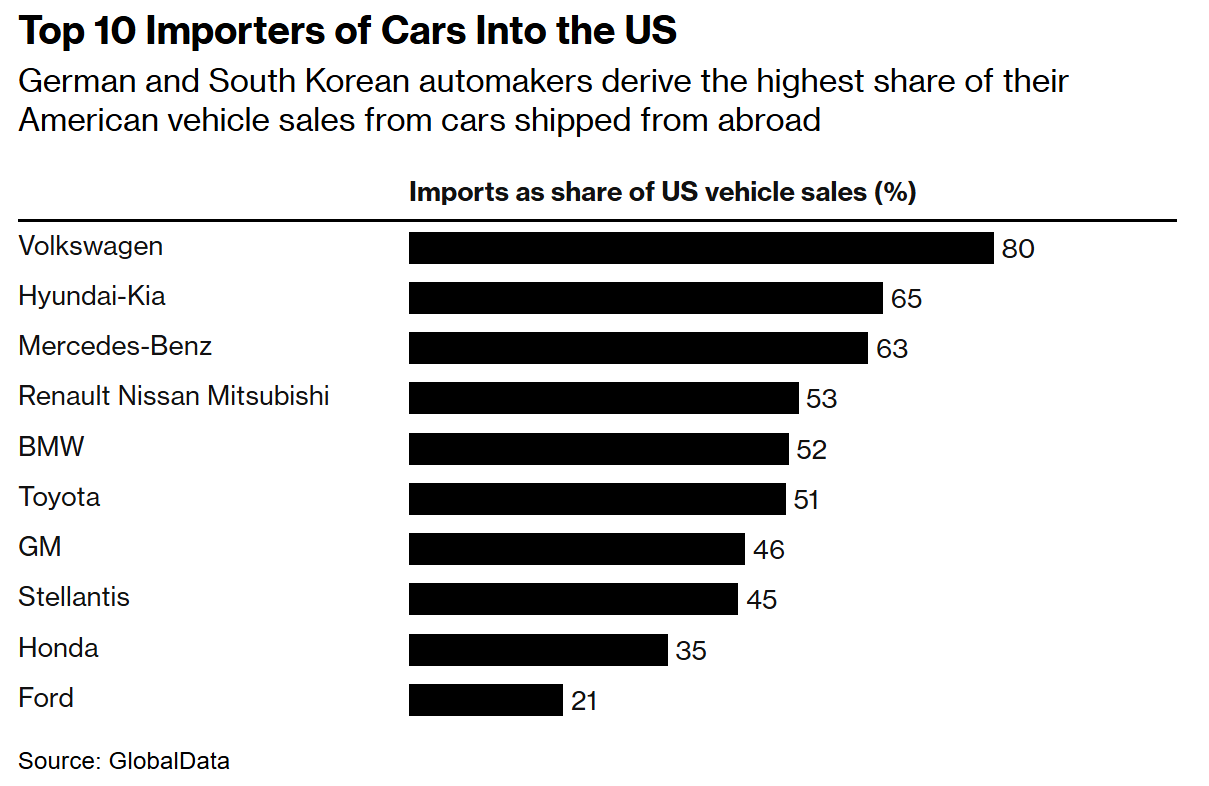
Group 1 - The EU plans to seek rapid legislative approval to eliminate all import tariffs on U.S. industrial goods, a condition set by President Trump for reducing tariffs on EU car exports [1][6] - The EU will also offer preferential tariff rates on certain seafood and agricultural products, acknowledging that the trade arrangement favors the U.S. but is necessary for providing stability and certainty for businesses [1] - The EU Commission President referred to the agreement as a "strong (if not perfect) deal" [1] Group 2 - Currently, EU cars and parts face a 27.5% tariff when exported to the U.S. Although a trade agreement has been reached to reduce U.S. tariffs on nearly all European products to 15%, Trump stated that this rate would not apply to cars unless industrial tariffs are legislatively removed [6] - If the EU proposes legislation by the end of the month, the 15% tariff on European cars will be retroactive to August 1 [6] - Cars are a significant export product for the EU to the U.S., with Germany exporting $34.9 billion worth of new cars and parts to the U.S. in 2024 [6] - To expedite the process, the EU Commission will skip the usual impact assessment for the proposal [6]
欧盟据悉拟于本周提出取消对美国工业产品关税 以满足特朗普要求
Xin Lang Cai Jing· 2025-08-27 10:38
Core Points - The EU aims to expedite the legislative process to eliminate tariffs on U.S. industrial products by the end of the weekend [1] - This move is in response to a request from U.S. President Donald Trump, who stated that the U.S. would lower tariffs on EU automobile exports only if this condition is met [1] - The European Commission is also expected to offer preferential tariff rates on certain seafood and agricultural products [1] - The EU acknowledges that the trade arrangement reached with Trump is beneficial for the U.S. but emphasizes its importance for ensuring stability and certainty for businesses [1] - Ursula von der Leyen, President of the European Commission, referred to the agreement as "a strong deal, albeit not perfect" [1]