金银比

Search documents
国投期货贵金属日报-20251105
Guo Tou Qi Huo· 2025-11-05 01:56
Report Industry Investment Rating - The investment rating for precious metals is "★★★", indicating a clearer long - term trend and a relatively appropriate current investment opportunity [1] Core Viewpoints - Overnight, precious metals continued to fluctuate. The US October ISM Manufacturing PMI was 48.7, slightly lower than the expected 49.5 and the previous value of 49.1. With the Fed's internal differences, the US government shutdown, and the possible non - release of this week's non - farm payroll data, the market is waiting for new drivers, and precious metals are building a high - level oscillation platform, suggesting a temporary wait - and - see approach. Regarding silver, as the US dollar index rebounds, market risk appetite has weakened, and the gold - silver ratio may rise again [2] - The Fed cut interest rates by 25 basis points to the 3.75% - 4.00% range last week, the second cut this year. However, Chairman Powell stated that "another rate cut is not a certainty", causing the probability of a December rate cut expected by traders to drop from nearly 100% a week ago to 65.3%, removing the interest - rate decline support for non - interest - bearing gold [2] - The doves advocate significant rate cuts, while the hawks are cautious about further rate cuts due to concerns about inflation and financial market risks. The market is in a "high - level interest - rate" stage, and gold prices face short - term callback risks due to uncertainties such as unclear Fed policies, data vacuum caused by the US government shutdown, and China's end of the gold tax - exemption policy [2][3]
贵金属日报-20251104
Guo Tou Qi Huo· 2025-11-04 11:13
Report Industry Investment Rating - The investment rating for precious metals is represented by three red stars, indicating a more distinct upward trend and relatively appropriate investment opportunities currently [1] Core Viewpoints - Overnight, precious metals continued to fluctuate. The US October ISM Manufacturing PMI was 48.7, slightly lower than the expected 49.5 and the previous value of 49.1. The market is waiting for new drivers, and precious metals have formed a high - level oscillation platform. It's advisable to stay on the sidelines for now. For silver, as the US dollar index rebounds, market risk appetite has weakened, and the gold - silver ratio may rise again [2] - The Fed cut interest rates by 25 basis points to the 3.75% - 4.00% range last week, the second cut this year. However, Chairman Powell indicated that another rate cut is not certain. Traders' expectation of a December rate cut dropped from nearly 100% to 65.3%, causing non - interest - bearing gold to lose the support of falling interest rates [2] - The dovish representative, Governor Milan, advocates significant rate cuts, while hawks like Chicago Fed President Goolsbee are concerned about inflation, and Kansas City Fed President Schmid believes that further rate cuts carry high risks [3] - The market has entered a typical "high - level interest - rate" phase. Three uncertainties, including the unclear Fed policy outlook, data vacuum due to the US government shutdown, and China's end of the gold tax - exemption policy, are putting pressure on gold prices. Gold prices still face a risk of further correction in the short term [3] Summary by Related Content Market Conditions of Precious Metals - Overnight precious metals continued to oscillate. The US October ISM Manufacturing PMI was 48.7, lower than expected and the previous value. Precious metals have formed a high - level oscillation platform, and it's recommended to wait and see. For silver, the market risk appetite has weakened, and the gold - silver ratio may rise [2] Fed's Interest - Rate Policy - The Fed cut interest rates by 25 basis points to 3.75% - 4.00% last week, the second cut this year. Chairman Powell said another cut is not certain. Traders' expectation of a December rate cut dropped from nearly 100% to 65.3% [2] - Dovish and hawkish officials have different views on interest - rate cuts. Dovish officials advocate significant cuts, while hawkish officials are concerned about inflation and the risks of further cuts [3] Market Risks and Outlook - The market is in a "high - level interest - rate" phase. Three uncertainties are pressuring gold prices, and there is a risk of further short - term correction [3]
国际金价进入区间震荡
Zhao Shang Qi Huo· 2025-11-03 09:05
1. Report Industry Investment Rating No information available. 2. Core Viewpoints of the Report - COMEX gold prices have entered a range - bound oscillation, once falling below $3900 per ounce, and COMEX silver prices are also range - bound, falling below $46 per ounce. Multiple factors such as the easing of Sino - US economic and trade relations, the long - term US government shutdown, and the unresolved Russia - Ukraine conflict may cause the COMEX gold price to enter a phased range - bound oscillation after a pull - back from its high, and the silver price to enter a range - bound oscillation after a sharp drop from its high [45]. 3. Summary by Relevant Catalogs This Week's Review - COMEX gold prices entered a range - bound oscillation and once fell below $3900 per ounce, while COMEX silver prices were range - bound and fell below $46 per ounce [45]. - On the early morning of October 30th, the Federal Reserve ended its monetary policy meeting and announced a 25 - basis - point cut in the federal funds rate target range to between 3.75% and 4.00%, meeting market expectations [45]. - On the morning of October 30th, the Chinese and US presidents met in Busan, South Korea, to discuss bilateral economic and trade relations. The bilateral economic and trade relations tend to ease, sending a positive signal to the global economy [45]. Short - Term Outlook - Sino - US economic and trade relations are temporarily easing [45]. - The long - term US government shutdown is dragging down the US economy, especially the employment market, and the Federal Reserve may turn dovish [45]. - The Russia - Ukraine conflict is unlikely to ease within the year [45]. Price and Ratio - Gold and silver prices are both oscillating, the gold - silver ratio is decreasing, the gold - oil ratio has stabilized after a decline, and the copper - gold ratio is decreasing [7]. Position - Domestic gold futures positions have slightly decreased, and domestic silver futures positions have slightly increased [13]. Exchange Rate and Interest Rate - The report presents the exchange rate and interest rate spreads between the US and Europe, the US and the UK, and the US and Japan, as well as the comparison of US Treasury bond spreads with overseas and exchange rate changes [16][17][18]. Inventory - The inventory data of the Shanghai Futures Exchange and COMEX are presented, but specific trends are not clearly described [27]. ETF - Gold ETFs have slightly increased, and silver ETFs have slightly decreased [29][32]. CFTC Net Long Position - The net long positions of COMEX gold and silver management funds are presented [35][38]. Central Bank Gold Reserve - The global major central bank gold reserves and their growth rates are presented [40]. Basis - The gold TD - SHFE basis and silver basis data from 2022 to 2025 are presented [42][43].
纽商所理事会主席:投资者需求决定金价,后市仍看涨
2 1 Shi Ji Jing Ji Bao Dao· 2025-10-27 23:16
Core Viewpoint - After nine consecutive weeks of increase, international gold prices have experienced a notable correction, with a weekly decline of approximately 3.3% as of October 24, 2023, closing at $4,113.05 per ounce. Despite this, gold has seen a year-to-date increase of 57%, supported by central bank purchases, dovish signals from the Federal Reserve, and strong inflows into gold ETFs. Analysts suggest that the current correction is more of a technical adjustment rather than a trend reversal, indicating that gold remains a crucial asset for long-term investment [1][2][3]. Factors Driving Gold Price Increase - The recent surge in gold prices is attributed to multiple factors, including safe-haven demand, monetary policy expectations, and speculative investments. The primary driver remains investor demand, with central bank purchases acting as an additional variable. Since 2003, investment demand has been the main force behind gold price movements [3][6]. Gold and Silver Market Dynamics - Gold and silver are fundamentally different markets, with gold serving primarily as a store of value and silver having significant industrial applications. The gold-to-silver ratio has fluctuated, indicating market dynamics, but should not be the sole basis for investment decisions. Each metal should be analyzed based on its unique fundamentals [4][5]. Investor Behavior and Market Corrections - The current market shows signs of overcrowding in gold trading, with potential for significant corrections if dollar liquidity tightens. Observing market sentiment and news can provide early warning signals for potential corrections. Historically, gold prices tend to dip during periods of liquidity tightening but often rebound afterward [7][8]. Long-term Outlook for Gold - The long-term outlook for gold remains positive, with potential for prices to reach $5,000 or even $6,000 per ounce, driven by increasing public debt and a shift away from fiat currencies. The demand for gold is expected to persist as investors seek hard assets. However, external factors can lead to significant price fluctuations [9].


21专访丨纽商所理事会主席:投资者需求决定金价,后市仍看涨
2 1 Shi Ji Jing Ji Bao Dao· 2025-10-27 23:05
Core Viewpoint - After nine consecutive weeks of increase, international gold prices have experienced a notable correction, with a weekly decline of approximately 3.3% as of October 24, 2023, despite a year-to-date increase of 57% [1] Group 1: Factors Influencing Gold Prices - The strong performance of gold is supported by several factors, including continuous purchases by central banks, dovish signals from the Federal Reserve, and significant inflows into gold ETFs [1] - Investment demand remains the core driver of gold prices, with central banks acting as buyers but not the primary force behind price increases [2][3] - The current market dynamics indicate that the recent correction is more of a technical adjustment rather than a trend reversal, allowing for the digestion of previous gains [1][5] Group 2: Market Sentiment and Future Outlook - Analysts suggest that despite short-term fluctuations, the long-term support factors for gold remain intact, emphasizing its importance as a core asset in investment portfolios [1] - The potential for gold prices to reach higher levels, such as $5,000 or even $7,000, exists, particularly in the context of rising public debt in the U.S. and a shift away from fiat currencies [7] - Market volatility is expected, with gold prices likely to rebound after temporary declines during periods of liquidity tightening [6][7] Group 3: Gold vs. Silver Dynamics - The gold-silver ratio has returned to around 80, indicating differing market dynamics between the two precious metals, with gold primarily serving as a store of value and silver having stronger industrial applications [3][4] - The analysis of the gold-silver ratio can provide insights into market behavior, although it is essential to consider the fundamental differences between the two metals [3]
金银周报-20251026
Guo Tai Jun An Qi Huo· 2025-10-26 11:28
1. Report Industry Investment Rating - Not provided in the content 2. Core Viewpoints of the Report - Gold is in a high - level adjustment, and silver has seen a rapid price decline as the spot contradiction eases. The gold - silver ratio has risen from 78.6 to 85.6, mainly due to the sharp drop in silver prices. The first target for silver's downward movement is $47.5, and the second is $43 - 44. Gold needs a monthly - level price adjustment, but its bottom support is stronger than silver's [3]. - The US economic outlook is complex. Although the real demand is not weak, the expectations are affected by policies. The US government shutdown has continued for four weeks, and 10 - month hard data may be missing. Soft data shows an improvement in October's Markit manufacturing, services, and composite PMIs compared to September, with the new orders composite index reaching its highest level this year. However, the manufacturing employment index has dropped to a three - month low [3]. 3. Summary by Relevant Catalogs 3.1 Transaction Aspect (Price, Spread, Inventory, Capital, and Position) 3.1.1 Overseas Spot - Futures Price Spread - This week, the spread between London spot and COMEX gold主力 fell to - $15.345 per ounce, and the spread between COMEX gold continuous and COMEX gold主力 was - $22.7 per ounce [9]. - The spread between London spot and COMEX silver主力 rose to $0.2135 per ounce, and the spread between COMEX silver continuous and COMEX silver主力 was - $0.27 per ounce [12]. 3.1.2 Domestic Spot - Futures Price Spread - This week, the gold spot - futures price spread was - 2.77 yuan per gram, at the lower end of the historical range [16]. - The silver spot - futures price spread was - 15 yuan per gram, at the upper end of the historical range [19]. 3.1.3 Monthly Spread - This week, the gold monthly spread was 7.12 yuan per gram, at the upper end of the historical range [23]. - The silver monthly spread was 46 yuan per gram, at the upper end of the historical range [27]. 3.1.4 Cross - Month Positive Arbitrage Delivery Cost - For gold, the total cost of buying TD and selling Shanghai gold was 4.20 yuan per gram, and the cost of buying Shanghai gold December contract and selling June contract was 15.69 yuan per gram [30][31]. - For silver, the total cost of buying TD and selling Shanghai silver was 50.54 yuan per kilogram, and the cost of buying Shanghai silver December contract and selling June contract was 178.05 yuan per kilogram [32][33]. 3.1.5 Deferred Fee Payment Direction - This week, the gold exchange's deferred fee for gold was mainly paid by longs to shorts, indicating strong delivery power. The same was true for silver [34]. 3.1.6 Inventory and Position - to - Inventory Ratio - This week, COMEX gold inventory decreased by 0.23 million ounces, and the registered warrant ratio rose to 51.3%. COMEX silver inventory decreased by 389 tons to 15,456 tons, and the registered warrant ratio dropped to 33.7%. Gold futures inventory increased by 2.41 tons, and silver futures inventory decreased by 255 tons to 664 tons [36][38][41]. 3.1.7 CFTC Non - Commercial Position - This week, the non - commercial net long position of COMEX CFTC gold increased slightly, while that of silver decreased slightly [43]. 3.1.8 ETF Position - This week, the gold SPDR ETF inventory increased by 12.31 tons, and the silver SLV ETF inventory increased by 77.59 tons [49][51]. 3.1.9 Gold - Silver Ratio - This week, the gold - silver ratio fell from 78.6 to 85.6 [54]. 3.1.10 COMEX Gold Delivery Volume and Gold - Silver Lease Rate - This week, the 3 - month gold lease rate was - 0.13%, and the 3 - month silver lease rate was 13.86% [57]. 3.2 Core Drivers of Gold 3.2.1 Gold and Real Interest Rate - This week, the correlation between gold and real interest rate recovered, and the 10 - year TIPS continued to decline [62]. 3.2.2 Inflation and Retail Sales Performance - Not summarized in detail as only relevant charts are provided without specific text analysis [67] 3.2.3 Non - Farm Employment Performance - Not summarized in detail as only relevant charts are provided without specific text analysis [70] 3.2.4 Industrial Manufacturing Cycle and Financial Conditions - Not summarized in detail as only relevant titles are provided without specific content [75] 3.2.5 Economic Surprise Index and Inflation Surprise Index - Not summarized in detail as only relevant titles are provided without specific content [77] 3.2.6 Fed Rate - Cut Probability - Not summarized in detail as only a title is provided without specific content [79]
Silver's $50 Breakout: A Healthy Retest Before The Next Leg Higher
Benzinga· 2025-10-23 19:35
Core Viewpoint - The silver market is currently experiencing a critical retest of the $50 level, which has historically acted as a significant resistance point. This phase is essential for determining whether this level can now serve as a support base for future price increases [1][3][6]. Group 1: Historical Context and Importance of $50 Level - The $50 price level has been a psychological barrier for over four decades, previously reached in 1980 and 2011, both times leading to rapid price collapses [3][4]. - The recent breakout above $50 in October is significant as it reflects strong fundamentals, including rising industrial demand and stagnant mine supply, rather than speculative trading [4][6]. Group 2: Market Dynamics and Technical Analysis - The current fluctuations around the $50 mark are not indicative of market weakness but rather a necessary cooling-off period after a strong rally, allowing for a reassessment of market positions [6][8]. - Technical indicators, such as the Relative Strength Index (RSI), suggest that the market is merely taking a breather, with bullish signals indicating potential for future price increases [8][12]. Group 3: Supply and Demand Fundamentals - The silver market remains tight, with physical silver trading at a premium and showing signs of backwardation, indicating scarcity [17][18]. - Global mine production has been flat, and the demand from sectors like solar energy and electric vehicles continues to rise, contributing to a structural deficit in the market [23][24]. Group 4: Future Scenarios and Market Outlook - If the $50 level holds, it could signify a new phase in the silver market, potentially leading to higher prices as the market adjusts to structural scarcity [7][39]. - Various scenarios suggest that while a minor pullback may occur, the overall bullish trend remains intact, with long-term investors likely to benefit from any price dips [34][36]. Group 5: Gold/Silver Ratio Implications - The Gold/Silver Ratio currently indicates that silver is historically undervalued compared to gold, suggesting that there is significant room for price appreciation in the silver market [27][28]. - Historical patterns show that when the ratio compresses, it often leads to substantial gains in silver prices, reinforcing the notion that the current market is still in its early stages of a bull cycle [29][32].
银价单日大跌!巨震下前路在何方?
Jin Rong Shi Bao· 2025-10-23 11:15
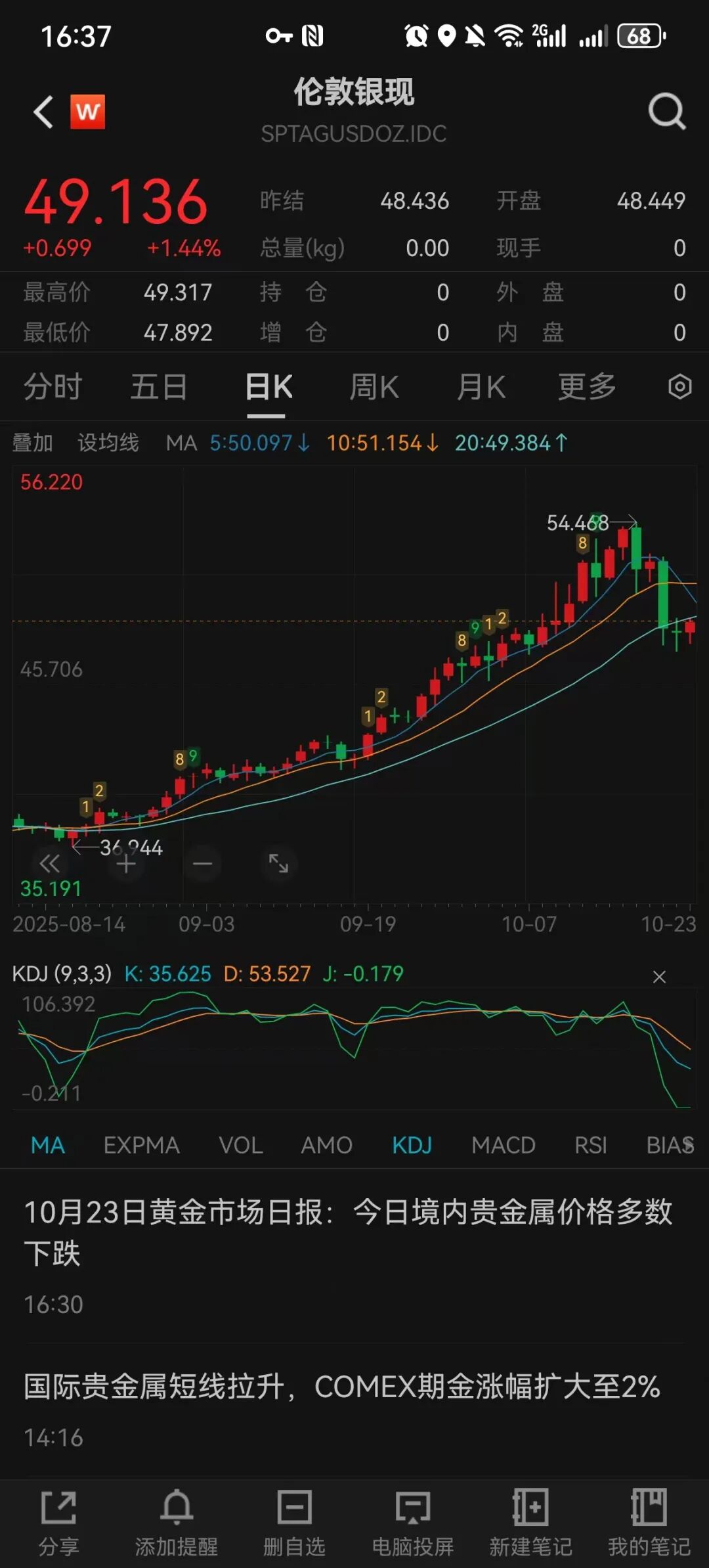
Core Insights - Recent fluctuations in precious metal prices, particularly silver, have garnered market attention, with silver reaching a historical high of $54.47 per ounce before a significant drop [1] - Year-to-date, spot gold has increased by 56.77%, while spot silver has surged by 70.03%, raising questions about silver's future trajectory [1] Price Movements - On October 21, the London spot silver price experienced a decline of 7.11%, marking the largest single-day drop since early 2021 [1] - As of October 22, the closing prices were $4,097.94 per ounce for gold and $48.44 per ounce for silver, resulting in a gold-silver ratio of approximately 84, indicating a gradual return to a historically reasonable range [3] Market Dynamics - The correlation between gold and silver prices has remained high, with a rolling annual correlation coefficient around 80% since 2004 [3] - The gold-silver ratio typically ranges from 50 to 70, and when it exceeds this range, silver prices tend to rise rapidly to restore balance [3] Historical Context - Silver has undergone three major bull markets since the 1970s, influenced by factors such as inflation, geopolitical tensions, and monetary policy [6] - The most recent bull market began in 2020, with silver prices increasing from $17.82 per ounce at the end of 2019 to around $48 per ounce, reflecting a rise of over 169% [6] Future Outlook - Analysts suggest that the silver market is currently entering a high-level consolidation phase after significant prior gains, with a potential for a double top formation similar to trends observed in 2011 [7] - Long-term support for precious metal prices remains intact, but short-term caution is advised due to the risk of technical corrections following rapid price increases [8]
今日热点:它,涨势超过黄金
Sou Hu Cai Jing· 2025-10-20 01:04
Core Viewpoint - The price of silver has surged dramatically in 2023, surpassing gold's price increase, with a year-to-date rise of over 84% as of October 16, reaching $53.20 per ounce, marking a 45-year high [1][4]. Group 1: Market Dynamics - The current surge in silver prices is attributed to a rare "short squeeze" phenomenon, where short sellers face significant delivery pressure due to a shortage of physical silver [4][6]. - The London silver market has experienced a liquidity crunch, leading to a situation where there was "no silver to sell" at times, exacerbating the price increase [4][5]. - High demand for physical silver has resulted in rental rates for silver skyrocketing to over 30% [5]. Group 2: Supply and Demand Factors - Global silver supply has been in a state of shortage for the past five years, with current London silver inventories estimated at around 25,000 tons, but only about 4,000 tons are available for trading due to ETF holdings [4][5]. - Industrial demand for silver is a significant driver of its price increase, particularly in sectors like solar energy, electric vehicles, and semiconductors, with a projected 4% increase in industrial silver demand in 2024 [7][8]. - The strong performance of the solar energy sector has contributed to increased silver demand, with China's solar panel exports showing significant growth [8]. Group 3: Investment Trends - The global silver ETF holdings have increased to 1.13 billion ounces in the first half of 2025, indicating a strong investment interest in silver [9]. - Investors are increasingly turning to silver as a hedge against inflation and as a more elastic investment compared to gold, especially in light of anticipated interest rate cuts by the Federal Reserve [7][8]. Group 4: Future Outlook - While the current market dynamics support silver prices, there are concerns about potential price corrections due to the temporary nature of the short squeeze and increasing global silver inventories [10][11]. - The market remains sensitive to policy changes and potential investigations into silver tariffs, which could impact demand and pricing [10][11].

它,涨势超过黄金
Sou Hu Cai Jing· 2025-10-19 06:05
Core Viewpoint - The price of silver has surged dramatically this year, surpassing gold's price increase, with a year-to-date rise of over 84% as of October 16, reaching $53.20 per ounce, while gold's increase is around 60% [1][4]. Group 1: Market Dynamics - The current surge in silver prices is attributed to a rare "short squeeze" phenomenon, which has not been seen in 50 years, putting significant pressure on short sellers in the futures market [4][5]. - The tight supply of physical silver has been a key factor in this short squeeze, with global silver supply experiencing a shortage for the past five years, and London’s market liquidity tightening to the point of "no silver available" [4][5]. - As of now, the total silver inventory in London is approximately 25,000 tons, but the actual available inventory is likely less than 4,000 tons due to a significant portion being held in ETFs [4][5]. Group 2: Industrial Demand - The industrial demand for silver is becoming a primary driver of its price increase, particularly due to its applications in green energy, photovoltaics, and high-tech industries [8][9]. - The London Bullion Market Association (LBMA) reports that silver demand for industrial use is expected to grow by 4% to 680.5 million ounces in 2024, driven by the green economy [8]. - The global photovoltaic demand has exceeded expectations, particularly in overseas markets, compensating for domestic demand declines [8]. Group 3: Financial Attributes - Silver's financial attributes are increasingly influencing its pricing, with a significant divergence in the gold-silver ratio, currently around 82 to 85, compared to the historical range of 50 to 70, indicating potential for price correction [9]. - Silver is more sensitive to interest rate changes than gold, with a sensitivity ratio of 1.5 times, making it a more attractive option for investors seeking both safety and returns amid anticipated interest rate cuts [9]. Group 4: Investment Trends - The investment demand for silver is rising, with global silver ETF holdings expected to reach 1.13 billion ounces in the first half of 2025, nearly matching the peak levels seen in 2021 [10]. - The precious metals market is currently in a bull market phase, with the decline of the dollar's credibility serving as a core foundation for rising gold and silver prices [10].