净值化转型

Search documents
财富管理行业思考系列之一:银行理财资产端的痛需要负债端来解
China Securities· 2025-12-03 06:27
Investment Rating - The report does not explicitly provide an investment rating for the wealth management industry, but it discusses the challenges and potential strategies for improvement in the sector. Core Insights - The wealth management industry is transitioning to a net value management model, but there is a fundamental conflict between the liability side's rigid expectations for "capital preservation and high returns" and the asset side's need to face market volatility [1][3]. - The asset side is increasingly difficult to manage due to asset scarcity, regulatory changes, and intense competition, with fixed-income products dominating at 97.14% as of Q3 2025 [2][9]. - The report highlights the need for a transformation in the liability side's expectations to allow for a more flexible and diversified asset allocation strategy [17][18]. Summary by Sections Section 1: Challenges in the Asset Side - The asset side faces multiple pressures, including asset scarcity and regulatory requirements for net value management, leading to a decline in the ability to meet performance benchmarks [2][9]. - The reliance on fixed-income products limits the ability to diversify and share in other market returns, increasing liquidity risks during interest rate fluctuations [2][9]. Section 2: Conflict Between Liability and Asset Sides - There is a mismatch between the liability side's slow change in rigid capital preservation expectations and the asset side's need to adapt to market volatility [3][18]. - The public fund industry has seen significant growth, indicating a shift in investor acceptance of volatility, contrasting with the stagnant growth of the wealth management sector [3][16]. Section 3: Strategies for Transformation - The report suggests several strategies for the wealth management industry to adapt, including: 1. **Investor Education**: Enhancing understanding of market dynamics and risk-return relationships to reshape client expectations [19][20]. 2. **Service Model Transformation**: Shifting from single product sales to comprehensive account management to better align with client needs [21]. 3. **Product Diversification**: Developing a diverse product range to combat homogenized competition and meet varying client demands [22]. 4. **Focus on Core Value**: Transitioning from short-term alpha chasing to long-term beta management to meet clients' wealth preservation needs [23]. 5. **Systematic Research and Management**: Establishing a robust research framework to support multi-asset strategies and enhance investment capabilities [24][26]. 6. **Digital Transformation**: Leveraging technology to streamline operations and improve client service [28]. Section 4: Future Outlook - The report emphasizes that the key to future success in the wealth management industry lies in managing liability expectations and enhancing asset management capabilities to create a sustainable and mutually beneficial environment for both clients and institutions [17][18][29].
当“稳健”不再等于保本 大资管如何重建客户信任?
Jing Ji Guan Cha Bao· 2025-12-02 03:21
Core Insights - The Chinese asset management industry is undergoing a significant transformation from "guaranteed returns" to "net value rationality" in the context of low interest rates and high market volatility [1][8] - The focus is shifting towards multi-asset and multi-strategy allocation paths to meet the changing wealth management needs of residents [1][3] Group 1: Industry Trends - The low interest rate environment is compressing traditional fixed-income asset yields, prompting a shift from "everything + fixed income" to "fixed income + everything" in asset allocation logic [1][3] - The wealth structure of Chinese residents is changing, with a decrease in the proportion of fixed deposits and an increase in demand for asset management products [3][4] - The collaboration between public funds and bank wealth management is increasing, leveraging the strengths of both sectors to enhance investment strategies [4][5] Group 2: Client-Centric Strategies - The essence of "stability" is subjective and should bridge the gap between professional logic and client perception through product transformation and clear communication [2][6] - The ultimate goal of asset management is not just numerical returns but ensuring clients' "sense of gain" through understanding product logic and managing expectations [6][8] - Financial institutions must focus on providing suitable products for different risk profiles, ensuring that clients can understand and manage their investments effectively [3][7] Group 3: Risk Management and Strategy - Financial institutions are prioritizing risk control and the achievement of certain returns within limited timeframes, especially in a low-yield, high-volatility market [3][7] - The integration of various strategies and the ability to assess their effectiveness is crucial for wealth management firms to meet client needs [4][5] - A comprehensive approach that includes strategy selection, language simplification, and ongoing client support will enhance market recognition and client loyalty [7][8]
银行理财周度跟踪(2025.11.17-2025.11.23):理财子抢筹摊余债基,AI重塑理财生态-20251126
HWABAO SECURITIES· 2025-11-26 11:42
Investment Rating - The report does not explicitly provide an investment rating for the industry Core Insights - The industry is experiencing a shift in the main holders of amortized cost bond funds from banks to wealth management companies, which are increasingly viewing these funds as tools for reducing volatility in a low-interest and high-volatility environment [3][11][12] - The application of AI in the industry has progressed from initial human-machine interaction to a collaborative phase, with AI becoming a core component of business operations [3][17] - The report highlights the launch of a global commodity integration strategy index by a wealth management company, aiming to capture diverse returns through systematic allocation across various commodity strategies [4][18][19] Summary by Sections Regulatory and Industry Dynamics - The concentrated opening period for amortized cost bond funds is expected in Q4 2025 to Q1 2026, with a total opening scale exceeding 480 billion [11][10] - The transition of holders from banks to wealth management companies is driven by market changes and regulatory policies, leading to a shift in the underlying assets of these funds from government bonds to credit bonds [12][13] Peer Innovation Dynamics - A wealth management company has introduced a global commodity integration strategy index, which utilizes quantitative models for dynamic rebalancing to capture diverse risk factors in different market environments [18][19] - A partnership between a regional equity trading center and a wealth management company has successfully completed the first fund share transfer, marking a significant step for wealth management funds to enter the private equity investment field [20] Yield Performance - Cash management products recorded a 7-day annualized yield of 1.27%, a decrease of 2 basis points, while money market funds remained stable at 1.17% [21][23] - The bond market is currently experiencing a narrow fluctuation pattern, influenced by various factors including Federal Reserve interest rate expectations and market concerns regarding AI [24][25] Net Value Tracking - The net value ratio of bank wealth management products increased to 1.16%, up 0.43 percentage points, indicating a potential upward pressure on the net value ratio if credit spreads continue to widen [28][30]
【银行理财】理财子抢筹摊余债基,AI重塑理财生态——银行理财周度跟踪(2025.11.17-2025.11.23)
华宝财富魔方· 2025-11-26 10:19
Regulatory and Industry Dynamics - The amortized cost bond funds are entering a concentrated opening period from Q4 2025 to Q1 2026, with a total opening scale exceeding 480 billion yuan, marking a significant maturity peak [6][7] - The shift in the main allocation body of amortized cost bond funds from bank proprietary funds to wealth management companies is driven by market changes, with the latter viewing these funds as "volatility reduction tools" in a low-interest and high-volatility environment [6][7] - The application of AI in the industry has evolved from initial "human-machine interaction" trials to an "human-machine collaboration" exploration phase, with various wealth management companies implementing AI in trading, research, and customer engagement [9][11] Peer Innovation Dynamics - China Merchants Bank Wealth Management launched a global commodity integration strategy index on November 19, aiming to systematically allocate three mainstream strategies in the commodity CTA field, enhancing the ability to capture diverse returns in different market environments [12] - On November 25, Hangzhou Bank Wealth Management successfully completed its first fund share transfer through the Zhejiang Equity Exchange, marking a significant step for wealth management funds to enter the private equity investment field through a compliant secondary market [13][15] Yield Performance - During the week of November 17-23, 2025, cash management products recorded an annualized yield of 1.27%, a decrease of 2 basis points, while money market funds remained stable at 1.17% [16][17] - The bond market experienced a narrow fluctuation pattern, with the 10-year government bond yield remaining stable at 1.81%, influenced by the Federal Reserve's interest rate expectations and concerns over AI market bubbles [17][19] Net Asset Value Tracking - The net asset value (NAV) of bank wealth management products rose to 1.16%, an increase of 0.43 percentage points, while credit spreads widened by 0.16 basis points, indicating limited cost-effectiveness [22][24]


【银行理财】理财公司密集“换帅”,股权投资探索新实践——银行理财周度跟踪(2025.11.10-2025.11.16)
华宝财富魔方· 2025-11-19 09:08
Regulatory and Industry Dynamics - Recent high-level management changes have occurred in several wealth management companies, including Zhaoyin Wealth Management, Xinyin Wealth Management, Jiaoyin Wealth Management, and Beiyin Wealth Management, attracting widespread industry attention [6] - The wealth management industry is facing dual structural challenges: low interest rates are pressuring traditional fixed-income asset yields, while regulatory measures are reinforcing the authenticity and standardization of net value management, pushing funds towards technology innovation and green development [6][7] Innovation in the Industry - Jianxin Wealth Management has successfully launched a non-standard equity investment business, utilizing a "customized wealth management product + non-standard equity investment" model to guide market funds towards supporting technology enterprises [8][9] - Jiaoyin Wealth Management participated in the China International Import Expo for the first time, launching a comprehensive upgrade of its "ten categories" wealth management product system, focusing on innovative products such as "Cash+" and "Pension Wealth Management" [10] Performance of Financial Products - Last week, cash management products recorded a 7-day annualized yield of 1.29%, remaining flat week-on-week, while money market funds saw a slight increase to 1.17% [11] - The bond market exhibited a narrow fluctuation pattern, with the 10-year government bond yield remaining stable at 1.81% [12] - The overall environment for the bond market in the fourth quarter remains favorable, but significant constraints persist, including low sensitivity to fundamental factors and ongoing market risk preferences [12] Net Value and Credit Spread Tracking - The net value ratio of bank wealth management products decreased to 0.56%, down 0.17 percentage points week-on-week, with credit spreads also contracting [16] - The current credit spread is at a historical low since September 2024, indicating limited cost-effectiveness, and future trends in credit spreads will be closely monitored as they may impact the net value ratio [16]

渝农商理财迎新副总裁,近年净利润经历“腰斩”后回升
Nan Fang Du Shi Bao· 2025-11-06 13:01
Core Insights - The Chongqing Financial Regulatory Bureau has approved the appointment of Tan Di as the Vice President of Chongqing Rural Commercial Bank Wealth Management Co., Ltd. (Yunongshang Wealth Management), requiring him to officially take office within three months from the decision date [1] Company Overview - Yunongshang Wealth Management, a wholly-owned subsidiary of Chongqing Rural Commercial Bank, officially opened on June 29, 2020, and is the first and only wealth management company in the rural commercial banking system in China [2] - The current management team has remained stable since the company's inception, with key figures including Chairman Li Sidao and CEO Zhang Fei [2] Financial Performance - As of June 30, 2025, the product scale of Yunongshang Wealth Management reached 163.56 billion yuan, an increase of 25.75 billion yuan from the previous year, marking a historical high after three years [2] - The company faced significant challenges in 2022 due to the implementation of new asset management regulations, leading to a decline in product scale from a peak of 146.33 billion yuan in June 2022 to 120.51 billion yuan by the end of 2023, a drop of 17.65% [3] - In 2023, the net profit of Yunongshang Wealth Management was 170 million yuan, a year-on-year decrease of 52.51%, but it rebounded to 177 million yuan in the first half of 2025, reflecting a growth of 28.26% [3] Product Structure and Market Challenges - As of June 30, 2025, Yunongshang Wealth Management had 807 existing wealth management products, all of which were fixed-income products, indicating a relatively narrow product structure [4] - The company launched its first mixed-asset product in September 2025, which is currently the only product with a risk level of R3 (medium risk) or above, while R2 (medium-low risk) products accounted for 97.7% and R1 (low risk) products for about 2.2% [4] - The low-interest-rate environment has prompted the wealth management industry to recognize the challenges of relying solely on fixed-income assets for stable returns, leading to a trend towards multi-asset and multi-strategy approaches [4] - The management has acknowledged the need to innovate product offerings and diversify the product portfolio to meet the evolving wealth management demands of consumers [4]
固收江湖,谁主沉浮?信达澳亚缘何十年跑赢95%同行?
Cai Fu Zai Xian· 2025-10-30 07:27
Core Insights - The Chinese financial market has undergone significant changes over the past decade, with a downward trend in risk-free interest rates and a shift in investor risk preferences towards rationality [1] - Xinda Australia Fund Management Co., Ltd. has emerged as a representative player in the fixed income sector, showcasing strong performance and a clear strategic layout [1] Group 1: Performance Metrics - As of September 30, 2025, Xinda Australia Fund's average return on fixed income assets over the past ten years reached 77.57%, ranking third among 71 comparable fund companies [1] - The company has consistently ranked in the top ten for both the past seven and five years, demonstrating its ability to generate sustained profits across market cycles [1] Group 2: Product Strategy - Xinda Australia has developed a clear and precise product line in fixed income, catering to diverse client risk preferences [1] - The company offers a short-term bond series focused on high liquidity and low volatility, as well as medium to long-term products like fixed-open bond funds and pure bond funds [1] - The "fixed income plus" product line aims to enhance portfolio yield while controlling volatility through a strategy of "bond foundation and equity enhancement" [1] Group 3: Investment Approach - The fixed income investment strategy emphasizes macroeconomic foresight, dynamic duration adjustment, and a rigorous credit evaluation system [2] - The investment team, led by experienced fund managers, integrates macro, credit, trading, and quantitative strategies to capture excess returns [2] - Xinda Australia aims to maintain a robust performance in a volatile market through a systematic and platform-based operation, supported by a comprehensive risk control mechanism [2] Group 4: Future Outlook - The macroeconomic environment is expected to impose higher demands on fixed income investments, with a continued downward trend in medium to long-term interest rates [2] - The company plans to deepen its focus on active management and diversify its product offerings to navigate market changes effectively [2]
R1 理财收益跌破 2%!净值化转型下,普通人的钱该放哪?
Sou Hu Cai Jing· 2025-10-28 03:57
Core Insights - The financial market is experiencing a significant shift, with traditional low-risk investment products like R1-level wealth management products seeing a decline in annualized returns from 2.1% to 1.9% in a short period, indicating a broader trend of decreasing yields in the market [2] - The majority of wealth management products (over 98%) are now net value-based, meaning they can no longer guarantee fixed returns, reflecting a transition in the industry towards market-driven performance [2] - The bond market's volatility is impacting the returns of seemingly safe fixed-income products, leading to instances where investors have experienced losses in principal [2] Industry Dynamics - Wealth management companies are increasingly dominating the market, while traditional banks are seeing a reduction in their share of wealth management products, influenced by regulatory pressures on smaller banks to decrease their wealth management scale [3] - The industry is shifting towards equity markets to enhance returns, with products like "fixed income plus" and index-based products becoming more prevalent, which complicates investment decisions for average consumers who prefer stability [3] - Investor education initiatives are being implemented to help consumers understand net value fluctuations, but many still prefer the security of fixed returns, highlighting a disconnect between industry trends and consumer preferences [3][4] Market Outlook - Experts predict that the market may improve by 2025, but this outlook feels distant for current investors who are reluctant to take on high risks while facing diminishing returns [4] - New wealth management products being marketed as "stable low volatility" are offering expected returns around 2.3%, but without guarantees, leaving investors uncertain about their choices [4]

“存款搬家”奔涌,银行理财站上32万亿
Bei Jing Shang Bao· 2025-10-26 13:53
Core Insights - The core viewpoint of the articles is that the low interest rate environment in China is driving residents to shift their savings from traditional bank deposits to wealth management products, leading to a significant growth in the wealth management market, which reached a record high of 32.13 trillion yuan by the end of Q3 2025 [1][3][7]. Market Growth - The total scale of wealth management products increased by 1.46 trillion yuan in Q3 2025, with a year-on-year growth of 9.42% [3][4]. - As of the end of Q3 2025, there were 181 banks and 32 wealth management companies offering a total of 43,900 wealth management products, marking a 10.01% increase in the number of products year-on-year [3][4]. Product Composition - Fixed income products remain the cornerstone of the wealth management market, with a total scale of 31.21 trillion yuan, accounting for 97.14% of all wealth management products [4]. - Mixed products accounted for 2.58% of the total, while equity and commodity derivatives products represented a small fraction, indicating a cautious approach from ordinary investors towards high-risk assets [4]. Investor Behavior - The shift from "savings thinking" to "investment thinking" among residents is evident, as they seek to balance capital preservation and returns amid declining deposit rates [7][10]. - The trend of "deposit migration" is ongoing, with banks adapting their product strategies to attract funds, particularly through "fixed income plus" products that combine bonds with equities to enhance returns [7][8]. Regulatory and Market Context - The People's Bank of China has implemented a market-oriented deposit rate adjustment mechanism, which has contributed to the decline in deposit rates, making wealth management products more attractive [7][8]. - Despite the overall increase in wealth management products, there are fluctuations in deposit flows, reflecting the dynamic nature of residents' asset allocation behavior [8][9]. Investor Education and Product Innovation - There is a pressing need for enhanced investor education and product innovation as the market transitions to a net value-based model, moving away from guaranteed returns [10][11]. - Financial institutions are encouraged to develop mid-to-low risk products that meet the dual demand for stable returns and liquidity, while also improving their research capabilities to better guide asset allocation [11][12].

银行理财子权益投资加码,年内调研“硬科技”超2000次
Di Yi Cai Jing· 2025-09-28 13:01
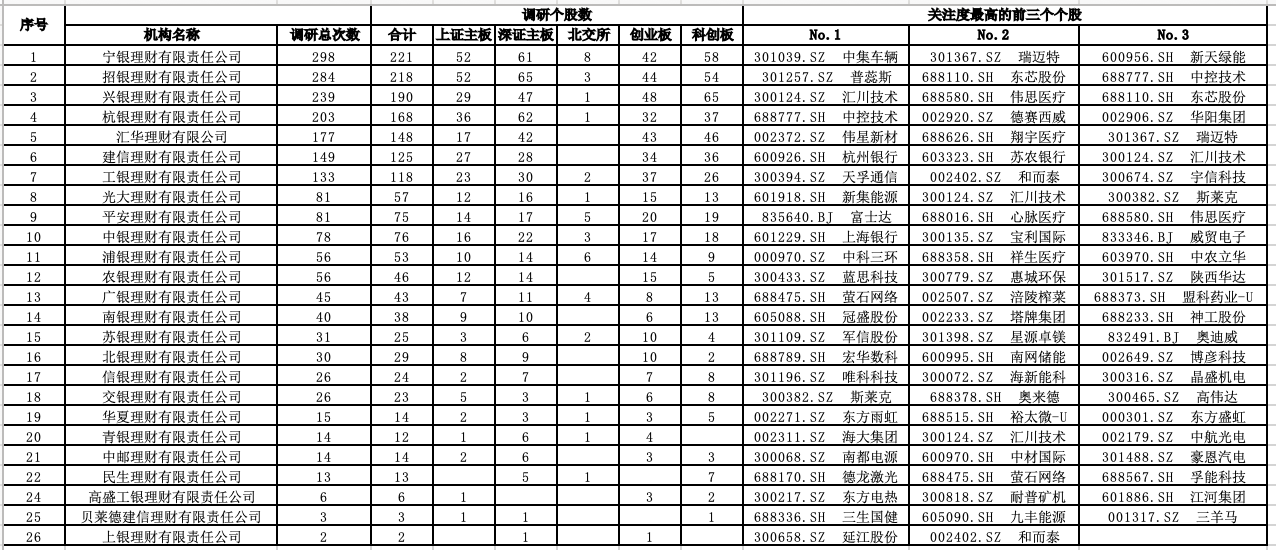
Group 1 - The issuance of equity and mixed financial products has significantly increased in 2025, with over 300 products currently available in the market [1][5] - As of September 2025, wealth management companies have conducted over 2,100 surveys of A-share listed companies, with a focus on the ChiNext and STAR Market, accounting for nearly half of the total surveys [2][4] - The active engagement of wealth management companies in surveys reflects a strategic shift towards active management and equity investment, influenced by macroeconomic conditions and changing client demands [1][4] Group 2 - The number of equity and mixed financial products issued in 2025 reached 259, with a total scale of 727 billion yuan, surpassing the entire issuance scale of the previous year [5][6] - The focus on "hard technology" companies has emerged, with frequent surveys conducted on firms like Zhongkong Technology and Dongxin Co., indicating a trend towards sectors with strong growth potential [4][6] - The current market environment shows a preference for "fixed income plus" products, as wealth management companies seek to meet client demand for higher risk-return profiles [5][6] Group 3 - The direct equity allocation scale for wealth management products dropped to a five-year low in the first half of 2025, while indirect allocation through funds reached a five-year high [6][7] - The issuance of mixed and "fixed income plus" products has significantly increased since August 2025, with expectations that total equity allocation will exceed 100 billion yuan in the latter half of the year [7] - The construction of equity investment capabilities within wealth management companies is deemed crucial for meeting the increasing client demand for equity investments as market conditions improve [7]