
劳动者权益保障

Search documents
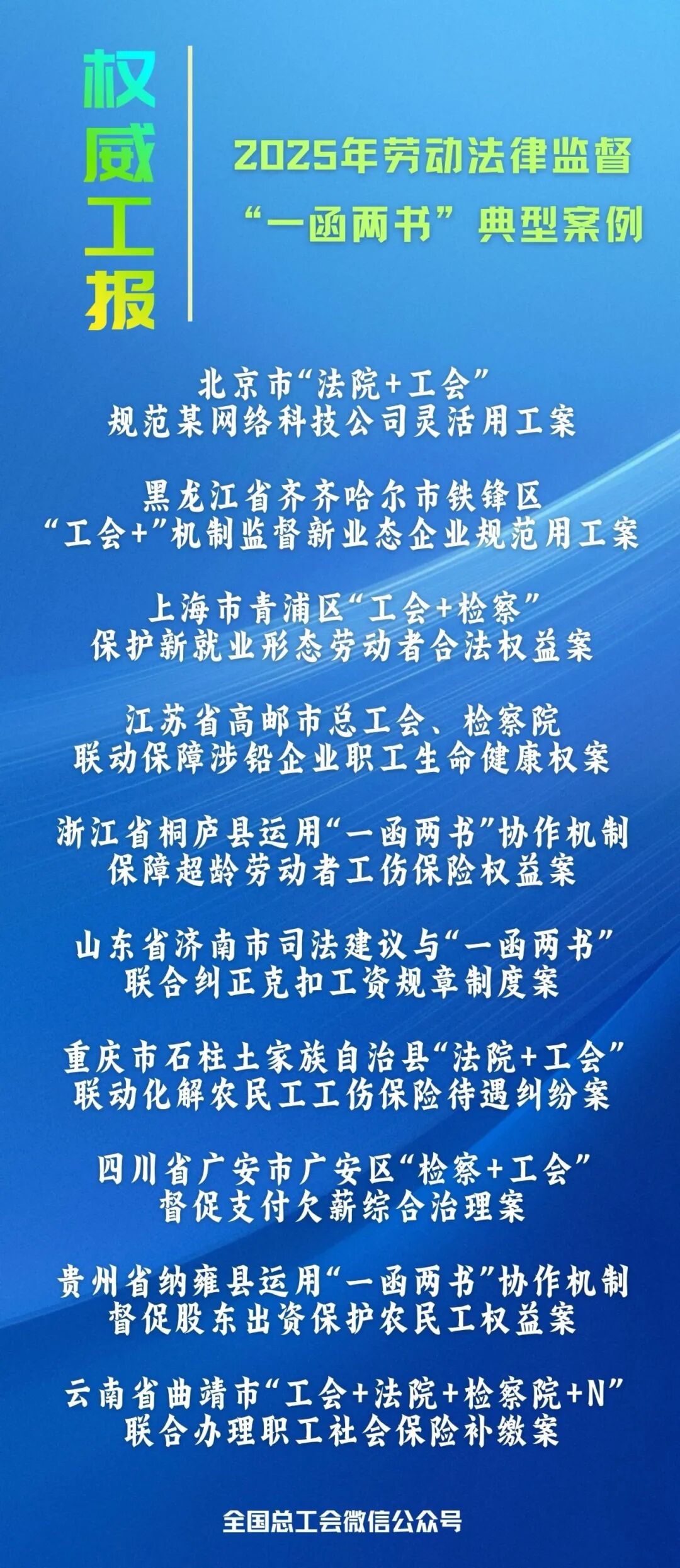
全国总工会、最高法、最高检联合发布2025年劳动法律监督“一函两书”典型案例
Yang Shi Wang· 2025-12-25 04:34
Core Viewpoint The article discusses the collaboration between the All-China Federation of Trade Unions, the Supreme People's Court, and the Supreme People's Procuratorate in promoting labor law supervision through ten typical cases, emphasizing the protection of workers' rights, especially in new employment forms, and the establishment of a multi-faceted cooperative mechanism for labor rights protection. Group 1: Key Characteristics of the Cases - The cases highlight the protection of the legitimate rights and interests of workers in new employment forms, ensuring timely and efficient handling of cases involving labor remuneration, rest, safety, and insurance [3][4] - The multi-faceted collaborative mechanism is emphasized, showcasing the systematic integration of social and judicial supervision to address labor disputes effectively [3][4] - The cases demonstrate the preventive and protective effects of governance through similar case management, aiming to resolve conflicts at the grassroots level [3][4] Group 2: Case Summaries - Case 1 involves a network technology company where the court ruled that the company was liable for unpaid wages due to improper outsourcing practices, highlighting issues in flexible employment [5][6] - Case 2 focuses on a new employment form in Heilongjiang, where the union and the procuratorate worked together to ensure the rights of delivery workers were protected, addressing issues like lack of insurance and inadequate working conditions [9][10] - Case 3 discusses the algorithmic issues in the express delivery industry in Shanghai, where the court and union collaborated to rectify unfair practices affecting workers' rights [13][14] - Case 4 addresses the health rights of workers in lead-related industries, where the union and procuratorate worked to ensure compliance with social insurance laws [18][19] - Case 5 highlights the protection of older workers' rights to workers' compensation, showcasing the collaborative efforts of the union and procuratorate in addressing legal ambiguities [22][23] - Case 6 illustrates the judicial recommendations and union supervision in correcting wage deduction practices in a car company, emphasizing the importance of fair labor practices [27][28] - Case 7 demonstrates the resolution of a workers' compensation dispute through the collaboration of the court and union, showcasing effective dispute resolution mechanisms [32][33] - Case 8 involves a construction company where the union and procuratorate worked together to ensure payment of owed wages to migrant workers, highlighting the importance of legal compliance [35][36] - Case 9 discusses the enforcement of shareholder contributions to protect migrant workers' rights in a company that failed to pay wages, showcasing the collaborative efforts of various authorities [39][40] - Case 10 illustrates a multi-department collaboration to address social insurance payment issues in companies, emphasizing the need for coordinated efforts to protect workers' rights [43][44]

【认真学习贯彻党的二十届四中全会精神·专家访谈】以高质量劳动法治筑牢高质量充分就业之基
Xin Lang Cai Jing· 2025-12-21 20:41
Group 1 - Labor law construction is a key support for promoting high-quality and full employment, as well as for driving sustainable economic and social development [1][2] - The 20th Central Committee's Fourth Plenary Session emphasized strengthening labor rights protection and creating a fair and orderly employment environment, guiding labor law construction during the 14th Five-Year Plan period [1][2] - High-quality employment requires both quantity and quality, necessitating a fair and stable legal environment to achieve employment goals [2][3] Group 2 - Strengthening labor law can better regulate the labor market, creating fairer employment opportunities and environments [2][3] - Labor law promotes harmonious labor relations by emphasizing written labor contracts and penalties for illegal dismissals, contributing to market stability [2][3] - Labor laws ensure workers' rights, including fair wages, rest rights, and social security, enhancing the quality of employment [2][3] Group 3 - The proposal to improve the labor standards system and labor relations negotiation mechanisms responds to the goal of high-quality employment [4][5] - Labor standards legislation is necessary to set minimum conditions for labor, as there is currently no dedicated labor standards law in China [4][5] - The labor relations negotiation mechanism is crucial for protecting workers' rights and fostering harmonious labor relations, especially for new employment forms [5] Group 4 - Labor legislation must adapt to economic and social developments, addressing issues such as employment discrimination and the impact of new technologies [6][7] - The need for a labor standards law is urgent, particularly to address new rights arising from the digital age, such as personal information protection and workplace harassment prevention [6][7] - Collective bargaining lacks specific legal regulations, necessitating prompt legislative action to protect new employment forms [7] Group 5 - The rise of platform work presents significant challenges to traditional labor law, requiring legal frameworks to protect new employment forms [8][9] - Proposed labor standards legislation should include provisions for new employment forms, ensuring fair compensation and working conditions [8][9] - Legal responses must address digital rights and ensure workers have participation and negotiation rights regarding platform algorithms [8][9] Group 6 - Labor law construction must continuously adjust to new situations and demands, ensuring comprehensive protection for workers [9][10] - Employment promotion legislation should ensure a balance between labor supply and market demand, encouraging new industry development [9][10] - Social insurance rights for flexible and new employment forms need to be improved to address social risk sharing [10]
【人民日报】冰城驿站,让温暖常驻(迈向“十五五”的民生图景)
Ren Min Ri Bao· 2025-12-11 00:18
加强劳动者权益保障。 ——摘自"十五五"规划建议 黑龙江哈尔滨道里区,清晨5点,室外温度低至零下20摄氏度。 松花江畔的街道上,寒风包裹着雪粒袭来,在路上铺了层薄霜。尽管戴了手套,环卫工人蒋华英握 着扫帚的手仍然冻得有些发红,处理完晚班的工作,她搓着手快步走向街边透着暖光的房子——户外驿 站。这间40平方米的户外驿站位于哈尔滨防洪纪念塔与中东铁路桥之间,是户外劳动者的暖心"补给 站"。 "每次来驿站不仅是歇歇脚,还能让我们这些成天在外面跑的快递员知道工会有哪些普惠服务政 策。"小杨看着张贴在宣传栏上的免费体检通知,默默记下体检地点和日期,"我妻子去年还参加了'直 播电商妈妈岗'技能培训,就是在驿站了解到的。" 方便、温暖、贴心,这样的户外驿站,在哈尔滨已有668个,既有固定站点,也有公交车改造的流 动驿站。在选址环节,哈尔滨组织公安、商务、公交等相关部门单位共同商讨,锁定重点商圈、热门景 区、快递分拣点等户外劳动者密集区域布设户外驿站。亚冬会期间,有5个流动驿站设置在场馆周边, 为志愿者和环卫工人等提供便捷服务。目前,哈尔滨市已有47个户外驿站获评全国最美驿站。 "'十五五'时期,我们要让驿站的服务更暖、更贴 ...
最高检部署开展检察机关治理欠薪冬季专项行动
Xin Hua She· 2025-11-28 09:09
Core Points - The Supreme People's Procuratorate has issued a notice to enhance the prosecution's role in addressing wage arrears, particularly for migrant workers, to support high-quality economic development and maintain social stability [1][2] Group 1: Legal Actions and Enforcement - National procuratorial agencies are required to strictly punish malicious wage arrears crimes and ensure effective legal actions against such offenses [1] - The notice emphasizes the need for timely initiation of case supervision procedures for cases that should be filed but are not, preventing any failure to prosecute [1] - There is a focus on ensuring that wage recovery efforts are integrated throughout the prosecution of wage arrears crimes, promoting the use of leniency for those who confess and fulfill their payment obligations [1] Group 2: Support for Workers - The notice mandates high-quality handling of cases related to wage arrears, ensuring that court rulings in favor of migrant workers are enforced [2] - Increased support for migrant workers in pursuing wage claims is highlighted, including the identification and punishment of false claims related to wage debts [2] - The notice targets industries with high incidences of wage arrears, such as construction, online delivery, and sanitation, to enhance administrative and legal oversight [2] Group 3: Collaboration and Mediation - The notice encourages mediation between employers and migrant workers to resolve wage issues amicably when there is a willingness to negotiate [2] - It distinguishes between malicious wage arrears and those arising from objective difficulties in business operations, aiming to balance worker rights and enterprise development [2] - The implementation of a feedback system for public grievances is emphasized, along with the promotion of judicial assistance and the use of big data for case management [2]
最高检部署开展治理欠薪冬季专项行动 聚焦工程建设、网络订单配送等多发领域
Yang Shi Wang· 2025-11-28 03:50
Core Viewpoint - The Supreme People's Procuratorate has issued a notification to enhance the prosecution's role in addressing wage arrears, particularly focusing on protecting the rights of migrant workers and supporting high-quality economic development [1][2]. Group 1: Prosecution's Role and Actions - The notification emphasizes the need for nationwide prosecution agencies to legally combat and severely punish malicious wage arrears crimes, ensuring effective deterrence through criminal penalties [1]. - It mandates the initiation of case supervision procedures for any wage arrears cases that should be filed but are not, preventing any cases from being ignored or unpunished [1]. - The prosecution is instructed to integrate wage recovery efforts throughout the process of combating wage arrears crimes, encouraging suspects to fulfill their wage payment obligations promptly and fully [1]. Group 2: Supervision and Support for Workers - The notification calls for high-quality handling of effective judgments in wage arrears disputes, enhancing supervision over the execution of these cases to ensure migrant workers' rights are upheld [2]. - It highlights the need to increase support for migrant workers in pursuing wage claims and to identify and penalize false wage claims during bankruptcy and execution processes [2]. - The focus is on industries with high occurrences of wage arrears, such as construction, online delivery, and sanitation, with an emphasis on administrative litigation and non-litigation execution supervision [2]. Group 3: Legal and Social Framework - The notification integrates wage arrears governance into the key areas of public interest litigation for labor rights, promoting the use of legal supervision mechanisms [2]. - It advocates for the "Fengqiao Experience" to enhance community governance and encourages mediation between enterprises and migrant workers to resolve wage issues amicably [2]. - The notification stresses the importance of distinguishing between malicious wage arrears and those arising from objective difficulties in business operations, balancing the protection of workers' rights with the development of enterprises [2].
发展向前 民生向暖|走好高质量充分就业之路
Zhong Guo Jing Ji Wang· 2025-11-19 06:25
Core Viewpoint - The article emphasizes the importance of prioritizing employment and enhancing policy support, training, and services to improve employment quality and expand job opportunities, aligning individual development with high-quality economic growth [5][6]. Group 1: Employment Strategy - The "14th Five-Year Plan" highlights the implementation of an employment-first strategy, aiming for over 12 million new urban jobs annually, which is crucial for improving livelihoods and supporting economic development [5][6]. - The focus on "high-quality" and "sufficient" employment indicates a need for job matching, fair employment conditions, and stable income for workers, reflecting a gradual and balanced approach to employment [5][6]. Group 2: Economic Development and Job Creation - Economic growth is identified as the fundamental pathway to achieving high-quality employment, with new industries and job roles emerging, particularly in sectors like low-altitude economy and drone technology [6]. - By the end of 2024, the number of registered drone users is expected to reach 1.619 million, with a total of 2.177 million registered drones, both doubling from the previous year, showcasing significant market growth [6]. Group 3: Training and Skills Development - Various regions are implementing innovative training programs, such as school-enterprise cooperation and targeted training, to enhance employment rates post-training [6]. - The development of a comprehensive skills training system is being prioritized to adapt to new economic demands, particularly in digital economy and smart manufacturing sectors [6]. Group 4: Labor Rights and Protection - The Ministry of Human Resources and Social Security has initiated pilot programs for occupational injury protection for new employment forms, covering over 22 million individuals by September of this year [7]. - The establishment of a multi-layered protection system for workers' rights, including pension subsidies for delivery workers, is crucial for addressing economic and social development challenges [7].

从“安全护甲”到“未来发展”,淘宝闪购让骑士保障更有温度
Cai Jing Wang· 2025-11-07 14:24
Core Insights - The recent rumors about the potential integration of Ele.me and Taobao Flash Delivery have sparked industry discussions, particularly focusing on the ongoing emphasis on rider rights, incentives, and protections [1] - Taobao Flash Delivery is establishing a comprehensive mechanism that includes equipment upgrades, social security coverage, and career development, creating a robust safety net for urban riders [1][3] - The platform's policies reflect a clear three-tiered approach: basic safety guarantees, medium to long-term social security, and career development support, demonstrating a precise understanding of rider needs and a commitment to social responsibility [1][9] Social Security Coverage - Taobao Flash Delivery announced a policy in August to provide nationwide riders with up to 100% social security subsidies, marking a historic leap in the social security system for delivery riders [3][4] - The policy is designed with humanistic considerations, offering subsidies regardless of full-time or part-time status, and allowing riders to choose where to pay their contributions [3][4] - For example, a typical rider in Shenzhen could receive a subsidy of approximately 684.85 yuan per month based on local insurance contribution standards [4] Equipment Upgrade - A nationwide uniform renewal initiative is underway, providing a new set of uniforms that enhance both safety and professional identity for riders [5][6] - The new uniforms and equipment, designed with safety and functionality in mind, signify a shift from a labor-intensive model to a more professionalized service industry [5][6] - The upgraded gear includes features such as windproof, breathable, and water-resistant materials, along with enhanced protective helmets, reflecting the platform's commitment to rider safety [5][6] Development Support - The "City Rider Orange Plan" is being implemented to create a comprehensive support system for rider career development, enhancing the incentive and protection framework [7][8] - This initiative rewards riders for acts of kindness and community service, fostering a positive social impact and encouraging a sense of belonging among riders [7][8] - The plan has already recognized numerous riders for their heroic actions, providing substantial financial rewards and additional benefits [8] Inclusivity and Social Responsibility - The platform has introduced specialized support for disabled riders, showcasing its commitment to inclusivity and equitable employment opportunities [9] - The comprehensive rider rights protection system addresses core demands from the rider community, moving towards a new stage of professional service industry characterized by skill certification, institutionalized social security, and visible professional dignity [9]

乌海800余名快递员签订集体合同
Nei Meng Gu Ri Bao· 2025-09-30 07:24
Core Points - The signing of the collective contracts in the express delivery industry of Wuhai City aims to protect the rights of over 800 employees across 7 companies [1] - The express delivery industry faces challenges such as high labor intensity and insufficient compensation and benefits for workers [1] - The collective negotiation mechanism is being actively promoted to improve working conditions and enhance the rights and benefits of delivery personnel [1] Group 1 - The Wuhai City Express Delivery Industry Association and the Wuhai City Express Delivery Industry Trade Union signed the "Wuhai City Express Delivery Industry Collective Contract" and the "Wuhai City Express Delivery Industry Wage Special Collective Contract" [1] - The contracts cover all employees in the local express delivery sector, ensuring comprehensive rights protection [1] - Delivery personnel representatives highlighted issues with the current wage model and high turnover rates among older employees, suggesting reforms to the compensation system [1] Group 2 - The Wuhai City Federation of Trade Unions will continue to strengthen coordination with relevant departments to ensure the effective implementation of the collective contracts [2] - Efforts will be made to enhance the sense of gain, happiness, and safety for express delivery workers [2] - The initiative aims to inject new momentum into the high-quality development of new employment forms in the city [2]
用“不消费”倒逼996企业倒闭?别天真了,这才是劳动者唯一的出路
Sou Hu Cai Jing· 2025-09-28 17:42
Core Viewpoint - The article discusses the challenges of consumer boycotts against "sweatshop" products, highlighting the information gap that consumers face in understanding labor compliance and the systemic issues that prevent effective change in labor rights protection [1] Information Dilemma: The Invisible "Sweatshops" - Consumers struggle to access genuine labor compliance information due to companies' reluctance to disclose sensitive data, often citing business confidentiality [3] - The complexity of supply chains makes it difficult for consumers to trace back to original suppliers, leading to a lack of transparency [3][4] - Different labor regulations across regions and internal management chaos within companies further complicate the situation, making it hard for consumers to make informed ethical choices [4] Reality of Choices: Cost Considerations - Workers prioritize cost-effectiveness in their purchases due to limited incomes and rising living expenses, leading them to seek high-value products [5] - The prevalence of e-commerce and price transparency drives consumers to focus on getting better quality for the same price, reinforcing the importance of cost-performance ratio in their buying decisions [5][6] True Solution: Institutional Transparency - The article emphasizes the need for improved legal frameworks to protect workers' rights, as existing labor laws do not adequately cover new employment forms like gig work [8] - Regulatory bodies are becoming more professional and utilizing big data to monitor compliance, aiming to enhance oversight and reduce violations [9] - The role of labor unions is highlighted as crucial in negotiating better conditions and providing legal support for workers, fostering a more inclusive dialogue in workplaces [9][10]
我听说在温州,双休是要浸猪笼的
Hu Xiu· 2025-09-27 11:37
Core Viewpoint - The article discusses the labor conditions in Wenzhou, highlighting the disparity between work schedules and compensation, particularly the prevalence of single rest days and the lack of employee benefits in many industries [1][6][9]. Group 1: Work Conditions - Many workers in Wenzhou experience single rest days or even monthly rest days, which are not sufficient for a balanced work-life [2][4]. - The article describes a scenario where workers are pressured to work long hours, often until 10 or 11 PM, with minimal compensation, leading to a cycle of exhaustion and financial struggle [4][5]. Group 2: Economic Implications - The current labor practices in Wenzhou are seen as detrimental to economic growth, with the region's economy failing to match its designation as a second-tier city [9][11]. - The article argues that the normalization of labor exploitation and inadequate rest days reflects a regression in labor rights, which could hinder overall economic development [8][9]. Group 3: Social Commentary - There is a critique of the societal acceptance of poor labor conditions, where workers feel compelled to accept unfavorable terms due to a lack of alternatives [6][8]. - The article emphasizes the importance of recognizing labor rights and the need for a healthier work environment, advocating for better treatment of workers across all industries [10][11].