反内卷行动

Search documents
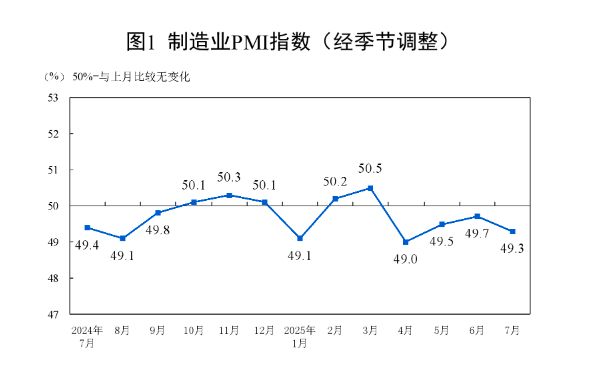
制造业PMI季节性回落至49.3%,下阶段走势如何
Di Yi Cai Jing Zi Xun· 2025-07-31 03:29
Economic Overview - The manufacturing Purchasing Managers' Index (PMI) for July is reported at 49.3%, a decrease of 0.4 percentage points from the previous month, indicating a slight contraction in manufacturing activity [1] - The non-manufacturing business activity index stands at 50.1%, also down by 0.4 percentage points, reflecting a slowdown in growth [1] - The composite PMI output index is at 50.2%, down 0.5 percentage points, but still above the critical point, suggesting overall expansion in business activities [1] Manufacturing Sector Insights - The new orders index for manufacturing is at 49.4%, a decline of 0.8 percentage points, indicating a tightening in market demand [3] - The new export orders index is reported at 47.1%, down 0.6 percentage points, further highlighting weak demand [3] - Despite the demand weakness, the production index remains at 50.5%, indicating continued expansion in manufacturing activities for the third consecutive month [3] - The raw material purchase price index has risen to 51.5%, an increase of 3.1 percentage points, suggesting a recovery in raw material prices [3] Price Trends - The ex-factory price index for manufactured goods is at 48.3%, up 2.1 percentage points, marking the second-highest point this year [3] - The basic raw materials sector is driving the stabilization and recovery of market prices, with the purchase price index rising over 7 percentage points to 52% [4] Business Confidence and Expectations - The production and business activity expectation index is at 52.6%, an increase of 0.6 percentage points, indicating improved confidence among manufacturing enterprises [4] - Large enterprises maintain a PMI of 50.3%, while medium-sized enterprises show improvement with a PMI of 49.5%, and small enterprises have a PMI of 46.4%, indicating varying levels of economic health across different company sizes [4] Non-Manufacturing Sector Performance - The non-manufacturing business activity index is at 50.1%, reflecting a slowdown but still within the expansion range [8] - The construction sector's business activity index is at 50.6%, down 2.2 percentage points, indicating a slowdown due to seasonal weather impacts [8] - Consumer spending during the summer shows positive trends, with retail and postal service indices rising above 50% and 60%, respectively, indicating strong consumer purchasing intentions [9] Future Outlook - The construction sector is expected to rebound post-rainy season, with infrastructure activities projected to continue steady growth [8][9] - The overall economic foundation remains solid, with expectations for continued stable expansion and quality improvement in the second half of the year, supported by ongoing macroeconomic policies [5]

新闻1+1丨中央政治局会议:下半年经济怎么干?
Yang Shi Wang· 2025-07-30 22:05
Group 1 - The core viewpoint of the article emphasizes the need for China to focus on economic growth strategies for the second half of the year, following a better-than-expected performance in the first half [1] - The international environment has shown some improvement since April, with progress in trade negotiations, but complexities and challenges remain for the second half [2][4] - Domestic economic growth reached 5.3% in the first half, but structural issues persist, indicating potential uncertainties ahead [4] Group 2 - Expanding consumer demand is a strategic priority for China, requiring systemic adjustments rather than short-term stimulus measures [5] - Policies aimed at improving education support and social security for vulnerable groups are expected to continue in the second half, enhancing consumer spending [7] - Investment remains crucial for stabilizing growth, with a focus on revitalizing private investment and addressing the slowdown in real estate and private sector investment [9] Group 3 - The need to address disordered competition among enterprises is highlighted, as many companies are currently unprofitable despite advancements in technology and industry upgrades [11] - The emphasis on stabilizing foreign trade and foreign investment reflects changes in the external trade environment, particularly regarding US-China trade negotiations [12][13] - The "old-for-new" policy has a budget of 300 billion yuan, with expectations for continued expansion in the second half, focusing on new consumer goods and services [15] Group 4 - The focus on high-quality urban renewal indicates a shift in policy to address changing risk dynamics in the real estate sector, aiming to stabilize the market and reduce risks [15]
反内卷号角吹响,锂行业迎来积极变化
Xiangcai Securities· 2025-07-29 07:53
Group 1: Macro Perspective - The Chinese government has initiated actions to combat "involution" in various industries, focusing on enhancing product quality and regulating low-price competition[3] - The recent meetings of the Central Economic Work Conference and the Central Finance Committee emphasize the need for a unified national market and the elimination of chaotic competition[9][14] - The "anti-involution" campaign is expected to reshape and invigorate the Chinese economy over the long term, addressing key economic bottlenecks[15] Group 2: Lithium Industry Insights - The lithium industry, as the upstream of the new energy vehicle supply chain, has seen intensified competition and a decline in lithium prices since 2023 due to excess capacity[4][16] - In 2024, China's lithium carbonate production capacity is projected to reach 1.3 million tons, with an output of 701,000 tons, reflecting a year-on-year increase of 35.4%[16] - Recent regulatory actions, including the rectification of Yichun lithium mines and the suspension of operations at Zangge Lithium, signal a government effort to stabilize lithium prices and restore order in the industry[19][20] Group 3: Investment Opportunities - The anti-involution movement is expected to create investment opportunities across emerging industries such as new energy vehicles, lithium batteries, and photovoltaics, as well as traditional industries facing overcapacity issues[6][21] - The restructuring of various industries in response to the anti-involution campaign is anticipated to yield a series of investment prospects[5]
开工低位压减库存 多措并举缺一不可----2025年上半年多晶硅市场概况
中国有色金属工业协会硅业分会· 2025-07-18 03:04
Core Viewpoint - The silicon industry is facing significant challenges in 2025, with prices consistently below production costs, leading to widespread losses among producers. Group 1: Market Prices and Production Costs - In the first half of 2025, the average price of polysilicon dropped to 38,000 yuan per ton, below the industry average cost for over 14 months [1] - Industrial silicon prices fell to 9,648 yuan per ton by the end of April 2025, remaining below average costs for nearly 3 months [1] - The average price of 182mm silicon wafers decreased to 0.95 yuan per piece, with cost overruns lasting over 2 months [1] Group 2: Production and Operational Rates - To address supply-demand imbalances, companies reduced production, resulting in historical lows for monthly operating rates: 41.9% for industrial silicon, 38.6% for polysilicon, and 44.3% for silicon wafers [1] - The average monthly production of polysilicon in the first half of 2025 was 100,000 tons, with a significant drop to 92,000 tons in February, a year-on-year decrease of 47.4% [1] - The overall operating rate of the top five polysilicon producers was 42.2%, with the lowest at 24.1% [1] Group 3: Inventory and Supply-Demand Dynamics - Prior to 2023, polysilicon inventory was maintained at around 2 weeks of production, but by the end of 2023, inventory accumulated to 63,000 tons due to supply surplus [3] - By the end of 2024, total inventory reached a historical high of 398,000 tons, with a year-on-year increase of 335,000 tons [3] - In the first half of 2025, domestic polysilicon production was approximately 597,000 tons, a year-on-year decrease of 44.0%, with a slight inventory reduction of 31,000 tons by the end of June [3] Group 4: Price Trends and Market Adjustments - Polysilicon prices showed a "stable then declining" trend in the first half of 2025, with an average price of 36,800 yuan per ton, down 28.8% year-on-year [7] - From January to mid-April, prices increased slightly by 2.7% but fell by 17.5% from late April to the end of June [7] - The global demand for polysilicon in 2025 is projected at 1.4 million tons, with domestic demand around 1.3 million tons [8] Group 5: Industry Restructuring and Future Outlook - The polysilicon industry is undergoing significant adjustments and restructuring, with government interventions aimed at stabilizing prices and production [8][10] - Measures include capacity mergers, performance standards, and efforts to avoid excessive competition that leads to price declines [10] - The industry is expected to face ongoing challenges, but with coordinated efforts, a more balanced market may emerge [10]

冠通期货热点评论:“大美丽法案”通过对大宗商品的影响
Guan Tong Qi Huo· 2025-07-07 06:31
1. Report Industry Investment Rating - Not mentioned in the provided content 2. Core View of the Report - The passage of the "Great Beauty" Act may serve as a relay for the "anti-involution" action, further boosting commodity prices. It can be observed from both macro - aggregate and structural - variety dimensions. The act will have different impacts on the economy, inflation, and various commodity prices in the short and long term [2] 3. Summary According to Related Content Event Summary - On July 4, 2025, US President Trump signed the "Great Beauty" tax and spending bill into law. The bill passed the House of Representatives on July 3 with 218 votes in favor and 214 against, and was approved by the Senate on July 1. It is a landmark legislative agenda after Trump returned to the White House in early 2025, covering corporate tax cuts, personal and family tax cuts, reduction of clean - energy subsidies, compression of Medicaid, and cuts to the Supplemental Nutrition Assistance Program (SNAP) [1] Impact on the Macro - Aggregate - Globally, the "Great Beauty" Act's measures such as raising the debt ceiling and corporate tax cuts will boost US economic growth and inflation in the short term but damage US credit and increase the possibility of stagflation in the long term. It will also affect the Fed's interest - rate cut rhythm. Asset prices will show a weak dollar, rising US Treasury yields and US stocks, and commodities will benefit in the short term. Domestically, the act is expected to support the rebound of commodity prices [2] Impact on Structural Varieties - **Gold**: Benefited from short - term dollar weakness and long - term US credit weakening, but the slowdown of Fed's interest - rate cut expectations weakens the increase in gold prices [4] - **New - energy - related Commodities**: Measures like abolishing new - energy tax credits in the act will hit the terminal demand of the new - energy industry, reducing the industrial demand for silver, copper, polysilicon, lithium carbonate, etc. [4] - **Traditional Energy (Crude Oil)**: It will benefit in the short term but face long - term supply increases due to policies in the act, showing a short - term positive and long - term negative impact [4] - **Agricultural Products**: The impact is less than that on industrial products. The cut to the SNAP will suppress short - term consumer demand and indirectly reduce the demand for agricultural products [4]
光伏硅片、电池价格跌势未止 上游控量保价力度成关键变量
Zheng Quan Shi Bao Wang· 2025-07-04 02:54
Group 1: Market Overview - The average transaction price of multi-crystalline silicon N-type raw materials has slightly rebounded to 34,700 yuan/ton, up 0.87% week-on-week [1] - The market for silicon materials shows signs of recovery, with some previously delayed orders being renegotiated at higher-than-expected prices [1][2] - The average price of multi-crystalline silicon has been below the industry average cost for over a year, leading to the shutdown of several companies due to long-term losses [1][5] Group 2: Price Dynamics - InfoLink reports that new single transactions are close to 34,000-36,000 yuan/ton, but actual transactions remain low due to inventory and weak demand [2] - The average transaction prices for N-type single crystal silicon wafers have decreased, with N-type G10L at 0.86 yuan/piece, down 3.37% week-on-week [2] - The decline in silicon wafer prices is attributed to weak demand and pressure from battery manufacturers to lower prices [2][3] Group 3: Future Outlook - The silicon industry association believes that silicon wafer prices are currently below the cash costs of most producers, leading to a strong willingness to maintain prices [3] - Despite potential price stabilization due to production cuts, InfoLink warns of continued downward pressure on prices in the short term due to weak end-demand [3][4] - The overall uncertainty in the market is increasing, with potential for further price declines unless upstream prices can be stabilized [4][6] Group 4: Production and Demand - In June, domestic multi-crystalline silicon production was approximately 102,000 tons, remaining stable and matching demand [5] - The total domestic production for the first half of the year was 596,000 tons, a significant year-on-year decrease of 44.1% [5] - The forecast for global multi-crystalline silicon demand in 2025 is about 1.4 million tons, with domestic demand at approximately 1.3 million tons [5]
【安泰科】单晶硅片周评-企业计划减产挺价 硅片价格有望触底企稳(2025年7月3日)
中国有色金属工业协会硅业分会· 2025-07-03 08:47
Group 1 - The price of silicon wafers continues to decline, with N-type G10L wafers averaging 0.86 yuan per piece, down 3.37% week-on-week; N-type G12R wafers at 1.00 yuan, down 1.96%; and N-type G12 wafers at 1.19 yuan, down 3.25% [1] - The main reasons for the decline in silicon wafer prices are weak demand and price pressure from downstream battery manufacturers, leading to slow procurement of silicon wafers [1] - The overall operating rate in the industry has slightly decreased, with leading companies operating at 50% and 52%, while integrated companies are operating between 50%-80% [1] Group 2 - Downstream battery and module prices have also slightly decreased, with mainstream battery prices at 0.23-0.24 yuan/W, down 0.01 yuan/W, and module prices at 0.65-0.66 yuan/W, also down 0.01 yuan/W [2] - Recent policy meetings have emphasized the need to regulate low-price competition and encourage companies to improve product quality, aiming to phase out outdated production capacity [2] - There is a strong willingness among silicon wafer manufacturers to maintain prices as current wafer prices are below the cash costs of most producers, and major manufacturers plan to reduce operating rates by about 40% starting in July [2]