居民增收

Search documents
明年将如何提高居民收入、扩内需 中央财办详解中央经济工作会议
2 1 Shi Ji Jing Ji Bao Dao· 2025-12-18 00:02
Core Viewpoint - The central economic work conference indicates that China's economy is expected to grow around 5% in 2025, with a total economic volume reaching approximately 140 trillion yuan, despite facing challenges in the coming year [1][11]. Group 1: Macroeconomic Policies - China will continue to implement more proactive fiscal and monetary policies in 2026, maintaining necessary fiscal deficits and debt levels while optimizing fiscal expenditure structures [2][12]. - The total government bond issuance for 2025 is projected to be 11.86 trillion yuan, with a deficit rate of around 4%, which is expected to remain stable in 2026 [2][13]. - Monetary policy will focus on maintaining liquidity and supporting economic growth, with tools including interest rate cuts and reserve requirement ratio adjustments [3][14]. Group 2: Income and Employment - A plan to increase urban and rural residents' income is expected to be implemented in 2026, aiming to enhance the quality of employment and raise the basic pension for residents [5][15]. - The goal is to synchronize income growth with economic growth, ensuring that labor remuneration increases alongside productivity [6][16]. - Employment policies will prioritize stability, focusing on key groups such as college graduates and migrant workers, while promoting training in high-demand industries [7][17]. Group 3: Consumption and Investment - Expanding domestic demand is a top priority for 2026, with a focus on balancing goods and service consumption, particularly in sectors like tourism and elderly care [8][18]. - Investment is expected to stabilize, with an emphasis on infrastructure projects that enhance consumer services and improve living standards [9][20]. - The government aims to stimulate private investment, particularly in high-tech and service sectors, to boost overall economic activity [10][21].
国家发改委:着力释放居民消费潜力
Zheng Quan Shi Bao Wang· 2025-12-16 01:53
Core Viewpoint - The article emphasizes the importance of implementing a strategy to expand domestic demand, focusing on enhancing consumer spending potential and capability [1] Group 1: Enhancing Consumer Spending Potential - The government aims to significantly boost residents' willingness to consume through targeted actions [1] - Initiatives include stabilizing major consumption sectors and promoting policies like trade-in for consumer goods [1] - There is a focus on creating new consumption scenarios through brand leadership, standard upgrades, and new technology applications [1] - Support will be provided for emerging economies, event economies, and e-commerce development [1] - Key projects will be implemented in areas such as elderly care, childcare, health, and cultural tourism to meet the needs of consumption upgrades and population aging [1] - Urban renewal projects will be prioritized, including updates to parking facilities and old elevators [1] - Efforts will be made to expand inbound consumption and improve convenience levels [1] Group 2: Enhancing Consumer Capability - The government will strengthen employment-first policies to stabilize and expand job opportunities through multiple channels [1] - There will be an emphasis on optimizing the entrepreneurial environment to promote employment [1] - A plan to increase income for urban and rural residents will be implemented, aiming to raise the share of residents' income in national income distribution [1] - The government will work to ensure that labor remuneration increases in tandem with economic growth and productivity [1] - Policies aimed at direct consumer benefits will be enhanced, with increased government funding for social welfare expenditures [1] - The social security system will be improved, and efforts will be made to promote equal access to basic public services [1] - Support for childbirth and parenting will be increased [1]
明明是要提振消费,怎么成了鼓励贷款了?
Sou Hu Cai Jing· 2025-12-14 13:00
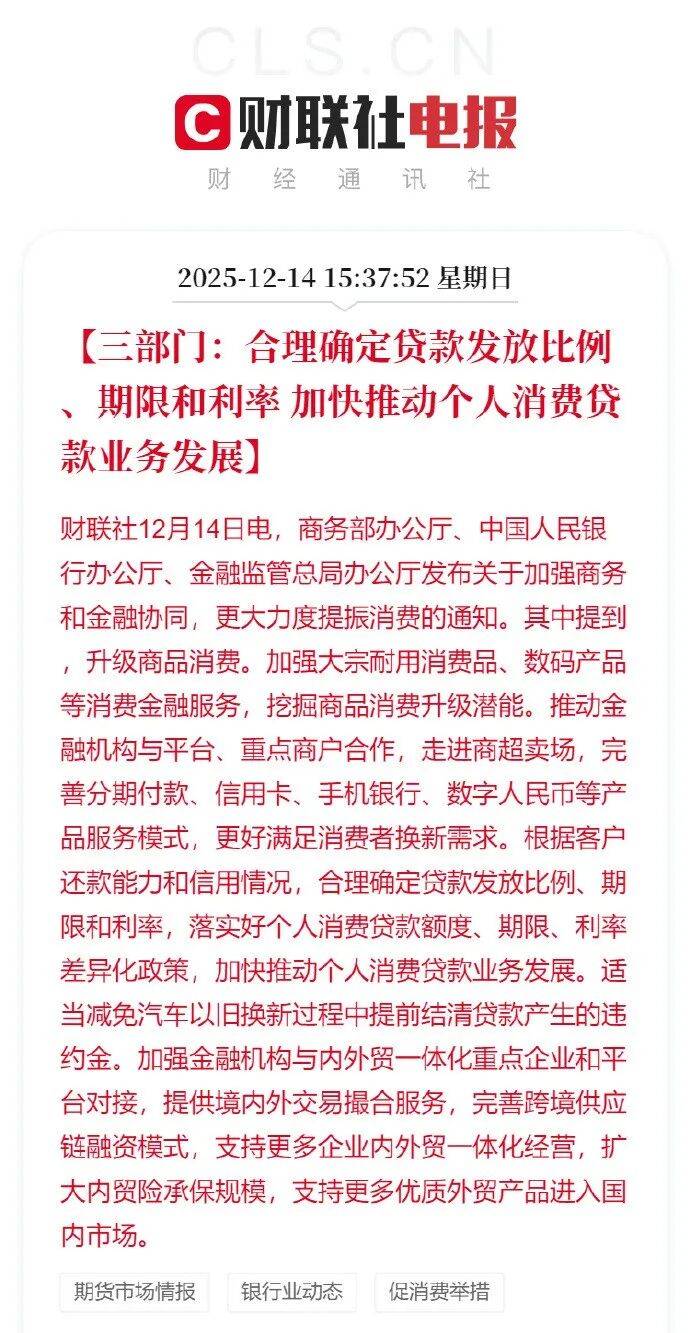
Group 1 - The recent announcement from the Ministry of Commerce, the Central Bank, and the Financial Regulatory Authority focuses on boosting consumer spending by facilitating personal consumption loans [4] - The strategy appears to aim at fundamentally changing the growth model rather than merely stimulating consumption, as indicated by the continuation and potential expansion of national subsidies [4] - Despite the nominal growth of per capita disposable income and consumption expenditure both at 5.3% in 2024, the growth rate of net property income at 2.2% lags behind wage income growth of 5.8%, indicating a reliance on wage income rather than asset appreciation [4][5] Group 2 - The decline in real estate has directly reduced household income, leading to a perception of reduced wealth and consequently tighter spending [5] - The overall household debt level decreased slightly from 63.5% to 63.2% between Q2 and Q3 of 2024, but this is significantly higher than the 20% level a decade ago, indicating a rapid increase in debt primarily driven by housing [6] - The trend of proactive deleveraging is evident, with more individuals opting for early mortgage repayments than taking out new loans, reflecting a cautious approach to financial management [6] Group 3 - Consumer confidence index remains below the neutral line of 100, indicating persistent pessimism among consumers, with a recorded value of 89.4 in October 2025 [7][8] - The decline in real estate prices has led to a reduction in household wealth, affecting consumer spending and employment across related industries [8] - The fundamental issue is identified as insufficient total demand and lack of consumer confidence, rather than inadequate credit supply [10] Group 4 - The approach of increasing credit supply to stimulate consumption is seen as a supply-side solution to a demand-side problem, which may not yield sustainable results [10] - The strategy may lead to a short-term boost in consumption data but risks exacerbating long-term debt burdens and potentially creating new bad debts if economic conditions do not improve [11][12]

以确定性政策托举信心 让百姓“有钱花、敢花钱” | 措施如何精准触达?解读↓
Yang Shi Wang· 2025-12-14 10:00
Group 1 - The core objective of China's economic work for 2026 is to prioritize domestic demand and build a strong domestic market, as highlighted in the recent Central Economic Work Conference [1] - China's total import and export value reached 41.21 trillion yuan in the first 11 months of 2025, marking a year-on-year increase of 3.6%, with a trade surplus exceeding 1 trillion USD for the first time [1][3] - The trade surplus of over 1 trillion USD is the highest in history, showcasing China's irreplaceable role in the global industrial chain and international economic landscape [3] Group 2 - Exports to the US decreased by 18.9% year-on-year, while exports to ASEAN and the EU increased significantly, compensating for the decline in US exports [3] - Private enterprises have become the mainstay of foreign trade, with their import and export value reaching 23.52 trillion yuan, a year-on-year increase of 7.1%, accounting for 57.1% of China's total foreign trade [4] - The import growth was only 0.2%, indicating weak domestic demand, which the Central Economic Work Conference emphasized needs to be addressed [4] Group 3 - The current economic challenge is characterized by strong supply but weak demand, leading to a mismatch that affects both businesses and consumers [7][9] - The final consumption rate is 56.6% of GDP, which is still significantly lower than the 80% rate in developed countries, indicating a large gap and potential for growth [7] Group 4 - The Central Economic Work Conference emphasized the need to shift from price competition to quality competition to address supply-demand mismatches [11][13] - A plan to enhance consumer spending and optimize the supply structure of consumer goods is set to be implemented by 2027, aiming to create significant consumption sectors [13][14] Group 5 - The new policy aims to implement a comprehensive income increase plan for urban and rural residents, moving beyond just supporting low-income groups [16][21] - Experts suggest that improving basic public services and investing in education, healthcare, and elderly care will enhance consumer capacity, particularly for low-income groups [23] Group 6 - The stability of the real estate market is crucial for consumer confidence, with measures proposed to stabilize the market and encourage the acquisition of existing properties for affordable housing [25]

事关居民增收、扩大内需,中国经济年会最新发声
Xin Lang Cai Jing· 2025-12-13 06:54
Group 1 - The 2025-2026 China Economic Annual Conference will be held on December 13 in Beijing, focusing on implementing the spirit of the Central Economic Work Conference and achieving high-quality development for the "14th Five-Year Plan" [1][4] - The Deputy Director of the Central Financial Office, Han Wenxiu, emphasized the need to maintain stable economic growth, employment, and overall price stability while synchronizing the growth of residents' income with economic growth [1][4] - The conference highlighted the importance of continuing a moderately loose monetary policy to support domestic demand expansion and ensure that various policy measures work in concert [1][4] Group 2 - Opportunities for economic development in the coming year include improvements in the microeconomic balance sheets of entities and the wealth effect from the high-tech sector, which can enhance residents' balance sheets [5] - The State-owned Assets Supervision and Administration Commission stressed the need for central enterprises to expand the supply of quality goods and services based on market demand, ensuring stable supply and prices for essential products [5] - The National Development and Reform Commission's Director, Zheng Zhanjie, called for increased efforts to improve people's livelihoods and promote common prosperity, emphasizing the need for an employment-first strategy and improved income distribution [5][6] Group 3 - The "14th Five-Year Plan" suggests establishing a primary distribution mechanism that rewards contributions based on market evaluations, promoting higher earnings for those who work more, possess higher skills, or innovate [6] - The Vice Chairman of the Economic Committee of the National Committee of the Chinese People's Political Consultative Conference, Yang Weimin, pointed out that the low proportion of residents' consumption in total demand is due to the low share of residents' income in national income and significant income disparities [6] - Former Deputy Director of the State Council Development Research Center, Liu Shijun, advocated for reducing the gap in basic public services between urban and rural residents and converting unsold housing into affordable housing for low-income groups [6]
贵州:实施新一轮居民增收行动方案,确保居民收入增长与经济增长基本同步
news flash· 2025-08-01 07:13
Core Viewpoint - The Guizhou Provincial Government has issued an implementation plan to boost consumption, focusing on increasing residents' income and ensuring it grows in sync with economic growth [1] Group 1: Income Growth Initiatives - A new round of income growth action plans will be implemented to ensure that residents' income growth aligns with economic growth [1] - The "Six Six Employment Stabilization Plan" will be promoted, focusing on skills training to enhance employment capabilities in line with industrial development needs [1] Group 2: Support for Entrepreneurship - Strengthened support for entrepreneurship will be provided, including guaranteed loans and one-time subsidies for eligible individuals [1] - Subsidies for venue rental will also be offered to encourage entrepreneurial activities [1] Group 3: Labor and Welfare Measures - The plan includes promoting labor remuneration through project construction in transportation, water conservancy, agriculture, and ecology by using labor instead of cash [1] - There will be a continuous and steady increase in urban and rural minimum living standards to enhance social safety nets [1]
重庆出台26条措施提振消费 涉及促进居民就业增收、保障居民消费能力等6个方面
Sou Hu Cai Jing· 2025-07-19 06:03
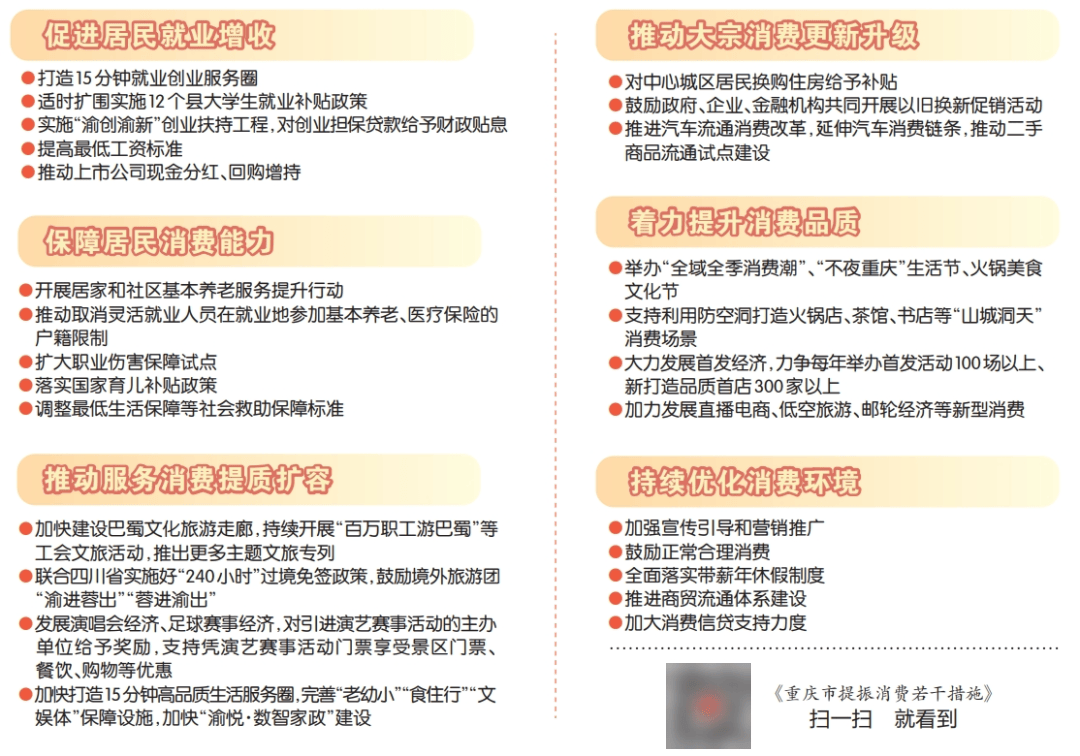
Core Viewpoint - The introduction of the "Measures" by Chongqing aims to enhance consumption's foundational role in economic development and better meet the people's needs for a better life [5][6][12]. Group 1: Key Highlights of the Measures - The Measures include 26 initiatives focusing on promoting employment, ensuring consumer capacity, enhancing service consumption, upgrading major consumption, improving consumption quality, and optimizing the consumption environment [5][6]. - Chongqing's approach emphasizes creating unique consumption scenarios by leveraging its geographical features, such as utilizing "cave resources" for immersive dining experiences [6]. - The Measures provide targeted financial incentives for the automotive industry, particularly for smart connected new energy vehicles, with subsidies of up to 80,000 yuan for specific vehicle types [6][7]. Group 2: Financial Incentives and Support - Chongqing's Measures outline substantial financial support, including up to 5 million yuan for hosting major events and various rewards for new retail initiatives [7]. - The Measures aim to enhance consumer confidence by ensuring a safe consumption environment, addressing issues from consumer rights to product quality [11]. Group 3: Economic Growth and Consumer Behavior - Chongqing's social retail sales are projected to reach 15,677.37 billion yuan in 2024, with an average annual growth rate of 7.4% from 2020 to 2024, surpassing the national average [11][12]. - The Measures focus on increasing residents' income and employment opportunities, targeting the creation of over 650,000 urban jobs annually [8][12]. - The strategy includes enhancing consumer willingness through various subsidies for new energy vehicles and household appliances [11]. Group 4: Long-term Strategies for Consumption - The Measures emphasize the need for sustained economic growth to support consumption, suggesting a dual focus on economic stability and income growth [12][13]. - Recommendations include developing local industries and new business models to expand consumption opportunities, such as low-altitude and cruise economies [13][14]. - The focus on job stability and skill enhancement aims to empower residents to increase their consumption capacity [14].
大家提前做好准备,若不出意外,7月以后,国内将迎来3个重要变化
Sou Hu Cai Jing· 2025-06-26 22:19
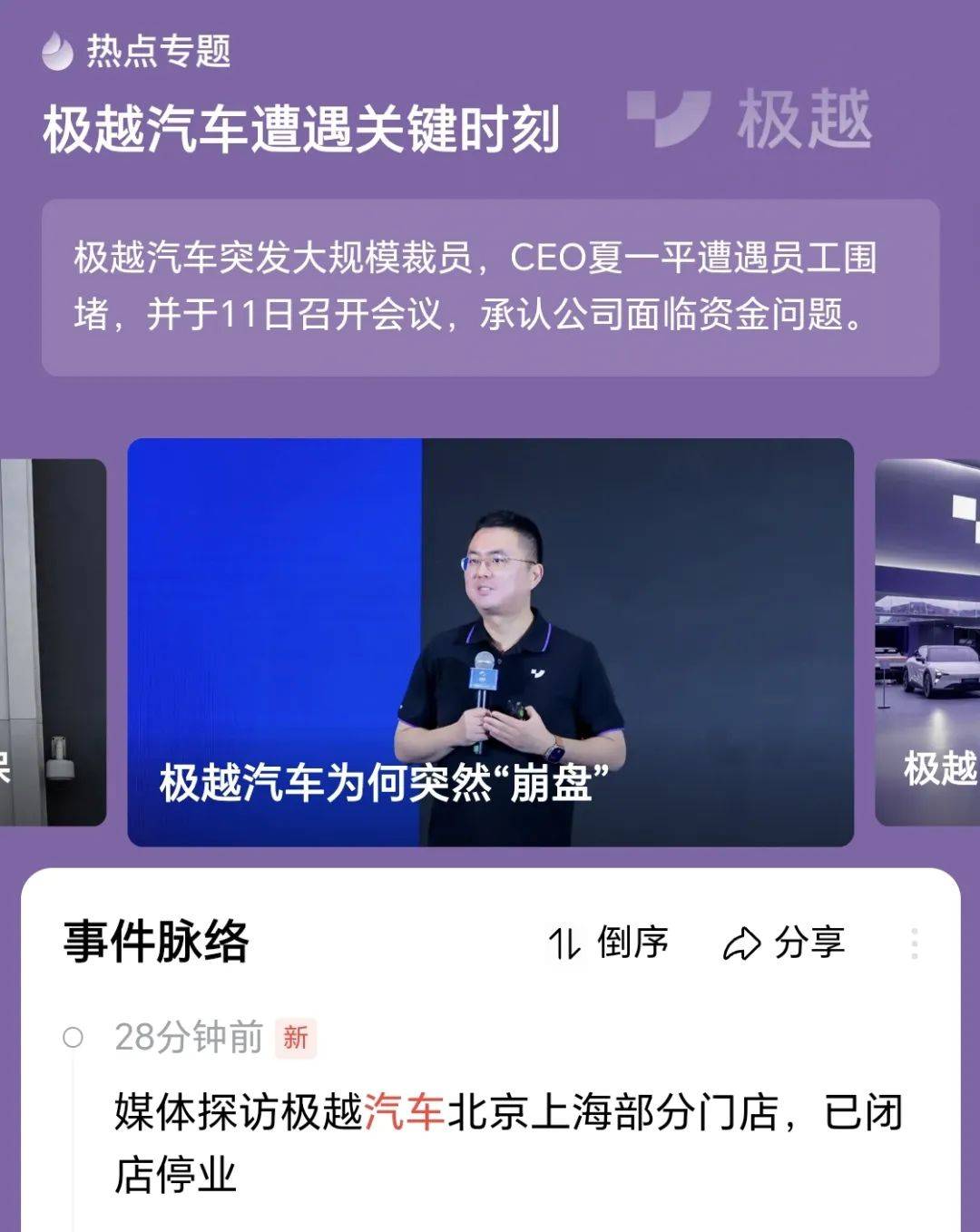
Group 1 - The overall economic growth rate is higher than the national average of 5% and the previous year's Q1 growth of 5.3%, positioning it among the leading global economies, yet many individuals and businesses continue to struggle in a challenging environment [1] - The automotive industry is facing significant difficulties, with reports of large-scale layoffs, such as those at Jiyue Auto, attributed to a lack of support from shareholders and subsequent cash flow issues [1][3] - The broader economic environment is causing shareholders to be concerned about potential losses, leading to predictions of a challenging market outlook [3] Group 2 - There are expectations for three significant changes in the domestic economy post-July, including potential increases in household income, driven by government policies aimed at supporting wage growth [5][7] - Recent policy initiatives have led to local governments raising minimum wage standards, such as in Shanghai and Qinghai, which directly benefits low-income workers [8] - The government is set to implement more aggressive fiscal and monetary policies, with a historical high deficit rate of 4% and a total new scale of 12 trillion yuan in 2025, aimed at stimulating economic activity and increasing income for the lower strata [10][11] Group 3 - A new round of real estate market liberalization is underway, with Guangzhou being the first major city to fully lift purchase restrictions, which may encourage similar actions in other cities and boost market confidence [14][17] - The removal of restrictions in major cities is expected to create a ripple effect, potentially increasing demand in surrounding areas and stabilizing property prices [17] - The government is likely to continue introducing policies to promote economic growth and consumer spending, presenting opportunities for both businesses and workers [19]
撬动消费大市场需供需两侧协同发力
Zheng Quan Ri Bao· 2025-04-28 19:10
Group 1 - The Qinghai provincial government announced an adjustment to the minimum wage standard, increasing the monthly minimum wage from 1880 yuan to 2080 yuan, a rise of 10.6%, and the hourly minimum wage from 18 yuan to 20 yuan, an increase of 11% effective from May 1, 2025 [1] - Multiple provinces, including Fujian, Guangdong, Guizhou, and Sichuan, have raised their minimum wage standards this year, indicating a broader trend towards increasing wages for low-income groups [1] - The 2025 Government Work Report emphasizes multi-channel measures to promote income growth for residents, particularly for low- and middle-income groups, and aims to improve the normal wage growth mechanism for workers [1] Group 2 - Policies are suggested to enhance consumer capacity by increasing subsidies for durable goods and expanding the scope of trade-in programs for consumer goods [2] - There is a call for supporting service consumption innovation and digital consumption enhancement to meet the diverse and quality-oriented consumption demands of the public [2] - Recommendations include reducing unreasonable consumption restrictions, improving consumer protection measures, and strengthening market regulation to ensure a safe consumption environment [2] Group 3 - The expectation is for coordinated efforts on both the demand and supply sides to convert the income growth of low- and middle-income groups into tangible benefits, thereby stimulating the consumption market and contributing to high-quality economic development [3]
东吴证券晨会纪要-2025-04-02
Soochow Securities· 2025-04-01 23:30
Macro Strategy - The March PMI data indicates three characteristics of economic recovery: the pre-positioning of work due to the Spring Festival, better recovery of manufacturing demand compared to supply, and weak consumer service consumption [1][30]. - The manufacturing PMI for March is 50.5%, showing a slight increase of 0.3 percentage points from the previous month, while the service PMI is at 50.3%, also up by 0.3 percentage points [1][30]. - The new order index for manufacturing increased by 0.7 points to 51.8%, indicating stronger demand recovery compared to supply [1][30]. Industry Insights - The report highlights the need for macro policies to be adjusted in response to potential economic pressures in the second quarter, particularly in exports and real estate [1][30]. - The construction industry PMI rose to 53.4%, reflecting seasonal recovery, but remains at a historically low level for this time of year [1][30]. - The report emphasizes the importance of monitoring the impact of tariff increases on exports and the ongoing trends in the real estate market [1][30]. Company Analysis - The report provides insights into various companies, including their performance forecasts and investment ratings, such as the significant growth in sales for Lao Pu Gold and the strategic partnerships for Jianghuai Automobile [9][15]. - Companies like Yubiquitous and Geli Pharmaceutical are noted for their innovative product developments and market potential, with investment ratings maintained at "buy" [11][12]. - Shanghai Pharmaceuticals reported a revenue of 275.25 billion yuan, reflecting a 5.75% year-on-year increase, with a net profit of 4.553 billion yuan, up 20.82% [14]. Financial Performance - The report indicates that the overall financial performance of companies is under scrutiny, with adjustments made to profit forecasts for several firms based on market conditions and operational challenges [15][19]. - Companies such as China Communications Construction Company and Orient Securities are highlighted for their revenue growth and strategic adjustments in response to market dynamics [22][23]. - The report also notes the importance of cash flow management and cost control in maintaining profitability amid fluctuating market conditions [22][24].