日元贬值

Search documents
日元贬值成加息“催化剂” 日本央行“鹰派”立场超预期
Xin Hua Cai Jing· 2026-02-02 02:38
该摘要释放了一个信号,即植田和男领导的委员会可能以快于市场普遍预期的速度上调基准利率(目前 市场预期自去年12月加息后,大约每半年加息一次)。日元汇率似乎是一个关键因素,摘要中"日元贬 值"和"外汇"出现的次数较上次会议翻了一番。 (文章来源:新华财经) 新华财经北京2月2日电日本央行1月政策会议的意见摘要显示,随着当局密切监测日元疲软对通胀的影 响,内部对于及时加息必要性的认识正在增强。 根据1月23日结束的为期两天的政策会议摘要,九位委员会成员中有一位表示:"鉴于应对物价上涨是日 本的当务之急,央行不应花费过多时间审视调高政策利率的影响,而应在不失时机的情况下采取下一步 行动,即加息。" ...
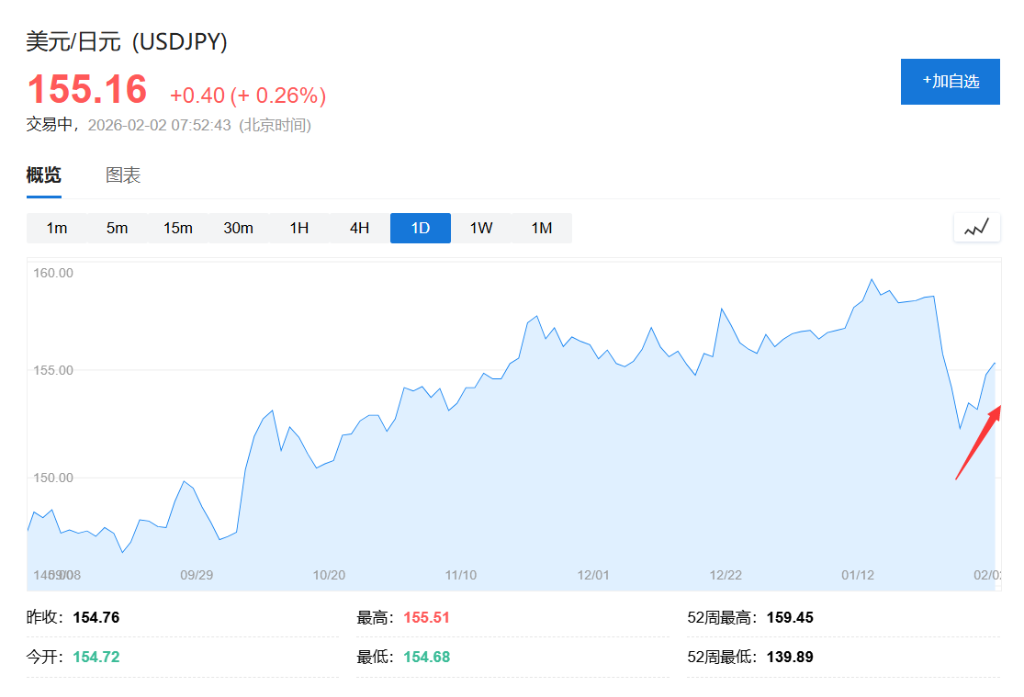
高市早苗为干预“降温”,日元又要重回跌势?
Hua Er Jie Jian Wen· 2026-02-02 00:06
日元兑美元本周可能延续跌势。 据彭博最新报道,这一趋势主要受到两方面因素推动:一是美元表现出更强的韧性;二是日本首相高市早苗周末的言论令交易员们更加确信,日 本当局直接出手支撑日元的可能性正在降低。 高市早苗在周末谈及汇率问题时,先是强调弱日元对出口的积极影响,"弱日元对出口行业来说是一个巨大的机遇,也能为汽车行业抵御美国关税 提供缓冲",随后语气转向克制。 她表示,希望"建立一个对汇率波动具有韧性的强大经济结构"。 市场解读认为,这一表态并未释放出强烈的护盘信号,反而可能抬高了官方直接支持日元的门槛。报道称,这在客观上削弱了此前通过"口头干 预"遏制日元贬值的效果。 交易员普遍认为,这可能意味着当局实施潜在支持措施的门槛已经提高。 美日政策信号共振,日元再度暴露基本面压力 除日本方面态度趋于谨慎外,美方立场同样未为日元提供支撑。 彭博指出,美国财政部长贝森特上周明确表示,美国偏好强势美元,更重要的是,美国政府并未采取任何行动来支撑日元。 与此同时,日本财务省上周五公布的数据显示,截至1月28日,日本并未进行任何官方外汇干预,进一步削弱了市场对政策托底的期待。 在缺乏政策保护的情况下,日元重新暴露在其长期结构 ...

美国汇率报告删除对日本央行加息的要求
日经中文网· 2026-01-30 08:00
Core Viewpoint - The focus of the U.S. Treasury has shifted from monetary policy to other factors influencing the currency market, particularly regarding Japan's economic policies and the yen's depreciation [2][5]. Group 1: U.S. Treasury Report Insights - The U.S. Treasury's semi-annual currency report, released on January 29, indicates a change in stance regarding Japan's monetary policy, removing previous recommendations for the Bank of Japan to continue tightening [2][4]. - Japan remains on the "monitoring list" for potential currency manipulation, with trade surpluses exceeding specified thresholds, but not meeting the criteria for frequent intervention [2][5]. - The report highlights that the yen's depreciation is influenced not only by interest rate differentials but also by the new government's expansionary fiscal policy outlook [5]. Group 2: Currency Market Dynamics - The recent appreciation of the yen has been influenced by scrutiny from U.S. and Japanese authorities, leading to a temporary stabilization of the market [5]. - The U.S. Treasury Secretary emphasized the pursuit of a "strong dollar," which has contributed to the dollar's depreciation against other major currencies [5]. - The report does not designate any countries as "currency manipulators," but includes Japan, China, South Korea, Taiwan, Thailand, Singapore, Vietnam, Germany, Ireland, and Switzerland on the monitoring list, with Thailand being a new addition [5].

日本借力美国支持、以策略性沉默对抗日元空头
Xin Lang Cai Jing· 2026-01-29 08:54
Core Viewpoint - The Japanese monetary authorities are leveraging rare support measures from the U.S. to combat yen depreciation, employing strategic silence and cautious communication to promote significant yen appreciation without large-scale market interventions [1][4]. Group 1: Strategy and Execution - The strategy is primarily executed by Jun Mimura, Japan's Chief Foreign Exchange Diplomat, whose limited public statements serve as a policy signal [1][4]. - Mimura's approach involves controlling the rhythm of his statements, leading speculators to continuously speculate on potential market interventions by the Japanese government [1][4]. - The strategy has reportedly led to a decline in the USD/JPY exchange rate by approximately 7 yen, demonstrating remarkable efficiency [1][4]. Group 2: Market Reactions and U.S. Involvement - Since the weekend, the yen has experienced three significant appreciations, with the most notable fluctuations occurring after news of unusual interest rate checks by the New York Federal Reserve, raising investor awareness of a potential joint market intervention by the U.S. and Japan for the first time in 15 years [1][4]. - Despite U.S. Treasury Secretary Scott Bessenet denying any intervention to support the yen, former Japanese monetary officials view U.S. involvement in interest rate checks as a significant breakthrough, reinforcing the perception of a unified stance between the U.S. and Japan against yen depreciation [5][6]. Group 3: Communication and Market Perception - The Japanese government maintains deliberate silence regarding daily market fluctuations, only stating that it is closely coordinating with U.S. authorities, which fuels market speculation and uncertainty [2][5]. - Jun Mimura, set to become Japan's Vice Minister of International Affairs in 2024, has acknowledged that both silence and direct statements are valid communication strategies [2][5]. Group 4: Economic Factors and Limitations - The sustainability of yen appreciation ultimately depends on fundamental factors, particularly the Bank of Japan's policy direction and the fiscal trajectory of the new government post-February elections [3][6]. - The Bank of Japan raised interest rates to 0.75%, a 30-year high, but this has not effectively curbed yen depreciation, as the market perceives the central bank's actions as lagging in addressing inflation [3][6]. - Analysts suggest that if Prime Minister Fumio Kishida wins the upcoming elections, it may embolden inflationist advisors, potentially intensifying opposition to interest rate hikes [7].
日本央行会议纪要:日元贬值成“心头大患”,加息步伐还要迈?
Jin Shi Shu Ju· 2026-01-28 03:20
日本央行委员会成员在去年12月讨论政策时,对日元贬值影响价格趋势的程度表示了日益增长的担忧, 随后在会议上决定将基准利率上调至1995年以来的最高水平。 根据周三公布的会议纪要,一些成员表示,"在决定是否提高政策利率时,央行应考虑日元贬值对通胀 率的影响,在某些情况下,还应考虑对核心通胀的影响。" "该成员表示,央行应考虑在观察经济活动和物价反应的同时,每隔几个月调整一次货币宽松程度。" 日本的消费者通胀率已连续四年超过日本央行2%的通胀目标,预计本周五公布的东京CPI数据将显示这 一趋势在1月份继续延续。 "我们将根据去年9月份的联合声明,在必要时与美国当局密切协调,继续对汇率变动采取适当的应对措 施,"财务大臣片山皋月周二晚间在七国集团(G7)财长会议后告诉记者,他们在会上讨论了关键矿产 问题。 日本央行在上周五结束的最新会议上维持借贷成本不变。不过,有一张反对票呼吁再次加息。此外,该 央行在季度展望中上调的通胀预测超出了经济学家的预期,这增加了对4月可能加息的猜测。日本央行 的下一个决定将在3月19日做出。 尽管日本央行强调去年12月19日的加息是因为经济发展符合其预期,但会议纪要表明,委员会成员对弱 ...
日本股票策略:日本股市能在利率上升与日元贬值中扛住多大压力?-Japan Equity Strategy_ To what extent can Japanese equities withstand rising rates and JPY depreciation_
2026-01-26 02:49
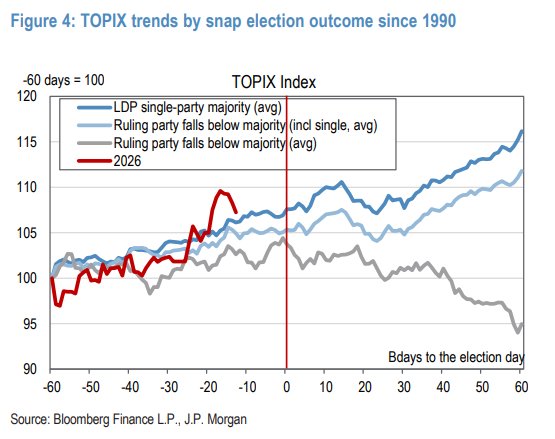
Summary of J.P. Morgan's Japan Equity Strategy Conference Call Industry Overview - The report focuses on the Japanese equity market, particularly in the context of rising interest rates and JPY depreciation, especially with the upcoming snap general election on February 8, 2026 [1][11]. Core Insights and Arguments - **Election Impact on Market**: The outcome of the snap general election is expected to influence the equity market significantly. A simple majority for the LDP is anticipated, which could lead to a flat or slightly declining market initially, but potentially rising to 57,000 by year-end [11]. - **Equity Market Projections**: - If the LDP secures a simple majority, the Nikkei could be flat to down slightly post-election but may rise to 57,000 by year-end [11]. - If the LDP falls short, the Nikkei could initially decline to 52,000 but then rise to 55,000 by year-end [11]. - A stable majority could push the Nikkei above 56,000 immediately after the election, potentially exceeding 60,000 by year-end [11]. - **Threshold Levels for JPY and Interest Rates**: - The market is closely monitoring the USD/JPY rate, with concerns rising if it exceeds ¥165/$ and particularly if it reaches ¥170/$ [7][19]. - A 10-year JGB yield above 3% is also a critical threshold, as it could lead to a downturn in stocks [58][67]. - **Corporate Earnings Outlook**: - Under risk scenarios where interest rates and FX exceed break-even levels, corporate earnings, especially for export-oriented companies, are expected to increase. However, the negative impact of yen depreciation and declining P/E ratios may outweigh these gains, potentially leading to a market correction [7][11]. - **Market Correction and Buying Opportunities**: - Even if a correction occurs, it is viewed as a lower bound based on earnings and valuation, presenting a potential buying opportunity for Japanese equities [7][11]. - **Fund Flows**: - Short-term selling pressure from foreign investors is expected, but medium-term fund flows from domestic players, such as pension funds, could provide upward pressure on Japanese equities [7][73]. Additional Important Insights - **Investor Sentiment**: A survey indicated that 94% of corporate managers rated the Takaichi administration's fiscal policy positively, suggesting confidence in the administration's ability to manage market concerns [18]. - **Valuation Trends**: Overseas demand-oriented sectors have been favored in the market, with rising P/E ratios, while domestic demand-oriented sectors have seen limited downside risk [44][45]. - **Fiscal Impact of Rising Rates**: The government may face increased interest expenses due to rising long-term yields, but fiscal expansion could also raise tax revenue if corporate earnings and household income increase [66]. - **Repatriation of Investments**: There is potential for significant repatriation into Japanese assets by financial institutions and pension funds, which could positively impact the equity market [75]. Conclusion - The Japanese equity market is at a critical juncture with the upcoming election and the potential for rising interest rates and JPY depreciation. While there are risks, particularly concerning thresholds for JPY and interest rates, the overall sentiment remains cautiously optimistic, with potential buying opportunities identified in the event of market corrections. The focus on fund flows and corporate earnings will be crucial in determining the market's trajectory moving forward [1][11][73].

21评论丨日本央行为何维持利率不变?
Xin Lang Cai Jing· 2026-01-23 22:58
Group 1 - The Bank of Japan (BOJ) decided to maintain the current policy interest rate at 0.75%, reflecting its struggle to balance market expectations and government pressures following a significant drop in Japanese government bonds [1][5] - The market reacted with little volatility to the BOJ's decision, as it was largely anticipated, but the downward pressure on Japanese government bond prices and the yen remains [5] - The BOJ's recent economic outlook report revised core CPI forecasts upward for 2025 to 3% and adjusted GDP growth estimates, indicating a cautious approach to inflation and economic growth [3] Group 2 - The Japanese government announced a dissolution of the House of Representatives, with elections scheduled for February 8, raising concerns about potential tax cuts and increased fiscal spending [4] - The yen has depreciated against the dollar and euro, reaching historical lows, although the overall dollar depreciation against other currencies may mitigate further yen declines [4] - The BOJ's independence is emphasized as crucial for price stability, but the lack of aggressive monetary policy changes raises doubts about its effectiveness in reversing the yen's depreciation trend [5]

日股能否抗住日元贬值、收益率上行的双重压力?
Hua Er Jie Jian Wen· 2026-01-23 06:39
Core Viewpoint - Despite facing challenges such as early elections, a weak yen, and rising long-term interest rates, Japanese stocks still have room for growth by the end of 2026 [1] Group 1: Market Outlook - The core conclusion indicates that as long as the USD/JPY exchange rate does not exceed 165 and the 10-year Japanese government bond yield remains below 3%, the upward trend of Japanese stocks is likely to remain unchanged [2] - The upcoming early election on February 8 will significantly influence short-term market reactions, but expectations of fiscal stimulus and political stability point towards a stock market rise by the end of the year [3] Group 2: Currency and Interest Rate Thresholds - The critical threshold for the yen is set at 165, where excessive depreciation could harm unhedged investors' asset values and hinder real wage growth [4] - The 10-year government bond yield at 3% is a key pressure point for the financial system and stock valuations, particularly affecting regional financial institutions [8] Group 3: Scenarios and Predictions - In a baseline scenario where the ruling Liberal Democratic Party (LDP) secures a majority, the Nikkei index may remain flat or slightly decline post-election but is expected to rebound, targeting 57,000 points by the end of 2026 [5] - In a weak scenario where the LDP fails to secure a majority, the market may initially drop to around 52,000 points but could recover to 55,000 points by year-end due to fiscal expansion policies [5] - In a strong scenario where the LDP achieves a stable majority, the Nikkei index could immediately surpass 56,000 points post-election and reach over 60,000 points by year-end [5] Group 4: Risk and Support Dynamics - The sensitivity of Japanese corporate profits to exchange rates has decreased, with the beta coefficient dropping from 1.0 to 0.6, indicating reduced responsiveness to currency fluctuations [5] - If the 10-year JGB yield rises to the 3.0%-3.5% range, regional banks may face capital adequacy issues, potentially leading to forced selling of stocks to bolster capital [10] - Domestic institutional investors possess significant potential for capital repatriation, which could stabilize the market as domestic yields rise [10]
贝森特甩锅日本
Sou Hu Cai Jing· 2026-01-21 06:42
Group 1 - The core argument presented is that U.S. Treasury Secretary Mnuchin refuted claims that the U.S. market downturn was primarily due to tariffs imposed on European countries over Greenland, attributing the rise in U.S. Treasury yields to issues in Japan instead [1][3] - Mnuchin emphasized that the U.S. market's reaction cannot be separated from developments in Japan, where there has been a significant surge in Japanese government bond yields [3] - The Japanese media expressed dissatisfaction with Mnuchin's comments, suggesting that the turmoil caused by President Trump's interest in Greenland is the main reason for the rise in long-term U.S. Treasury yields [3] Group 2 - Japanese Finance Minister Katayama stated that measures have been taken to stabilize the market and assured that these measures will continue [3] - Concerns have arisen regarding the expansionary fiscal policies proposed by Japan's new Prime Minister, which are believed to exacerbate fiscal deficits and worsen the government's financial situation [3] - Following the announcement of early elections in Japan, the trend of rising bond yields intensified, with the 10-year Japanese government bond yield reaching 2.38%, a record high since 1999 [3][4]

ATFX:高市解散众议院 2月8日重新大选日元走向何方?
Xin Lang Cai Jing· 2026-01-21 01:53
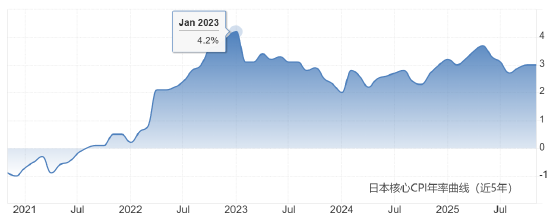
Group 1 - The core point of the article is that Japanese Prime Minister Sanna Takichi plans to dissolve the House of Representatives and call for a new election, which raises concerns about the timing and implications of this decision given the lack of a major economic crisis in Japan [1][7] - Takichi's approach has been characterized by a strong alignment with the United States while adopting a hardline stance towards other countries, which mirrors the foreign policy of former Prime Minister Shinzo Abe [1][7] - The dissolution of the House of Representatives is seen as a strategic move to strengthen the ruling coalition's position, as Takichi's policies have reportedly caused significant damage to the macroeconomy, potentially interrupting the recovery trend [1][7] Group 2 - Financial institutions predict Japan's core CPI for December to drop to 2.4%, down from 3%, indicating a potential loss of inflation advantage which is critical for economic recovery [4][10] - The Japanese yen has been depreciating significantly, with the USDJPY exchange rate increasing from 103.24 in January 2021 to 157.94 in January 2026, marking a depreciation of 52.98% [4][10] - While yen depreciation can boost tourism and exports, it also signals a decline in national strength, and if the upcoming election does not meet Takichi's expectations for increased seats, the depreciation trend may accelerate [4][10] Group 3 - The USDJPY is currently trading within a channel, with recent price action indicating a potential new upward trend if the lower channel support holds [6][13] - Key resistance levels to watch are the middle and upper channel lines, and a significant drop below the lower channel could lead to a larger correction in the USDJPY [6][13]