汽车行业反内卷

Search documents
三家已“打样” 车企加速兑现账期承诺
Bei Jing Shang Bao· 2025-08-12 16:12
Core Viewpoint - The automotive industry is undergoing a transformation to address "involution" competition, with companies committing to a "60-day payment term" for suppliers, aiming to enhance the industry's health and orderliness [1][9][10]. Group 1: Commitment Implementation - Several automotive companies, including China FAW, GAC Group, and Seres Group, have begun implementing the "60-day payment term" commitment, showcasing their specific practices and results [1][3]. - China FAW has established a cross-departmental task force to ensure seamless management and has revised contract templates to specify payment terms [3][4]. - GAC Group has developed a comprehensive control system covering the entire process from order issuance to payment, allowing real-time tracking of progress for both suppliers and the company [5][6]. Group 2: Payment Process and Challenges - The payment initiation time and review process are critical for suppliers, as delays in internal audits can extend the payment timeline [4][7]. - GAC Group emphasizes cash payments, with 95% of transactions being cash, significantly reducing the burden on suppliers [8]. - China FAW has introduced 100% cash payments for recognized small and medium-sized enterprise suppliers, moving away from a mixed payment model [8]. Group 3: Industry Trends and Financial Health - The automotive industry has seen a decline in profit margins, dropping from 7.8% in 2017 to 4.3% in 2024, with a further decrease to 4.1% noted this year [9][10]. - Despite increased production and sales, the industry faces challenges from price wars, which have been identified as a significant factor in declining profitability [10][11]. - Recent data indicates a recovery in profit margins, with the automotive industry generating revenues of 963.4 billion yuan in June, a 12% year-on-year increase, and a profit margin of 6.9% [11].




车企破卷求新,小红书何以成为长效经营新阵地
Zhong Guo Qi Che Bao Wang· 2025-07-30 14:31
Core Insights - The automotive industry is shifting from a "transactional" relationship to a "partnership" model with consumers, emphasizing lifestyle integration in marketing strategies [2][3][4] - Xiaohongshu (Little Red Book) is emerging as a key platform for automotive brands to engage with consumers and build long-term relationships, particularly in a saturated market [4][17][22] Group 1: Market Dynamics - The Chinese automotive market is transitioning to a stock market, with approximately 70% of purchases now involving trade-ins, indicating a shift towards consumption upgrades [2] - New generation consumers are increasingly focused on lifestyle integration and specific scenarios when considering vehicle purchases, moving beyond traditional metrics like specifications [3][4] Group 2: Marketing Evolution - Automotive marketing is undergoing a fundamental change, requiring brands to focus on detailed user needs and scenarios to find new growth opportunities [4][6] - Xiaohongshu has become a vital tool for brands to navigate this new marketing landscape, leveraging its large user base and content generation capabilities [4][6][17] Group 3: Xiaohongshu's Role - Xiaohongshu boasts 350 million monthly active users and has become a significant platform for automotive content, with over 200 million users interested in automotive topics and a 1318% annual growth in content volume [4][6] - The platform facilitates a comprehensive marketing approach, from pre-launch insights to post-launch word-of-mouth, effectively bridging the gap between consumer engagement and sales conversion [6][18][22] Group 4: Case Studies - The collaboration between Dongfeng Nissan and Xiaohongshu successfully targeted younger demographics, achieving over 5 million exposures on launch day through strategic content and event marketing [7][8][10] - Xiaopeng Motors utilized Xiaohongshu to redefine its brand image and successfully increased monthly sales from approximately 8,000 to 30,000 units by targeting female consumers and leveraging user-generated content [12][14][17] Group 5: Future Implications - Xiaohongshu is positioned as a primary partner for automotive brands, moving beyond a mere traffic channel to a comprehensive ecosystem for long-term growth and product development [22] - The platform's ability to integrate user feedback into product design signifies a new model for automotive companies, allowing for more precise alignment of products with consumer needs [22]
汽车出口与反内卷近况政策展望
2025-07-29 02:10
Summary of Conference Call on Automotive Industry and Policies Industry Overview - The conference call discusses the automotive industry in China, focusing on the impact of anti-involution policies and the growth of automotive exports, particularly in the context of electric vehicles (EVs) and traditional car manufacturers [1][2][4]. Key Points and Arguments Anti-Involution Policies - The Chinese government has strengthened regulations to combat involution in the automotive industry, including production consistency checks, cost audits, and tracking of payment terms to stabilize market prices [1][3]. - The anti-involution policies are expected to benefit traditional car manufacturers significantly, leading to a stabilization of the market and a consistent penetration rate of new energy vehicles (NEVs) at around 53% [1][5]. Automotive Exports - China's automotive exports have surged, with 2 million vehicles exported in the first half of the year, marking a 70% year-on-year increase, with NEVs accounting for 40% of total exports [1][4]. - Brands like BYD have made significant inroads into the European market, while demand remains strong in the Middle East and Southeast Asia [1][4]. Market Dynamics - The traditional car manufacturers, including joint ventures like FAW, Dongfeng, SAIC, and GAC, have shown stable profits and robust growth, with companies like Geely and Wuling also experiencing significant sales increases [1][5]. - The tightening of anti-involution policies has led to longer approval processes for new products, impacting companies' flexibility in responding to price wars but ultimately stabilizing market confidence [1][6]. Consumer Behavior - Consumer purchasing intentions are influenced by market confidence and reasonable purchasing reasons, with high-income levels and savings supporting consumption capacity [1][9]. - Companies like Xiaomi have successfully stimulated demand through marketing strategies that create a sense of urgency among consumers [1][9]. Future Outlook - The anti-involution policies are expected to continue until at least the end of 2027, although the subsidy amounts per vehicle may decrease [2][11]. - The EU's imposition of tariffs on Chinese electric vehicles is a concern, but China can counter this by developing plug-in hybrids and fuel vehicles [2][14][15]. - The outlook for 2026 suggests continued strong growth in automotive exports, with expectations of over 10% growth driven by markets in Russia, the US, and other regions [18][19]. Challenges and Opportunities - The EU's minimum import price policy for electric vehicles may restrict the export of small vehicles from China, but manufacturers can adapt by producing in Southeast Asia and leveraging partnerships [16][17]. - The performance of plug-in hybrid vehicles in both domestic and international markets is strong, with significant advantages over traditional fuel vehicles [20][21]. Additional Important Insights - The average income in China is approximately 21,800 yuan, with an average expenditure of 14,300 yuan, indicating a healthy consumer spending capacity despite price stability in the automotive market [8]. - The automotive industry is seen as a critical sector for economic growth, with the government keen to avoid setbacks in this area due to its role in new energy and industrial transformation [11][12]. This summary encapsulates the key discussions and insights from the conference call regarding the automotive industry, highlighting the interplay between government policies, market dynamics, and consumer behavior.

12家整车上市公司2025半年业绩“交卷”,商用车企均“预喜”丨车市半年考⑤
Mei Ri Jing Ji Xin Wen· 2025-07-22 11:05
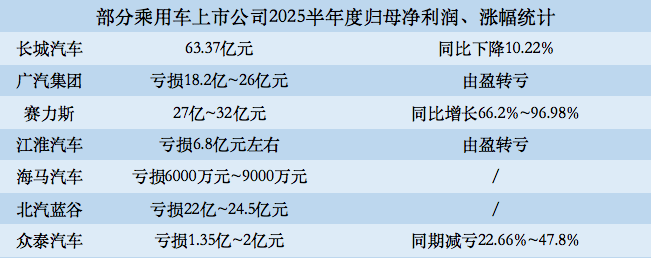
Core Insights - The automotive industry is experiencing a shift as companies disclose their 2025 semi-annual performance forecasts, serving as a test for their responsiveness to industry initiatives [1] - Among the 11 disclosed forecasts, 7 companies expect positive net profits, while 5 anticipate losses [1] Group 1: Passenger Vehicle Companies - Great Wall Motors is projected to have the highest net profit at 63.4 billion yuan, but with a decline of 10.2% year-on-year [2][3] - GAC Group and JAC Motors are expected to report significant losses, with GAC's loss estimated between 18.2 billion to 26 billion yuan, and JAC's loss around 6.8 billion yuan [3][6] - Seres is expected to achieve a net profit between 27 billion to 32 billion yuan, reflecting a substantial growth of 66.2% to 96.98% year-on-year, despite a 15.77% decline in sales volume [5][3] Group 2: Commercial Vehicle Companies - Commercial vehicle manufacturers generally report positive forecasts, with notable growth in net profits for companies like Foton Motor (7.76 billion yuan, up 87.5%) and King Long Motor (11.6 billion yuan, up 74.71%) [9][11] - The export market is a significant contributor to the performance of commercial vehicle companies, with a 10.8% increase in bus exports and a 10.5% increase in truck exports in the first half of 2025 [11] - Despite a projected profit of 1.8 million to 2.2 million yuan, FAW Jiefang anticipates a dramatic decline of 96.45% to 95.66% year-on-year due to intensified competition and market conditions [12]



汽车行业双周报:汽车反内卷力度加码,看好科技、品牌向上的车企-20250720
Hua Yuan Zheng Quan· 2025-07-20 14:56
Investment Rating - The investment rating for the automotive industry is "Positive" (maintained) [1] Core Viewpoints - The automotive industry is experiencing intensified efforts to combat "involution," leading to a more orderly terminal price competition. Since May 2025, various government departments have indicated a commitment to regulate "involution-style" competition in the automotive sector, with measures including cost investigations and price monitoring [3][6] - The impact of "involution" is expected to be more adverse for mid-to-low-end manufacturers, while manufacturers that can create user demand through technology and branding are likely to benefit [3][15] - The anticipated reduction in subsidies for new energy vehicles (NEVs) in 2026 may put pressure on actual sales growth, despite short-term support from consumer expectations of recovering discounts and potential tax incentives [3][16] Summary by Sections Automotive Industry Involution Measures - The core reason for the current round of involution in the automotive industry is weak demand, triggered by price cuts from major players like BYD. The market is entering a phase of stock competition, with many manufacturers resorting to price cuts to gain market share [6][7] - Key measures to combat involution include resisting low-price competition, enhancing product quality checks, advocating for the orderly exit of outdated capacities, and standardizing supplier payment terms to within 60 days [7][10] Impact on Price Competition - The measures taken are expected to lead to a more orderly terminal price competition, with significant promotional policies being retracted and efforts to stabilize dealer inventories and accelerate rebate payments [10][12] - Several manufacturers have committed to paying dealers within 60 days, which is expected to alleviate pressure on dealer inventories and stabilize terminal prices [11][13] Sales Outlook - The automotive industry is projected to face challenges in sales growth due to the anticipated reduction in NEV purchase tax subsidies in 2026. The expected decrease in subsidies may lead to a decline in sales growth rates, particularly for low-price segment manufacturers [16][17] - Historical data suggests that previous tax reduction policies have led to significant sales increases, indicating that the upcoming subsidy changes could similarly impact sales dynamics [20][21]
【汽车】国常会定调“反内卷”,聚焦技术升级+技术降本新趋势——汽车和汽车零部件板块跟踪报告(倪昱婧/邢萍)
光大证券研究· 2025-07-20 14:03
Core Viewpoint - The article discusses the recent initiatives by the Chinese government to regulate the competition in the electric vehicle (EV) industry, aiming for high-quality development and a shift from price competition to value competition in the automotive sector [3][4]. Group 1: Government Initiatives - On July 16, 2025, the State Council, led by Premier Li Qiang, held a meeting to discuss the regulation of competition in the EV industry, emphasizing the need for high-quality development and monitoring of production consistency [3]. - The "anti-involution" strategy has been highlighted, indicating a shift from aggressive price cuts to a healthier industry model [3]. Group 2: Industry Self-Regulation - Since the mention of preventing "involution-style" competition in July 2024, various self-regulatory measures have been introduced, including a May 2025 initiative by the China Automobile Association to oppose below-cost dumping [4]. - In June 2025, 17 major automakers, including FAW and Dongfeng, committed to a payment term of no more than 60 days to suppliers [4]. Group 3: Market Dynamics - In the first half of 2025, domestic retail sales of narrow-sense passenger cars increased by 10.8% year-on-year to 10.9 million units, with new energy vehicle sales rising by 33.3% to 5.468 million units [5]. - As of June 2025, the total inventory depth of domestic passenger car manufacturers was approximately 1.6, down 18% year-on-year and 11% month-on-month [5][6]. Group 4: Sales Risks - Some major automakers, including BYD and Dongfeng, have only achieved 40% or less of their annual sales targets by mid-2025, indicating potential risks for sales adjustments throughout the year [6].
数据解放生产力——琰究汽车数据系列(2025年6月)【民生汽车 崔琰团队】
汽车琰究· 2025-07-17 14:59
Group 1 - The core viewpoint of the article emphasizes the continuous growth and trends in the automotive industry, highlighting the importance of data updates and visual enhancements for better understanding [1] - In June 2025, total automobile sales reached 2.904 million units, representing a year-on-year increase of 13.8% and a month-on-month increase of 8.1% [2] - For the first half of 2025, total automobile sales amounted to 15.653 million units, with a year-on-year growth of 11.4% [2] Group 2 - Passenger car sales in June 2025 were 2.536 million units, up 14.5% year-on-year and 7.8% month-on-month [3] - Commercial vehicle sales in June 2025 were 368,966 units, reflecting a year-on-year increase of 9.5% [11] - The inventory coefficient for automobile dealers in June 2025 was 1.42, an increase from 1.38 in May [2] Group 3 - The market share of domestic brands in June 2025 was 68.8%, while European, Japanese, American, and Korean brands held 13.7%, 9.6%, 6.1%, and 1.7% respectively [3] - In terms of vehicle classification, the market shares for A00, A0, A, B, C, and D class vehicles were 3.9%, 13.2%, 37.7%, 28.2%, 14.4%, and 1.5% respectively [4] - The market share by price range showed that vehicles priced between 0-10 million yuan accounted for 21.8%, while those above 30 million yuan accounted for 13.7% [5] Group 4 - Key automotive companies showed varied sales growth in June 2025, with BYD, Chery, and Geely experiencing year-on-year increases of 15.3%, 11.9%, and 46.4% respectively [6] - The overall discount rate in June 2025 increased compared to May, with the industry average reaching 16.7% by the end of June [7][8] - Fuel vehicles saw a decrease in discount rates, while new energy vehicles experienced a significant increase in discount rates [9] Group 5 - The Ministry of Industry and Information Technology's advocacy for reducing internal competition in the automotive industry is expected to benefit the passenger car sector [14] - The first week of July 2025 saw passenger car sales of 405,000 units, marking an 18.7% year-on-year increase [14] - The article suggests that the automotive market's fundamentals are expected to improve with the upcoming launch of new models [14] Group 6 - Investment recommendations include focusing on quality domestic brands such as Geely, BYD, and new energy vehicle manufacturers [16] - The article highlights the potential for growth in the automotive parts sector, particularly in intelligent driving and smart cockpit technologies [16] - The report also suggests monitoring the robotics sector, particularly companies with strong customer positioning and production capabilities [16]




数据解放生产力——琰究摩托车数据系列(2025年6月)【民生汽车 崔琰团队】
汽车琰究· 2025-07-17 07:22
Core Viewpoint - The motorcycle industry is experiencing growth, particularly in the sales of larger displacement motorcycles, with a significant increase in sales figures for June 2025 compared to the previous year and the first half of the year [1][2]. Sales Data Summary - For motorcycles with displacement over 250cc, June 2025 sales reached 102,000 units, a year-on-year increase of 14.3% and a month-on-month increase of 1.7%. Cumulative sales from January to June totaled 501,000 units, up 41.3% year-on-year [1]. - In the 250ml to 400ml displacement category, June sales were 53,000 units, up 15.3% year-on-year and 0.2% month-on-month, with cumulative sales of 265,000 units for the first half of the year, reflecting a 45.0% year-on-year increase [2]. - For the 400ml to 500ml category, June sales were 25,000 units, down 17.6% year-on-year but up 38.19% month-on-month, with a total of 129,000 units sold in the first half, a 7.1% year-on-year increase [2]. - In the 500ml to 800ml category, June sales reached 21,000 units, a remarkable year-on-year increase of 99.44% and a month-on-month increase of 38.19%, with cumulative sales of 93,000 units for the first half, up 104.4% year-on-year [2]. - For motorcycles over 800cc, June sales were 2,300 units, down 27.06% year-on-year and 8.3% month-on-month, with cumulative sales of 14,000 units for the first half, up 125.9% year-on-year [2]. Market Share Insights - Chuanfeng Power sold 21,000 units in June for the 250cc+ category, achieving a market share of 21.2%, with a cumulative market share of 21.6% for the first half, up 1.8 percentage points from the full year of 2024 [3]. - Longxin General sold 15,000 units in June for the 250cc+ category, with a market share of 12.9%, and a cumulative market share of 13.5% for the first half, down 0.7 percentage points from the full year of 2024 [3]. - Qianjiang Motorcycle sold 11,000 units in June for the 250cc+ category, with a market share of 11.2%, and a cumulative market share of 13.9% for the first half, down 2.9 percentage points from the full year of 2024 [3]. Industry Recommendations - The company suggests focusing on key stocks in the automotive sector, including Geely Automobile, BYD, Li Auto, Xpeng Motors, Xiaomi Group, Chuanfeng Power, and others [5][8]. - The company also highlights the importance of the Ministry of Industry and Information Technology's advocacy for reducing internal competition in the automotive industry, which is expected to benefit the overall market dynamics [6].



汽车行业周报:行业反内卷持续,领先车企表现亮眼-20250713
Guoyuan Securities· 2025-07-13 12:13
Investment Rating - The report maintains a "Recommended" investment rating for the automotive industry [6] Core Insights - The automotive industry is experiencing a healthy growth trajectory, with wholesale sales outpacing retail sales. The passenger car market saw retail sales of 238,000 units from July 1-6, 2025, a year-on-year increase of 1%, while wholesale sales reached 233,000 units, marking a 39% increase year-on-year [1][20] - The report highlights the ongoing implementation of anti-involution policies in the automotive sector, aimed at curbing unhealthy competition and ensuring sustainable growth [2][4] - Leading companies like Seres and Leap Motor are showing significant performance improvements, with Seres reporting a net profit increase of 66.20% to 96.98% year-on-year for the first half of 2025, and Leap Motor achieving a record delivery of over 48,000 units in June, a 138% increase year-on-year [3][4] Summary by Sections 1. Weekly Market Review (July 5-11, 2025) - The automotive sector index fell by 0.41% during the week, underperforming the broader market [12] - The passenger vehicle segment experienced a decline of 1.49%, while the automotive services sector saw a gain of 3.52% [15] 2. Weekly Data Tracking (July 5-11, 2025) - Passenger car retail sales for the first half of July totaled 238,000 units, with a cumulative retail of 11.14 million units for the year, reflecting an 11% year-on-year growth [20] - New energy vehicle retail sales reached 135,000 units, with a market penetration rate of 56.7% [20] 3. Industry News (July 5-11, 2025) - The report discusses the introduction of new national standards for passenger car braking systems, which will require the installation of anti-lock braking systems (ABS) starting January 1, 2026 [32] - The establishment of a feedback window for small and medium enterprises regarding payment issues with major automotive companies was announced, aimed at improving payment practices [40]
比新国标更严格 8吨追尾+30吨夹击……汽车安全迎接“极限挑战”!
Yang Shi Xin Wen Ke Hu Duan· 2025-07-12 01:24
Core Viewpoint - The recent initiatives by the Chinese government and automotive associations aim to promote healthy and orderly development in the automotive industry, addressing the issue of "involution" competition [1][3][5]. Group 1: Government and Industry Initiatives - Since the release of the initiative to maintain fair competition in May, the automotive industry has seen a wave of responses aimed at countering involution [3]. - Multiple government departments, including the Ministry of Industry and Information Technology, have quickly introduced measures such as product consistency checks and support for companies to adhere to a 60-day payment term [3][5]. - Major automotive companies are responding by shortening payment cycles and optimizing dealer rebate mechanisms [3]. Group 2: Quality and Safety Standards - The automotive industry is shifting focus from price wars to high-quality development centered on safety and technology [10][17]. - New mandatory national standards have been introduced, including updates to collision safety requirements, which will take effect on July 1 next year [11][13]. - The new standards include increased requirements for side collision tests and additional safety measures for electric vehicles [11][13][15]. Group 3: Advanced Testing and Safety Measures - Third-party testing organizations are conducting safety tests that exceed the new national standards, focusing on battery safety and structural integrity under extreme conditions [18][22]. - Rigorous testing scenarios include high-speed collisions and multiple impact tests to ensure vehicle safety, particularly for new energy vehicles [21][23]. - The upcoming standards for vehicle door handles will also include safety performance tests, emphasizing the reliability of new designs under various conditions [25].