
科技进步

Search documents
英思特:公司所处的稀土永磁材料行业具有广阔的发展前景
Zheng Quan Ri Bao Zhi Sheng· 2025-09-17 09:42
Core Viewpoint - The rare earth permanent magnet materials industry has a broad development prospect, primarily benefiting from the global green economy transition and technological advancements driving demand growth [1] Industry Summary - The demand for rare earth permanent magnet materials is expected to continue expanding due to the rapid development of sectors such as electric vehicles, wind power generation, and robotics [1] - The consumer electronics industry's technological iterations provide a stable incremental space for rare earth permanent magnet devices, especially in high-end smart devices [1] Company Summary - The company's growth drivers include: - Increasing R&D investment to promote technological innovation and product upgrades to meet customer needs [1] - Deepening cooperation with existing customers while exploring new customer groups [1] - Actively expanding into emerging markets, particularly in the fields of electric vehicles, robotics, and low-altitude economy [1] - Optimizing production processes to enhance capacity utilization and product quality, further consolidating the company's competitive advantage and increasing market share [1]
英思特(301622) - 2025年9月16日投资者关系活动记录表
2025-09-17 01:26
Group 1: Customer Relationships and Market Risks - The company has established long-term stable relationships with internationally renowned consumer electronics brands, with a high concentration of sales revenue from the top five customers [2][3] - The risk of dependency on a single customer exists, especially if market competition intensifies or if major clients fail to meet consumer demands [2] Group 2: Industry Growth Prospects - The rare earth permanent magnet materials industry has significant growth potential, driven by the global green economy transition and technological advancements [3] - Key growth drivers include increased demand from sectors like electric vehicles, wind power, and robotics, as well as ongoing technological iterations in the consumer electronics industry [3] Group 3: Financial Performance and Profitability - The company's overall gross margin for the first half of 2025 is 25.47%, an increase of 1.15% compared to the same period last year [3][4] - The gross margin for the main business improved from 26.61% in the first half of 2024 to 28.46% in the first half of 2025, a year-on-year increase of 1.85 percentage points [3] Group 4: Operational Strategies - The company plans to enhance the proportion of high-value-added products and improve product competitiveness through technological upgrades and process improvements [4] - Continuous automation and intelligent upgrades in production are aimed at increasing efficiency and reducing costs, thereby supporting stable gross margins [4] Group 5: Workforce Composition - As of the end of 2024, the company has a total of 2,909 employees, including 271 R&D personnel and 2,390 production staff [4]
A股8月收官!沪指站上3800点
第一财经· 2025-08-29 07:49
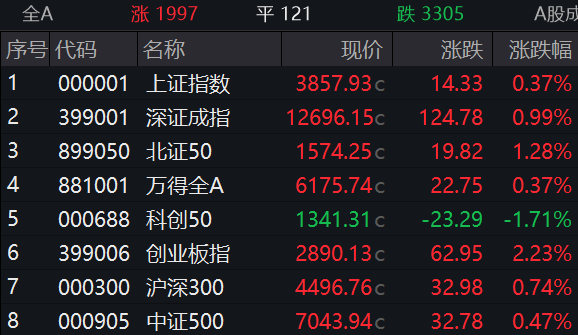
Core Viewpoint - The A-share market showed positive performance in August, with significant gains across major indices, indicating a potential recovery in investor sentiment and market dynamics [3][5]. Market Performance - The Shanghai Composite Index rose by 0.37% to close at 3857.93 points, while the Shenzhen Component Index increased by 0.99% to 12696.15 points. The ChiNext Index saw a notable rise of 2.23% [3][4]. - For the month, the Shanghai Composite Index accumulated a gain of 7.97%, the Shenzhen Component Index increased by 15.32%, and the ChiNext Index surged by 24.13% [5]. Trading Volume - The total trading volume for the Shanghai and Shenzhen markets reached 2.8 trillion yuan [7]. Sector Performance - Sectors such as batteries, liquor, insurance, precious metals, and military equipment experienced significant gains, while sectors like semiconductors, education, computing leasing, and communication equipment faced declines [9]. - The lithium battery sector saw substantial growth, with companies like Xian Dai Intelligent and Jie Bang Technology hitting the daily limit of 20% [9]. Notable Stocks - Contemporary Amperex Technology Co., Ltd. (CATL) saw its stock price rise above 300 yuan, peaking at 316.66 yuan [10]. - Industrial Fulian's market capitalization exceeded 1 trillion yuan, with the stock closing at a daily limit increase [12]. - Cambricon Technologies surpassed Kweichow Moutai in stock price, becoming the new "king" of A-shares [13]. Capital Flow - There was a net inflow of capital into sectors such as power equipment, non-ferrous metals, pharmaceuticals, and automobiles, while sectors like electronics, computers, communications, and real estate saw net outflows [14][15]. Institutional Insights - Guojin Securities noted a market rotation, highlighting the explosive movement of large-cap tech companies and suggesting a focus on buying opportunities in strong sectors during pullbacks [17]. - China International Capital Corporation (CICC) identified multiple factors supporting the current rebound in the Chinese stock market, including accelerated technological advancements and improved market sentiment regarding the long-term economic outlook [17].






收盘丨A股8月收官!沪指站上3800点,科创50指数单月大涨28%
Di Yi Cai Jing· 2025-08-29 07:39
Market Performance - The A-share market showed positive performance in August, with the Shanghai Composite Index rising by 0.37%, the Shenzhen Component Index increasing by 0.99%, and the ChiNext Index gaining 2.23% [1][2] - The cumulative gains for the month include a 7.97% increase for the Shanghai Composite Index, a 15.32% rise for the Shenzhen Component Index, a 24.13% increase for the ChiNext Index, a 28.00% rise for the Sci-Tech 50 Index, and a 10.64% increase for the North Star 50 Index [3] Sector Performance - Key sectors that performed well include batteries, liquor, insurance, precious metals, and military equipment, while sectors such as semiconductors, education, computing leasing, and communication equipment faced declines [7] - Notable stocks in the lithium battery sector saw significant gains, with companies like Xian Dao Intelligent, Jie Bang Technology, and Hang Ke Technology hitting the 20% daily limit up [7][8] Stock Highlights - Contemporary Amperex Technology Co., Ltd. (CATL) saw its stock price rise above 300 yuan, reaching a peak of 316.66 yuan [9] - Industrial Fulian's market capitalization exceeded 1 trillion yuan, and the stock hit the daily limit up [11] - Cambricon Technologies surpassed Kweichow Moutai in stock price, becoming the new "king of A-shares" [12][13] Capital Flow - There was a net inflow of funds into sectors such as power equipment, non-ferrous metals, pharmaceuticals, and automobiles, while sectors like electronics, computers, communications, and real estate experienced net outflows [14] - Specific stocks that attracted significant net inflows include Dongfang Fortune, Industrial Fulian, and Tongfu Microelectronics, with inflows of 3.058 billion yuan, 1.972 billion yuan, and 1.742 billion yuan respectively [14] Institutional Insights - Guojin Securities noted a market rotation, highlighting the explosive movements of large-cap tech companies while suggesting that the weight index still has room for recovery [15] - CICC pointed out multiple factors supporting the current rebound in the Chinese stock market, including accelerated technological progress and a correction in overly cautious long-term economic expectations [15]
上市公司的盈利,为啥长期是上涨的?|投资小知识
银行螺丝钉· 2025-08-15 14:04
Group 1 - The core viewpoint of the article emphasizes that production efficiency improvements are a key driver of long-term economic growth and stock market performance [3][4]. - Production efficiency can be enhanced through various factors such as technological advancements and urbanization, which lead to increased opportunities and higher per capita output [3]. - A well-functioning society with fluid movement of business and labor will naturally result in long-term growth in the profitability of listed companies [3][4]. Group 2 - The article suggests that the overall stock market is likely to experience long-term upward trends as a result of these efficiency improvements [4].

华尔街策略师批美联储“严重滞后” 呼吁大幅降息200基点
Xin Hua Cai Jing· 2025-08-15 00:39
Group 1 - David Zervos, Chief Market Strategist at Jefferies, criticizes the Federal Reserve for being "seriously behind" in monetary policy adjustments and calls for immediate large-scale interest rate cuts to address potential economic slowdown risks [1][2] - Zervos emphasizes that the current monetary policy is overly tight and needs aggressive easing to support the labor market and stimulate economic growth, despite the Producer Price Index (PPI) rising to 3.3% year-on-year in July [1][2] - He suggests that a reduction of 200 basis points in interest rates is acceptable, considering the long-term deflationary effects of artificial intelligence and technological advancements [1][2] Group 2 - Zervos warns that continued delays by the Federal Reserve could lead to significant deterioration in the job market, predicting that timely monetary easing could create an additional 1 million jobs within a year [2] - He advocates for the inclusion of more professionals who truly understand market operations in the Federal Reserve's decision-making process [2] - The market currently anticipates a rate cut in September, with a preference for a moderate adjustment of 25 basis points, while Zervos and other advocates for aggressive easing are intensifying the focus on this policy shift [2]
世界人形机器人运动会开幕,新京报小记者提前“探鲜”各类机器人
Xin Jing Bao· 2025-08-14 08:09
Core Points - The 2025 World Humanoid Robot Games will be held in Beijing, featuring 280 teams and over 500 robots competing in 26 events from August 14 to August 17 [1][2] - The event is co-hosted by multiple organizations, including the Beijing Municipal Government and the World Robot Cooperation Organization, with significant preparations underway [1] - The event aims to showcase cutting-edge technology alongside exciting competitions, attracting interest from both children and adults [1][3] Event Details - The opening ceremony will take place at the National Speed Skating Stadium, which has been transformed for the event [2] - Competitions will include various sports such as athletics, martial arts, dance, gymnastics, and 5v5 football, with a total of 538 matches scheduled [2][4] - The 5v5 football matches are a highlight, requiring larger fields and more complex control systems for the robots [4][5] Technological Innovations - The event features advanced robotic technologies, including a self-operating drink-making robot that reduces labor costs and improves consistency [3] - Robots will autonomously make decisions during matches, with minimal human intervention, showcasing advancements in AI and robotics [6] - The presence of various types of robots, including a basketball shooting robot, highlights the rapid development in robotic capabilities [3][7] Audience Engagement - The event has attracted young reporters who are actively engaging with the technology and learning about robotics [1][6] - Children are particularly fascinated by the robots, which enhances their curiosity and interest in technology [3][7] - The event serves as an educational platform, allowing children to experience the future of technology firsthand [7]

“更好地体验大陆发展的美好前景”
Ren Min Ri Bao Hai Wai Ban· 2025-07-31 21:34
Core Points - The 22nd Taiwan Youth Summer Camp, themed "Dragon Pulse Passing, Youth China," attracted approximately 1,800 Taiwanese youth from Taiwan, Hong Kong, Macau, and 16 other countries and regions, promoting cultural exchange across nearly 30 provinces in mainland China [1][2] - The National Taiwan Federation emphasized its role in fostering cross-strait youth exchanges and cooperation since the camp's inception in 2004, aiming to create more platforms for Taiwanese youth to engage with mainland China [2] - Participants shared personal stories of pursuing dreams in mainland China, highlighting the importance of firsthand experiences in understanding the culture and opportunities available [3][5] Group 1 - The summer camp serves as a bridge for deepening understanding and friendship between youth from both sides of the Taiwan Strait [2][3] - Taiwanese youth expressed excitement about returning to the mainland, emphasizing the shared cultural roots and the importance of unity [2][3] - The camp included various activities, such as visits to cultural experience centers and technology exhibitions, showcasing advancements in traditional medicine and aerospace [4][6] Group 2 - Participants were impressed by the technological developments in the Guangdong-Hong Kong-Macau Greater Bay Area, including the intelligent unmanned research vessel and the space station exhibition [5][6] - The camp provided opportunities for Taiwanese youth to engage with traditional culture and modern technological advancements, enhancing their understanding of mainland China's progress [5][6] - The experiences shared by participants aim to encourage more Taiwanese youth to explore and understand the mainland, fostering a sense of belonging and contribution to national development [3][6]

桃子更甜的密码(人民论坛)
Ren Min Ri Bao· 2025-07-20 21:52
Group 1 - The core idea of the articles revolves around the development of the peach industry in China, highlighting the importance of scientific advancements and local conditions in enhancing the sweetness and quality of peaches [1][2]. - A recent scientific discovery identified a special protein that plays a crucial role in the accumulation of sucrose in peaches, providing a theoretical basis for breeding better-tasting varieties [1]. - The peach industry in Zaoyang, Hubei, has evolved significantly, with fresh peaches available from mid-May to early November, and a variety of products such as peach wine and peach gum being developed [2]. Group 2 - The integration of cultural and tourism activities with the peach industry has led to comprehensive revitalization, showcasing the importance of local resources and conditions in driving economic growth [2]. - The article emphasizes the need for continuous exploration and adaptation in business, as illustrated by the story of a businessman from Yiwu who found success by pivoting to a specific product after multiple attempts [3]. - The concept of "maturity" in industry and regional development is highlighted, suggesting that a mature industry can better withstand external shocks and navigate challenges, ultimately contributing to a stronger national economy [4].
中美竞争的世界,欧洲的未来在哪里?
Hu Xiu· 2025-07-19 08:22
Group 1 - The core idea of the articles revolves around the geopolitical and economic strategies of the US and China, emphasizing the importance of technology and leverage in their future growth [1][2][3] - The US is expected to rely heavily on technology and leverage after 2025, moving away from previous population growth strategies [2][3] - Both the US and China share similar goals regarding technological advancement, but their approaches and levels of commitment differ due to various factors [5][6] Group 2 - The competition between the US and China is characterized by a shared strategic framework, which is a notable aspect of the current geopolitical landscape [4][7] - The EU's foreign policy is complicated by its relationship with NATO, leading to mixed signals and a lack of a unified stance on security matters [9][10] - Eastern European countries tend to favor US involvement over European solutions due to historical experiences, which complicates the EU's diplomatic efforts [11][12] Group 3 - The ongoing Russia-Ukraine conflict has highlighted the differing perspectives within the EU regarding security and foreign policy, leading to hesitations and inconsistencies [17][18] - The EU's future is uncertain, as it faces challenges in population growth, technological advancement, and maintaining fiscal discipline in a competitive global environment [18][20] - The historical context of US-Soviet relations influences current US strategies, while China's unique development path presents its own set of challenges [19][20]