美国非农就业数据

Search documents
宏观快评:9月美国非农数据点评:就业数据真空或促使联储12月不降息
Huachuang Securities· 2025-11-22 11:38
Employment Data Summary - In September, the U.S. added 119,000 non-farm jobs, exceeding the forecast of 50,000[1] - Job growth was primarily concentrated in two sectors: education and healthcare services (+59,000) and leisure and hospitality (+47,000), accounting for about 90% of total job additions[1] - The unemployment rate rose to 4.4%, higher than the expected 4.3%, driven by an increase in labor supply with a participation rate of 62.4%[1][2] Wage and Hourly Data - Hourly wage growth was slightly below expectations, increasing by 0.2% month-over-month, compared to the forecast of 0.3%[2] - Year-over-year wage growth remained at 3.8%, matching expectations[2] - Average weekly hours worked remained stable at 34.2 hours, a low level since 2015[2] Market Expectations and Federal Reserve Outlook - Following the employment data release, the market's expectation for a December rate cut increased, with the probability rising from 29.3% to 34.9%[2] - The Federal Reserve's decision-making may be influenced by the lack of recent employment data, leading to a cautious stance on rate cuts in December[4][5] - Recent statements from Fed officials indicate a preference for maintaining rates, with 7 out of 14 officials leaning towards not cutting rates in December[4][5] Economic Indicators and Future Projections - The overall employment situation remains weak but has not deteriorated significantly, with initial jobless claims between 220,000 and 230,000 since October[3] - The ADP report indicates job additions remain below 50,000, suggesting ongoing labor market challenges[3] - The market anticipates potential rate cuts in early 2024, with expectations for three additional cuts based on current economic conditions[7][19]
海外观察:美国2025年9月非农数据:9月非农数据的表与里
Donghai Securities· 2025-11-21 11:15
Employment Data - In September 2025, the U.S. added 119,000 non-farm jobs, significantly exceeding the forecast of 50,000, while the previous month's figure was revised down from 22,000 to -4,000[2] - The unemployment rate rose from 4.3% to 4.4%, against an expectation of 4.3%[2] Job Sector Analysis - The education and health services sectors contributed 59,000 jobs, and leisure and hospitality added 47,000 jobs, together accounting for 89.1% of the total job growth[3] - The manufacturing sector saw a slight improvement, with a job loss of only 6,000 compared to a loss of 15,000 in the previous month[2] Economic Implications - The increase in unemployment rate and the reliance on part-time jobs in key sectors suggest that the job market may not be as strong as the headline figures indicate[3] - The market's focus has shifted from job creation to the rising unemployment rate, with a slight increase in the probability of a rate cut by the Federal Reserve in December to 39.1%[5] Future Projections - The Federal Reserve may only have room for one 25 basis point rate cut before the chairmanship change in May 2026, as the current benchmark rate is approximately 40 basis points above neutral levels[6][3] - The overall labor force participation rate increased by 0.1 percentage points to 62.4%, with a notable decline in immigrant labor supply[3] Wage Growth Concerns - Average hourly earnings growth slowed to 0.2% in September from 0.4% in August, particularly in the service sector, raising concerns about purchasing power amid rising inflation[3]
美国9月非农新增就业11.9万人 失业率为4.4%
Sou Hu Cai Jing· 2025-11-20 15:45
Group 1 - The U.S. Labor Department reported that 119,000 jobs were added in September, with an unemployment rate of 4.4% [1] - The previous two months' employment data were revised downwards, with July's job additions adjusted from 79,000 to 72,000 and August's from 22,000 to a decrease of 4,000, totaling a reduction of 33,000 jobs for July and August [1] - Employment in healthcare, dining, and social assistance sectors continued to rise, while transportation and warehousing, along with federal government jobs, saw declines [1] Group 2 - The average hourly wage for non-farm employees in September was $36.67, reflecting a month-over-month increase of 0.2% and a year-over-year increase of 3.8% [1] - Due to the federal government shutdown, data collection was interrupted, leading to the absence of the October non-farm employment data, which will be reported alongside November's data on December 16 [1] - Economic indicators suggest that while the U.S. economy appears stable, there are increasing signs of pressure, including a slowdown in hiring, reduced consumer spending, and rising inflation [2]
铜冠金源期货商品日报-20251118
Tong Guan Jin Yuan Qi Huo· 2025-11-18 02:27
Report Industry Investment Rating No relevant content provided. Core Viewpoints of the Report - Overseas, the expectation of the Fed's interest rate cut has converged again, and the domestic risk appetite has weakened. The market needs to pay attention to the US non - farm payroll data and the earnings reports of the US stock technology sector this week. In the domestic market, although there is a possibility of reaching a new high this year, it is necessary to guard against the risk of a phased correction. The bond market is likely to maintain a relatively strong and volatile pattern in the short term [2][3]. - Precious metals are in a phased adjustment, and it is necessary to continue to pay attention to the speeches of Fed officials and the US non - farm payroll data [4][5]. - Copper prices are expected to fall from high levels in the short term due to increased sanctions on Russia and the Fed's hawkish attitude [6][7]. - Aluminum prices continue to adjust due to the decline in the expectation of the Fed's interest rate cut and the increase in domestic aluminum ingot supply [8]. - Alumina is in a weak and volatile state as the supply pressure remains high [9][10]. - The decline of the casting aluminum price is expected to be limited as the cost provides support and there is replenishment demand in the future [11]. - Zinc prices are in a weak and volatile state as the expectation of the Fed's interest rate cut in December has cooled and the dollar index has rebounded [12]. - Lead prices are expected to adjust following the decline of LME lead, and it is necessary to pay attention to the support of the 40 - day moving average [13][14]. - Tin prices are expected to maintain a high - level adjustment as the expectation of the Fed's interest rate cut in December has declined and the fundamentals have limited driving force [15]. - Industrial silicon prices are expected to maintain a range - bound oscillation as the supply and demand contradiction is not significant [16][17]. - Lithium carbonate prices may continue to rise, but it is necessary to be vigilant against the impact of demand falling short of expectations and increased imports [18][19]. - Nickel prices are expected to oscillate at a low level, and it is necessary to pay attention to the opportunity of going long at a low price [20][21]. - The prices of soda ash and glass are expected to oscillate at a low level as the demand has no bright spots [22][23]. - Steel prices are expected to oscillate as the supply pressure has decreased after the steel mills' production cuts, but the weak demand pattern remains unchanged [24]. - Iron ore prices are expected to oscillate as the supply pressure remains and the iron - making output has rebounded slightly [25]. - The prices of coking coal and coke are expected to oscillate weakly in the short term as the supply has increased marginally and the market sentiment has declined [26]. - The prices of soybean meal and rapeseed meal are expected to oscillate strongly in the short term as the external market has strengthened and the domestic inventory has reached an inflection point [27][29]. - Palm oil prices are expected to oscillate in the short term as the production has increased and the demand has decreased [30][31]. Summary by Relevant Catalogs Macroeconomic Situation - Overseas: The Fed has internal differences. Vice - Chairman Jefferson believes that the interest rate is approaching the neutral level and the subsequent interest rate cut needs to be cautious. The next Fed Chairman candidate Waller supports a 25 - bp interest rate cut in December. The market - priced probability of an interest rate cut in December has dropped to 43%. The US dollar index has rebounded to 99.5, the US stocks have risen and then fallen, and the 10 - year US Treasury bond yield has oscillated and fallen to 4.13%. Gold, copper, and oil prices have all adjusted [2]. - Domestic: The A - share market has oscillated and adjusted, and the trading volume of the two markets has fallen to 1.93 trillion. The margin trading balance has basically remained flat since November, indicating a weakening willingness to add leverage. The bond market is in a volatile period without a clear main line and is likely to maintain a relatively strong and volatile pattern in the short term [3]. Precious Metals - On Monday, international precious metal futures prices continued to fall. COMEX gold futures fell 1.20% to $4045.10 per ounce, and COMEX silver futures fell 1.25% to $50.05 per ounce. The market's expectation of the Fed's interest rate cut has been weakening, and precious metal prices have fallen for three consecutive days. In addition, the low physical demand in the Asian market and Indonesia's plan to impose an export tax on gold products have also affected the prices [4]. Copper - On Monday, the main contract of Shanghai copper oscillated and fell, and LME copper adjusted to around $10,700 to seek support. The US has increased sanctions on Russia, and the Fed has different attitudes towards interest rate cuts, with the probability of an interest rate cut in December dropping to 57%. Fundamentally, the shortage of ore supply continues, and domestic refined copper production has declined. It is expected that copper prices will fall from high levels in the short term [6][7]. Aluminum - On Monday, the main contract of Shanghai aluminum closed at 21,725 yuan per ton, down 1.14%. The LME aluminum price also fell. The inventory of electrolytic aluminum ingots and aluminum rods has increased. The Fed's recent statements have affected the decline of the interest rate cut expectation, and the domestic aluminum supply has increased. The previous positive factors have faded, and aluminum prices continue to adjust [8]. Alumina - On Monday, the main contract of alumina futures closed at 2,817 yuan per ton, down 0.7%. The domestic and foreign spot prices of alumina have shown a trend of stabilizing after falling, and the market is in a wait - and - see state. The supply side is expected to cut production due to cost pressure and environmental protection policies, and alumina is in a weak and volatile state [9][10]. Casting Aluminum - On Monday, the main contract of casting aluminum alloy futures closed at 20,990 yuan per ton, down 1.11%. The cost of scrap aluminum provides support, and there is replenishment demand in the future. It is expected that the decline of casting aluminum prices will be limited [11]. Zinc - On Monday, the main contract of Shanghai zinc oscillated weakly. The supply of zinc in the market is still tight, and the inventory has decreased slightly. The expectation of the Fed's interest rate cut in December has cooled, and the US dollar index has rebounded, putting pressure on zinc prices. The zinc market has both positive and negative factors, and zinc prices are in a weak and volatile state [12]. Lead - On Monday, the main contract of Shanghai lead fell. The LME lead inventory has increased significantly, dragging down the price of LME lead, and Shanghai lead has also adjusted weakly. The production of primary lead smelters has recovered, while some secondary lead smelters have cut production. The consumption of electric bicycles has weakened, and the social inventory has increased slightly. It is expected that lead prices will follow the adjustment of LME lead [13][14]. Tin - On Monday, the main contract of Shanghai tin oscillated at a high level. The expectation of the Fed's interest rate cut in December has declined, and the market sentiment has tightened. The improvement of the raw material supply is limited, and the downstream is cautious about purchasing high - priced tin. The inventory has increased for two consecutive weeks. It is expected that tin prices will maintain a high - level adjustment [15]. Industrial Silicon - On Monday, industrial silicon oscillated narrowly. The supply side has slightly converged, and the demand side has different situations in different sectors. The social inventory has decreased slightly, and the spot market has generally stabilized. It is expected that industrial silicon prices will maintain a range - bound oscillation in the short term [16][17]. Lithium Carbonate - On Monday, lithium carbonate prices rose strongly. The supply of lithium carbonate has reached a new high, but the inventory has decreased, and the destocking has accelerated. The market has a strong ability to absorb lithium carbonate. The bullish sentiment in the market is strong, which may push lithium carbonate prices higher, but attention should be paid to the impact of demand falling short of expectations and increased imports [18][19]. Nickel - On Monday, nickel prices oscillated weakly. The inventory of nickel at home and abroad has increased significantly, putting pressure on nickel prices. However, the current price has touched the cost line of some production capacities, and the downstream procurement is active. Indonesia has begun to control the nickel industry. It is expected that nickel prices will oscillate at a low level, and attention should be paid to the opportunity of going long at a low price [20][21]. Soda Ash and Glass - On Monday, the main contract of soda ash oscillated, and the glass price was also at a low - level oscillation. The demand for soda ash and glass has no bright spots. The inventory of soda ash has decreased significantly, but the glass market is still weak. It is expected that the prices of soda ash and glass will oscillate at a low level [22][23]. Steel - On Monday, steel futures oscillated and rebounded. The production of the five major steel products has decreased, and the inventory has declined, but the demand is still weak. It is expected that steel prices will oscillate [24]. Iron Ore - On Monday, iron ore futures oscillated and rebounded. The overseas arrival volume has decreased, but the shipping volume has increased, and the port inventory has continued to increase. The iron - making output has rebounded slightly. It is expected that iron ore prices will oscillate [25]. Coking Coal and Coke - On Monday, coking coal and coke futures oscillated weakly. The production of coking coal has rebounded from a low level, and the fourth - round price increase of coke has been implemented. The downstream steel mills' iron - making output has rebounded, but the demand for raw materials is expected to weaken. It is expected that the prices of coking coal and coke will oscillate weakly in the short term [26]. Soybean Meal and Rapeseed Meal - On Monday, the prices of soybean meal and rapeseed meal futures fell, but the external market has strengthened. The US soybean crushing volume in October exceeded expectations, and the Brazilian soybean planting progress is normal. The domestic soybean and soybean meal inventories are at a high level but have reached an inflection point. It is expected that the prices of soybean meal and rapeseed meal will oscillate strongly in the short term [28][29]. Palm Oil - On Monday, palm oil futures rose slightly. The production of Malaysian palm oil in the first half of November has increased, while the export demand has decreased. The domestic palm oil inventory has increased. It is expected that palm oil prices will oscillate in the short term [30][31].
摩根士丹利:美9月数据或3日后公布 10月或难赶12月会议
Sou Hu Cai Jing· 2025-11-11 05:12
Core Insights - Morgan Stanley analysts predict that the U.S. non-farm payroll data for September may be released approximately three business days after the end of the government shutdown [1] - Most other key monthly indicators are expected to be published one to two weeks later [1] - Due to disruptions in data collection, the release of October data may take longer and might not be available before the December Federal Open Market Committee meeting [1] - However, the firm's economists believe that the Federal Reserve will have sufficient data to justify another interest rate cut [1]
领峰环球三大优势助力投资者迎击非农数据
Sou Hu Wang· 2025-10-03 09:28
Core Insights - The article emphasizes the significance of U.S. non-farm payroll data as a key indicator for the health of the job market and its direct impact on the gold market [1][2]. Group 1: Non-Farm Data as a Market Indicator - Non-farm payroll data includes three critical indicators: new non-farm jobs added, unemployment rate, and average hourly wage growth [2]. - Strong data typically leads to increased interest rate hike expectations, strengthening the dollar and putting pressure on gold prices, while weak data tends to elevate risk aversion, providing an opportunity for gold to rise [2]. - In 2024, the average volatility of gold on non-farm announcement days reached $28, indicating significant trading opportunities that require professional strategies [2]. Group 2: Core Advantages of the Company - The company offers an efficient trading app that allows investors to capitalize on fleeting non-farm market opportunities with features like one-click trading [3]. - It provides specialized non-farm reports and live analysis to guide investors through the trading process, helping them learn from past experiences and adapt their strategies [4]. - The company implements strict risk control mechanisms, ensuring the separation of client funds from operational funds and providing built-in risk management tools within its trading systems [5]. Group 3: Trading Strategies for Investors - New investors can start with a low entry point of 70 yuan and use a demo account to familiarize themselves with the trading process, employing preset stop-loss and take-profit features to avoid impulsive trades [6]. - Experienced traders can utilize various technical indicators to analyze historical volatility patterns and develop multi-dimensional strategies, with live sessions providing real-time data analysis to support informed decision-making [6]. - The company positions itself as a comprehensive solution provider for gold investors, offering services from data interpretation to trade execution, thereby helping users navigate market volatility effectively [6].
美国非农就业数据大幅下降 ,远超市场预期,企业面临用工短缺
Sou Hu Cai Jing· 2025-09-15 16:23
Group 1 - The core point of the article highlights the significant discrepancy in the U.S. non-farm payroll data for August, with actual job additions at 22,000, far below the expected 75,000, marking a deviation of -2.68 standard deviations [3] - The unemployment rate rose to 4.3%, the highest level since 2021, indicating increasing pressure in the labor market [3][5] - The labor market showed a stark contrast with a reduction of 357,000 full-time jobs while part-time positions surged by 597,000, suggesting a shift in employment dynamics [5] Group 2 - The labor force participation rate slightly increased to 62.3%, with the participation rate for the prime age group (25 to 54 years) rising to 83.7%, reflecting potential changes in workforce engagement [5] - The unemployment rate among the Black community reached 7.5%, the highest since 2021, with slight increases in unemployment rates for White, Asian, and Hispanic groups, indicating structural issues within the labor market [5] - The weak employment data has led to heightened expectations for the Federal Reserve to consider interest rate cuts, with predictions of a 25 basis point cut in September and December [7][8] Group 3 - Following the release of the non-farm data, the market reacted sharply, with significant declines in U.S. stocks and the dollar index, while gold prices surged [11] - The unexpected employment data has shifted market expectations, with the possibility of a 50 basis point rate cut now being considered, complicating the economic outlook [11][13] - The overall market atmosphere has become tense and uncertain, with investors needing to reassess their strategies in light of the new data [11][13]


降息预期已近拉满,如何定价黄金高点
2025-09-07 16:19
Summary of Key Points from the Conference Call Industry Overview - The discussion primarily revolves around the **gold market** and its relationship with **U.S. economic indicators**, particularly focusing on interest rate expectations and inflation trends. Core Insights and Arguments 1. **Gold Price Drivers**: The recent increase in gold prices is primarily driven by heightened expectations of U.S. interest rate cuts due to weaker economic data, particularly non-farm payrolls, and manageable inflation risks [2][3][4]. 2. **Interest Rate Expectations**: The market has largely priced in a rate cut in September, with expectations of 2-3 cuts by the end of the year, potentially lowering the federal funds rate to 3% by the end of 2025 [3][27]. 3. **Employment Market Analysis**: The decline in non-farm payrolls does not necessarily indicate an impending recession; it reflects a complex interplay of factors including economic slowdown, declining labor participation, and increased AI investments [5][10][11]. 4. **Inflation Dynamics**: Oil prices are identified as the primary driver of U.S. inflation, with the Consumer Price Index (CPI) expected to decline due to base effects and falling prices in key categories like used cars and rent [15][17][23]. 5. **Geopolitical Factors**: Geopolitical tensions have historically influenced gold prices, but their impact is currently diminishing as the market stabilizes [37]. 6. **Central Bank Gold Purchases**: Central banks, particularly in emerging markets, are expected to continue increasing their gold holdings as part of long-term reserve diversification strategies [31][35]. 7. **ETF Influence**: The relationship between gold prices and ETF holdings is significant; as U.S. Treasury yields decline, ETF purchases of gold are likely to increase, further supporting gold prices [32][42]. 8. **Speculative Indicators**: Speculative long positions in gold can provide some insights into price movements, but their reliability is limited, especially at market peaks [34][36]. Additional Important Insights 1. **Labor Market Trends**: The U.S. labor market is characterized by a "three lows" balance (low hiring, low employment, low unemployment), which is crucial for maintaining economic stability [11][12]. 2. **Future Economic Outlook**: The potential for a global monetary easing environment could benefit both stocks and gold, although stocks may outperform in such scenarios [41]. 3. **Risks to Gold Market**: Potential risks include short-term volatility around the September FOMC meeting and geopolitical developments that could alter central bank purchasing behavior [40][43]. 4. **Long-term Economic Indicators**: The inversion of the nominal GDP and federal funds rate suggests a need for rate cuts to alleviate economic pressures, historically indicating a recession [28]. This comprehensive analysis highlights the interconnectedness of economic indicators, interest rate policies, and gold market dynamics, providing a nuanced understanding of current trends and future expectations.
美国8月非农数据大幅不及预期,美元指数下挫、黄金大涨
财联社· 2025-09-05 12:56
Group 1 - The core viewpoint of the article indicates that the U.S. labor market is showing significant signs of cooling, as evidenced by the lower-than-expected job growth in August and downward revisions in previous months' data, leading to increased bets on rapid interest rate cuts by the Federal Reserve starting this month [1][2][3] Group 2 - In August, the seasonally adjusted non-farm payrolls recorded an increase of 22,000 jobs, significantly below the market expectation of 75,000 jobs [2] - The previous two months' job growth figures were revised downwards, with June's job additions being adjusted from 14,000 down to -13,000, and July's from 73,000 up to 79,000, resulting in a total downward revision of 21,000 jobs for June and July combined [3] - Following the data release, the U.S. dollar index fell approximately 40 points, while spot gold prices rose nearly $25, reaching a record high of $3,580 per ounce [3]

万腾外汇前瞻金价:非农数据公布前,金价能否稳守3550美元关口?
Sou Hu Cai Jing· 2025-09-05 10:34
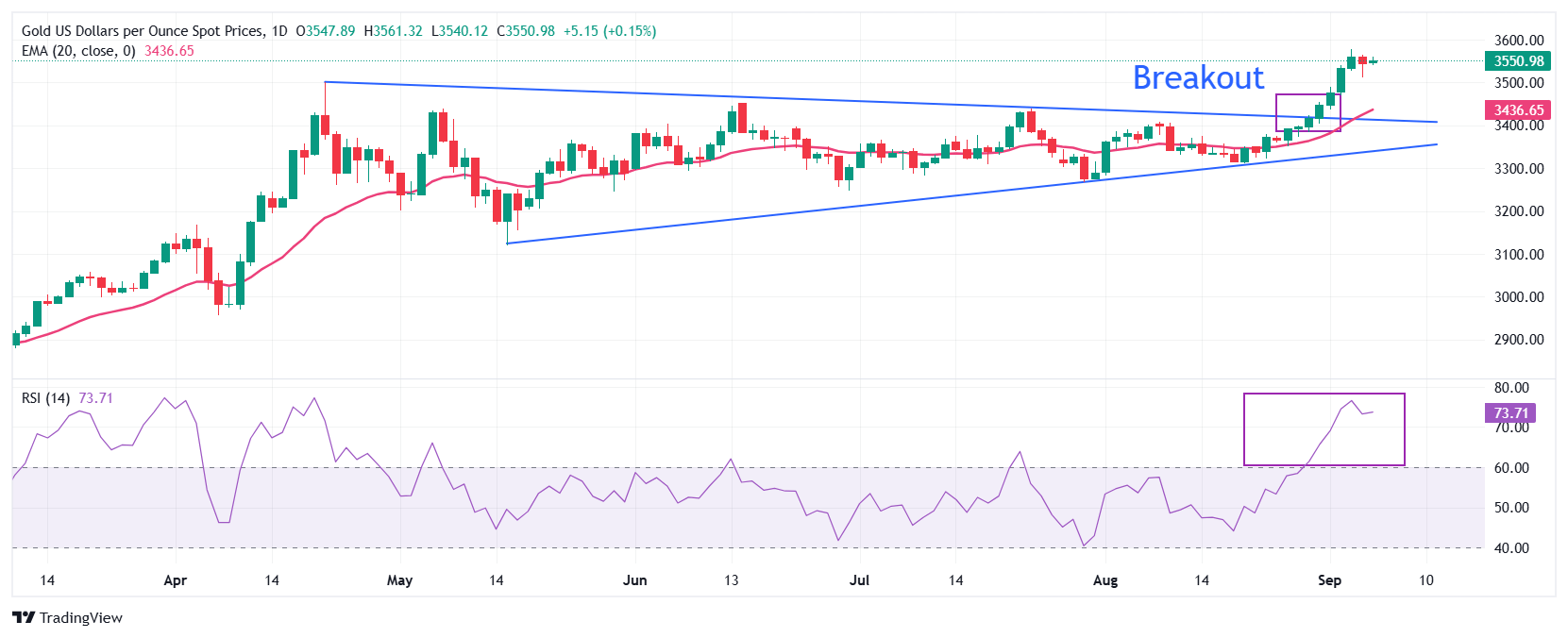
Group 1 - Investors are awaiting the critical U.S. non-farm payroll data for August, with gold prices consolidating around $3,550 [1] - Economists expect the U.S. to add 75,000 jobs in August, nearly unchanged from July's 73,000 [2] - The unemployment rate is projected to rise from 4.2% to 4.3% [2] Group 2 - Average hourly earnings are expected to grow at a moderate pace of 3.7%, down from 3.9% in July, with a steady monthly increase of 0.3% [3] - The U.S. dollar index (DXY) fell by 0.25% to around 98.00 before the non-farm payroll data release, making gold more attractive to investors [3] - Gold prices paused after reaching a historical high of around $3,580, following a bullish breakout from a symmetrical triangle pattern on the daily chart [3] Group 3 - The recent trend for gold prices is bullish, with the 20-day exponential moving average (EMA) rising near $3,436.70 [4] - The 14-day relative strength index (RSI) surged to around 75.00, indicating potential overbought conditions for gold prices [5] - The 20-day moving average will serve as a key support level, while the $3,600 level will act as a significant resistance point for gold [5]