金融脱媒

Search documents
特朗普关税致贫65万美国人,如期降息25基点,中国资产迎来估值修复?
Sou Hu Cai Jing· 2025-09-18 04:02
Group 1 - The impact of tariffs is primarily affecting American consumers, who have already borne approximately 22% of the tariff costs, which could rise to 67% if the tariffs remain in place [1] - The Federal Reserve's interest rate cuts are seen as a potential solution, but the current economic environment is challenging, with high unemployment and inflation risks [1] - A potential global liquidity increase due to the Fed's rate cuts could lead to a reallocation of funds, benefiting non-US assets like A-shares and gold [1] Group 2 - The new interest rate cycle initiated by the Federal Reserve is expected to positively influence emerging markets, particularly in stock and real estate sectors [3] - Current valuations in A-shares and Hong Kong stocks are significantly lower than those in mature markets, indicating a potential for valuation recovery [3] - The average daily trading volume in the A-share market remains robust, suggesting that a new round of Fed rate cuts could further enhance market liquidity [3] Group 3 - Recent disclosures from public funds indicate that market leaders are optimistic about the second half of the year, despite a decrease in implied returns due to rising stock prices [5] - The overall Chinese stock market is not in a bubble state, but opportunities for easy gains are becoming scarcer [5] Group 4 - The global monetary easing cycle initiated by the Fed is likely to drive up risk asset prices, creating favorable conditions for a bull market [7] - The potential for a rate cut by the People's Bank of China could alleviate the interest rate gap between the yuan and the dollar, benefiting financial stocks [7] Group 5 - Historical data suggests that preemptive rate cuts by the Fed can support stock market strength, although current economic indicators show signs of weakness [9] - The contrasting performance of tech giants highlights market volatility, with significant investments from leaders like Elon Musk in Tesla, while companies like Nvidia face regulatory scrutiny [9] Group 6 - Upcoming decisions from global central banks could lead to significant currency market fluctuations, making it crucial for long-term investors to monitor the Fed's rate cut pace and US-China trade negotiations [10] Group 7 - The low interest rate environment is pushing investors to seek alternative assets, such as money market funds and bond funds, which offer more attractive returns compared to traditional savings [12] - The stock market's growth is drawing funds away from bank deposits, indicating a shift towards more dynamic investment opportunities [12] - The trend of financial disintermediation is becoming more pronounced, with a greater emphasis on direct financing and diversified investment channels [12]


管涛:股市上涨并非存款搬家,居民仍在“多存少贷”
和讯· 2025-09-11 09:48
Core Viewpoint - The fluctuation in resident deposits cannot adequately explain the stock market's rise and fall, as the key to stock market movements lies more with non-bank financial institutions rather than changes in resident deposits [2][3][4]. Group 1: Resident Deposit Changes and Stock Market - Since 2009, July has consistently shown negative growth in resident deposits, indicating seasonal factors rather than significant economic implications [3]. - Historical data shows that in 11 out of 17 years since 2009, the stock market rose in July, despite significant drops in resident deposits in some years [3]. - The relationship between resident deposit changes and stock market performance appears weak, as evidenced by contrasting outcomes in various years despite similar deposit declines [4]. Group 2: Non-Bank Financial Institutions - Changes in deposits from non-bank financial institutions are more reliable indicators of stock market performance, with significant increases in their deposits correlating with stock market gains [5]. - In July 2023, non-bank financial institutions saw an increase of 2.14 trillion yuan in deposits, which was a substantial year-on-year increase [5]. - A strong positive correlation exists between the changes in non-bank financial institution deposits and stock market performance, suggesting that as these deposits increase, the stock market tends to rise [6]. Group 3: Resident Sector Leverage - The trend of residents saving more and borrowing less continues, indicating a de-leveraging process within the resident sector [8]. - As of Q2 2023, the leverage ratio for the resident sector was 61.1%, a slight decrease from the previous year, reflecting ongoing de-leveraging efforts [8]. - Historical data shows that the resident sector has undergone multiple rounds of de-leveraging, with the current trend being the most recent in a series of adjustments since 2004 [12]. Group 4: Economic Context and Policy Implications - The current economic environment, characterized by high leverage ratios and a focus on de-leveraging, suggests that expectations for a quick reversal in this trend may be unrealistic [15]. - The government may need to increase leverage to stabilize and stimulate demand, especially in light of the challenges faced by the resident sector [16]. - The historical context of leverage changes in response to economic crises indicates that government intervention is crucial for maintaining macroeconomic stability [16].

这次的“存款搬家” 有所不同
Sou Hu Cai Jing· 2025-09-07 16:35
Core Insights - The decline in household deposits in July 2023 is interpreted as a seasonal effect rather than a significant economic indicator, as historical data shows similar trends in previous years [2][3] - The relationship between household deposit changes and stock market fluctuations is weak, with non-bank financial institutions playing a more crucial role in market movements [4][5] - The trend of "more savings, less borrowing" among Chinese households continues, indicating a persistent deleveraging process [7][10] Group 1: Household Deposits and Loans - In July 2023, household deposits decreased by 1.11 trillion yuan, which is 780 billion yuan more than the same month last year [1] - The decline in household loans in July 2023, amounting to 489.3 billion yuan, marks a shift from the previous trend of positive growth since 2009 [3] - Cumulatively, household deposits increased by 9.66 trillion yuan in the first seven months of 2023, reflecting a year-on-year increase of 720.3 billion yuan [3] Group 2: Stock Market Dynamics - The stock market's performance in July does not correlate strongly with household deposit changes, as evidenced by varying stock index movements despite significant deposit fluctuations in previous years [2][4] - Non-bank financial institutions saw an increase in deposits of 2.14 trillion yuan in July 2023, indicating a potential shift in investment behavior away from traditional bank deposits [4][5] Group 3: Deleveraging Trends - The household leverage ratio in China has slightly decreased to 61.1% as of Q2 2023, down from 62.3% in Q1 2023, indicating ongoing deleveraging efforts [7][10] - The average household loan increase in the first seven months of 2023 was only 680.8 billion yuan, a decrease of 579.4 billion yuan compared to the previous year [4] - The widening gap between new deposits and new loans, reaching 8.98 trillion yuan, highlights the trend of households prioritizing savings over borrowing [4]
管涛:这次“存款搬家” 有所不同,居民仍然“多存少贷”
Di Yi Cai Jing· 2025-09-07 11:30
Core Insights - The fluctuations in the stock market are more influenced by non-bank financial institutions rather than changes in household deposits, indicating a continued trend of excess savings among Chinese residents [1][2][4] - The monthly data volatility does not alter the ongoing trend of household deleveraging, as evidenced by the widening loan-to-deposit gap [1][4] Summary by Sections Household Deposits - In July, household deposits in RMB decreased by 1.11 trillion yuan, which is 780 billion yuan more than the same month last year, reflecting seasonal factors rather than a significant trend [2][3] - Since 2009, July has consistently shown negative growth in household deposits, with 11 out of 14 years seeing stock market gains during this month [2] Household Loans - For the first time since 2009, household loans decreased in July, dropping by 489.3 billion yuan, which is significantly lower than the average for the same period from 2020 to 2024 [3][4] - The trend of "more savings, less borrowing" is evident, with household loans increasing by only 680.8 billion yuan in the first seven months of the year, a decrease of 579.4 billion yuan year-on-year [4] Non-Bank Financial Institutions - The increase in deposits at non-bank financial institutions is a more reliable indicator of stock market movements, with a notable increase of 2.14 trillion yuan in July, which is 1.39 trillion yuan more than the previous year [4][5] - The correlation between changes in non-bank financial institution deposits and stock market performance is moderate to strong, suggesting that as these deposits increase, the stock market tends to rise [5][6] Deleveraging Trends - The household leverage ratio has slightly decreased, with the ratio at 61.1% as of the second quarter, down from 62.3% in the previous year [7][11] - The ongoing trend of household deleveraging reflects a broader economic context where the leverage ratio of the entire economy has been rising, with households contributing less to this increase compared to other sectors [10][11] Economic Context - The current economic environment shows that despite the increase in household savings, there is a lack of willingness to invest in riskier assets, indicating potential for future diversification in asset allocation [6][16] - The government may need to increase leverage to stabilize and stimulate demand, as current household debt levels and consumption capabilities are insufficient [16]
银行存款不香了?不去存银行钱去哪了?
Sou Hu Cai Jing· 2025-08-25 00:25
Group 1 - The attractiveness of bank deposits has significantly declined, with many investors shifting their focus to capital markets due to decreasing deposit interest rates [3][5] - As of July, the People's Bank of China reported a net increase of 5 trillion yuan in RMB deposits, with non-bank financial institutions seeing a rise of 2.14 trillion yuan, while household deposits showed a negative growth [3][5] - The average interest rates for fixed-term deposits have dropped, with one-year deposits now below 2%, leading to a decrease in real income for depositors [5][6] Group 2 - The stock market has seen a remarkable rise, with A-shares surpassing 100 trillion yuan in market capitalization, indicating a growing consensus of a bull market [4] - The low interest rate environment is pushing users to seek alternative assets, as traditional bank deposits no longer provide adequate returns [5][8] - Financial technology advancements have transformed investment practices, allowing easier access to a variety of financial products, thus attracting investors away from traditional bank deposits [8][9] Group 3 - The robust performance of the stock market, particularly in technology and consumer sectors, has drawn significant investor interest, with many seeking higher returns compared to bank deposits [8][9] - The implementation of a registration system and improved delisting mechanisms in the stock market has enhanced the investment landscape, providing more opportunities for investors [9][12] - The trend of financial disintermediation reflects a shift towards direct financing and diversified investment channels, which is becoming the norm for household participation in the economy [12]

居民存款搬家潜力几何?
2025-08-19 14:44
Summary of Key Points from Conference Call Industry Overview - The discussion revolves around the phenomenon of "deposit migration" in the Chinese banking sector, particularly focusing on the shift of funds from fixed deposits to demand deposits and investments in the stock market. Core Insights and Arguments - **M1 Growth and Economic Indicators**: M1 growth has risen to 5.6% in July, indicating improved monetary liquidity and suggesting a potential bottoming out of economic demand and inflation, typically leading by about six months [2] - **Deposit Migration Drivers**: The migration of deposits is driven by several factors including a recovery in the stock market, changes in long-term economic expectations, and a resurgence in the financial assets of high-net-worth individuals [10] - **Excess Savings**: Approximately 5 trillion yuan of excess savings accumulated between 2022 and 2024 is a significant source for potential market entry, supported by a liquidity-rich environment and government leverage [5][20] - **Stock Market Activity**: Since August, A-share trading volume has exceeded 2 trillion yuan, indicating increased trading activity, although the number of new accounts opened is still below last year's peak [6] - **Shift in Loan Composition**: The proportion of loans for mechanical manufacturing and green finance has increased from 40% to 70%, while real estate loans have dropped to 0%, reflecting a shift in financial resource allocation [3][7] Additional Important Content - **Impact of Fixed Deposits**: A significant amount of fixed deposits, particularly those maturing in 2025, is expected to be reallocated, with about 70 trillion yuan in total fixed deposits maturing, including 7 trillion yuan in three-year fixed deposits [14][13] - **Financial Disintermediation**: The phenomenon of financial disintermediation has led to a significant outflow of deposits towards non-bank financial products, with an estimated drag on physical deposits of about 12 trillion yuan, which has since reduced to 8 trillion yuan [8] - **Contribution to Deposit Creation**: The contribution of fiscal measures to deposit creation has increased from 25% in 2023 to 53% currently, while the contribution from entity credit has decreased from 73% to 41% [9] - **Potential Market Entry Funds**: The potential funds available for market entry are estimated to be between 5 to 7 trillion yuan, influenced by macroeconomic conditions, policy expectations, and external environments [11][21] - **Liquidity and Investment Trends**: The trend of residents and enterprises activating their deposits is expected to enhance market liquidity and stimulate investment activities, with a projected increase in M1 growth to around 10% [17][18] This summary encapsulates the key points discussed in the conference call, highlighting the dynamics of deposit migration, market conditions, and potential investment opportunities within the Chinese financial landscape.
中金:居民存款搬家潜力几何?
智通财经网· 2025-08-19 00:10
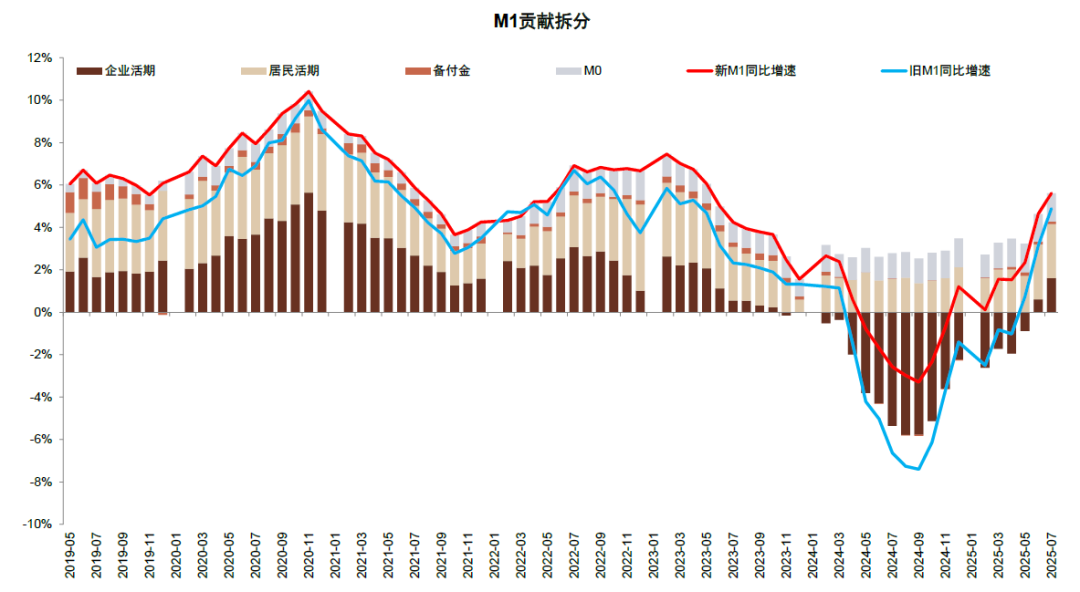
Group 1 - The article highlights signs of deposits moving towards the stock market since May, driven by factors such as increased M1 growth and a shift in deposit trends [1] - M1 growth reached 5.6% year-on-year in July, up from 2.3% in May, indicating a trend of deposit activation [1] - There is a notable increase in the popularity of equity funds, with a slowdown in fixed-income wealth management products compared to last year [1][9] Group 2 - The capital market has become more active, with daily trading volumes in A-shares exceeding 2 trillion yuan since August [2] - The number of new accounts opened on the Shanghai Stock Exchange increased by 26% in July compared to May, although it remains below the peak in October of the previous year [2] Group 3 - The article discusses the sources of deposits, including fiscal spending and international balance of payments, which have contributed to deposit creation [15] - The contribution of fiscal measures to deposit creation rose from 25% at the end of 2023 to 53% currently, while the contribution from entity credit decreased from 73% to 41% [15][23] Group 4 - Factors driving the movement of deposits to the stock market include improved risk appetite due to government stimulus policies and a recovery in stock market returns [31] - The average return on A-shares over the past 12 months has reached around 20%, prompting a shift in investment strategies [31][33] Group 5 - The potential for deposits to move into the stock market is estimated at 5-7 trillion yuan, based on excess savings, maturing deposits, and the activation of deposits [45][46] - The article notes that the actual movement of deposits will depend on macroeconomic conditions, policy expectations, and external factors [45][46] Group 6 - The shift of deposits to the stock market is expected to benefit banks by expanding interest margins and improving the outlook for credit demand [48] - The article suggests that while the stock market's attractiveness may reduce the appeal of high-dividend yields, it remains attractive for long-term funds [48]
中金:居民存款搬家潜力几何?
中金点睛· 2025-08-18 23:36
Core Viewpoint - The article discusses the potential for residents' deposits to shift towards the stock market, highlighting signs of this trend emerging since May 2023, driven by various economic factors and changes in investor behavior [2][30]. Group 1: Signs of Deposit Migration - Since May 2023, there have been indications of deposits moving towards the stock market, including an increase in M1 growth from 2.3% in May to 5.6% in July, suggesting a trend of deposit activation [2]. - The growth of fixed-income wealth management products has slowed compared to last year, while equity mutual funds and private securities investment funds have seen a rebound in growth [2]. - Non-bank deposits increased significantly, with a year-on-year increase of 1.4 trillion yuan in July, indicating that deposits may be entering brokerage margin accounts in preparation for market entry [2][9]. Group 2: Capital Market Activity - Since August 2023, the A-share market has seen daily trading volumes exceed 2 trillion yuan, with a notable increase in trading activity and a financing balance surpassing 2 trillion yuan [3]. - The number of new accounts opened on the Shanghai Stock Exchange increased by 26% from May to July, although it remains below the peak levels seen in October 2022 [3]. Group 3: Sources of Deposit Creation - The article estimates that residents have accumulated approximately 5 trillion yuan in "excess savings" from 2022 to 2024, which could potentially be used for investment [14]. - The contribution of fiscal measures to deposit creation has risen from 25% at the end of 2023 to 53% currently, while the contribution from entity credit has decreased from 73% to 41% [14]. - The weakening of financial disintermediation has led to a significant outflow of deposits from fixed-income products back into the banking system, contributing to the recent increase in deposits [15]. Group 4: Motivations for Deposit Migration - Improved risk appetite among residents, driven by government stimulus policies and positive economic expectations, has led to a shift in investment behavior towards the stock market [30]. - The current environment of weak returns from major risk assets like real estate and stocks has prompted funds to flow into higher-yielding investments, with the A-share market showing a 12-month average return of around 20% [30]. - The weakening of the US dollar has facilitated the return of overseas funds to the Chinese stock market, as investors seek better returns domestically [31]. Group 5: Potential for Deposit Migration - The potential for deposits to migrate to the stock market is estimated at around 5-7 trillion yuan, which could exceed the amounts seen during previous market rallies in 2016-2017 and 2020-2021 [42]. - The upcoming maturity of approximately 70 trillion yuan in fixed-term deposits in 2025 may drive residents to seek higher-yielding assets, as the re-pricing of these deposits will result in lower interest rates [40]. - The activation of deposits, driven by a favorable economic environment, could lead to an additional net increase of around 5 trillion yuan in resident demand deposits, which may also flow into the stock market [41].

150万亿大资管
2 1 Shi Ji Jing Ji Bao Dao· 2025-07-31 23:52
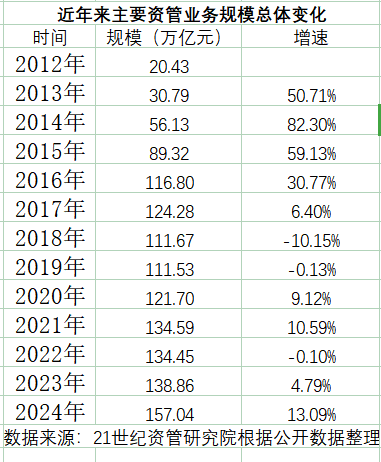
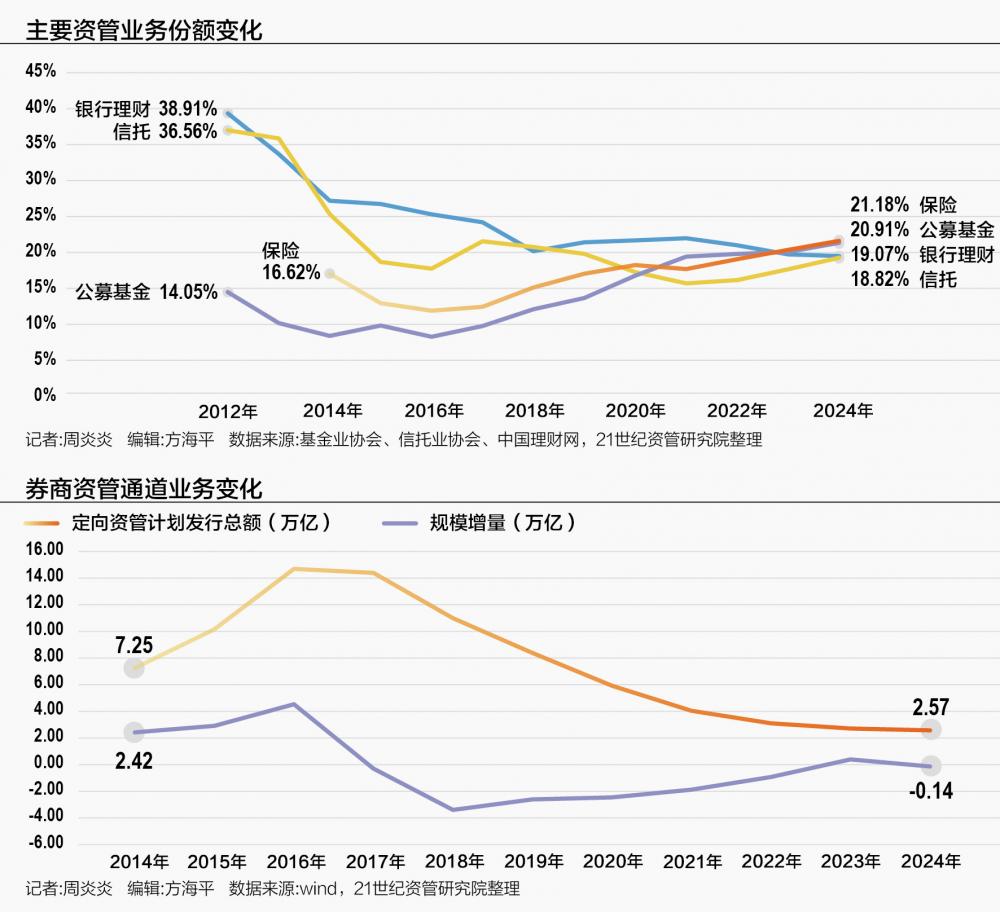
Core Viewpoint - By the end of 2024, China's total asset management scale is expected to reach 150 trillion yuan, indicating significant growth across various asset management sectors despite regulatory challenges and a shift towards financial disintermediation [1][5]. Group 1: Historical Development of Asset Management - The asset management industry in China has evolved significantly since the introduction of bank wealth management products in 2004, with key milestones including the rise of trust companies in 2011 and the implementation of the Asset Management New Regulations in 2018 [2]. - The industry has transitioned from rapid growth to a more regulated and transparent environment, with the establishment of wealth management subsidiaries and a focus on compliance since 2019 [2][5]. Group 2: Current Market Dynamics - As of the end of 2024, the total asset management scale in China is projected to be 157.04 trillion yuan, marking a 13.09% increase from the previous year, the highest growth rate since the introduction of the new regulations [5][6]. - The trust sector has shown the highest growth rate at 23.58%, closely followed by public funds at 20.39% and insurance at 15.08%, while bank wealth management grew by 11.75% [5][6]. Group 3: Sector-Specific Insights Bank Wealth Management - By the end of 2024, bank wealth management is expected to approach 30 trillion yuan, reflecting a recovery from previous declines due to market volatility [9][10]. - The share of bank wealth management in the overall asset management market has decreased from 38.91% in 2012 to 19.07% in 2024, as other sectors like public funds and insurance have gained traction [10]. Trust Sector - The trust industry experienced significant contraction from 2018 to 2020 but has since rebounded, with a notable increase in scale and a shift towards more diversified and professional asset management services [14][15]. Public Funds - Public funds have grown from 846 million yuan in 2000 to 32.83 trillion yuan by the end of 2024, benefiting from favorable market conditions and the shift towards net asset value-based products [16][17]. Insurance Asset Management - Insurance asset management has shown steady growth, reaching over 30 trillion yuan by the end of 2024, with a market share increase from 11.46% in 2016 to 21.18% in 2024 [18][19]. Securities Asset Management - The securities asset management sector has faced significant declines since 2018, with a 7.76% drop in 2024, reflecting the impact of regulatory changes and a shift away from traditional channel-based business models [20][21].
数看150万亿大资管:险资、公募突破30万亿,信托增速最快
2 1 Shi Ji Jing Ji Bao Dao· 2025-07-31 13:51
Core Insights - The asset management industry in China is experiencing significant growth, with a total scale reaching 157.04 trillion yuan by the end of 2024, marking a 13.09% increase from the previous year, the highest since the implementation of the new asset management regulations [6][8][12] - The growth is driven by a shift in investor behavior, as lower bank deposit rates and regulatory changes have led to a "financial disintermediation" effect, with substantial inflows into wealth management products, insurance, and public funds [1][6][9] Group 1: Historical Context and Regulatory Changes - The asset management industry has evolved significantly since the introduction of bank wealth management products in 2004, with key milestones including the rise of trust companies and the implementation of the new asset management regulations in 2018 [2][4] - The new regulations aimed to standardize the industry, eliminate shadow banking, and promote transparency, leading to a more compliant and structured asset management environment [2][4][9] Group 2: Growth by Sector - Trust companies saw the highest growth rate at 23.58%, with their scale approaching that of bank wealth management products, which grew by 11.75% [8][12] - Public funds and insurance asset management also experienced significant growth, with increases of 20.39% and 15.08% respectively, indicating a shift in market dynamics [8][12] - By the end of 2024, the asset management scale for various sectors was as follows: insurance at 33.26 trillion yuan (21.18%), public funds at 32.83 trillion yuan (20.91%), bank wealth management at 29.95 trillion yuan (19.07%), and trust at 29.56 trillion yuan (18.82%) [8][12] Group 3: Market Trends and Investor Behavior - The trend of "deposit migration" is evident, with investors moving funds from traditional bank deposits to higher-yielding wealth management products due to declining interest rates [6][9][16] - The asset allocation preferences of investors have shifted, with a notable increase in the proportion of investments in securities and a decrease in non-standard debt investments, reflecting a more cautious approach to risk [30][33] Group 4: Financial Performance and Revenue Trends - The revenue for trust companies increased to 940.36 billion yuan in 2024, although net profits saw a significant decline of 45.52% compared to the previous year, indicating challenges in profitability despite growth in asset scale [40] - Public funds experienced a decline in management fees due to regulatory changes and market conditions, with a notable shift towards passive investment strategies [41] - Bank wealth management products reported a decrease in annualized returns to 2.65% in 2024, highlighting the impact of the low-interest-rate environment on profitability [43]