风险收益比

Search documents
中银基金范锐:构建右偏的收益曲线,做投资者敢买的产品
点拾投资· 2025-09-25 11:00
Core Viewpoint - The article emphasizes the importance of utilizing convertible bonds (CBs) as a strategic investment tool, focusing on risk-reward analysis based on the characteristics of the underlying stocks. The investment philosophy is centered around maintaining a balanced risk-return profile while capitalizing on market inefficiencies and price discrepancies in CBs [2][3][20]. Group 1: Investment Philosophy - The investment approach prioritizes a risk-reward ratio that does not overly depend on future predictions, acknowledging the inherent uncertainties in the market [2][11]. - The strategy involves adjusting the allocation between stocks and CBs based on their relative valuations, aiming to enhance the overall risk-return profile of the portfolio [3][19]. - The philosophy of "not losing is winning" is highlighted, indicating a focus on preserving capital while seeking opportunities for growth [5][12]. Group 2: Timing and Selection - Timing decisions are made based on the relative valuation of CBs compared to stocks, with a preference for increasing CB exposure when they are undervalued [17][18]. - The selection of individual CBs is based on a detailed analysis of four factors: CB price, premium rate, and the characteristics of the underlying stock and industry [20][21]. - The article notes that high-potential opportunities typically arise during market downturns, allowing for strategic left-side investments [3][24]. Group 3: Performance Metrics - The performance of the managed fund, 中银产业债A, has shown a significant outperformance with a 9.31% return over the past year compared to a benchmark of 2.36%, indicating effective management and strategy execution [2]. - The article provides specific performance data for various funds managed, showcasing consistent rankings in the top quartile among peers, particularly during different market conditions [14][48]. Group 4: Market Conditions and Adjustments - The investment strategy adapts to changing market conditions, with a focus on maintaining a balanced exposure to both stocks and CBs based on their respective valuations [30][31]. - The article discusses the importance of liquidity management and the avoidance of excessive exposure to liquidity risks, especially during market downturns [42]. Group 5: Long-term Perspective - The long-term investment philosophy is rooted in the understanding that the valuation at the time of purchase significantly impacts future returns, advocating for a focus on undervalued assets [45][43]. - The article concludes with a reminder of the unpredictable nature of markets, emphasizing the need for a disciplined approach to investment management that prioritizes risk control and capital preservation [46][47].


不战而屈人之兵
Bao Cheng Qi Huo· 2025-09-17 06:46
Report Core View - The highest level of cognition and ability in futures trading is to understand the essence, follow the trend, and obtain the maximum results at the minimum cost, transforming from a "fighter" to a "strategist" [2] - Traders should learn continuously, keep an open mind, and draw wisdom, not being confined to their own opinions or superstitious about a single technical indicator or trading system [3] - The core of "subduing the enemy without fighting" is the establishment and application of "momentum", which means following the market trend in futures trading and making decisions based on risk - return assessment [4][5] Summary by Related Content Comparison between Ordinary Traders and High - level Traders - Ordinary traders are like inexperienced generals, believing in the power of "fighting", frequently trading, and facing high costs and risks. Some even go all - out to recover losses and end up with total failure [3] - High - level traders are like Han Xin, willing to learn from others, waiting for the right "momentum" in the market, and making trades based on sufficient research and strict discipline [3][4] Establishment and Application of "Momentum" in Trading - In futures trading, when the long - term trend is established, the moving average system diverges upward, the fundamentals are strong, and market sentiment is optimistic, traders should follow the trend and let profits run [4] - When the trend is unclear or in a short - term pattern, forcing a long position is against the "momentum" and will be punished by the market. Traders should wait for the right opportunity [4] Risk - Return Assessment in Trading - Before each trade, traders should assess the upside potential, downside risk, and probability of success. If the risk - return ratio is not good, they can choose not to trade [5] - When there is a floating profit in the account, traders should decide whether to hold or close the position based on the trend, fundamentals, and market sentiment [5]
红筹投资总经理邹奕:做“安心”投资 锚定价值顺势而为
Zhong Guo Zheng Quan Bao· 2025-09-15 00:29
Core Viewpoint - The recent strong performance of the A-share market is attributed to long-term valuation compression and the potential for valuation recovery, which has been building up over the past few years [1] Investment Philosophy - The investment philosophy emphasizes "value anchoring and going with the trend," focusing on maintaining a balanced portfolio while adhering to low valuation assets for a more "secure" investment approach [1][5] - The strategy involves a flexible adjustment to market conditions, allowing for rebalancing of positions and combinations based on market dynamics [7] Investment Strategy - The preferred investment model is to focus on low-valuation assets, reflecting a preference for a stable investment style [5] - The approach includes diversified sector allocation and holding assets at different valuation realization stages, rather than concentrating on a single high-risk investment [5] - The focus is on capturing valuation recovery rather than speculative valuation expansion, with a keen eye on risk-reward ratios and certainty [5][6] Market Outlook - The investment outlook remains positive across multiple sectors, including innovative pharmaceuticals, technology, cyclical industries, automotive, and public utilities [10][11] - The innovative pharmaceutical sector is particularly highlighted as a promising area, with expectations for domestic companies to transition from following to leading innovation [10] - The AI sector is noted for its potential, especially in computing power and humanoid robotics, which are expected to become significant markets [11] Sector-Specific Insights - In advanced manufacturing, the shift towards higher value chain segments is seen as crucial for enhancing competitiveness and market returns [11] - The cyclical sector, particularly energy and chemicals, is anticipated to see price stabilization and growth potential due to favorable market conditions [11] - In the automotive sector, the focus is on identifying companies undergoing deep reforms or new product cycles, with an emphasis on smart and robotic trends [11] - The public utilities sector is viewed as presenting medium to long-term investment opportunities due to currently reasonable valuations and expected growth in electricity demand [11] Conclusion - Overall, the A-share market is expected to witness a maturation of shareholder return and market value management systems, with a focus on identifying undervalued assets that show potential for fundamental improvement [12]

告别“过山车”,如何利用红利实现1+1>2的实战组合
Sou Hu Cai Jing· 2025-08-26 08:23
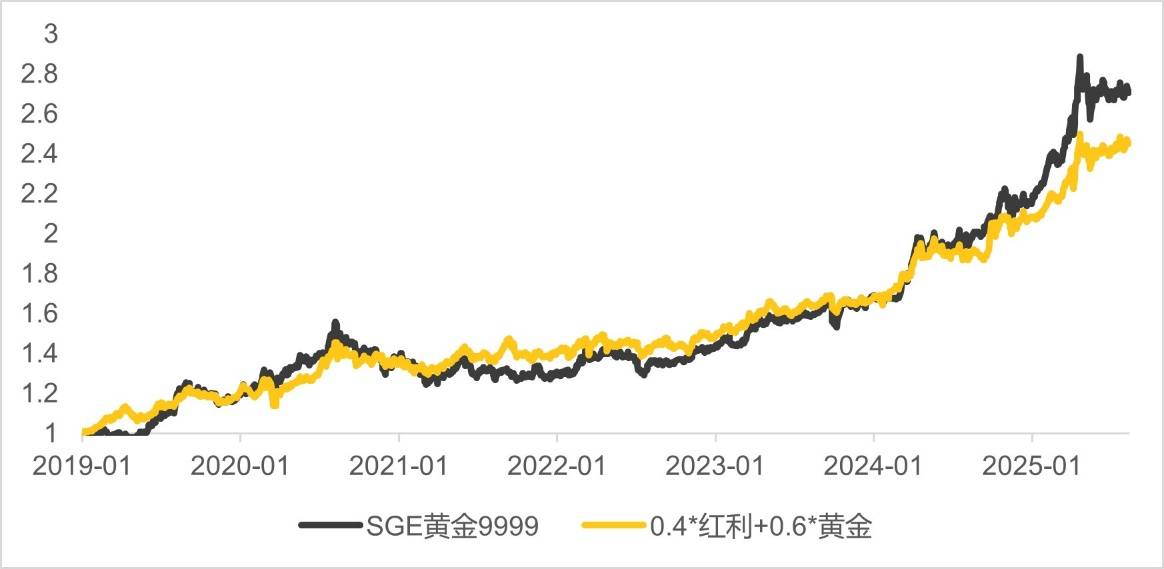
Core Viewpoint - Dividend assets serve as a dual-purpose investment, providing both growth potential akin to stocks and stable income similar to bonds, making them an effective balancing tool in investment portfolios [1]. Group 1: Dividend Assets Characteristics - Dividend assets are rooted in sectors closely tied to economic cycles, such as coal, petrochemicals, and finance, exhibiting strong stock-like characteristics while also offering regular dividends [1]. - The unique cross-asset nature of dividend assets allows them to effectively reduce overall portfolio volatility while potentially enhancing returns, achieving a surprising effect of 1+1>2 in holding experience [1]. Group 2: Performance with Other Assets - The "Dividend + Gold" combination effectively controls maximum drawdown while improving the risk-return ratio, especially beneficial during periods of gold market downturns [1][2]. - The "Dividend + Commodity" strategy enhances returns, risk-return ratios, and reduces maximum drawdown compared to holding commodities alone, demonstrating resilience during market downturns [5]. - The "Dividend + Bond" approach offers higher long-term compound return potential with limited increase in maximum drawdown, providing strong inflation resistance [8]. - The "Dividend + Growth" strategy lowers volatility and maximum drawdown while maintaining the elasticity of growth assets, thus improving the risk-return ratio [10]. Group 3: Investment Tools - The E Fund (515180), tracking the CSI Dividend Index, is highlighted as a low-fee quality option for investors seeking to allocate to A-share dividend products [12].
连续加仓
Zhong Guo Ji Jin Bao· 2025-08-11 06:01
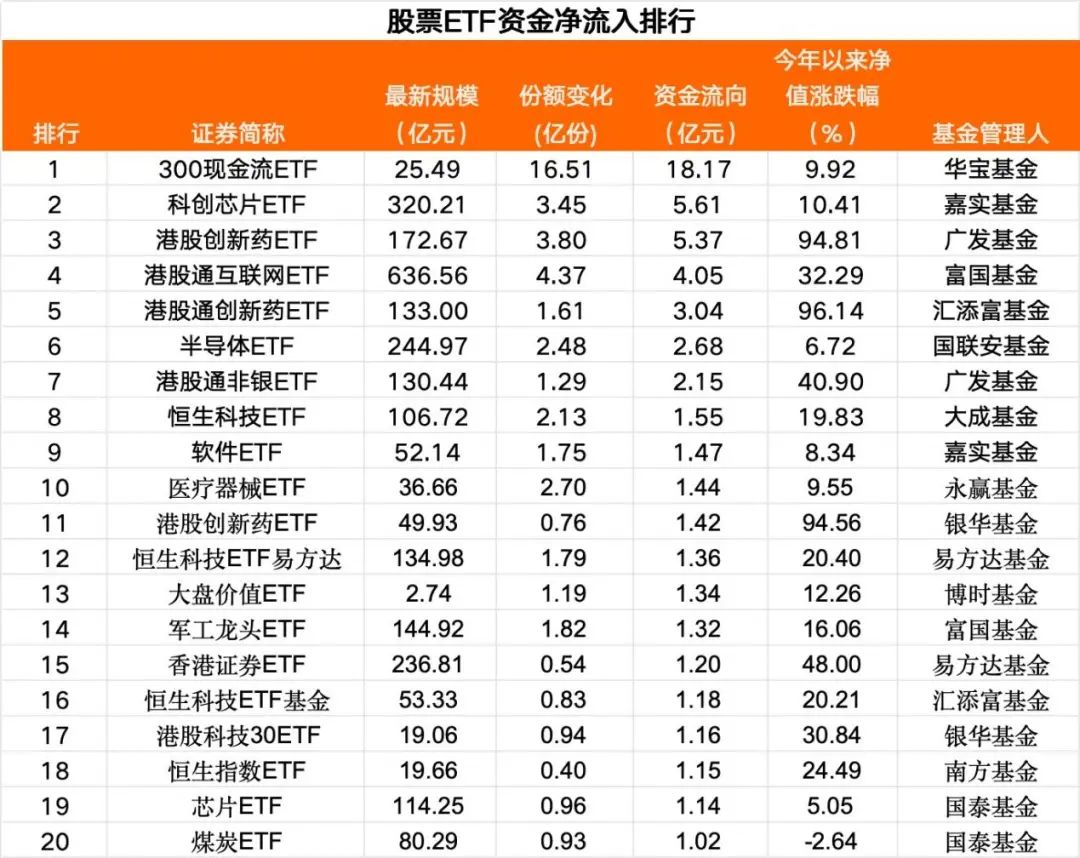
Core Insights - The A-share market experienced a slight decline on August 8, with the three major indices collectively falling, while stock ETFs attracted significant capital inflow of 19.40 billion yuan on the same day [1][2] Group 1: Stock ETF Performance - Stock ETFs have seen a continuous inflow of nearly 150 billion yuan over six consecutive trading days in August, with over 130 billion yuan inflow recorded in the week from August 4 to August 8 [1][2] - As of August 8, there are 1,167 stock ETFs in the market, with a total scale of 3.80 trillion yuan [2] - The top three stock ETFs by net inflow on August 8 were: Huabao 300 Cash Flow ETF (5.61 billion yuan), Jiasheng Sci-Tech Chip ETF (5.37 billion yuan), and Guangfa Hong Kong Innovative Medicine ETF (4.05 billion yuan) [2][4] Group 2: Sector and Theme Analysis - The sectors attracting the most capital inflow on August 8 included cash flow (17.8 billion yuan), Hong Kong pharmaceuticals (12.2 billion yuan), semiconductors (10.2 billion yuan), and Hong Kong technology (8.1 billion yuan) [2] - Among the top 20 stock ETFs by net inflow, 11 were related to Hong Kong stocks, focusing on innovative medicine, internet, technology, and non-bank sectors [2][4] Group 3: Outflow Trends - On August 8, 24 stock ETFs experienced outflows exceeding 1 billion yuan, particularly those tracking broad indices like the CSI 300 and the ChiNext, as well as industry ETFs related to gaming, consumption, and artificial intelligence [5][6] - The top three stock ETFs by net outflow included the CSI 300 ETF (6.03 billion yuan), ChiNext ETF (3.78 billion yuan), and Gaming ETF (3.34 billion yuan) [7] Group 4: Market Outlook - The A-share market is expected to maintain a slow upward trend supported by policy backing and reasonable liquidity, with structural opportunities remaining abundant [6]
连续加仓
中国基金报· 2025-08-11 05:54
Core Viewpoint - The stock ETF market in China has seen significant inflows, with a total of approximately 150 billion yuan in net inflows over six consecutive trading days in August, indicating strong investor interest and confidence in the market [2][4]. Summary by Sections Stock ETF Inflows - On August 8, the stock market experienced slight declines, with total trading volume reaching 1.74 trillion yuan, while stock ETFs attracted a net inflow of 19.40 billion yuan [2][3]. - Since the beginning of August, stock ETFs have accumulated nearly 150 billion yuan in net inflows, with over 130 billion yuan flowing in during the week of August 4 to August 8 [2][4]. Leading ETFs - As of August 8, there are 1,167 stock ETFs in the market, with a total scale of 3.80 trillion yuan. On that day, 21 ETFs saw net inflows exceeding 1 billion yuan, with industry and thematic ETFs leading the inflows [4]. - The top three ETFs by net inflow on August 8 were: - Huabao 300 Cash Flow ETF: 18.17 billion yuan - Jiashu Science and Technology Chip ETF: 5.61 billion yuan - Guangfa Hong Kong Innovative Medicine ETF: 5.37 billion yuan [4][6]. Sector Performance - The sectors with the highest net inflows on August 8 included: - Cash Flow: 17.8 billion yuan - Hong Kong Pharmaceuticals: 12.2 billion yuan - Semiconductors: 10.2 billion yuan - Hong Kong Technology: 8.1 billion yuan - Hong Kong Internet: 4.0 billion yuan [4][5]. Outflows from Certain ETFs - On August 8, 24 stock ETFs experienced net outflows exceeding 1 billion yuan, particularly those tracking broad indices like the CSI 300 and ChiNext, as well as industry ETFs related to gaming, consumption, and artificial intelligence [8][10]. - The top three ETFs with the largest net outflows included: - CSI 300 ETF: -6.03 billion yuan - ChiNext ETF: -3.78 billion yuan - Gaming ETF: -3.34 billion yuan [10]. Market Outlook - According to Guangfa Fund, the risk-return ratio and funding supply will be key factors influencing asset price performance. The current A-share market shows low certainty in profitability, with moderate valuation attractiveness and improving funding supply, suggesting a continued wide-ranging fluctuation in the market [9]. - Fuqun Fund anticipates that with policy support and reasonable funding conditions, the market is likely to maintain a slow upward trend, presenting structural opportunities [9].

远东宏信(03360.HK):发力普惠 追寻更好风险收益比
Ge Long Hui· 2025-08-05 03:30
Core Viewpoint - Far East Horizon reported a decline in revenue for the first half of 2025, but a growth in net profit, indicating a mixed performance in its financial results [1][2]. Group 1: Financial Performance - In 1H25, the company achieved operating revenue of 17.336 billion yuan, a year-on-year decrease of 3.9%, while net profit attributable to shareholders was 2.164 billion yuan, an increase of 3.8% [1]. - The average return on equity for the first half of 2025 was 8.66%, up by 0.17 percentage points year-on-year [1]. Group 2: Business Segments - The financial and consulting business remains a key pillar, generating revenue of 11.090 billion yuan (up 2.1% year-on-year), while equipment operation and industrial operation revenues were 4.350 billion yuan (down 10.7%) and 1.797 billion yuan (down 15.5%), respectively [2]. - The gross margins for these segments were 57.5%, 21.6%, and 18.0%, reflecting changes of +1.7, -10.4, and -3.9 percentage points year-on-year [2]. Group 3: Asset Management - The company maintained a stable interest-earning asset scale of 266.626 billion yuan, with a quarter-on-quarter increase of 2.3% [2]. - The average yield on interest-earning assets rose to 8.08%, while the cost of interest-bearing liabilities decreased to 4.02%, leading to a net interest margin increase to 4.51% [2]. Group 4: Inclusive Finance - The inclusive finance business saw significant growth, with interest-earning assets reaching 22.192 billion yuan, a quarter-on-quarter increase of 28.7%, and revenue of 1.451 billion yuan, a year-on-year increase of 124.1% [3]. - The yield for this business segment was 14.72%, notably higher than the overall financial business yield of 8.1% [3]. Group 5: Asset Quality - The non-performing loan ratio and attention ratio were 1.05% and 5.51%, respectively, both showing a decline from the previous year [3]. - The provision coverage ratio remained stable at 227.33%, indicating good asset quality [3]. Group 6: Dividend and Future Outlook - The company has a high cash dividend payout ratio of 56% for 2024 and 50% for 1H25, with potential for stability and further increases [3]. - Projected net profits for 2025 to 2027 are 4.01 billion yuan, 4.23 billion yuan, and 4.48 billion yuan, reflecting year-on-year growth rates of 3.8%, 5.5%, and 5.9% respectively [3].
远东宏信(03360):2025年中期业绩点评:发力普惠,追寻更好风险收益比
NORTHEAST SECURITIES· 2025-08-03 11:42
Investment Rating - The report maintains a "Buy" rating for the company [4][6]. Core Views - The company reported a 3.9% year-on-year decline in revenue for the first half of 2025, totaling 17.336 billion yuan, while net profit attributable to shareholders increased by 3.8% to 2.164 billion yuan [1]. - The financial and consulting business remains a key revenue driver, with a revenue increase of 2.1% year-on-year, while equipment and industrial operations saw declines of 10.7% and 15.5%, respectively [1][17]. - The company has focused on the development of inclusive finance, achieving a 28.7% growth in the asset scale of this business, with revenue soaring by 124.1% year-on-year [3][38]. Summary by Sections Financial Performance - In the first half of 2025, the average return on equity was 8.66%, an increase of 0.17 percentage points year-on-year [1]. - The company’s interest-earning assets stood at 266.626 billion yuan, reflecting a 2.3% increase from the end of the previous year [2]. - The average yield on interest-earning assets rose to 8.08%, while the cost of interest-bearing liabilities decreased to 4.02%, leading to a net interest margin of 4.51% [2][25]. Business Segments - The financial and consulting segment generated 110.90 billion yuan in revenue, accounting for 64.0% of total revenue, with a gross margin of 57.5% [1][19]. - The inclusive finance business achieved a revenue of 14.51 billion yuan, significantly contributing to overall growth [3][38]. Asset Quality - The company reported a non-performing loan ratio of 1.05% and a watchlist ratio of 5.51%, both showing a decline from the previous year [3][36]. - The provision coverage ratio remained stable at 227.33%, indicating solid asset quality [3]. Future Outlook - The company is expected to maintain a high cash dividend payout ratio, with projections for net profit attributable to shareholders of 4.01 billion yuan, 4.23 billion yuan, and 4.48 billion yuan for 2025, 2026, and 2027, respectively [4][5].
有理财产品年内收益率超30%,啥情况?
Jing Ji Wang· 2025-07-31 06:32
Group 1 - The core viewpoint is that equity wealth management products have shown impressive returns, with 18 products yielding over 10% this year, and some exceeding 30% [1] - As of July 24, there are 46 publicly offered equity wealth management products, with 42 of them generating positive returns, indicating that 90% of these products are profitable [1] - The highest return among these products is 31.72% from the Huaxia Wealth Management Tian Gong Ri Kai 8 (precious metal index) [1] Group 2 - The performance of equity wealth management products is attributed to the short-term elasticity of equity assets and market mechanism arbitrage, particularly in sectors like new energy and AI [2] - Despite the strong performance, the number of equity products has not significantly increased, with the total scale of bank wealth management products at 30.67 trillion yuan, where equity products only account for 700 billion yuan [2] - The majority of bank wealth management clients prioritize capital safety, leading institutions to favor 'fixed income+' and mixed products over pure equity offerings [2] Group 3 - Banks are still developing their research and risk control capabilities in equity investments, with a current focus on fixed income assets [3] - The regulatory environment encourages banks to channel wealth management funds into equity markets to enrich long-term patient capital, although challenges remain in changing investor behavior [3] - Investors are advised to consider their risk tolerance and investment goals when selecting equity wealth management products, as higher returns come with higher risks [3] Group 4 - A comprehensive decision-making process should consider risk tolerance, liquidity needs, and market assessments, emphasizing a 'risk-return ratio' mindset for long-term asset allocation [4]
投资长跑选手的“攻守道”——访华商润丰混合基金经理胡中原
Shang Hai Zheng Quan Bao· 2025-07-27 13:57
Core Viewpoint - The article discusses the investment strategy of Hu Zhongyuan, a fund manager at Huashang Fund, emphasizing the importance of both offensive and defensive strategies in investment, particularly during market adjustments [4][8]. Group 1: Investment Strategy - Hu Zhongyuan employs a "dual diversification" strategy in product allocation, focusing on industry diversification to reduce portfolio volatility by including both high-growth and stable defensive sectors [5][9]. - The fund managed by Hu Zhongyuan, Huashang Runfeng Flexible Allocation Mixed Fund, has shown impressive long-term performance, with a net value increase of 193.98% over nearly seven years, significantly outperforming the benchmark and the CSI 300 index [5][6]. - The investment framework is based on industry cycles and win rates, selecting industries with upward revenue and profit trends for allocation, while avoiding a preset preference for any specific industry [6][7]. Group 2: Market Adaptation - Hu Zhongyuan has demonstrated a proactive approach to market changes, such as shifting investments from high-valued sectors like liquor and pharmaceuticals to undervalued sectors like coal and pork during market fluctuations [7][10]. - The fund's performance during market downturns has been notable, with a smaller drawdown compared to many peers, attributed to a mix of defensive public utilities and bond assets [10]. Group 3: Market Outlook - The current market is viewed as favorable, with structural opportunities expected due to ongoing policy support, ample liquidity, and evolving industry dynamics [11][12]. - Key factors supporting the A-share market include sustained policy effects, a favorable funding environment, and emerging structural investment opportunities in sectors like artificial intelligence, new consumption, and innovative pharmaceuticals [12][13][14].