AI基础设施投资

Search documents
AMD:对 OpenAI 合作的看法及初步反馈
2025-10-09 02:00
Summary of AMD and OpenAI Deal Insights Company and Industry Involved - **Company**: Advanced Micro Devices (AMD) - **Industry**: Semiconductor and AI Infrastructure Core Insights and Arguments - AMD has announced a deal with OpenAI involving a total of **6GW** of capacity, positioning AMD as a significant player in the merchant GPU market, particularly as a "core strategic compute partner of OpenAI" [2] - The deal includes the issuance of AMD warrants for **160 million shares** (approximately **10%** of AMD's outstanding shares) to OpenAI, allowing OpenAI to purchase AMD shares at **$600** as they meet specific milestones [2] - J.P. Morgan estimates that the total spend for every **GW** is around **$50-60 billion**, with approximately **50%** allocated to chips, suggesting potential incremental revenue of **$150 billion** from the deal [3] - Initial investor feedback indicates a projected **EPS** (Earnings Per Share) range of **$10-12**, reflecting a significant re-rating of AMD's valuation to **30x** [4] Additional Important Points - The comparison between AMD's **6GW** deal and NVIDIA's **10GW+** deal is deemed unfair, as AMD's capacity is through cloud partners [4] - The deal is considered much larger than a previously discussed **$10 billion** margin dilutive deal by AVGO related to AI ASICs [4] - The deal is expected to benefit TSMC and ASML, indicating positive implications for the semiconductor supply chain [4] - The initial capacity of **1GW** is set to begin in the second half of **2026** [2]

港股大涨,中芯国际历史新高
Zhong Guo Zheng Quan Bao· 2025-10-02 11:11
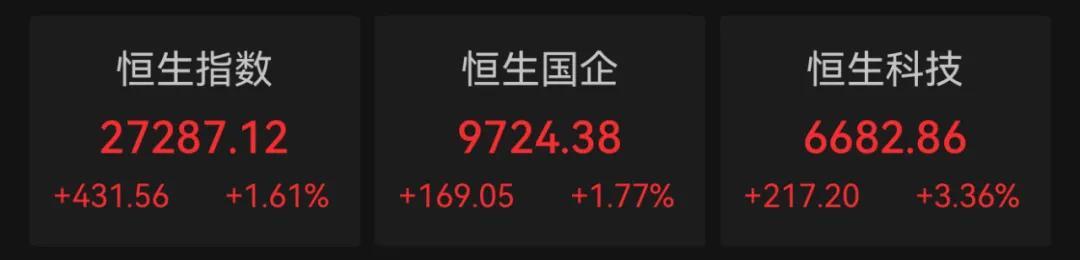
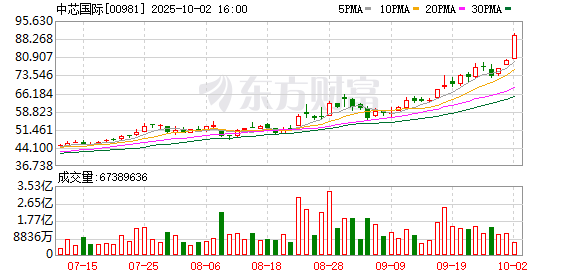
Group 1 - The Hong Kong stock market showed strong performance on October 2, with all three major indices closing higher. The Hang Seng Index rose by 1.61% to 27,287.12 points, the Hang Seng China Enterprises Index increased by 1.77% to 9,724.38 points, and the Hang Seng Tech Index surged by 3.36% to 6,682.86 points [2] - The semiconductor, electrical equipment, non-ferrous metals, pharmaceutical biology, and hardware equipment sectors performed strongly. Notably, the semiconductor sector saw a significant rise, with SMIC increasing by over 12% and Hua Hong Semiconductor rising by more than 7% [3] - SMIC's stock price reached a historic high, closing at 90.35 HKD per share after a 12.70% increase. This marked a cumulative rise of 22.89% over three consecutive trading days [5] Group 2 - As of September 30, SMIC has attracted substantial investment, with southbound funds holding over 2.5 billion shares valued at over 200 billion HKD, accounting for more than 20% of its total market capitalization. Multiple institutions have given SMIC a buy rating [7] - The global semiconductor industry is experiencing a notable recovery, with the market size reaching 346 billion USD in the first half of the year, reflecting an 18.9% year-on-year growth driven by AI infrastructure investments and terminal application demand. The domestic market size is expected to reach 102.6 billion RMB by 2025, with SMIC playing a crucial role in mature process expansion and local supply chain [7]


港股大涨,中芯国际,历史新高
Zhong Guo Zheng Quan Bao· 2025-10-02 09:45
Group 1 - The Hong Kong stock market showed strong performance on October 2, with all three major indices closing higher. The Hang Seng Index rose by 1.61% to 27,287.12 points, the Hang Seng China Enterprises Index increased by 1.77% to 9,724.38 points, and the Hang Seng Tech Index surged by 3.36% to 6,682.86 points [3] - The semiconductor, electrical equipment, non-ferrous metals, pharmaceutical biology, and hardware equipment sectors performed strongly. Notably, the semiconductor sector saw a significant rise, with SMIC increasing by over 12% and Hua Hong Semiconductor rising by more than 7% [4] - SMIC's stock price reached a new high, increasing by 12.70% to 90.35 HKD per share, marking a cumulative increase of 22.89% over three consecutive trading days. As of September 30, southbound funds held over 2.5 billion shares of SMIC, with a market value exceeding 200 billion HKD, accounting for over 20% of its total market capitalization [6] Group 2 - The global semiconductor industry is experiencing a notable recovery, with a market size of 346 billion USD in the first half of the year, reflecting an 18.9% year-on-year growth. This growth is primarily driven by investments in AI infrastructure and demand for end-user applications [7] - The domestic market size is projected to reach 102.6 billion RMB by 2025, with SMIC playing a crucial role as a leading foundry in the expansion of mature processes and the localization of the supply chain [7]
东兴证券晨报-20250919
Dongxing Securities· 2025-09-19 09:23
Core Insights - The report highlights the ongoing economic adjustments and policy responses from various government departments, indicating a focus on enhancing consumer living standards and stabilizing key industries [2][4][5]. Economic News - The Ministry of Commerce emphasizes the importance of maintaining principles in international negotiations, particularly regarding TikTok and EU tariffs on Chinese electric vehicles, advocating for the removal of market barriers [2]. - The Bank of Japan maintains its benchmark interest rate at 0.5%, with expectations of potential rate hikes later in the year amid economic uncertainties [2]. - The Ministry of Industry and Information Technology outlines a plan for the light industry to achieve stable growth from 2025 to 2026, focusing on optimizing supply, expanding consumption, and enhancing international competitiveness [2]. - The Ministry of Ecology and Environment reports significant progress in pollution control, with substantial reductions in PM2.5 levels in key regions by 2024 compared to 2020 [2]. - The National Taxation Administration reports positive growth in major tax categories, particularly in the financial sector, driven by increased capital market activity [2]. Company News - Qilu Bank's executives increased their shareholding by 20,000 shares, representing 0.0003% of the total share capital, despite a slight decline in stock price [3]. - Nanjing Public Utilities terminated its cash acquisition of a 68% stake in Hangzhou Yugu Technology, reflecting strategic adjustments [3]. - Tianpu Co. has faced unusual trading fluctuations, prompting warnings to investors about potential risks [3]. - Fengshan Group signed a technology development contract with Tsinghua University to enhance its competitive edge in battery technology [3]. - Fulian Precision signed a prepayment agreement with CATL for a total of 1.5 billion yuan to secure lithium iron phosphate supply [3]. Industry Insights - The report discusses the aviation industry, noting a cautious approach to capacity expansion among airlines due to low growth in supply and improved passenger load factors in August [14][15]. - Domestic airlines increased capacity by approximately 1.7% year-on-year in August, with a notable improvement in load factors compared to July [15][16]. - Internationally, airlines based in Shanghai saw significant increases in load factors, indicating strong demand in the region [17]. - The report highlights the impact of the "Self-Discipline Convention" in the aviation sector, which aims to curb market chaos and improve profitability [18].
波动降低后是更好的参与时机
China Post Securities· 2025-09-15 11:38
Market Performance Review - The A-share market recovered from last week's decline, with significant volatility remaining a characteristic feature. Major indices mostly rose, with the ChiNext index rebounding by 5.48% after a previous drop of 5.42%. The CSI A50 and SSE 50, which are heavily weighted by large-cap stocks, lagged behind in terms of growth. Growth style stocks showed a strong rebound, while financial stocks had smaller gains. Small-cap stocks significantly outperformed large-cap stocks, with the Ning and Mao indices both rising, the Ning combination increasing by 1.95% and the Mao index slightly up by 0.40% [3][12][29]. Industry Overview - The industry saw a general rebound but lacked a clear leading theme. Among the Shenwan first-level industries, electronics (6.15%), real estate (5.98%), agriculture, forestry, animal husbandry, and fishery (4.81%), media (4.27%), and non-ferrous metals (3.76%) led the gains. Conversely, sectors like social services (-0.28%), pharmaceuticals and biology (-0.36%), oil and petrochemicals (-0.41%), banking (-0.66%), and comprehensive (-1.43%) performed poorly. The current market is still entangled in narratives around AI infrastructure investment, potential Fed rate cuts, and anti-involution policies [4][13][29]. Future Outlook and Investment Views - The report suggests that lower volatility presents better participation opportunities. Although there was a significant single-day rise in the A-share market, it does not imply that short-term downward volatility risks have been fully alleviated. Intense bull-bear battles are common at the tail end of a trend, indicating that time is needed for consolidation before the next upward phase. Future volatility in the A-share market is expected to be more influenced by overseas factors, particularly following disappointing U.S. non-farm payroll data in August, which solidifies expectations for a Fed rate cut in September. The A-share market will likely use the rate cut as a key pricing logic point after completing its adjustment [4][29]. Stock Selection Strategy - The report emphasizes that individual stock alpha logic is superior to industry beta logic, focusing on identifying "turnaround" opportunities in individual stocks. The TMT growth sectors, represented by AI applications, computing power chains, and optical modules, which have been adjusting since March, are expected to see valuation recovery opportunities. The report highlights that simply buying stocks with "earnings exceeding expectations" during the mid-year reporting season may not yield sustained relative returns. Instead, the "turnaround" strategy is deemed more effective for performance discovery during this period. The report constructs a portfolio of stocks expected to exceed earnings expectations for the mid-year report, aiming to capture excess returns from individual stock alpha in September and October [5][29].
招银国际:升中兴通讯目标价至42港元 维持买入评级
Zhi Tong Cai Jing· 2025-09-03 09:08
Group 1 - The core viewpoint of the report is that 招银国际 has raised the target price for 中兴通讯 from HKD 26.5 to HKD 42, which corresponds to a projected P/E ratio of 25 times for next year, aligning with industry valuation forecasts [1] - 中兴通讯's target price in RMB has been increased from CNY 32.86 to CNY 57, maintaining a "buy" rating [1] - In the first half of the year, 中兴通讯's revenue increased by 15% year-on-year to CNY 71.6 billion, while net profit decreased by 12% to CNY 5.1 billion [1] Group 2 - The shift in product mix towards higher shipment volume servers has negatively impacted gross margin and net margin, which fell by 8 and 2.1 percentage points to 32.5% and 7.1%, respectively [1] - 招银国际 anticipates that 中兴通讯 will maintain strong growth momentum in the coming years, supported by the AI infrastructure investment cycle and the trend of domestic semiconductor localization [1] - Projected net profits for 中兴通讯 from 2025 to 2027 are CNY 7.976 billion, CNY 8.035 billion, and CNY 9.568 billion, reflecting year-on-year changes of -5.3%, +0.7%, and +19.1%, respectively [1]

招银国际:升中兴通讯(00763)目标价至42港元 维持买入评级
智通财经网· 2025-09-03 09:07
Group 1 - The core viewpoint of the report is that ZTE Corporation's target price has been raised significantly, indicating a positive outlook for the company's stock performance [1] - ZTE's revenue for the first half of the year increased by 15% year-on-year to 71.6 billion RMB, while net profit decreased by 12% to 5.1 billion RMB [1] - The shift in product mix towards higher shipment volume servers has negatively impacted gross margin and net margin, which fell by 8 and 2.1 percentage points to 32.5% and 7.1% respectively [1] Group 2 - The report anticipates that ZTE will maintain strong growth momentum in the coming years, supported by the AI infrastructure investment cycle and the trend of domestic semiconductor localization [1] - ZTE's projected net profits for 2025 to 2027 are estimated at 7.976 billion, 8.035 billion, and 9.568 billion RMB, reflecting a year-on-year decline of 5.3%, a slight increase of 0.7%, and a growth of 19.1% respectively [1]
高盛“唱高”寒武纪目标价至2104元!
Di Yi Cai Jing Zi Xun· 2025-09-01 10:06
Core Viewpoint - The article discusses the recent fluctuations in the stock price of Cambricon (688256.SH) and the optimistic outlook provided by Goldman Sachs, which has raised its target price for the company to 2104 RMB, reflecting a 14.7% increase from previous estimates [2][3]. Financial Performance - Cambricon reported a significant increase in revenue for the first half of 2025, reaching 2.881 billion RMB, which represents a year-on-year growth of 4347.82% [3]. - The company achieved a net profit of 1.038 billion RMB, marking a turnaround from previous losses [3]. - Goldman Sachs has adjusted its net income forecasts for Cambricon for the years 2025 to 2030, with a notable 34% increase in the 2025 forecast [2][3]. Market Position - Cambricon's stock price has been volatile, competing closely with Kweichow Moutai (600519.SH) for the title of "stock king" in the market [3][4]. - On September 1, 2023, Cambricon's stock opened at 1460 RMB per share, falling behind Kweichow Moutai, which opened at 1482.20 RMB per share, indicating ongoing competition and market dynamics [4]. Analyst Predictions - Goldman Sachs' optimistic outlook is based on two main factors: an increase in AI chip shipments and improvements in operational efficiency leading to better cost management [2]. - The firm has also raised its EBITDA expectations for 2030 by 8% and the enterprise value/EBITDA multiple by 6% [2].

美股英伟达财报中这些重要信号不得不看
3 6 Ke· 2025-08-28 06:50
Group 1: Nvidia Financial Performance - Nvidia reported Q2 revenue of $46.743 billion, a 56% year-over-year increase, exceeding market expectations [3] - Adjusted earnings per share were $1.05, up 54% year-over-year, also slightly above market forecasts [3] - Gross margin remained high at 72.7%, with a slight improvement from the previous quarter after excluding H20-related costs [3] Group 2: Future Guidance and Market Dynamics - For Q3, Nvidia expects revenue between $52.9 billion and $55.1 billion, with a midpoint of $54 billion, which is above market consensus [5] - The guidance for gross margin is set at 73% to 74%, aligning with market expectations [5] - The data center segment remains core but is experiencing a slowdown, with year-over-year growth dropping to 56% from 73% in the previous quarter [5] Group 3: China Market Uncertainty - Nvidia did not sell new H20 chips in Q2, with $180 million in revenue coming solely from old inventory releases [7] - The Q3 revenue guidance does not assume any sales of H20 chips to China, impacting growth potential [7] - Market sentiment towards Nvidia's prospects in China remains cautious due to geopolitical and compliance risks [8] Group 4: Stock Buyback and Market Support - Nvidia announced a $60 billion stock buyback plan to stabilize market sentiment after a 5% drop in stock price post-earnings announcement [8] - The CFO indicated that capital expenditures for cloud service providers and large enterprises are expected to reach $600 billion by 2025, with global AI infrastructure investment potentially reaching $3 to $4 trillion by 2030 [8] Group 5: Broader Market Trends - U.S. corporate stock buybacks have surpassed $1 trillion as of August 20, 2025, marking the fastest record to this milestone [11] - In July alone, announced buybacks reached $166 billion, driven by major financial and tech companies [11] - Analysts predict that announced buybacks could reach $1.3 trillion by the end of the year, providing significant support to the U.S. stock market [12]

盘后大跌16%!超微电脑增长神话破灭?大幅下调营收指引,“价格战”威胁利润率
美股IPO· 2025-08-06 02:25
Core Viewpoint - The recent earnings report from the company indicates a significant decline in revenue expectations and profitability, highlighting the challenges faced in a competitive market despite the ongoing AI trend [1][3][7]. Financial Performance - In the fourth quarter, the company reported revenue of $5.76 billion, a year-over-year increase of 7.5%, but below analyst expectations of $6.01 billion [3][4]. - Adjusted earnings per share were $0.41, also falling short of the anticipated $0.44 [3][4]. Downgraded Expectations - The company expects next quarter's revenue to be between $6 billion and $7 billion, significantly lower than analyst forecasts [4]. - Revenue expectations for fiscal year 2026 have been revised down from $40 billion to $33 billion, a decrease of 17.5% [4][13]. Profitability Pressure - The projected operating profit margin for the next quarter is only 5%, well below the analyst expectation of 7% [5][10]. - The company faces dual pressures from inventory backlog and pricing competition, particularly from Dell [5][12]. Business Challenges - Customers are delaying purchases in anticipation of new products featuring the latest NVIDIA chips, negatively impacting current product demand [5][10][12]. - The company is struggling with old inventory and is compelled to accept lower prices to secure large AI server orders, reflecting a broader trend in the industry [10][12][13]. Market Reaction - Following the disappointing earnings report and lowered guidance, the company's stock price fell over 16% in after-hours trading [1][7]. - The stock had previously surged 88% this year, driven by optimistic market sentiment regarding AI, but the recent developments have dampened this enthusiasm [7][13].