AI战略

Search documents
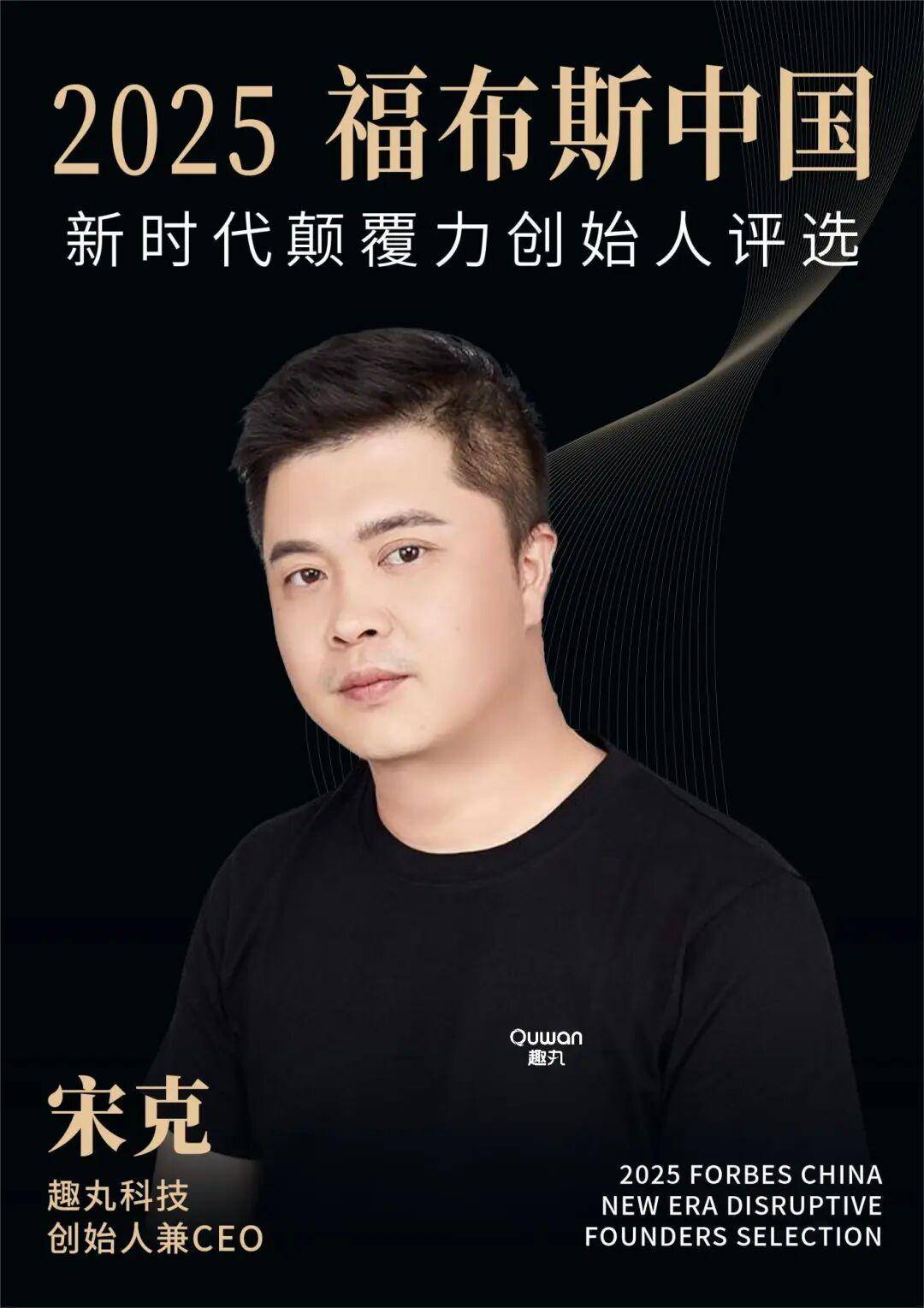
趣丸科技创始人兼CEO宋克荣膺“2025福布斯中国新时代颠覆力创始人
Sou Hu Cai Jing· 2026-01-30 14:12
Group 1 - Forbes China and the Globalization Business Research Institute announced the final results of the "2025 Forbes China New Era Disruptive Founders Selection," with Song Ke, founder and CEO of Quwan Technology, recognized alongside notable entrepreneurs like Lei Jun of Xiaomi and Liang Wenfeng of DeepSeek [1][3] - The selection criteria included five dimensions: business achievements, industry contributions, disruptive power, innovation, and social responsibility, aimed at identifying founders who drive industry transformation through breakthrough thinking in technology and business [3] - In the context of the intensifying global AI competition in 2025, Chinese tech companies face critical strategic choices, such as whether to invest in general large models or build irreplaceable ecological barriers in vertical fields [3] Group 2 - Quwan Technology, under Song Ke's leadership, proposes a unique approach by deeply integrating esports, social interaction, and AI technology to construct a complete AI ecosystem from models to applications and hardware within the "interest economy" vertical track [3] - Song Ke emphasized that the core of their AI strategy is to enhance human emotional expression and creativity, maintaining a user-centric approach as the key to Quwan Technology's sustained growth across cycles [3]

独家丨理想新设人形机器人和软件本体部门,多数自动驾驶员工划入基座模型团队
晚点Auto· 2026-01-30 13:42
Core Viewpoint - Li Auto is undergoing a significant organizational restructuring to enhance its AI strategy, aiming to align with the operational models of leading AI companies and redefine personnel roles for collaborative development of silicon-based life forms [4][6]. Group 1: Organizational Changes - A new software core team has been established, led by Vice President of Intelligent Space, Guo Xiaofei [4]. - A humanoid robot team has been formed, headed by Senior Vice President of Autonomous Driving R&D, Lang Xianpeng [4]. - The base model team will be led by Zhan Kun, with most employees from the autonomous driving department transitioning to this team [4]. Group 2: Leadership Background - Guo Xiaofei previously served as Chief Architect at LeEco Auto and has been involved in key projects at Li Auto, including the intelligent cockpit system for Li ONE [6]. - Lang Xianpeng joined Li Auto in 2018 and has risen from R&D Director to Senior Vice President, previously working at Baidu on various autonomous driving projects [6][7]. - Zhan Kun, who graduated from Beihang University in 2016, has focused on autonomous driving architecture and technology stack deployment since joining Li Auto in 2021 [7]. Group 3: Future Plans and Innovations - Li Auto plans to launch its "end-to-end + VLM" solution by October 2024, aiming to position itself among the top tier in driving experience [7]. - The full rollout of the VLA solution is scheduled for September 2025, with an updated OTA 8.2 version and enhanced VLA driver model expected in January 2026 [7].

创业慧康:预计2025年归母净利润为亏损3.05亿元至4.05亿元
Xin Lang Cai Jing· 2026-01-30 10:21
Core Viewpoint - The company expects a net loss attributable to shareholders of 305 million to 405 million yuan for the fiscal year 2025, compared to a loss of 174 million yuan in the same period last year [1] Group 1: Financial Performance - The company's loss situation has worsened during the reporting period, with a significant increase in expected losses [1] - The anticipated net loss for 2025 is projected to be between 305 million and 405 million yuan, indicating a decline in financial performance compared to the previous year's loss of 174 million yuan [1] Group 2: Operational Challenges - The company faces dual pressures on its operations due to the industry and policy environment, which has led to a temporary contraction in client investment in information technology [1] - The new generation HI-HIS product is currently in a critical phase of market introduction and adjustment, limiting its short-term contribution to performance, although long-term potential remains promising [1] - Changes in the competitive landscape have compressed the industry's profit margins, further impacting the company's financial health [1] Group 3: Strategic Investments - The company continues to invest heavily in its AI strategy, resulting in high research and development expenses that are negatively affecting short-term profit performance [1] - Some subsidiaries have not met expected profitability levels, leading to an anticipated goodwill impairment provision of approximately 100 million to 130 million yuan [1]

韩歆毅详解蚂蚁新十年战略:从“有钱花”到“有命花”的双重守护
Xin Lang Cai Jing· 2026-01-25 03:48
Core Insights - Ant Group is shifting its strategic focus to include healthcare as a third pillar alongside payment and finance, with the AI health assistant "Afu" being a significant development in this transition [1][3][9] Group 1: Strategic Shift - The new CEO, Han Xinyi, emphasizes that the company is not focused on merely maintaining stability but is actively pursuing innovation, particularly in healthcare [1][3] - The decision to elevate healthcare to a strategic priority is based on a deep understanding of user needs, particularly the importance of health alongside financial stability [3][8] - The company aims to address unmet needs in the healthcare sector, such as support for new parents and elderly individuals, leveraging its past experience in digital healthcare services [3][4] Group 2: Market Response - The launch of "Afu" has seen a rapid increase in user engagement, with daily inquiries doubling to 10 million and monthly active users surpassing 30 million within a month [4] Group 3: Organizational Changes - To support the healthcare initiative, Ant Group is restructuring its organization, moving healthcare out of the Alipay business unit to establish it as an independent department with significant resources [5][7] - Han Xinyi's investment-focused mindset is driving the company's strategic decisions, prioritizing long-term value over short-term cost considerations [5][7] Group 4: Long-term Vision - The company envisions a future where it can enhance both wealth and health for users, aiming to improve financial outcomes and life quality through its services [9] - The strategic focus on healthcare is seen as a natural extension of Ant Group's mission to provide inclusive services, ensuring that quality healthcare is accessible to a broader audience [8][9]

蚂蚁下一个十年:韩歆毅详解“支付、金融、健康”三条腿战略
Bei Jing Shang Bao· 2026-01-24 12:12
Core Viewpoint - Ant Group is re-entering the market with a focus on three key areas: payment, finance, and healthcare, as part of its strategic blueprint for the next decade [1][2]. Group 1: Strategic Focus - Ant Group's CEO, Han Xinyi, emphasizes that the company's future relies on a balanced approach with payment, finance, and healthcare as its three pillars [1]. - The company aims to leverage AI to enhance its services in these three sectors, with a specific focus on redefining healthcare services [1][3]. - The healthcare sector is viewed as a critical area for strategic breakthroughs, addressing the growing demand for accessible medical resources in China [2][3]. Group 2: Investment and Development - Ant Group plans to invest tens of billions annually in its healthcare initiatives, particularly in the AI-driven health assistant "Afu" [3][4]. - The company has upgraded its healthcare business to an independent unit, reflecting its commitment to this sector despite internal debates [3]. - Han Xinyi believes that the success of "Afu" is crucial not only for Ant Group but also for the broader healthcare AI market in China [4]. Group 3: Vision and Goals - The long-term vision includes enhancing the quality of life and increasing life expectancy through its healthcare services [4]. - The success of "Afu" will be measured by its adoption among the Chinese population and the willingness of users to recommend it to others [4]. - Ant Group's strategy aims to create a sustainable foundation for its future growth, moving beyond short-term innovations to long-term value creation [1][4].
中泰国际每日晨讯-20260120
ZHONGTAI INTERNATIONAL SECURITIES· 2026-01-20 02:28
Market Overview - On January 19, Hong Kong stocks showed weak upward momentum, with the Hang Seng Index falling by 281 points (1.1%) to close at 26,563 points[1] - The Hang Seng Tech Index decreased by 72 points (1.2%), closing at 5,749 points, with total trading volume at HKD 225.7 billion[1] - Xiaomi, OPPO, vivo, and Transsion lowered their annual shipment forecasts, impacting stock prices, with Xiaomi (1810 HK) down 1.7% and Sunny Optical (2382 HK) down 2.3%[1] Sector Performance - The aviation sector strengthened, with Eastern Airlines (670 HK) and Southern Airlines (1055 HK) rising by 6%-9% due to expected record-high passenger transport during the Spring Festival[1] - The power equipment sector benefited from a planned investment of HKD 4 trillion by the State Grid during the 14th Five-Year Plan, with stocks like Dongfang Electric (1072 HK) and Harbin Electric (1133 HK) increasing by 5%-6%[1] Macroeconomic Insights - The GDP growth for Q4 2025 is projected at 4.5%, with an annual growth rate of 5.0%, meeting expectations[2] - Exports for 2025 are expected to increase by 5.5%, despite a 20% decline in exports to the U.S., showing resilience with an annual trade surplus of USD 1.2 trillion, a historical high[2] Real Estate Sector - Real estate development investment fell by 36.9% year-on-year to RMB 419.7 billion, a larger decline than November's 31.4%[3] - New housing starts decreased by 19.3% to 53.13 million square meters, while the average price index for new residential properties in 70 cities dropped by 3.0% year-on-year[3] Industry Developments - The automotive sector saw Chery Automobile (9973 HK) rise by 4.5% after announcing its AI strategy, marking a shift towards smart vehicles[4] - The renewable energy sector is encouraged to adopt zero-carbon practices, with companies like CIMC Enric (3899 HK) expected to benefit from new policies[4] Pharmaceutical Sector - Most pharmaceutical stocks declined alongside the Hang Seng Index, but leading reproductive health company Jinxin Fertility (1951 HK) rose by 5.3%[5] - The number of newborns is projected to drop from 9.54 million in 2024 to 7.92 million in 2025, prompting government support for childbirth[5]
小米打破24小时耐力赛纪录!尚界Z7官图发布!奇瑞发布AI战略!保时捷2025全球交付27.94万辆,下滑10%!丨一周大事件
电动车公社· 2026-01-19 16:05
New Car Launches - Aito M7 extended range version launched with a price range of 299,800 to 319,800 yuan, featuring a single motor with 227 kW and a CLTC range of 327 km, improving from 315 km [1][3][5] - The new Arcfox Kaola S launched with a price range of 99,800 to 119,800 yuan, offering an 8-year or 150,000 km battery warranty and a CLTC range of 520 km [1][5][11] - Wuling Star 560 launched with plug-in hybrid and pure electric versions priced at 91,800 and 98,800 yuan respectively, featuring a design inspired by the Hongguang X concept car [1][13][17] - Leado L60 "Ma Dao Cheng Gong" version launched at 218,900 yuan, maintaining similar design and features to existing models [1][21][23] Company Developments - Lantu Motors signed a strategic cooperation agreement with Yiwang to enhance collaboration in smart driving and marketing [1][28][30] - BAIC New Energy announced L3 and L4 strategic achievements, with the Alpha S (L3 version) starting trial operations in designated areas [1][32][34] - Tesla will shift its Full Self-Driving (FSD) to a subscription model starting February 14, 2024, with current buyout prices at 8,000 USD in the US and 64,000 yuan in China [1][37][38] - Honda announced a new logo for its electric and hybrid vehicles, set to be applied to future models [1][39][40] - Great Wall Motors launched the "Guiyuan" AI platform, compatible with multiple powertrains, aiming to reduce production costs and meet diverse market needs [1][41][45] - Chery unveiled its AI strategy, focusing on making advanced driving features accessible in lower-priced models [1][46][48] Industry News - The Ministry of Industry and Information Technology outlined key tasks for the 2026 new energy vehicle sector, emphasizing technology development and market regulation [1][59][62] - Porsche's global deliveries in 2025 reached 279,449 units, a 10% decline, with significant drops in the Chinese market [1][55][56][58] - The new Xiaomi SU7 set a record in a 24-hour endurance race, covering 4,264 km, showcasing advancements in electric vehicle technology [1][49][51][54]




晚点独家丨理想调整基座模型业务:詹锟接手,VLA 研发整合
晚点LatePost· 2026-01-15 02:17
Core Insights - The article discusses the strategic shift at Li Auto, focusing on the integration of the VLA (Vision-Language-Action) model into its AI strategy, which aims to enhance the company's capabilities in autonomous driving and intelligent cockpit technologies [4][6]. Group 1: Leadership Changes and Organizational Structure - Jian Kun, a senior algorithm expert in autonomous driving, will take over the VLA model business, reporting directly to the CTO, Xie Yan, instead of the previous head of autonomous driving, Lang Xianpeng [4]. - The VLA model development was previously divided between two departments, with the language component led by Chen Wei and the vision and action components managed by the autonomous driving team [6]. - The VLA model has been elevated from a single project to a company-wide foundational model, indicating a clearer focus on embodied intelligence as a core part of Li Auto's AI strategy [6]. Group 2: VLA Model and Future Developments - The VLA model is designed to support embodied intelligence, with "V" representing perception, "L" for planning and decision-making, and "A" for action, applicable to both physical and digital realms [6]. - Li Auto plans to fully deploy the VLA driver model in its AD Max vehicles by September 2025, aiming for smoother longitudinal control and improved accuracy at complex intersections [8]. - The company intends to enhance language and behavioral interactions and adapt its self-developed M100 chip by 2026 [8]. Group 3: Talent Movement and Industry Context - Several technical talents have left Li Auto following the AI model boom, but some maintain close communication with the company and participate in industry sharing sessions [7]. - Chen Wei, the outgoing head of the VLA model, previously emphasized the importance of building a complete agent system centered around the VLA model, viewing all products as robotic entities [7].

晚点说詹锟接手理想基座模型业务向CTO汇报, 不向郎咸朋汇报
理想TOP2· 2026-01-14 14:55
Core Viewpoint - The article discusses the restructuring of the base model business at Li Auto, with Zhan Kun taking over the VLA base model development, which will support autonomous driving, smart cockpit, and potentially robotics in the future [1] Group 1: Leadership Changes - Zhan Kun will report to CTO Xie Yan instead of Senior Vice President of Autonomous Driving R&D, Lang Xianpeng [1] - Zhan Kun will continue to be responsible for the engineering and platformization of the intelligent driving VLA model [1] Group 2: Strategic Direction - The VLA has been upgraded from a single project to a company-level base model, indicating a clear organizational focus on AI strategy centered around VLA [1] - Resources will be further concentrated on embodied intelligence, with the core objective being the construction of a complete Agent system based on VLA [1] Group 3: Industry Connections - Individuals who have left companies like Weita Power and Zhijian Power, such as Zhao Zhelun and Jia Peng, maintain close communication with Li Xiang and will share industry insights at Li Auto's AI meetings [1]
独家丨理想调整基座模型业务:詹锟接手,VLA 研发整合
晚点Auto· 2026-01-14 13:59
Group 1 - The core strategy of the company has become clearer, focusing on the VLA (Vision-Language-Action) model as the central AI direction [2][3] - The VLA model development has transitioned from being managed by two separate departments to a unified approach, emphasizing the importance of embodied intelligence in automotive products [5][6] - The new head of the VLA model, Zhan Kun, has a background in autonomous driving algorithms and has been promoted to oversee the integration of technology for autonomous driving and smart cockpit applications [3][6] Group 2 - The VLA model consists of three components: "V" for perception, "L" for planning and decision-making, and "A" for action, applicable to both physical and digital environments [5][6] - The company plans to fully implement the VLA driver model in the AD Max vehicle by September 2025, aiming for smoother longitudinal control and improved accuracy at complex intersections [7] - The company is also set to enhance language and behavioral interactions and adapt its self-developed M100 chip by 2026 [7]