AI数据中心建设

Search documents
长飞光纤光缆(06869)高开10.5% 机构指AI数据中心建设驱动的超级周期仍是2026年最重要主线
Xin Lang Cai Jing· 2026-01-19 07:03
Core Viewpoint - Changfei Fiber Optics (06869) opened 10.5% higher at HKD 55.8 with a trading volume of HKD 86.62 million, following the announcement of its candidacy for a procurement project by China Unicom for a hollow core fiber mixed cable for the 2025 Shenzhen-Hong Kong cross-border financial data channel [1][2] Group 1: Company Developments - Changfei Fiber Optics and Hengtong Optic-Electric are the two candidates for the procurement project announced by China Unicom [1][2] - The stock price increase reflects positive market sentiment regarding the company's involvement in significant infrastructure projects [1][2] Group 2: Industry Insights - Huatai Securities' latest report indicates that the AI data center supply chain, represented by GPU optical modules, has been a major investment theme in the global tech industry over the past two years [1][2] - The report confirms that the primary focus for the tech industry in 2026 will continue to be the super cycle of AI infrastructure, driven by the construction of AI data centers, impacting computing chips, storage, network equipment, and power [1][2] - The importance of storage within the AI computing supply chain is expected to significantly increase [1][2] - AI system development is increasingly focusing on co-design to reduce token production costs, creating value enhancement opportunities for server assembly/cooling, optical interconnection, and PCB manufacturing [1][2]

信创ETF(159537)涨超1%,行业技术演进与需求复苏受关注
Mei Ri Jing Ji Xin Wen· 2026-01-16 06:49
Core Viewpoint - The main investment theme in the technology sector for 2026 is expected to be driven by AI data center construction, with high growth in AI computing power demand [1] Group 1: Industry Trends - The storage industry is entering a "super cycle" driven by AI, with significant growth in demand for HBM4e and new storage systems like Context Memory Storage System [1] - 2026 may be recognized as the "physical AI year," where humanoid robots are anticipated to surpass smart electric vehicles as the most notable hardware form, with China's electronic supply chain having a first-mover advantage in core robot components [1] Group 2: Technological Advancements - In smart hardware, significant progress has been made in core technologies such as micro-displays and optical waveguides, with market expectations for the launch of Android XR ecosystem products to drive a new cycle [1] - Cloud cameras have entered a popularization phase, becoming a new growth segment in the market [1] Group 3: ETF Overview - The Xinchang ETF (159537) tracks the Guozheng Xinchang Index (CN5075), which selects listed companies involved in software development and computer equipment to reflect the overall performance of securities related to information technology innovation [1]
消电ETF(561310)涨超2.2%,行业景气获市场关注
Mei Ri Jing Ji Xin Wen· 2026-01-16 06:44
Core Viewpoint - The consumer electronics ETF (561310) has risen over 2.2%, indicating increased market attention on industry prosperity driven by AI data center construction and a "super cycle" in the storage sector [1] Group 1: Industry Trends - The technology sector's main investment theme for 2026 is expected to be driven by AI data center construction, with strong demand for computing chips, storage, network equipment, and electricity [1] - The storage industry is entering a "super cycle" driven by AI, with significant growth in demand for HBM4e and new storage systems [1] - 2026 may be recognized as the "physical AI year," where humanoid robots will surpass smart electric vehicles as the most notable hardware form, with China's electronic supply chain having a first-mover advantage in core robot components [1] Group 2: ETF and Index Information - The consumer electronics ETF (561310) tracks the consumer electronics index (931494), which selects securities from companies involved in the design, manufacturing, and sales of consumer electronic products [1] - The index covers sectors such as smartphones, home appliances, and wearable devices, reflecting the overall performance of the consumer electronics industry characterized by technology-driven and consumption-upgrading features [1]
20cm速递|科创芯片ETF国泰(589100)涨超1.7%,行业需求复苏获关注
Mei Ri Jing Ji Xin Wen· 2026-01-16 06:24
Group 1 - The core viewpoint is that the technology sector is entering a "super cycle" driven by AI data center construction, with strong demand for computing chips, storage, network equipment, and power [1] - The storage industry is experiencing a surge in demand for HBM4e, with increasing manufacturing difficulties, while new storage systems like Context Memory Storage System aim to address the massive data storage needs of large models [1] - Advanced processes and packaging in semiconductor equipment are in continuous demand, with relevant equipment manufacturers playing a crucial role [1] Group 2 - The ETF Guotai (589100) tracks the semiconductor index (000685), which has a daily price fluctuation limit of 20%, focusing on companies across the entire semiconductor industry chain, including materials, equipment, design, manufacturing, and packaging [2] - The index selects no more than 50 large-cap securities in the relevant fields to reflect the overall performance of the semiconductor industry chain and its high growth and technological innovation characteristics [2]
ETF盘中资讯|有色逆市大涨原因或已找到!美联储发布《褐皮书》,有色ETF华宝(159876)盘中上探3.76%续创历史新高!
Sou Hu Cai Jing· 2026-01-15 05:53
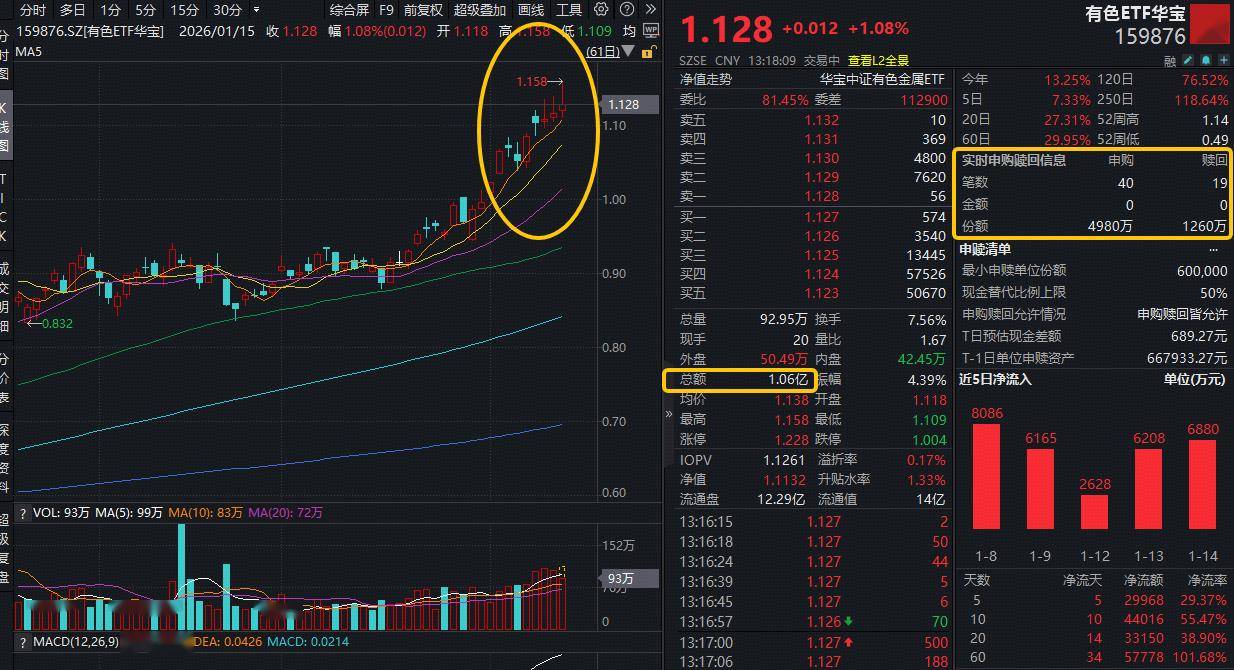
Group 1 - Over 10 billion in main funds flowed into the non-ferrous metal sector, making it the top sector among 31 Shenwan first-level industries [1] - The popular ETF, Huabao Non-Ferrous ETF (159876), saw an intraday increase of 3.76%, currently up 1.08%, reaching a historical high [1] - The ETF recorded a net subscription of 37.2 million units, accumulating a total of 440 million in the past 10 days, indicating strong investor confidence in the non-ferrous metal sector [1] Group 2 - Key stocks in the non-ferrous metal sector include Huayou Cobalt, which rose by 6.37%, and Hunan Silver, which increased by 4.64% [2] - Other notable performers include Jiangxi Copper and Ganfeng Lithium, both showing significant gains [5] - The overall market sentiment is bolstered by the expectation of a dovish monetary policy from the Federal Reserve, which is likely to lead to further interest rate cuts [3] Group 3 - The non-ferrous metal sector is expected to benefit from a "super cycle" driven by various factors, including global monetary easing and increased demand for industrial metals like copper and aluminum [3][4] - The Huabao Non-Ferrous ETF and its linked funds cover a wide range of metals, including copper, aluminum, gold, rare earths, and lithium, allowing for better exposure to the sector's performance [4]

有色逆市大涨原因或已找到!美联储发布《褐皮书》,有色ETF华宝(159876)盘中上探3.76%续创历史新高!
Xin Lang Cai Jing· 2026-01-15 05:32
Group 1 - Over 10 billion in main funds flowed into the non-ferrous metal sector, making it the top sector among 31 Shenwan first-level industries [1][8] - The popular ETF, Non-Ferrous ETF Huabao (159876), saw an intraday increase of 3.76%, currently up 1.08%, reaching a historical high [1][8] - As of the report, there was a net subscription of 37.2 million units, with a total of 440 million yuan raised over the past 10 days, indicating strong investor confidence in the non-ferrous metal sector [1][8] Group 2 - Key stocks in the sector include Huayou Cobalt, which rose over 6%, and Hunan Silver and Chihong Zn & Ge, which increased by over 4% [4][10] - Other notable stocks include Jiangxi Copper, Ganfeng Lithium, and Zhongjin Lingnan, which also experienced gains [4][10] Group 3 - The Federal Reserve's recent Beige Book indicated moderate economic expansion in the U.S., but inflationary pressures remain, with potential interest rate cuts later this year [2][12] - Analysts suggest that the Fed's interest rate cuts could lead to a depreciation of the dollar, making dollar-denominated metals cheaper and increasing global demand [3][12] - The current monetary policy environment is expected to be favorable for the non-ferrous metal market, with a potential "super cycle" for industrial metals like copper and aluminum [3][12] Group 4 - The Non-Ferrous ETF Huabao and its linked funds cover a wide range of sectors including copper, aluminum, gold, rare earths, and lithium, allowing for better exposure to the entire sector's performance [5][12]
有色金属主题基金成机构“新宠”
Shang Hai Zheng Quan Bao· 2026-01-14 17:47
Core Viewpoint - The non-ferrous metal sector is becoming a focal point for institutional investment, with a significant increase in the number of themed funds and net subscriptions for ETFs in this category over the past year [1][2]. Group 1: Fund Activity - In the past week, seven non-ferrous metal themed funds have been reported, with several more in the pipeline for issuance [1]. - Over the past year, non-ferrous metal themed ETFs (excluding gold) have seen net subscriptions exceeding 51 billion yuan, with 15 ETFs currently having a total scale of nearly 80 billion yuan [1][2]. - As of January 1, 2025, the total scale of non-ferrous metal themed ETFs was approximately 8.08 billion yuan, which increased to 78.81 billion yuan by January 13, 2026 [2]. Group 2: Index Characteristics - There are multiple non-ferrous metal themed indices, each with different focuses, requiring investors to carefully select ETFs based on their characteristics [1]. - The CSI Shenwan Non-Ferrous Metal Index selects 50 listed companies from the non-ferrous metal and non-metal materials sectors [1]. - The CSI Industrial Non-Ferrous Metal Index focuses on 30 larger market cap companies involved in copper, aluminum, lead-zinc, and rare metals [1]. - The CSI Non-Ferrous Metal Mining Index selects 40 companies with non-ferrous metal mineral resource reserves [1]. Group 3: Market Trends and Drivers - The recent surge in the non-ferrous metal sector is attributed to various factors, including global monetary easing and increased demand from AI data centers for copper, silver, and rare metals [2]. - Supply constraints and regional imbalances in supply and demand, along with frequent mining accidents, contribute to uncertainties in the supply side [2]. - Long-term macroeconomic logic for non-ferrous metals remains intact, with a strategy of accumulating during market adjustments recommended [2]. Group 4: Future Outlook - The current demand for non-ferrous metals is driven by emerging fields such as AI computing and robotics, which have a higher price acceptance for commodities than previously expected [3]. - Despite the strong performance of the non-ferrous sector in 2025, expectations should be moderated for 2026, although the long-term resource cycle is still ongoing [3].

铜冠金源期货商品日报-20260113
Tong Guan Jin Yuan Qi Huo· 2026-01-13 01:26
1. Report Industry Investment Rating No relevant content provided. 2. Core Views of the Report - Trump's actions have increased market disturbances both domestically and internationally, leading to new highs in gold and silver prices, a rise in oil prices, and a recovery in the 10Y US Treasury yield. The A - share market has shown strong performance with 17 consecutive gains, and the market style has rotated to sectors such as the Internet, media, and AI applications. [2][3] - The criminal investigation of Fed Chairman Powell has boosted the safe - haven sentiment in the financial market, causing gold and silver to reach new highs. The market expects the Fed to maintain interest rates in the January 27 - 28 meeting, and there may be two interest rate cuts this year. [4] - The copper price is expected to maintain a strong high - level oscillation in the short term due to factors such as the resonance with gold and silver, the demand prospects brought by global electrification and AI data center construction, and the structural imbalance in the fundamentals. [6][7] - The aluminum price is expected to remain strong due to the re - inflow of funds after the US Department of Justice's investigation of Powell, which has reduced the pressure of the US dollar on metals. [8] - The alumina price faces significant upward pressure due to the oversupply in the market, high inventory, and general procurement enthusiasm from downstream. [9][10] - The casting aluminum price will follow the cost fluctuations and show a strong performance, but the profit is compressed due to the poor cost transmission in the industrial chain and consumption suppression. [11] - The zinc price is expected to maintain a high - level and strong oscillation in the short term, driven by the macro and capital aspects, although the fundamentals show a divergence, with increased supply pressure and weak downstream consumption. [12][13] - The lead price will maintain a wide - range oscillation pattern, with the inventory increasing slightly but still at a relatively low level, and the supply - demand relationship remaining weak. [14][15] - The tin price is expected to be easy to rise and difficult to fall in the short term, supported by supply disruptions and consumption growth expectations from sectors such as AI, photovoltaics, and new energy. [16] - The steel price is expected to oscillate, with the industry's prosperity weakening, the demand in the off - season deepening, and the inventory starting to accumulate. [17] - The iron ore price is expected to oscillate, with a high arrival volume at ports and stable demand, resulting in a supply - strong and demand - weak situation. [18] - The coking coal and coke prices will fluctuate at a high level. The market sentiment has improved, but the price increase is restricted by the inventory pressure of finished products in the off - season. [19] - The soybean meal price is expected to oscillate in the short term. The USDA report is generally bearish, but the domestic oil mills' soybean and soybean meal inventories are expected to be depleted faster, providing support for the near - end price. [20][21] - The palm oil price is expected to oscillate and strengthen in the short term. The MPOB report's bearish news has been realized, and the high - frequency data shows an improvement in the supply - demand relationship, which is conducive to inventory depletion. [23][24] 3. Summaries According to Relevant Catalogs 3.1 Macro - Overseas: Trump has increased market disturbances. Domestically, he has launched a criminal investigation into Fed Chairman Powell and pressured the US Supreme Court on tariff issues. Internationally, he has imposed a 25% tariff on countries trading with Iran. Gold and silver have reached new highs, the oil price has risen, the US stock market has closed higher, and the 10Y US Treasury yield has recovered to 4.17%. Attention is paid to the US December CPI data. [2] - Domestic: The A - share market has continued to rise strongly with 17 consecutive gains. The Shanghai Composite Index closed at 4165 points, and the trading volume of the two markets reached a record high of 3.65 trillion yuan. The market style has rotated to sectors such as the Internet, media, and AI applications. The margin trading volume has reached a new high, and attention is paid to the volume sustainability and the export and financial data to be released this week. [3] 3.2 Precious Metals - Gold and silver have reached new highs. The main reason is the criminal investigation of Fed Chairman Powell by the US Department of Justice, which has triggered market shocks, a decline in the US dollar index, and an increase in safe - haven demand. The market expects the Fed to maintain interest rates in the January 27 - 28 meeting, and there may be two interest rate cuts this year. [4] 3.3 Copper - On Monday, the Shanghai copper main contract oscillated at a high level, and the LME copper price reached above $13,000. The domestic electrolytic copper spot market had light trading, and the LME inventory decreased to 137,000 tons, while the COMEX inventory continued to increase to 520,000 tons. The criminal investigation of Powell has intensified the contradiction between Trump and Powell, increasing the safe - haven sentiment in the capital market. The copper price is expected to maintain a strong high - level oscillation in the short term. [6][7] 3.4 Aluminum - On Monday, the Shanghai aluminum main contract closed at 24,650 yuan/ton, up 2.54%. The LME aluminum price rose 1.33%. The inventory of electrolytic aluminum ingots and aluminum rods increased. The US Department of Justice's investigation of Powell has reduced the pressure of the US dollar on metals, and the re - inflow of funds has led to an increase in the aluminum price. [8] 3.5 Alumina - On Monday, the alumina futures main contract closed at 2,866 yuan/ton, up 1.63%. The spot price was flat, and the theoretical import window was open. The market is in a state of oversupply, and the price faces significant upward pressure. [9][10] 3.6 Casting Aluminum - On Monday, the casting aluminum alloy futures main contract closed at 23,340 yuan/ton, up 2.3%. The spot price also increased. The cost of casting aluminum is supported by the strong performance of primary aluminum, but the profit is compressed due to poor cost transmission and consumption suppression. [11] 3.7 Zinc - On Monday, the Shanghai zinc main contract oscillated strongly, and the LME zinc price closed higher. The spot market had poor trading, and the social inventory decreased slightly. The US Department of Justice's investigation of Powell has led to a decline in the US dollar index, which is beneficial to the metal price. The zinc price is expected to maintain a high - level and strong oscillation in the short term. [12][13] 3.8 Lead - On Monday, the Shanghai lead main contract oscillated widely, and the LME lead price oscillated narrowly. The spot market had active sales by holders at a discount, and the social inventory increased slightly. The lead price will maintain a wide - range oscillation pattern. [14][15] 3.9 Tin - On Monday, the Shanghai tin main contract hit the daily limit, and the LME tin price rose sharply. The supply side is disturbed by factors such as the instability in the Congo and the delay in tin mine复产 in Myanmar. The demand side has consumption growth expectations from sectors such as AI, photovoltaics, and new energy. The tin price is expected to be easy to rise and difficult to fall in the short term. [16] 3.10 Steel (Screw and Coil) - On Monday, the steel futures oscillated. The spot market had a trading volume of 105,000 tons. The industry's prosperity has weakened, with a significant decline in the apparent demand for construction steel and an increase in inventory. The price is expected to oscillate, and attention is paid to the inventory accumulation rhythm. [17] 3.11 Iron Ore - On Monday, the iron ore futures oscillated and adjusted slightly. The spot market had a trading volume of 750,000 tons. The supply side has a high arrival volume at ports, and the demand is stable, resulting in a supply - strong and demand - weak situation. The price is expected to oscillate. [18] 3.12 Coking Coal and Coke - On Monday, the coking coal and coke futures fluctuated at a high level. Some coking enterprises in Ningxia and Inner Mongolia have raised the coke price. The market sentiment has improved, but the price increase is restricted by the inventory pressure of finished products in the off - season. [19] 3.13 Soybean and Rapeseed Meal - The USDA January report is generally bearish. The US soybean yield remains unchanged, but the production is slightly increased, the export demand is decreased, and the ending inventory is increased. The South American soybean production is expected to be abundant. The domestic oil mills' soybean and soybean meal inventories are at a high level, but the de - stocking rhythm is expected to accelerate. The price is expected to oscillate. [20][21] 3.14 Palm Oil - The December MPOB report shows that the Malaysian palm oil ending inventory is slightly higher than expected, but the export volume has increased, and the production has decreased. The high - frequency data in January shows a decrease in production and an increase in exports. The price is expected to oscillate and strengthen in the short term. [22][23][24]
乐观情绪重燃 沪铜出现反弹【1月12日SHFE市场收盘评论】
Wen Hua Cai Jing· 2026-01-12 08:34
Group 1 - The core viewpoint of the articles indicates that copper prices are experiencing upward momentum due to tight supply conditions and increased production pressures from smelters, despite weak domestic demand and rising social inventories [1][2] - Domestic copper concentrate processing fees are under pressure, and disruptions in overseas supply have exposed vulnerabilities in the mining sector, providing support for copper prices [1] - The recent cancellation of export tax rebates for photovoltaic products may temporarily boost metal demand, influencing copper price trends, although high prices continue to suppress actual demand [1] Group 2 - New Lake Futures suggests that after a decline in copper prices, previously suppressed domestic consumption may be released, potentially alleviating inventory pressure [2] - The global mining and smelting sector faces significant production reduction pressures by 2026, indicating a challenging mid-term fundamental outlook [2] - The demand side remains resilient, driven by growth in the renewable energy sector, AI data center construction, and global grid renovation cycles, contributing to strong global copper consumption [2]
光大期货1231热点追踪:铜价止跌企稳,节前红盘收官
Xin Lang Cai Jing· 2025-12-31 06:34
Core Viewpoint - This week, copper prices experienced volatility, reaching a yearly high on Monday, followed by a decline on Tuesday due to the performance of precious metals, and stabilizing with a gain of over 2% on Wednesday. The rebound is attributed to the dovish tone from the Federal Reserve's meeting minutes, indicating potential interest rate cuts if inflation decreases as expected [3][9]. Group 1: Market Dynamics - On Monday, copper prices hit a new high for the year, but faced a pullback on Tuesday as the precious metals market negatively impacted overall market sentiment [3][9]. - The Federal Reserve's meeting minutes revealed that most participants support a potential interest rate cut in December, citing increased risks to employment in recent months [3][9]. - The dovish atmosphere from the Fed has contributed to a recovery in non-ferrous metal prices, leading to a strengthening of copper prices [3][9]. Group 2: Domestic Factors - Recent policy measures in China have been introduced to boost market confidence [4][10]. - Inventory levels show a decrease in LME copper stocks by 5,100 tons to 149,475 tons, while Comex stocks increased by 2,177 tons to 445,180 tons. SHFE copper warehouse receipts rose by 5,860 tons to 71,738 tons, and BC copper warehouse receipts remained at 1,053 tons [4][10]. - Despite rising copper prices, downstream enterprises are adopting a cautious approach to procurement, focusing on essential needs. However, strong demand from the renewable energy sector, AI data center construction, and grid renovation cycles are expected to support global copper consumption [4][10].