
人民币汇率

Search documents
需要稳汇率吗
Sou Hu Cai Jing· 2026-01-08 17:18
Core Viewpoint - The article discusses the potential for the appreciation of the Renminbi (RMB) in 2024, emphasizing that while there is a long-term potential for appreciation based on purchasing power parity, the reliance on exports will likely limit the extent of this appreciation in the short term [1]. Economic Dependence on Exports - China's economy is highly dependent on exports, with the net export contribution to economic growth projected at 30.3% in 2024, an increase from 2023 [1]. - The trade surplus for goods in the first eleven months of 2025 is expected to exceed $1 trillion, although the current account surplus will be smaller due to a long-term service trade deficit [1]. Impact of Trade Surplus on Currency - A significant trade surplus does not necessarily lead to a direct increase in RMB value, as part of the surplus may remain in foreign currency accounts or be used for debt repayment and investments [3]. - The narrowing interest rate differential between China and the U.S. is a more direct factor influencing the exchange rate [3]. Export Structure and Currency Appreciation - The export structure shows that labor-intensive products, which account for about 15.1% of total exports, are vulnerable to RMB appreciation due to their reliance on price competitiveness [3]. - In contrast, high-tech products like integrated circuits and automobiles, which make up 60.9% of exports, are less affected by currency fluctuations and may benefit from lower import costs for core components [5]. Resilience of Exports - The resilience of China's exports is supported by a complete industrial cluster, a skilled workforce, and rapid product innovation capabilities, marking a transition from being the "world's factory" to a regional innovation center [6]. Commodity Pricing and Import Costs - Major commodities are priced in U.S. dollars, and RMB appreciation could help control import prices, which would otherwise increase costs for intermediate and consumer goods [8]. - The cancellation of export tax rebates is suggested as a means to support domestic populations affected by foreign trade dynamics, allowing for higher export prices and potentially benefiting domestic welfare [8]. Overall Assessment of RMB Appreciation - The article concludes that RMB appreciation is more beneficial than detrimental, with the negative impact on exports being overstated, suggesting that the government is unlikely to excessively intervene in the appreciation process [8].


2026年,人民币汇率还会涨吗?
Sou Hu Cai Jing· 2026-01-08 12:26
Core Viewpoint - The article discusses the fluctuations of the RMB against the USD in 2025, highlighting the significant psychological impact of the RMB breaking the 7 mark and the overall trends in currency valuation and economic indicators during the year [2][3]. Currency Trends - By the end of 2025, the USD/RMB exchange rate was around 7, with the onshore closing at 6.9901 and the midpoint at 7.0348 [2]. - The RMB appreciated over 4% against the USD throughout the year, while the USD index fell by approximately 9% to 10% [3]. - The RMB's effective exchange rate against a basket of currencies did not necessarily strengthen, indicating a complex relationship with other currencies [3]. Economic Indicators - The GDP growth rates for the first three quarters of 2025 were reported at 5.4%, 5.2%, and 4.8%, respectively, showing a trend of "high at the beginning and low at the end" [3]. - The RMB began to strengthen in the second half of the year, correlating with a recovery in risk assets, particularly from November onwards [3]. Asset Performance - Precious metals and certain industrial metals performed well in 2025, with silver and gold showing particularly strong results [3]. - Oil prices remained relatively weak, indicating ongoing market adjustments regarding supply and demand [3]. RMB's Role in Commodities - The RMB's fluctuations are expected to influence the narrative around China's demand for commodities, with the central bank emphasizing the importance of market-driven exchange rates and maintaining stability [5]. - The RMB's trajectory over the "14th Five-Year Plan" period (2021-2025) is characterized by an "N-shaped" pattern, with a cumulative depreciation of about 7% against the USD [5][6]. Future Outlook - For the "15th Five-Year Plan" (2026-2030), the RMB is expected to exhibit higher elasticity and dual-directional fluctuations rather than a simple appreciation or depreciation trend [7]. - The cross-border use of the RMB is increasing, with its share in non-bank cross-border receipts reaching 53% in the first half of 2025, which may enhance its resilience against external shocks [7]. 2026 Predictions - The main theme for the RMB in 2026 is expected to be finding a balanced range amid USD fluctuations and domestic recovery, rather than a clear trend of appreciation or depreciation [8][10]. - Three scenarios for the RMB's performance in 2026 are outlined: optimistic (6.80-6.90), neutral (6.90-7.10), and pessimistic (7.10-7.30), depending on external factors such as USD strength and risk premiums [9].

创2015年以来新高!中国外储连续五个月增长,汇率资产双因素驱动
Sou Hu Cai Jing· 2026-01-08 10:32
Group 1 - As of December 2025, China's foreign exchange reserves reached $3357.9 billion, marking a month-on-month increase of $11.5 billion, or 0.34%, and achieving a ten-year high since December 2015, reflecting the resilience of the Chinese economy in stabilizing cross-border capital flows [1][3] - The increase in foreign reserves in December 2025 was primarily influenced by multiple factors in the international market, including the Federal Reserve's third interest rate cut of the year, which lowered the federal funds rate target range to 3.50%-3.75%, resulting in a 1.1% decline in the US dollar index to 98.3, thus contributing positively to the valuation of non-dollar assets [3] - China's trade surplus exceeded $1 trillion for the first time in the first eleven months of the previous year, with an upgraded export product structure and diversified markets significantly supporting the international balance of payments [3] Group 2 - The exchange rate of the Chinese yuan has shown a positive interaction with changes in foreign reserves, with the yuan entering an appreciation channel since July 2025, and both onshore and offshore rates surpassing the 7 mark by year-end [4] - Analysts predict that foreign reserves will remain stable in 2026, with expectations of continued interest rate cuts by the Federal Reserve, a potential decline in the US dollar index and Treasury yields, alongside a steady improvement in the Chinese economy [4] - The long-term supportive conditions and fundamental trends for the Chinese economy remain unchanged, which will continue to provide stability for foreign reserves [4]
以破“7”收官2025,2026年人民币汇率将何去何从?
Xin Hua Cai Jing· 2026-01-08 08:36
Core Viewpoint - In 2025, the RMB exchange rate experienced significant appreciation against the USD, influenced by tariff expectations, fluctuations in the USD, and improvements in the domestic environment, with onshore and offshore RMB appreciating approximately 4.27% and 4.93% respectively [1][2][3] Group 1: RMB Exchange Rate Trends in 2025 - The RMB exchange rate reached its highest levels since May 2023, closing at 6.9879 for onshore and 6.9697 for offshore [2] - The year can be divided into two phases: the first phase saw a depreciation of about 0.65% until early April due to rising global tariff risks, while the second phase from mid-April to year-end saw a cumulative appreciation of approximately 4.9% as external economic conditions improved [2][3] - The depreciation of the USD, driven by various factors including the Federal Reserve's shift to a loose monetary policy, contributed to the RMB's strength [3] Group 2: Internal and External Factors Supporting RMB Appreciation - Strong export performance supported the RMB's appreciation, with a trade surplus exceeding $1 trillion for the first 11 months of 2025 [3] - The Chinese capital market showed resilience, with the Shanghai Composite Index rising 18.41%, the Shenzhen Component Index increasing by 29.87%, and the ChiNext Index up by 49.57%, providing solid support for the RMB [3] - The implementation of stable exchange rate policies helped to smooth fluctuations and maintain market expectations [3][4] Group 3: Outlook for 2026 - The RMB is expected to continue a gradual appreciation against the USD in 2026, influenced by the USD's potential depreciation and narrowing interest rate differentials between China and the US [6][7] - The external economic environment's impact on the RMB may lessen, with improved resilience in China's economy and financial markets [6][7] - Despite potential short-term fluctuations, the RMB is projected to maintain a range of 6.9 to 7.3 against the USD, with a focus on balanced exchange rate management [7][8]
华东师大吴信如:我国已过依赖本币贬值刺激出口的阶段
Sou Hu Cai Jing· 2026-01-08 07:06
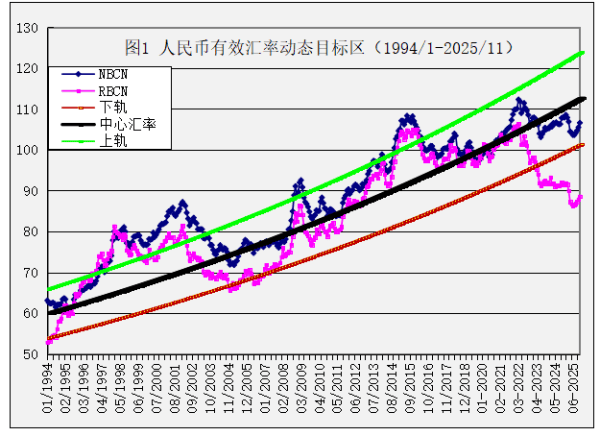
Core Viewpoint - The evaluation of the Renminbi (RMB) exchange rate should not be limited to its value against the US dollar but should consider a basket of currencies and the actual effective exchange rate, as the RMB's competitiveness is increasingly driven by industrial upgrades and import substitution rather than currency depreciation [1][4]. Group 1: RMB Exchange Rate Trends - The RMB has transitioned from a one-way appreciation to a two-way fluctuation since early 2014, with significant volatility observed post the "8-11 exchange rate reform" in 2015, where the RMB experienced fluctuations of 10%-15% [2]. - During the pandemic, the RMB depreciated to 7.19 against the USD but rebounded to around 6.3 in 2022 due to China's effective pandemic control and its role in the global supply chain [2]. - Over the past year, the RMB has shown an overall appreciation of approximately 5%, decreasing from a high of 7.4 to around 7.0 [2]. Group 2: Effective Exchange Rate Assessment - The RMB exchange rate index has shown a weakening trend, despite a 5% appreciation against the USD in the first half of the year, indicating that the nominal effective exchange rate is not the sole indicator of currency strength [3][4]. - The actual effective exchange rate (REER) is crucial for assessing export competitiveness, as it reflects the true value of the currency against a basket of currencies [3][4]. Group 3: Trade Competitiveness and Currency Management - China's export competitiveness has improved significantly over the past thirty years, with recent strong performance in the electric vehicle sector and enhanced import substitution capabilities, indicating a reduced reliance on currency depreciation for export stimulation [10]. - The RMB's nominal effective exchange rate has increased by 40% from 2005 to 2025, aligning closely with the projected annual appreciation rate of 2% based on the Balassa-Samuelson effect [6]. - The historical analysis shows that the RMB's effective exchange rate is currently undervalued by approximately 24%, primarily due to inflation differentials between China and Western countries [9]. Group 4: International Balance of Payments and Exchange Rate Dynamics - The relationship between the exchange rate and international balance of payments is bidirectional; while the exchange rate is influenced by the balance of payments, it also affects it [12]. - Recent trends indicate that changes in RMB exchange rate expectations have led to significant shifts in capital flows, with a surplus in currency conversion reflecting a positive outlook on the RMB's value [12].
【2026年汇市展望】以破“7”收官2025 2026年人民币汇率将何去何从?
Xin Hua Cai Jing· 2026-01-08 05:44
Core Viewpoint - The RMB exchange rate experienced significant appreciation in 2025, influenced by various factors including tariff expectations, fluctuations in the USD, and improvements in the domestic environment, with the onshore and offshore RMB appreciating approximately 4.27% and 4.93% respectively [1][2]. Group 1: RMB Exchange Rate Performance - In 2025, the RMB exchange rate reached its highest levels since May 2023, closing at 6.9879 for onshore and 6.9697 for offshore RMB against the USD [2]. - The year can be divided into two phases: the first phase saw a depreciation of the RMB due to rising global tariff risks, while the second phase experienced a gradual appreciation as external economic conditions improved [2][3]. - The RMB's appreciation was supported by a resilient export performance, with trade surplus exceeding $1 trillion for the first time in 2025 [3][4]. Group 2: External and Internal Factors - The depreciation of the USD was driven by various factors including the Federal Reserve's shift to a loose monetary policy and high fiscal deficits, leading to a cumulative decline of approximately 9.37% for the year [3][5]. - The internal economic resilience, particularly in exports, played a crucial role in supporting the RMB's appreciation, with significant inflows of foreign capital into the domestic market [3][4]. - The stable exchange rate policies implemented by the government helped to smooth fluctuations and maintain market expectations [3][4]. Group 3: Outlook for 2026 - Moving into 2026, the RMB is expected to continue a trend of gradual appreciation against the USD, influenced by the USD's potential depreciation and narrowing interest rate differentials between China and the US [6][7]. - The external economic environment is anticipated to remain favorable, with the RMB's asset attractiveness likely to draw in cross-border capital flows [7][8]. - However, there are cautions regarding the potential for rapid appreciation and the need for risk management strategies among enterprises and financial institutions [9].
1月8日人民币对美元中间价报7.0197 下调10个基点
Zhong Guo Xin Wen Wang· 2026-01-08 02:52
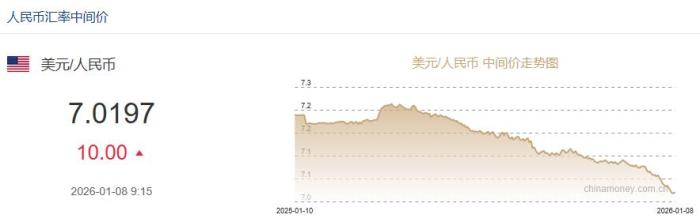
1月8日人民币对美元中间价报7.0197 下调10个基点 中新经纬版权所有,未经书面授权,任何单位及个人不得转载、摘编或以其它方式使用。 关注中新经纬微信公众号(微信搜索"中新经纬"或"jwview"),看更多精彩财经资讯。 图片来源:中国外汇交易中心网站截图 来源:中国新闻网 编辑:郭晋嘉 广告等商务合作,请点击这里 本文为转载内容,授权事宜请联系原著作权人 中新网1月8日电 据中国外汇交易中心网站消息,中国人民银行授权中国外汇交易中心公布,2025年1月 8日银行间外汇市场人民币汇率中间价为:1美元对人民币7.0197元,下调10个基点。 ...
人民币对美元中间价报7.0197 调贬10个基点
Zhong Guo Jing Ji Wang· 2026-01-08 02:34
Group 1 - The central exchange rate of the Renminbi (RMB) against the US dollar is reported at 7.0197, which represents a depreciation of 10 basis points compared to the previous trading day [1] - The People's Bank of China has authorized the China Foreign Exchange Trade System to publish the exchange rates for various currencies against the RMB, including 1 Euro at 8.1769, 100 Japanese Yen at 4.4674, and 1 British Pound at 9.4207 [2] - The exchange rate for the RMB against other currencies includes 1 Australian Dollar at 4.7027, 1 New Zealand Dollar at 4.0371, and 1 Canadian Dollar at 5.0502, among others [2]
以破“7”收官2025 2026年人民币汇率将何去何从?
Xin Lang Cai Jing· 2026-01-07 23:37
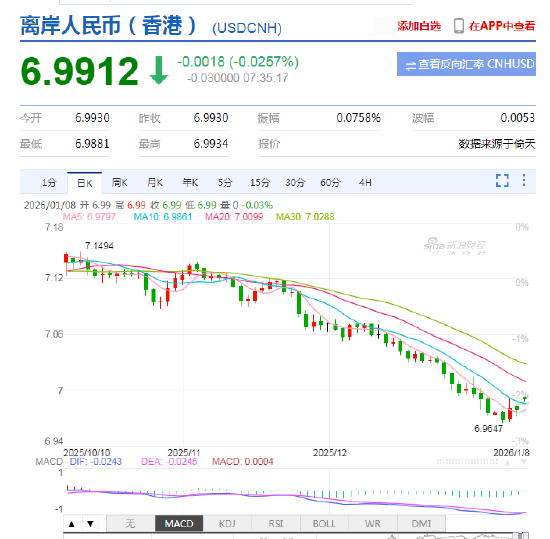
Core Viewpoint - The Chinese yuan (RMB) is expected to experience a significant appreciation in 2025, influenced by various factors including tariff expectations, fluctuations in the US dollar, and improvements in the domestic economic environment, with the onshore and offshore RMB appreciating approximately 4.27% and 4.93% respectively by year-end [1][3]. Group 1: 2025 RMB Exchange Rate Performance - The RMB exchange rate showed a notable recovery in 2025, marking the largest increase in five years, with the onshore and offshore RMB closing at 6.9879 and 6.9697 against the USD, respectively, both reaching new highs since May 2023 [3][4]. - The year can be divided into two phases: the first phase from early January to early April saw the RMB depreciate approximately 0.65% due to rising global tariff risks, while the second phase from mid-April to year-end witnessed a cumulative appreciation of about 4.9% as external economic conditions improved [4][5]. Group 2: External and Internal Factors Influencing RMB - Externally, the RMB's appreciation was supported by a warming external economic environment following agreements between China and the US, alongside a depreciation of the USD due to various pressures, including the Federal Reserve's shift to a loose monetary policy [5][6]. - Internally, strong export performance and resilience in the financial market contributed to the RMB's strength, with exports showing unexpected rebounds and a trade surplus exceeding 1 trillion USD for the first time in 2025 [5][6]. Group 3: Future Outlook for 2026 - Moving into 2026, the RMB is expected to continue a gradual appreciation against the USD, supported by a favorable external environment and a potential narrowing of interest rate differentials between China and the US [8][9]. - The RMB's asset attractiveness is anticipated to rise, attracting cross-border capital inflows, although there may be a decline in export growth, which could weaken the trade surplus's support for the exchange rate [9][10]. - Analysts predict that the RMB will likely fluctuate within the 6.9 to 7.3 range against the USD throughout 2026, with the potential for a mild appreciation against a basket of currencies [10][11].
开年以来人民币整体升值势头延续
Sou Hu Cai Jing· 2026-01-07 13:12
Core Viewpoint - The overall trend of the RMB appreciating against the USD has continued since the beginning of the year, prompting companies to consider engaging in financial derivatives trading to hedge against exchange rate and interest rate fluctuations [1][4]. Group 1: Company Actions - Oppein Home, a large home furnishing company, announced plans to engage in financial derivatives trading to mitigate risks from exchange rate and interest rate fluctuations, emphasizing that this is not for speculative purposes [2][3]. - The company plans to conduct financial derivatives transactions with a total amount not exceeding 3 billion RMB (including equivalent foreign currency) for the year 2026 [2]. - The types of financial derivatives to be traded include but are not limited to financial forwards, swaps, options, and other related products, with counterparties being reputable domestic and international financial institutions [2][3]. Group 2: Industry Context - Xuanfeng Automotive also announced plans to engage in financial derivatives trading, with a maximum contract value of 400 million RMB on any trading day in 2026, focusing on foreign exchange forwards and swaps [2][3]. - The overall trend of the RMB has been strong, with a 4.24% depreciation of the USD against the onshore RMB throughout 2025, leading to a significant appreciation of the RMB [4]. - Factors supporting the RMB's strength include a weaker USD and expectations of achieving around 5% economic growth in China for 2025, although uncertainties remain regarding future USD performance and external economic conditions [4][5].

