
品牌建设

Search documents
一年1797亿,华为公司为啥在研发上狠砸钱?任正非比很多人看得远
Sou Hu Cai Jing· 2025-09-24 02:02
Group 1 - The concept of "loyal customers" is questioned, as consumers prioritize utility and cost-effectiveness over brand loyalty [1] - Companies like Huawei invest heavily in R&D, with a commitment to allocate 10% of sales revenue for R&D, reflecting a long-term vision for innovation [3][9] - Huawei's R&D expenditure for 2024 is projected at RMB 1,797 million, accounting for 20.8% of total revenue, with a workforce of approximately 113,000 dedicated to R&D [3] Group 2 - Efficiency in business is defined as the ability to quickly generate profit, with a focus on maximizing return on investment [5] - The strategy of creating "affordable alternatives" can lead to short-term success but may limit long-term growth potential and market respect [6][7] - Companies must balance R&D with profitability, as innovation is essential for maintaining competitive advantage in high-tech industries [11] Group 3 - Founders with a long-term vision, like Ren Zhengfei of Huawei, prioritize building trust and a strong team over immediate profit maximization [9] - Continuous innovation is necessary for survival in a rapidly evolving market, and companies must invest in core technologies to establish brand strength [11][12] - The manufacturing industry must focus on brand development and original technology to compete globally, with Huawei serving as a model for success [12]

舍得酒业披露2024年业绩预告,主动控量挺价蓄力长期
Nan Fang Du Shi Bao· 2025-09-23 05:45
Core Viewpoint - Shede Liquor Industry (600702.SH) anticipates a significant decrease in net profit for 2024, projecting a range of 320 million to 420 million yuan, influenced by the broader challenges facing the liquor industry, including demand slowdown and high inventory levels [1] Group 1: Company Performance - The company expects net profit attributable to shareholders to be between 320 million and 420 million yuan for 2024, with a non-GAAP net profit forecast of 366 million to 466 million yuan [1] - Despite the performance pressure, the pricing structure of core products remains stable, with prices for key products like Wisdom Shede and Taste Shede showing increases compared to the beginning of 2024 [1] - The company is implementing a "control volume and support price" strategy to assist distributors and enhance sales, while also increasing investment in brand building [1] Group 2: Industry Context - The liquor industry is currently undergoing a deep adjustment period, facing challenges such as demand slowdown, high inventory, and price declines, leading to increased competition among companies [1] - The China Alcoholic Drinks Association has called for the industry to proactively lower expectations and manage profits to secure future growth [1] - Analysts believe that despite the current profitability challenges, Shede Liquor's differentiated advantage with "old liquor + famous liquor" remains intact, suggesting a potential for recovery in 2025 [3] Group 3: Future Outlook - Shede Liquor plans to focus on brand enhancement, channel development, and consumer cultivation, aiming to improve overall competitiveness and ensure stable growth [2] - The company has initiated significant projects in innovation and production expansion, which may impact short-term performance but are expected to enhance product quality and market competitiveness in the long run [2] - Analysts predict that with inventory improvements and continued product releases, Shede Liquor may experience a rebound in growth in 2025 [3]

巨星科技(002444):破局而立,走向全球
Donghai Securities· 2025-09-23 05:13
Investment Rating - The report assigns a "Buy" rating for the company, indicating a positive outlook for its stock performance in the next six months [2][45]. Core Viewpoints - The company has established a diversified product matrix in the tool industry, enhancing its manufacturing capabilities through acquisitions and restructuring, and is positioned for global expansion [5][10]. - The tool industry is mature with stable long-term demand, driven by active housing markets and industrial production expansion, with a projected global market size of $67.3 billion by 2026 [17][20]. - The company is actively responding to trade environment changes by implementing an international strategy since 2018, establishing a global supply chain and production bases [28][29]. - Despite a complex market environment, the company has built core competitiveness through optimized capacity layout, product innovation, and brand channel development [45]. Summary by Sections 1. Business Situation - The company achieved a revenue of 7.027 billion yuan in H1 2025, a year-on-year increase of 4.87%, and a net profit of 1.273 billion yuan, up 6.63% [10][14]. - The revenue distribution in H1 2025 was 65% from the US, 25.66% from Europe, and 4.96% from other regions [10]. 2. Industry Overview - The tool industry is characterized by stable demand, with a projected CAGR of 4% from 2024 to 2026 [17][20]. - The market is expected to see growth in segments like smart electric tools, driven by technological advancements [17]. 3. Company Competitiveness - The company has established 23 production bases globally and is investing in new facilities in Vietnam and Thailand [28][29]. - It has a strong focus on innovation, with significant R&D investments leading to a diverse product line exceeding 30,000 SKUs [31][32]. 4. Financial Performance - The company reported a net profit of 8.12 billion yuan in Q2 2025, reflecting a 4.08% increase year-on-year despite a slight revenue decline [35]. - The asset-liability ratio stands at 19.06%, indicating a low debt level and financial flexibility [35]. 5. Profit Forecast and Valuation - The company is expected to achieve revenues of 16.336 billion yuan, 18.747 billion yuan, and 21.714 billion yuan from 2025 to 2027, with corresponding net profits of 2.622 billion yuan, 3.057 billion yuan, and 3.587 billion yuan [3][45]. - The projected EPS for 2025, 2026, and 2027 are 2.20 yuan, 2.56 yuan, and 3.00 yuan, respectively, with a corresponding PE ratio decreasing from 15.21 to 11.12 [3][45].

禾赛科技 CEO 李一帆:“每天早上起来,我都在想昨天的自己的傻”
晚点LatePost· 2025-09-22 17:28
Core Viewpoint - The article discusses the journey of Hesai Technology, highlighting the importance of adapting to market needs and the evolution of its CEO, Li Yifan, from a technology-focused entrepreneur to a savvy business leader who understands the significance of sales and marketing in the tech industry [4][10]. Group 1: Company Background and Evolution - Hesai Technology was founded by Li Yifan, Sun Kai, and Xiang Shaoqing, who have impressive academic backgrounds and experience in technology [6]. - The company initially focused on detecting hazardous gases using lidar technology but pivoted to the automotive lidar market, where it has become a leader with a market share of over 100% in China [6][10]. - The first product was designed to be high-performance and cost-effective, significantly undercutting competitors like Velodyne [6][10]. Group 2: Market Challenges and Strategies - Since 2016, lidar prices have plummeted by 99.5%, leading to intense price competition [7]. - Li Yifan learned the importance of understanding customer needs and effectively communicating the value of lidar technology, especially in the face of skepticism from industry leaders like Elon Musk [7][10]. - The company emphasizes the need for a strong brand identity and product differentiation rather than merely competing on price [21][25]. Group 3: Leadership and Management Philosophy - Li Yifan's leadership style evolved from a technical focus to a more holistic approach that includes understanding market dynamics and customer relationships [11][14]. - The company values a culture of ownership among employees, encouraging them to think beyond their immediate roles [33]. - Li Yifan believes that maintaining a balance between innovation and operational efficiency is crucial for long-term success [18][31]. Group 4: Future Outlook and Market Position - Hesai Technology aims to maintain a competitive edge by investing at least 30% more in R&D compared to its closest competitor [26]. - The company recognizes the importance of the Chinese automotive market while also exploring opportunities in higher-margin sectors like robotics [25][26]. - The focus remains on delivering high-quality, high-performance products while ensuring that pricing remains reasonable to avoid losing customers to competitors [25][26].

为什么我们不再相信“第一”?
Hu Xiu· 2025-09-22 07:39
Core Viewpoint - The article discusses the phenomenon of "brand hollowing," where companies superficially engage in branding without genuine substance or innovation, leading to a lack of authenticity and competitive edge [6][9][12]. Group 1: Brand Perception and Strategy - Many companies that claim branding is ineffective are often benefiting from the branding efforts of others or are small startups lacking resources [2][3]. - Established companies recognize the necessity of branding as they reach a certain scale, where market competition demands comprehensive capabilities across various functions [4][5]. - The superficial aspects of branding, such as logos and endorsements, often mask a lack of genuine innovation and product development [6][7][8]. Group 2: Authenticity and Consumer Connection - The article emphasizes that true brand strength comes from authenticity and real experiences, rather than just marketing hype [15][20]. - Successful brands, like Apple and Nike, focus on solving significant industry challenges and creating impactful products, which naturally establishes their leadership [15][16]. - Consumers value real stories and experiences over mere labels, as authenticity fosters deeper emotional connections [20][23]. Group 3: Challenges and Opportunities - The current marketing landscape is saturated with brands claiming superiority without substantial backing, making it easy for competitors to imitate [12][13]. - Companies often struggle to produce genuine marketing materials because they lack real innovation and product development [14][24]. - Investing in genuine research, development, and user engagement can significantly reduce brand anxiety and enhance consumer loyalty [25][26].
推动调味品行业健康发展
Xin Lang Cai Jing· 2025-09-21 23:22
Core Viewpoint - Guangdong Jialong Food Co., Ltd. is actively adapting its strategies to enhance product quality and expand market channels in the competitive seasoning market, focusing on innovation and standardization as key drivers for industry upgrade [1][2]. Group 1: Industry Standards and Innovation - Jialong has been involved in drafting industry standards since 2008, addressing quality inconsistencies and helping the industry move towards standardization, which has provided the company with a competitive edge [2]. - The company has developed a closed-loop ecosystem of "R&D - Standards - Production" to strengthen its foundation and drive industry upgrades [1][2]. - Jialong's technical innovations, such as optimizing chicken juice production processes, have significantly improved product quality and generated substantial revenue, with chicken juice products contributing 15 million yuan in annual output and 3 million yuan in profit [2]. Group 2: Brand Matrix and Market Expansion - Jialong has established a multi-brand strategy to cater to diverse consumer needs, including brands like "Jialong," "Fuwei," and "Gangchu," which helps mitigate risks associated with relying on a single brand [4][5]. - The company is expanding into the soy sauce market, which has shown a compound annual growth rate of 9.2% from 2018 to 2022, indicating a growing demand for high-quality, differentiated products [6]. - New product lines, such as the high-end "Jialong Yipin Xian (Gold Label) Soy Sauce," target middle-to-high-income consumers, while the mid-range "Jialong Yipin Xian (Silver Label) Soy Sauce" aims at the mass market, enhancing the company's product matrix [6]. Group 3: Channel Strategy - Jialong is integrating online and offline sales channels to enhance brand penetration, having entered major platforms like Douyin and Tmall, and utilizing live streaming and content marketing to engage younger consumers [5][6]. - The company continues to strengthen traditional channels such as supermarkets and convenience stores, creating a comprehensive network that combines online attraction with offline experience [5].

佳隆股份总经理林长春:推动调味品行业健康发展
Zheng Quan Ri Bao· 2025-09-21 15:37
Core Viewpoint - Guangdong Jialong Food Co., Ltd. is actively adjusting its strategy to enhance product quality and expand market channels in response to the competitive seasoning market [2][3]. Group 1: Industry Standards and Innovation - The transition from extensive development to standardized, high-quality production in the seasoning industry relies on technological innovation and standardization [3]. - Jialong has been involved in drafting industry standards since 2008, addressing quality inconsistencies and helping the industry move towards standardized development [3][4]. - The company has accumulated 9 invention patents, 24 utility model patents, and 11 design patents, which have translated into market competitiveness [4]. Group 2: Brand Matrix Development - Jialong has established a multi-brand matrix to cater to diverse consumer needs, including brands like "Jialong," "Fuwei," and "Gangchu" [6]. - The core brand "Jialong" is recognized as a "China Famous Trademark," enhancing its market presence [6]. Group 3: Market Expansion and Channel Strategy - The company is expanding into the soy sauce market, which has shown significant growth, with production increasing from 575.6 million tons in 2018 to 818 million tons in 2022, reflecting a compound annual growth rate of 9.2% [7][8]. - Jialong is integrating online and offline channels, launching sales on major platforms like Douyin and Tmall to reach younger consumers while maintaining traditional retail channels [7][8].
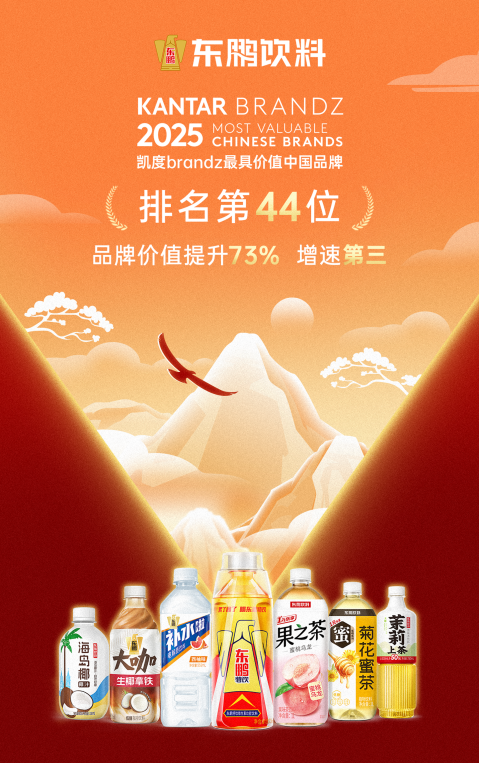
排名第44,东鹏饮料连续四年登榜凯度BrandZ中国品牌百强榜
Sou Hu Wang· 2025-09-21 00:30
Core Insights - The 2025 Kantar BrandZ Top 100 Most Valuable Chinese Brands list was released, showing a total brand value of $1.21 trillion, with a growth rate of 25% in a complex macroeconomic environment [1] Company Performance - Dongpeng Beverage has been listed for four consecutive years, significantly rising 25 places to rank 44th, with a brand value of $4.218 billion and a growth rate of 73%, making it the third on the growth list [4] - In 2024, Dongpeng Beverage achieved a total revenue of 15.84 billion yuan, a year-on-year increase of 40.63%, and a net profit of 3.327 billion yuan, up 63.09% [7] - For the first half of 2025, Dongpeng Beverage reported revenue of 10.737 billion yuan, with its flagship product Dongpeng Special Drink growing at 21.97% to achieve revenue of 8.361 billion yuan, and Dongpeng Water achieving a remarkable growth rate of 213.71% [10] Brand Strategy - The Vice President of Dongpeng Beverage, Jiang Weiwei, emphasized the importance of brand visibility, sales increase, and loyalty through a three-dimensional approach to "traffic" [5] - The company utilizes product display as a key marketing strategy, transforming shelves and coolers into advertising spaces, and employs digital systems for optimal resource allocation [5] - Dongpeng Beverage enhances brand awareness through strategic partnerships with major events like the World Cup and by utilizing various advertising platforms [6] - The company has developed a precise marketing strategy targeting specific consumer groups, which has proven effective in building brand loyalty and increasing repurchase rates [6] Industry Context - The growth of Dongpeng Beverage reflects a broader trend in the Chinese consumer brand landscape, transitioning from "scale expansion" to "value leadership" [10] - The resilience and innovative strategies of Chinese brands are highlighted as they adapt to a more mature economic environment, aiming to strengthen their competitiveness in the global market [10]

10 Effective Ways to Start a Business Today
Small Business Trends· 2025-09-19 15:51
Group 1: Business Planning - Starting a business requires careful planning and execution, including identifying a unique idea and conducting thorough market research [1][71] - A comprehensive business plan should outline purpose, products, target market, and financial projections [19][20] - Securing funding is critical, with various sources available such as personal savings, bank loans, and crowdfunding [31][32] Group 2: Market Research - Conducting thorough market research involves analyzing competitor strategies and identifying market gaps [12][16] - Understanding competitors' strengths and weaknesses can enhance product development and marketing strategies [13][15] - Tools like surveys and focus groups can provide insights into customer preferences and pain points [17] Group 3: Business Structure and Registration - Choosing the right business structure is essential for protecting interests and ensuring smooth operations [25][29] - Official registration involves completing forms, paying fees, and obtaining necessary licenses and permits [37][38] - Keeping organized documentation of registrations and licenses is crucial for future compliance [39][41] Group 4: Brand Development - Developing a strong brand identity is vital for standing out in a competitive market [42][45] - Creating a professional website and engaging with customers through social media are key strategies [49][47] - Consistent visual style and a memorable logo help differentiate from competitors [47] Group 5: Marketing Strategies - Implementing targeted marketing strategies is essential for connecting with ideal customers [51][54] - Utilizing social media and targeted advertising campaigns can effectively reach specific demographics [55] - Regularly analyzing marketing performance metrics helps refine strategies for better engagement [55] Group 6: Industry Insights - E-commerce is projected to grow to $6.39 trillion by 2024, making it a lucrative business opportunity [62] - Health and wellness services are expected to reach a market size of $4.24 trillion by 2026 [62] - Pet services are thriving due to 70% of U.S. households owning pets, creating opportunities in grooming and pet sitting [63]


悍高集团(001221) - 悍高集团股份有限公司投资者关系活动记录表
2025-09-19 12:34
Group 1: Company Overview and Competitive Advantages - The company has achieved quality and design comparable to international brands such as Baolong and Haidisi, while maintaining a cost-effective pricing strategy [2] - Key competitive advantages include product innovation, brand reputation, diverse channels, and manufacturing capabilities [2] - The company has been innovating continuously, focusing on original design and quality to enhance user experience and meet diverse consumer needs [2] Group 2: Future Development Goals - The company aims to innovate continuously in product development, focusing on micro and macro upgrades to meet market demands and lead industry trends [4] - Plans to enhance brand awareness and reputation through diversified marketing strategies, particularly targeting end consumers [4] - The company targets a 15% sales contribution from overseas markets, with plans to expand through overseas agents and establish offices [6][7] Group 3: Sales Channels and Management - The primary sales channel is through distributors, with a clear management system in place for onboarding and evaluating distributors [5] - The company conducts annual assessments of distributors based on sales performance and compliance with company standards [5] - Future strategies include empowering distributors with marketing support to align with the company's growth [5] Group 4: Product Categories and Market Positioning - The company focuses on multiple product categories, with a strong emphasis on hardware, particularly hinges and rails, which have significant market potential [5] - Plans to deepen collaboration with well-known home furnishing brands to strengthen market position in storage hardware [6] - The bathroom product line is in the incubation stage, with plans to enter the high-end market leveraging original design advantages [7]