
固定资产投资

Search documents
国债期货周报:债市底部震荡,修复动力偏弱-20250919
Rui Da Qi Huo· 2025-09-19 08:41
Report Industry Investment Rating - No relevant content provided Core Viewpoints of the Report - The bond market has been oscillating at the bottom, with weak repair momentum. In the short term, institutional behavior, expectations of incremental policies, and changes in the capital market are the main driving factors. The "supply - strong, demand - weak" pattern may continue in August economic data, and the bond market is unlikely to trend downward significantly, with yields expected to remain in a high - level oscillation pattern. It is recommended to wait and see on a single - side basis and focus on term spread trading opportunities brought by the steepening of the yield curve [97][98] Summary by Directory 1. Market Review - **Performance of Treasury Futures Contracts**: The 30 - year TL2512 contract fell 0.41%, the 10 - year T2512 contract rose 0.12%, the 5 - year TF2512 contract rose 0.07%, and the 2 - year TS2512 contract fell 0.02%. The trading volumes of TS, TF, and T contracts increased, while that of the TL contract decreased. The open interests of all TS, TF, T, and TL contracts increased [13][17][23][31] - **Performance of Deliverable Bonds**: The prices of some deliverable bonds changed, such as the 30 - year 210005 IB falling 0.14 and the 10 - year 220017 IB rising 0.05 [13] 2. News Review and Analysis - **Domestic News**: In August, the added value of industrial enterprises above designated size increased by 5.2% year - on - year, social consumer goods retail sales reached 39668 billion yuan, a year - on - year increase of 3.4%, and fixed - asset investment (excluding rural households) decreased by 0.20% month - on - month. The urban surveyed unemployment rate was 5.3%. The Sino - US economic and trade leaders held talks and reached a basic framework consensus on some issues [34] - **Overseas News**: US retail sales in August were 732.01 billion US dollars, a month - on - month increase of 0.6%. The initial jobless claims were 231,000, a significant drop. The Fed cut the federal funds rate target range by 25 basis points to 4% - 4.25% [10][35][36] 3. Chart Analysis - **Spread Changes** - **Yield Spreads**: The spread between 10 - year and 5 - year bonds widened slightly, while the spread between 10 - year and 1 - year bonds narrowed slightly. The spreads between 2 - year and 5 - year, 5 - year and 10 - year contract main contracts widened slightly. The 10 - year and 30 - year contract inter - period spreads widened significantly, the 5 - year contract inter - period spread narrowed, and the 2 - year contract inter - period spread widened [44][48][52] - **Treasury Futures Main Position Changes**: The net short positions of the top 20 positions in the T contract increased significantly [64] - **Interest Rate Changes** - **Shibor and Treasury Yields**: Overnight, 1 - week, 2 - week, and 1 - month Shibor rates all increased. The yields of treasury bonds due in 1 - 7 years changed between - 1 and 2 basis points, and the yields of 10 - year and 30 - year bonds rose by about 0.4 and 1 basis points to 1.80% and 2.10% respectively [68] - **Sino - US Treasury Yield Spreads**: The spreads between 10 - year and 30 - year Sino - US treasury bonds widened slightly [73] - **Central Bank Open - Market Operations**: The central bank conducted 1826.8 billion yuan in reverse repurchases and 150 billion yuan in treasury cash deposits, with 1264.5 billion yuan in reverse repurchases and 120 billion yuan in treasury cash deposits maturing, resulting in a net injection of 592.3 billion yuan. The weighted average DR007 rate rebounded to around 1.50% [77] - **Bond Issuance and Maturity**: This week, bonds worth 1708.793 billion yuan were issued, with a total repayment of 1190.265 billion yuan, and a net financing of 518.528 billion yuan [81] - **Market Sentiment** - **USD/CNY Exchange Rate**: The central parity rate of the US dollar against the RMB was 7.1128, with a cumulative depreciation of 109 basis points this week. The spread between the offshore and on - shore RMB weakened [86] - **US Treasury Yields and VIX Index**: The yield of 10 - year US Treasury bonds oscillated upward, and the VIX index increased [91] - **A - Share Risk Premium**: The yield of 10 - year treasury bonds decreased, and the A - share risk premium increased slightly [94] 4. Market Outlook and Strategy - **Domestic Fundamentals**: In August, industrial growth, social retail, and export growth slowed down, fixed - asset investment continued to shrink, and the unemployment rate rose seasonally. Social financing growth declined slightly, and credit growth was weak. The economic recovery has slowed down since July, and the manufacturing PMI is still in the contraction range. Supply - demand contradictions persist, and macro - policies need to boost domestic demand [97] - **Overseas Situation**: The number of initial jobless claims in the US decreased significantly, but overall employment growth slowed down. The Fed cut interest rates by 25 basis points, and the market's expectation of a rate cut in October increased [97] - **Bond Market Outlook and Strategy**: The bond market has been oscillating at the bottom, with weak repair momentum. The "supply - strong, demand - weak" pattern may continue, and the bond market is unlikely to trend downward significantly. It is recommended to wait and see on a single - side basis and focus on term spread trading opportunities [98]
前8月化学原料和化学制品制造业投资同比下降5.2%
Guo Jia Tong Ji Ju· 2025-09-17 19:51
Summary of Key Points Core Viewpoint - In the first eight months of 2025, China's fixed asset investment (excluding rural households) reached 32.6111 trillion yuan, showing a year-on-year growth of 0.5%, with notable declines in specific sectors such as chemical manufacturing [1] Investment by Industry - The primary industry saw an investment of 646.1 billion yuan, increasing by 5.5% year-on-year [1] - The secondary industry investment totaled 11.8246 trillion yuan, growing by 7.6% [1] - The tertiary industry investment was 20.1404 trillion yuan, which represents a decline of 3.4% [1] - Within the secondary industry, industrial investment grew by 7.7%, with mining investment increasing by 3.0%, manufacturing investment rising by 5.1%, and investment in electricity, heat, gas, and water production and supply surging by 18.8% [1] - In the tertiary industry, infrastructure investment (excluding electricity, heat, gas, and water production and supply) increased by 2.0%, with water transport investment up by 15.9%, water conservancy management investment up by 7.4%, and railway transport investment up by 4.5% [1] Regional Investment Trends - Eastern region investment decreased by 3.5% year-on-year [1] - Central region investment increased by 2.5% [1] - Western region investment grew by 2.3% [1] - Northeastern region investment declined by 6.0% [1] Investment by Registration Type - Domestic enterprises' fixed asset investment increased by 0.5% [1] - Investment from Hong Kong, Macau, and Taiwan enterprises grew by 2.3% [1] - Foreign enterprises' fixed asset investment saw a significant decline of 15.4% [1]
1至8月云南装备制造业增加值同比增长15.4%
Zhong Guo Xin Wen Wang· 2025-09-17 12:13
Core Insights - Yunnan's equipment manufacturing industry saw a year-on-year increase of 15.4% in value added from January to August, accelerating by 2 percentage points compared to the previous period, contributing 27.1% to the growth of industrial value added above designated size [1][2] - The overall industrial value added in Yunnan increased by 4% year-on-year during the same period, with mining, manufacturing, and electricity sectors showing growth rates of 9.5%, 4.4%, and 1% respectively [1][2] - High-tech manufacturing value added grew by 12.5%, contributing 23.6% to the overall industrial growth, with aerospace and communication equipment manufacturing increasing by 51.9% and 29.6% respectively [1][2] Industry Performance - The coal industry reported a year-on-year increase of 12.4%, while the oil industry remained stable at 6.4% growth [2] - The non-ferrous metal industry continued its rapid growth with a 15.4% increase, leading in contribution to industrial growth at 34.9% [2] - The production of green industrial products saw significant increases, with new energy vehicles and solar batteries rising by 83% and 64.9% respectively [2] Economic Indicators - Yunnan's total retail sales of consumer goods reached 838.08 billion yuan, marking a 4% year-on-year growth [2] - Fixed asset investment in Yunnan grew by 0.3%, with the first industry increasing by 2.5%, the second by 1.3%, and the third declining by 0.5% [2] - The Consumer Price Index (CPI) in August showed a year-on-year decrease of 0.4%, remaining stable month-on-month [2][3] Policy and Outlook - The Yunnan Provincial Bureau of Statistics indicated that macroeconomic policies are effectively supporting stable economic performance, but challenges such as weak expectations and insufficient effective demand remain [3] - Future efforts will focus on ensuring the implementation of policies aimed at stabilizing employment, businesses, markets, and expectations to promote healthy economic development [3]
2025年1-8月份河南固定资产投资增长4.7%
Sou Hu Cai Jing· 2025-09-17 04:03
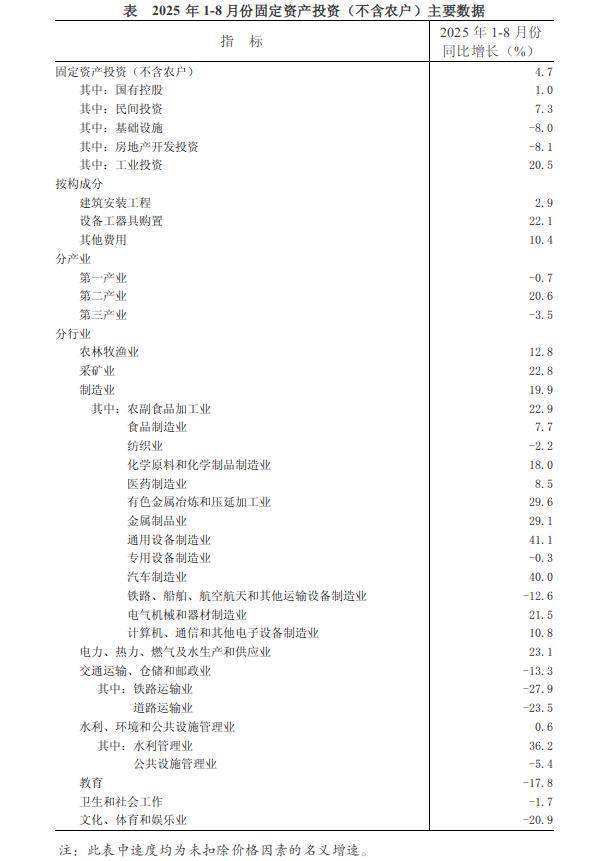
Core Insights - In the first eight months of 2025, fixed asset investment in Henan Province (excluding rural households) increased by 4.7% year-on-year, with private investment growing by 7.3% [1] Investment by Industry - Investment in the primary industry decreased by 0.7% year-on-year - Investment in the secondary industry increased by 20.6% - Investment in the tertiary industry decreased by 3.5% [1] Major Investment Areas - Industrial investment rose by 20.5% year-on-year - Infrastructure investment (excluding electricity, heat, gas, and water production and supply) fell by 8.0% - Real estate development investment decreased by 8.1% [1] Industrial Investment Breakdown - Mining industry investment increased by 22.8% - Manufacturing investment grew by 19.9% - Investment in electricity, heat, gas, and water production and supply rose by 23.1% [1] Infrastructure Investment Breakdown - Investment in water conservancy, environment, and public facilities management (excluding land management) increased by 0.4% - Investment in transportation and postal services decreased by 19.8% - Investment in information transmission fell by 10.4% [1] Investment by Ownership - Central project investment increased by 2.1% - Local project investment grew by 4.8% [1]

2021—2024年中央企业累计完成固定资产投资19万亿元,年均增速6.3%
Bei Jing Shang Bao· 2025-09-17 02:43
Core Insights - During the "14th Five-Year Plan" period, central enterprises have significantly increased effective investment, contributing to the stable and healthy operation of the economy and society [1] - From 2021 to 2024, central enterprises are expected to complete a total fixed asset investment of 19 trillion yuan, with an average annual growth rate of 6.3% [1] - Since the fourth quarter of last year, a total of 500 billion yuan in special bonds for stable growth and investment has been planned for issuance, effectively promoting investment in key projects [1]
前八月陕西经济运行平稳向好
Shan Xi Ri Bao· 2025-09-17 00:50
Economic Overview - The provincial economy has maintained a stable and positive trend in the first eight months, with steady industrial production, effective investment growth, and a robust consumer market [1][2] Industrial Production - The industrial added value of enterprises above designated size increased by 8.4% year-on-year in the first eight months [2] - The equipment manufacturing industry saw significant growth, with an increase of 11.8% in added value, and specific sectors such as electrical machinery and equipment manufacturing growing by 41.8% [1] - Key products showed notable increases: coal production up by 2.2%, natural gas production up by 3.4%, and automobile production up by 16.6%, with new energy vehicles increasing by 17.6% [1] Fixed Asset Investment - Fixed asset investment grew by 4.1% year-on-year, with industrial investment showing a rapid increase of 19.4% [1] - Manufacturing investment rose by 23.2%, and industrial technological transformation investment surged by 31% [1] - Private investment also performed well, increasing by 11%, which is 6.9 percentage points higher than the overall investment growth rate [1] Consumer Market - Retail sales of consumer goods by enterprises above designated size increased by 7.9% year-on-year [2] - The "old for new" consumption policy showed effectiveness, with home appliances and audio-visual equipment retail sales rising by 33.7% [2] - Online retail remained active, with a 21.2% year-on-year increase in sales through public networks, accounting for 22.6% of total retail sales [2] Foreign Trade - The total import and export value reached 332.597 billion yuan, a year-on-year increase of 10.5% [2] - Exports amounted to 230.434 billion yuan, growing by 13.2%, while imports were 102.163 billion yuan, up by 4.8% [2] - The export of "new three samples" products, including lithium-ion batteries and electric vehicles, saw remarkable growth, with increases of 97.7% and 84.4% respectively [2]
前八月江西经济平稳向好,亿元以上在建项目7828个
Zhong Guo Xin Wen Wang· 2025-09-17 00:47
Core Viewpoint - Jiangxi Province's fixed asset investment increased by 4.0% year-on-year in the first eight months, with 7,828 ongoing projects valued over 100 million yuan each [1] Investment Breakdown - Infrastructure investment grew by 12.8% year-on-year [1] - Manufacturing investment rose by 9.3% year-on-year [1] - Real estate development investment decreased by 10.4% year-on-year [1] Project and Investment Contribution - The 7,828 ongoing projects accounted for 71.9% of total investment, contributing to a 5.0 percentage point increase in overall investment growth [1] - Completed investment from these projects increased by 7.1% [1]
【省统计局】前八月陕西经济运行平稳向好
Shan Xi Ri Bao· 2025-09-17 00:43
Economic Overview - The provincial economy has maintained a stable and positive trend in the first eight months, with steady industrial production, effective investment growth, and a robust consumer market [1][2] Industrial Production - The industrial added value of enterprises above designated size increased by 8.4% year-on-year in the first eight months [1] - The equipment manufacturing industry experienced significant growth, with an increase of 11.8% in added value, and specific sectors such as electrical machinery and equipment manufacturing saw a remarkable 41.8% increase [1] - Key products showed varied growth, including coal production up by 2.2%, natural gas production up by 3.4%, and automobile production up by 16.6%, with new energy vehicles increasing by 17.6% [1] Fixed Asset Investment - Fixed asset investment grew by 4.1% year-on-year, with industrial investment showing a rapid increase of 19.4% [1] - Manufacturing investment rose by 23.2%, and industrial technological transformation investment surged by 31% [1] - Private investment also performed well, increasing by 11%, which is 6.9 percentage points higher than the overall investment growth rate [1] Consumer Market - Retail sales of consumer goods in enterprises above designated size increased by 7.9% year-on-year [2] - The "old-for-new" consumption policy showed positive effects, with home appliances and audio-visual equipment retail sales rising by 33.7% [2] - Online retail remained active, with a 21.2% year-on-year increase in sales through public networks, accounting for 22.6% of total retail sales [2] Foreign Trade - The total import and export value reached 332.597 billion yuan, a year-on-year increase of 10.5% [2] - Exports amounted to 230.434 billion yuan, growing by 13.2%, while imports were 102.163 billion yuan, up by 4.8% [2] - The export of "new three samples" products, including lithium-ion batteries and electric vehicles, saw significant growth, with increases of 97.7% and 84.4% respectively [2]
【固收】固定资产投资累计同比增速延续回落态势——2025年8月经济数据点评兼债市观点(张旭/李枢川)
光大证券研究· 2025-09-16 23:07
Core Viewpoint - The economic data for August 2025 indicates a slowdown in industrial production, a decline in fixed asset investment, and weaker-than-expected retail sales growth, reflecting the impact of "anti-involution" policies on the actual economy [4][5][6][7]. Industrial Production - The industrial added value for large-scale enterprises grew by 5.2% year-on-year in August, a decrease of 0.5 percentage points from July, marking two consecutive months of declining growth [4][5]. - Month-on-month, the industrial added value increased by 0.37% in August, lower than the growth rates in the same months of 2023 and 2024 [5]. Fixed Asset Investment - The cumulative year-on-year growth rate of fixed asset investment continued to decline, with August showing a significant drop in infrastructure investment [6]. - Real estate investment remains weak, while manufacturing and infrastructure investments have also retreated from their high levels earlier in the year, with negative year-on-year growth for two consecutive months [6]. Retail Sales - The total retail sales of consumer goods increased by 3.4% year-on-year in August, with a month-on-month growth rate of 0.17%, indicating a slight recovery but still below seasonal expectations [7]. - The month-on-month growth rate in August was lower than the corresponding rates in 2023 and 2024, suggesting a weaker consumer spending environment [7]. Bond Market Outlook - In the bond market, there has been a noticeable divergence in government bond yields since August, with short-term yields remaining stable while long-term yields have increased significantly [8]. - The current liquidity is relatively ample, and the bond market is expected to perform well, with the 10-year government bond yield estimated to stabilize around 1.7% [8][9]. - Convertible bonds have not outperformed their underlying stocks since August 25, and while they remain a relatively high-quality asset, their current valuation levels are elevated, necessitating a more strategic approach [9].
8月经济总体平稳,四季度稳增长政策需提前谋划 | 宏观月报
2 1 Shi Ji Jing Ji Bao Dao· 2025-09-16 13:28
Economic Overview - China's economy achieved a growth rate of 5.3% in the first half of the year, despite challenges from global trade uncertainties and the transition of economic drivers [1] - The necessity for stable growth policies in the fourth quarter is increasing, as indicated by the recent economic data [2] Financing and Credit - The growth rate of social financing decreased in August, with a total increment of 25,693 billion yuan, which is a year-on-year decrease of 4,630 billion yuan [3] - The demand for credit remains weak, with new loans amounting to 6,233 billion yuan in August, down by 4,178 billion yuan year-on-year [3][4] - Government bond financing has also seen a decline, indicating that the effectiveness of active fiscal policies needs to be supported in key quarters [5] Investment Trends - Fixed asset investment growth was only 0.5% year-on-year from January to August, with infrastructure investment growing by 2% and manufacturing investment by 5.1%, while real estate investment fell by 12.9% [6][7] - The government is focusing on stabilizing investment in key industries, particularly manufacturing, to support economic recovery [7] Consumption Patterns - In August, the total retail sales of consumer goods reached 39,668 billion yuan, with a year-on-year growth of 3.4%, although certain sectors like dining faced challenges [7][8] - The recovery in consumption is expected to take time, and effective demand needs to be stimulated [8] Policy Recommendations - There is a growing need for the introduction of stable growth policies in the fourth quarter, with potential measures including the issuance of special government bonds and the use of policy financial tools [2][8] - Structural policy tools may be accelerated to support key industries and foreign trade, while fiscal policies may need to be intensified [8]