
高性能计算

Search documents
美联新材EX电子材料实现批量销售 迈向全球市场
Zheng Quan Ri Bao Wang· 2025-08-05 03:14
Core Viewpoint - Guangdong Meilian New Materials Co., Ltd. has successfully achieved mass sales of its EX electronic materials, marking a significant advancement for China's high-end electronic resin materials in the global high-frequency and high-speed application fields [1][2]. Group 1: Product Development and Performance - EX electronic materials are high-performance resin materials based on hydrocarbon polymers, crucial for manufacturing high-end copper-clad laminate (CCL) insulation layers, with core technical indicators reaching international leading levels [1]. - The material exhibits industry-leading data transmission capabilities, significantly reducing signal loss and enhancing system stability, while also demonstrating excellent thermal stability and electrical insulation [1]. - Key performance metrics include a dielectric constant (Dk) of 2.54 and a dielectric loss (Df) of 0.0006 at 15GHz, outperforming traditional materials like PPO (Df of 0.007) [1]. Group 2: Market Applications and Clientele - EX materials address critical pain points in AI computing centers and high-performance computing systems, providing good electrical insulation and thermal processing stability, which improves yield and reduces manufacturing costs [2]. - The product has successfully entered the supply chain of leading global M8-level semiconductor clients and is expected to achieve stable annual supply at a hundred-ton level [2]. - Applications of EX materials extend to 5G and 6G communication devices, AI servers, supercomputers, and various intelligent terminals, including AI smartphones and drones [2]. Group 3: Future Growth and Strategic Positioning - The company has established a solid competitive advantage in the EX electronic materials sector, creating a complete closed-loop from monomer synthesis to polymer preparation and industrial application [3]. - Plans for capacity expansion are underway, with a hundred-ton new project having completed trial production, indicating readiness to meet rapidly growing market demand [2][3]. - The market for high-grade hydrocarbon resin materials is projected to reach a scale of tens of thousands of tons, with the company positioned to establish a global competitive edge in strategic emerging fields such as AI, 6G communication, and autonomous driving [3].

博通宣布推出Jericho4,实现跨数据中心分布式AI计算
Xin Lang Cai Jing· 2025-08-05 00:15
Core Insights - Broadcom has officially launched the Jericho4 Ethernet structure router, designed for next-generation distributed AI infrastructure [1] - The Jericho4 router can interconnect over one million XPU processors across multiple data centers, breaking traditional scaling limitations with its groundbreaking bandwidth, security, and lossless transmission performance [1] - Together with the Tomahawk 6 and Tomahawk Ultra product lines, Broadcom provides a comprehensive networking solution for high-performance computing (HPC) and artificial intelligence [1]

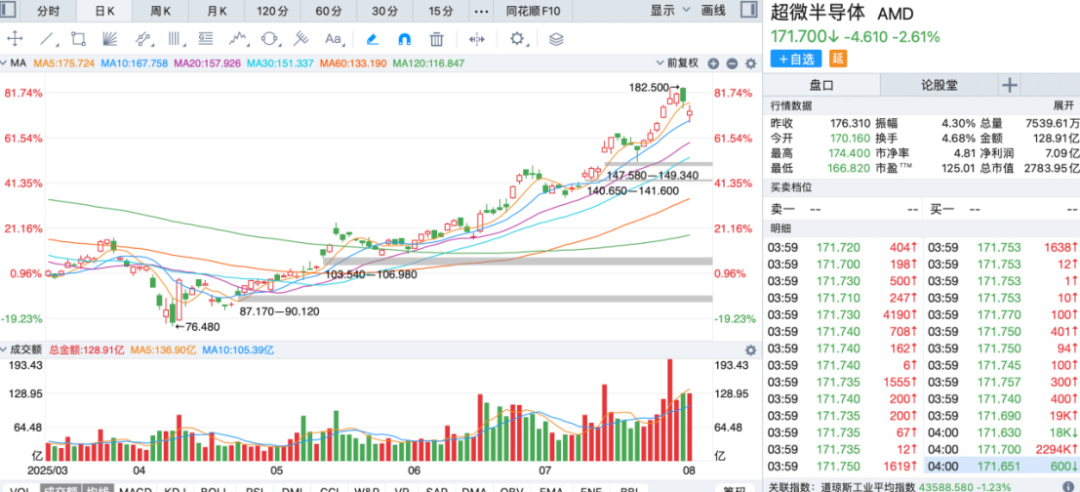
天风国际:AMD(AMD.US)涨价却帮助英伟达创新高?
智通财经网· 2025-08-04 13:01
Core Viewpoint - AMD is considering raising the average price of its Instinct MI350 series AI chips from $15,000 to $25,000, representing a 70% increase, which has positively impacted its stock price, reflecting market sentiment favoring positive news [1] Group 1: Pricing and Market Reaction - AMD's potential price increase for the MI350 series AI chips has led to a 4.32% rise in its stock price, reaching a new historical high [1] - The market appears to be selectively responding to positive news, disregarding potential negative implications [1] Group 2: Supply Chain and Production Costs - AMD's CEO mentioned that chips sourced from the new TSMC factory in Arizona will have costs 5% to 20% higher than those produced in Taiwan, but this is deemed acceptable for diversifying supply and enhancing supply chain resilience [3] - The yield of chips from the Arizona factory is now comparable to that of the Taiwan factory, with the first batch of U.S.-made chips expected by the end of the year, mitigating the impact of semiconductor import tariffs [3] Group 3: Revenue Projections and Market Demand - HSBC forecasts that AMD's revenue from AI chips will reach $15.1 billion by 2026, a significant increase from the previous estimate of $9.6 billion, indicating strong market demand for AI computing solutions [6] - The growing reliance on AI technology across industries is driving demand for high-performance computing solutions, which the MI350 series is well-positioned to meet [6] Group 4: Competitive Landscape - Despite NVIDIA's leading position in the AI chip market, AMD is gradually closing the gap through continuous technological innovation and strategic market approaches [8] - The current market dynamics suggest an overly optimistic sentiment, as AMD's price increase is interpreted as a sign of confidence in its ability to compete with NVIDIA's B200 chip [9]


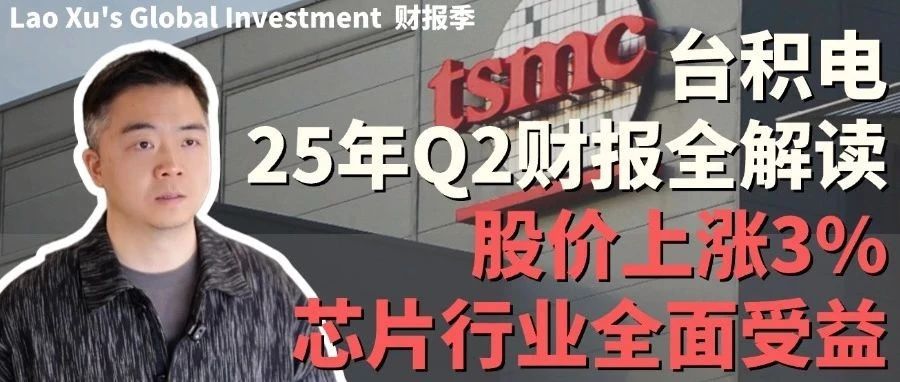
【财报季】台积电25年Q2财报全解读:股价上涨3%,芯片行业全面受益!
老徐抓AI趋势· 2025-08-02 05:56
Core Viewpoint - TSMC's Q2 2025 financial results demonstrate strong growth, with record revenue and net profit, reflecting the semiconductor industry's robust demand, particularly in advanced processes and AI applications [6][25][38]. Financial Performance Highlights - TSMC achieved consolidated revenue of NT$933.79 billion (approximately US$300.7 billion), a year-on-year increase of 38.6% and a quarter-on-quarter increase of 11.3% [6][8]. - Net profit reached NT$398.27 billion (approximately US$128.3 billion), marking a significant year-on-year growth of 60.7% [6][8]. - Gross margin stood at 58.6%, with operating and net profit margins at 49.6% and 42.7%, respectively, exceeding market expectations [7][8]. Business Structure and Technology Analysis - Advanced processes (7nm and below) contributed 74% of total wafer revenue, indicating TSMC's dominance in high-end manufacturing [10][26]. - The revenue distribution by application shows that High-Performance Computing (HPC) accounted for 60% of revenue, while smartphone revenue decreased to 27% [12][37]. Capacity and Supply Dynamics - TSMC's wafer shipments reached 3.718 million (equivalent to 12-inch wafers), reflecting a year-on-year increase of 19.0% [15][28]. - The company anticipates continued tight capacity for 3nm and 5nm processes over the next few years, driven by strong market demand [18][28]. Future Outlook and Industry Impact - TSMC is progressing well with its 2nm process, expected to enter mass production in 2025, with analysts predicting wafer prices could soar to US$30,000 each [19][29]. - The company maintains a long-term gross margin target of over 53%, indicating confidence in sustaining profitability amid evolving market conditions [22][40]. Emerging Opportunities - TSMC views the semiconductor market for humanoid robots as having significant long-term potential, particularly in the medical sector, despite current limitations in short-term demand [30][33]. - The company emphasizes its readiness to meet future semiconductor needs for robotics, particularly in sensor integration and energy efficiency [34][38].

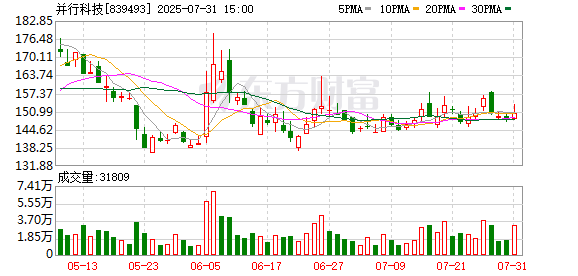
并行科技副总裁赵鸿冰:未来三年算力成本下降态势仍将持续
Zheng Quan Ri Bao· 2025-07-31 11:10
Group 1 - The core viewpoint of the article highlights the realization of AI applications moving from imagination to practical productivity, driven by advancements in domestic computing power and reduced costs [2][3] - The company, Beijing Parallel Technology Co., Ltd., leverages its high-performance computing (HPC) and AI technology to provide specialized computing solutions across various fields, including AI, intelligent manufacturing, and life sciences [2] - In the first half of 2025, the company reported a revenue of 458 million yuan, representing a year-on-year growth of 69.27%, and a net profit attributable to shareholders of 5.08 million yuan, up 20.05% year-on-year [2] Group 2 - At the World Artificial Intelligence Conference, the company showcased its Parallel Computing Network service and a cross-regional intelligent scheduling platform, emphasizing its core advantage in the commercial model of the Parallel Computing Network [3] - The Parallel Computing Network has integrated computing resources across 45 intelligent computing centers and 15 supercomputing centers, effectively adapting to various high-load scenarios such as AI model training and industrial simulation [3] - The company anticipates a continued decline in computing costs over the next three years, aiming to promote the accessibility of domestic computing power and enhance the utilization rate of domestic computing resources [3]
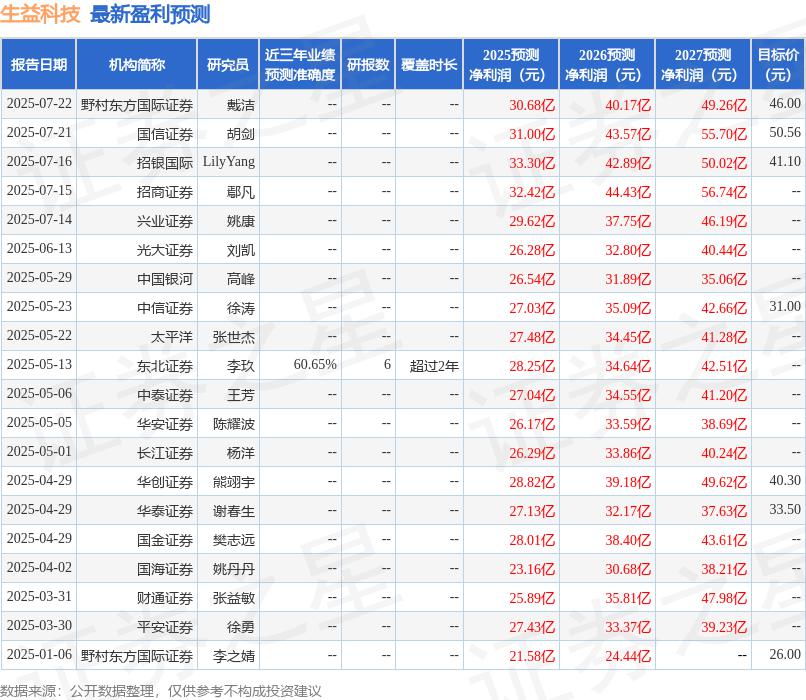
华金证券:给予生益科技增持评级
Zheng Quan Zhi Xing· 2025-07-30 14:32
华金证券股份有限公司熊军,宋鹏近期对生益科技(600183)进行研究并发布了研究报告《AI浪潮下,PCB&覆铜 板业务有望持续增长》,给予生益科技增持评级。 生益科技 投资要点 覆铜板营收增加&子公司生益电子业绩大幅增长,共促公司业绩提升。根据公司2025年半年度业绩预增公告, 2025H1,预计公司实现归母利润14.00亿元-14.50亿元,较去年同期将增长4.68亿元-5.18亿元,同比增长 50%-56%;实现扣除非经常性损益净利润13.50亿元-14.00亿元,较去年同期将增长4.41亿元-4.91亿元,同比增长 49%-54%;2025Q2,预计公司实现归母利润8.36亿元-8.86亿元,环比增长48.38%-57.25%,同比增长 54.77%-64.02%;实现扣除非经常性损益净利润7.90亿元到8.40亿元,环比增长41.26%%-50.20%,同比增长 51.26%-60.83%;2025H1,公司覆铜板销量同比上升,覆铜板产品营业收入增加,同时持续优化产品结构提升毛利 率,推动盈利水平提升。下属子公司生益电子紧抓行业发展机遇,持续优化产品结构、稳步推进产能布局调整, 着力提升高附加值产品占 ...

斯凯蒙太阳能上涨3.4%,报3.95美元/股,总市值1.07亿美元
Jin Rong Jie· 2025-07-30 14:06
Group 1 - The stock price of SkyMoon Solar increased by 3.4% to $3.95 per share, with a total market capitalization of $107 million as of July 30 [1] - For the fiscal year ending September 30, 2024, SkyMoon Solar reported total revenue of $49.864 million, a year-over-year decrease of 1.87% [1] - The net profit attributable to the parent company was $471,000, reflecting a significant year-over-year decline of 57.17% [1] Group 2 - SkyMoon Solar Group Limited is a holding company registered in the Cayman Islands, primarily operating through its domestic subsidiaries [1] - The company designs, develops, manufactures, and sells solar photovoltaic products and solar system solutions through its subsidiaries [1] - Additionally, SkyMoon Solar provides high-performance computing (HPC) products through its indirect wholly-owned subsidiaries [1]

专家:CoWoP对电子布、填料、树脂的影响
2025-07-30 02:32
Summary of Conference Call Notes Industry Overview - The conference call discusses the impact of new technologies on the PCB (Printed Circuit Board) manufacturing industry, particularly focusing on the CoWoP (Chip-on-Wafer-on-Panel) and Carop (Chip-on-Board) processes, which are expected to enhance performance and efficiency in high-performance computing applications, especially for NVIDIA's GPUs and CPUs. Key Points and Arguments 1. New PCB Manufacturing Techniques - NVIDIA's new scheme utilizes embedded substrate materials, increasing the complexity of PCB manufacturing, requiring 1/3 oz copper foil or peelable copper foil [1] - The Carop process eliminates ABF substrates, directly mounting chips on PCBs, which necessitates higher flatness and tighter spacing [2] 2. Material Demand Changes - The demand for Low CTE (Coefficient of Thermal Expansion) electronic cloth has significantly increased due to the larger area of embedded substrates, which is now 3-4 times larger than before [1][5] - The annual demand for Low CTE glass cloth is projected to be around 750,000 square meters, with a monthly increase of approximately 4 million square meters expected to start in 2027 [14][15] 3. Supplier Landscape - Major suppliers of embedded substrate materials include Taiko and Dousan, with specific models like EM526, EM528, EMC892, and EMC896 being highlighted [3][4] - The market is also seeing contributions from Korean companies, although their market share is smaller [4] 4. Technical Specifications and Requirements - The new PCB designs require a minimum of 18 layers of Low CTE electronic cloth for 7 to 9 stage HDI (High-Density Interconnect) technology, doubling the previous requirements [10][11] - The increase in glass cloth layers to 10 is necessary to accommodate complex circuit designs [8] 5. Performance Enhancements - The new scheme is expected to double the computational power due to increased pin counts and improved design methodologies [9] - The transition to higher performance, lower dielectric loss systems is anticipated by 2027, with corresponding increases in PCB area and material requirements [29] 6. Challenges and Future Outlook - The production of high-layer PCBs is challenging due to thickness, small holes, and stringent flatness requirements, which may take years to achieve high yield rates [19] - The new COOP scheme has been researched and applied domestically, with limited international attention [18] 7. Material Composition and Quality - The resin system primarily consists of PPO and hydrocarbon, with increased purity requirements leading to a projected 10% increase in demand [21] - The use of HVLP (High-Volume Low-Pressure) copper foil is critical for meeting the new performance standards [36] 8. Market Trends - The overall demand for Low CTE glass cloth is expected to quadruple as new projects progress, with current monthly demand only in the hundreds of thousands of square meters [16] - The industry is moving towards more advanced materials that meet stringent performance criteria, including low thermal expansion and low shrinkage stress [40] Additional Important Insights - The transition to new technologies is gradual, with major companies like Google, Meta, and Amazon unlikely to adopt these changes in the short term [28] - The expected completion of new projects is projected for late 2026 to 2027, with significant ramp-up in production anticipated thereafter [17]
环球市场动态:中国香港稳定币发行人首批牌照申请在即
citic securities· 2025-07-30 02:13
Market Overview - A-shares continued to rise, with the pharmaceutical and communication sectors leading the market[3] - The Hang Seng Index and the National Enterprises Index fell by 0.15% and 0.34%, respectively, but narrowed their losses in the afternoon[12] - European stock markets rose, with the Stoxx 600 index increasing by 0.43%[10] - U.S. stock markets opened high but closed lower, with the Dow Jones down 204 points or 0.46%[10] Currency and Commodities - Concerns over Trump's pressure on Russia and hopes for a tariff agreement boosted oil prices, with WTI crude rising by 3.75% to $69.21 per barrel[27] - The U.S. dollar index increased by 0.26%, reaching a one-month high of 98.886[27] - Gold prices ended a four-day decline, rising by 0.42% to $3,324 per ounce[27] Fixed Income - U.S. Treasury prices rose, with the 7-year note auction attracting strong demand, yielding 4.092%[31] - Asian bond markets showed slow trading but remained firm, with spreads narrowing by 1-3 basis points[31] Corporate Highlights - Intel's quarterly earnings exceeded expectations, but the company faces challenges due to tariffs and restructuring costs, leading to lower profit guidance[9] - Digital Realty's Q2 performance surpassed market expectations, prompting an upward revision of its annual guidance[9] Regulatory Developments - Hong Kong's Monetary Authority announced the implementation of a regulatory framework for stablecoin issuers starting August 1, with the first licenses expected by year-end[6]



英大证券晨会纪要-20250730
British Securities· 2025-07-30 01:03
Core Viewpoints - The report indicates that the A-share market is expected to exhibit a "slow bull" pattern characterized by structural opportunities, driven by favorable tariff negotiations, continuous policy support, and an overall improvement in liquidity conditions [2][8][10] - The report emphasizes the importance of avoiding high-flying stocks and suggests focusing on low-performing sectors that are likely to rotate, which is a key trend in the current market dynamics [2][9] Market Overview - The A-share market is currently experiencing fluctuations around the 3600-point mark, with no significant signs of weakness despite some index divergence [2][9] - The report notes that the market is likely entering a period of consolidation, with indices expected to oscillate around 3600 points to digest previous pressures [4][8] - Key characteristics of the market include a "weak Shanghai, strong Shenzhen" trend, with the ChiNext index performing particularly well, reaching new highs for the year [8][10] Sector Analysis Pharmaceutical Sector - The pharmaceutical sector, particularly innovative drugs, is highlighted as a growth area, with recent policy changes from the National Medical Insurance Administration expected to support this segment [6][7] - The report suggests that the pharmaceutical sector has significant investment value due to its previous downturn, low price-to-earnings ratios, and the increasing demand driven by an aging population [6] Semiconductor Sector - The semiconductor sector is noted for its strong performance, with government policies supporting the industry and a projected global market growth of over 15% by 2025 [7] - The report encourages investment in the semiconductor sector, particularly in companies that are leading in technology and can adapt quickly to industry changes [7] Trading Strategy - The report advises investors to maintain a rational approach, avoiding blind speculation and focusing on sector rotation, especially in low-performing areas [2][9] - It suggests that investors should consider reducing positions in stocks that have seen significant gains and look for opportunities in sectors that have lagged behind [2][9]