
红利策略

Search documents
招商基金:建议投资者今年应中长期给予股市更多关注
Xin Lang Cai Jing· 2025-07-29 09:49
Core Viewpoint - The recent market sentiment has improved significantly, with the index breaking through 3600 points, supported by policies aimed at stabilizing and enhancing market conditions [1] Group 1: Market Overview - The policy direction continues to support the market, with indicators such as margin trading and new fund issuance showing upward trends, suggesting an acceleration of incremental capital inflow [1] - Short-term market adjustments are expected due to technical needs, but the extent of these adjustments may be limited given the backdrop of increasing capital inflow [1] - The market is likely to experience high-level fluctuations in the short term, with attention needed on volatility risks if sentiment continues to rise [1] Group 2: Long-term Outlook - Domestic policy support and positive developments in industries are expected to sustain upward momentum in the equity market over the medium term [1] - Four main investment themes are recommended for the second half of the year: AI technology (TMT), new consumption (beauty, healthcare, outdoor sports), advanced manufacturing (automotive, smart driving, robotics, military), and resource products (gold, copper, rare earths) [1] - The dividend strategy remains valuable for low-entry positioning [1]
投资红利策略不能只看股息率
雪球· 2025-07-28 07:46
Core Viewpoint - The article discusses the recent surge in dividend rates and the implications for investment strategies, emphasizing that dividend yield should not be the sole basis for investment decisions due to the potential unsustainability of high dividend payouts [3][4][11]. Group 1: Dividend Rate Analysis - There has been a notable increase in dividend rates, with the rolling dividend rates for indices such as the CSI Dividend, CSI Low Volatility Dividend, and CSI Bank Index rising significantly from historical averages of 33.41%, 32.51%, and 26.39% to 48.32%, 49.63%, and 43.08% respectively [11]. - The calculation of dividend rate is defined as the ratio of dividends to net profit, and a method to derive it from price-to-earnings (P/E) and dividend yield is provided [7][12]. Group 2: Sustainability of High Dividend Yields - Relying on increased dividend rates to maintain high dividend yields is questioned, as excessive dividend payouts can hinder a company's reinvestment capabilities and affect long-term profitability [13][14]. - The current high dividend yield levels are attributed to short-term increases in dividend rates, making historical comparisons less relevant [14][15]. Group 3: Importance of Earnings Sustainability - The focus should shift back to the sustainability of earnings as the foundation for dividends, especially since many companies in dividend strategies are in mature stages with low or stagnant growth [17]. - The price-to-earnings (P/E) ratio becomes a critical reference point for evaluating dividend strategies, with current P/E ratios for CSI Dividend and Low Volatility Dividend being at high percentiles compared to historical data [18][19].


基金二季度“含银量”大涨27% 股份行最受欢迎
2 1 Shi Ji Jing Ji Bao Dao· 2025-07-28 04:34
Group 1 - Public funds' total market value of bank stocks reached 205.369 billion yuan by the end of Q2, a 27% increase from Q1 [1][2][3] - The banking sector has shown strong performance this year, with an increase of over 20% in the industry index and 18 stocks hitting historical highs [1][4] - Analysts predict a potential further increase of 60% in bank stocks, driven by favorable fundamentals and market conditions [8][9] Group 2 - By the end of Q2, public funds held a total of 2,917 A-share companies with a market value of approximately 2.5837 trillion yuan, a slight decrease from the previous quarter [2] - The electronic industry had the highest total market value among public fund holdings at about 439.2 billion yuan, followed by several other sectors including banking [2] - Significant increases in holdings were observed in specific banks, with Minsheng Bank seeing the largest increase of 582 million shares [3][4] Group 3 - The banking sector's appeal is attributed to its status as a dividend asset, with ongoing adjustments in asset allocation favoring underweighted sectors [4][8] - Several banks have reported strong earnings, with Ningbo Bank's revenue reaching 37.16 billion yuan and a net profit increase of 8.23% [5][6] - Analysts emphasize that the current market dynamics are shifting, with performance metrics beyond just dividend yield becoming critical for valuation [8]
本周聚焦:银行理财2025H1半年报:存续规模达30.67万亿,母行代销占比降至65%左右
GOLDEN SUN SECURITIES· 2025-07-27 06:56
Investment Rating - The report does not explicitly provide an investment rating for the banking sector Core Insights - The banking wealth management market showed stable growth in the first half of 2025, with a total scale of 30.67 trillion yuan, a year-on-year increase of 7.53% [1] - Cash management products continued to decline, with a scale of 6.4 trillion yuan, down 14.55% year-on-year, attributed to lower deposit rates and regulatory policies [1] - The market share of wealth management companies increased, with 32 companies holding 89.61% of the market by the end of Q2 2025, up 1.8 percentage points from the end of the previous year [2] - The asset allocation in wealth management products shifted, with a decrease in credit bond allocation and a notable increase in public fund allocation, which rose to 4.2% [3] - The average annualized yield of wealth management products was 2.12%, a decrease of 53 basis points compared to 2024, indicating a low-interest-rate environment [4] - The proportion of sales through parent banks has decreased to around 65%, as companies expand their distribution channels [5][8] Summary by Sections 1. Wealth Management Market Overview - As of the end of Q2 2025, the total scale of wealth management products reached 30.67 trillion yuan, with a year-on-year growth of 7.53% [1] - Cash management products saw a significant decline, with a scale of 6.4 trillion yuan, down 14.55% year-on-year [1] 2. Market Structure - The market share of wealth management companies increased to 89.61%, reflecting a concentration of market power among leading firms [2] 3. Asset Allocation - The allocation to credit bonds decreased, while public funds saw a significant increase, indicating a shift in investment strategy [3] 4. Yield Trends - The average annualized yield of wealth management products fell to 2.12%, continuing a downward trend since 2023 [4] 5. Distribution Channels - The share of sales through parent banks has decreased to approximately 65%, as firms diversify their distribution strategies [5][8] 6. Sector Outlook - The banking sector is expected to benefit from policy catalysts, with specific banks like Ningbo Bank, Postal Savings Bank, and others highlighted as potential investment opportunities [9]





港股红利ETF博时(513690)逆市红盘,冲击6连涨,机构:港股红利板块估值仍处历史中低位,具备较高安全边际
Xin Lang Cai Jing· 2025-07-25 03:29
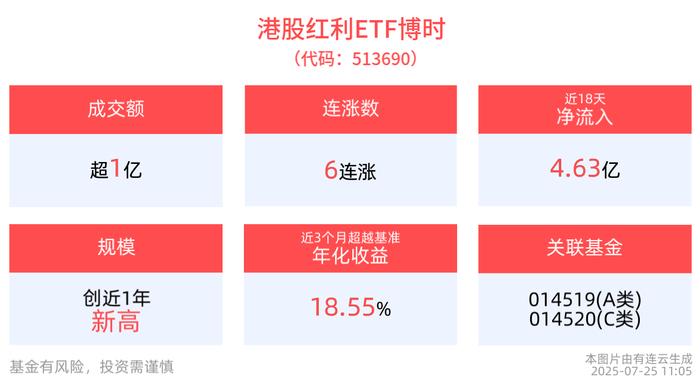
Core Viewpoint - The Hang Seng High Dividend Yield Index (HSSCHKY) has experienced a slight decline of 0.28% as of July 25, 2025, with mixed performance among constituent stocks, indicating a volatile market environment [3] Group 1: Market Performance - China Resources Land (01109) led the gains with an increase of 1.52%, while China Hongqiao (01378) saw the largest decline at 2.27% [3] - The Bosera Hang Seng High Dividend ETF (513690) has risen by 0.09%, marking its sixth consecutive increase, with a latest price of 1.09 yuan [3] - Over the past week, the Bosera ETF has accumulated a rise of 4.63% [3] Group 2: Liquidity and Fund Flow - The Bosera ETF recorded a turnover of 3.56% with a transaction volume of 175 million yuan [3] - The ETF's latest scale reached 4.917 billion yuan, a new high in nearly a year [4] - Despite a recent net outflow of 3.2457 million yuan, the ETF has attracted a total of 463 million yuan over the last 18 trading days [4] Group 3: Investment Strategy and Opportunities - Current valuations in the Hong Kong dividend sector are at historical mid-low levels, providing a high margin of safety, especially amid increasing market volatility [3] - Companies in the communication equipment sector are expected to benefit from the global expansion of AI capital expenditures, particularly with Meta's announcement of two large-scale AI data centers in the U.S. [4] - The ETF's focus on companies with strong cash flow and stable dividend policies offers good dividend return guarantees for investors [3][4] Group 4: Performance Metrics - The Bosera ETF has seen a net value increase of 48.65% over the past two years, ranking 101 out of 2237 index equity funds [5] - The ETF's highest monthly return since inception was 24.18%, with an average monthly return of 4.96% during rising months [5] - As of July 18, 2025, the ETF's Sharpe ratio over the past year was 1.55, indicating strong risk-adjusted returns [5] Group 5: Tracking and Fees - The Bosera ETF has a management fee of 0.50% and a custody fee of 0.10% [7] - The tracking error for the ETF over the past month was 0.048%, demonstrating its close alignment with the HSSCHKY index [8] - The top ten weighted stocks in the HSSCHKY index account for 29.27% of the index, with notable companies including Yancoal Australia (03668) and China Petroleum & Chemical Corporation (00386) [8]
Ta是“躺赢神器”还是“防守备胎”?三季度红利资产还能配吗?
天天基金网· 2025-07-24 11:56
Core Viewpoint - The article discusses the attractiveness of high dividend assets in a low interest rate environment, highlighting the potential for stable cash returns and capital appreciation, while emphasizing the importance of selecting appropriate passive and active investment products [1][2]. Group 1: Low Interest Rate Environment - In the low interest rate era, dividend assets are expected to outperform in the long term, as evidenced by Japan's experience in the 1990s where high dividend indices consistently outperformed the Nikkei 225 by 1.5%-3.4% [2]. - Domestic conditions show that with deposit rates falling below 1% and wealth management returns dropping to 2%-3%, the dividend yield of the CSI Dividend Index at 5.52% makes it an attractive asset allocation choice [2]. Group 2: Support for Dividend Assets - The safety of dividend assets is backed by state support, scarcity of high dividends, and fundamental support from banks and coal sectors [4][5]. - The new "National Nine Articles" enhances dividend regulation and facilitates the entry of insurance and pension funds into the market, aligning with the demand for dividend assets [6]. Group 3: Fundamental Analysis - The CSI Dividend Index's top three sectors by weight are banking (25.6%), coal (15.5%), and transportation (14.0%), with a cumulative return of 19.57% in 2024, primarily driven by banking [7]. - The banking sector maintains a high dividend yield of 5.03%, indicating a long-term advantage despite current performance pressures [7]. - Coal prices have dropped by 8.97% in 2024, but recent policies may improve the supply-demand balance, suggesting potential price stabilization [7]. Group 4: Technical Analysis - Since 2017, the dividend attribute has shifted from "offensive" to "defensive," providing excess returns during market downturns and stability in bull markets [8]. Group 5: Avoiding Dividend Traps - High dividend yield does not equate to high returns; investors should avoid pitfalls such as high payout ratios and low valuation traps, often found in small-cap stocks with volatile earnings [9]. Group 6: Investment Strategy - A "dividend + multi-factor" strategy is recommended, focusing on stable, sustainable dividend-paying companies, particularly state-owned enterprises and those with strong cash flow [10]. - In bear and volatile markets, high dividends provide stable cash flow and reduce drawdowns, while in bull markets, they offer a safety cushion [11][12]. Group 7: Long-term Value of Dividend Assets - The allocation of dividend assets is supported by a combination of policy, funding, and fundamental factors, emphasizing their role in achieving long-term stable growth rather than short-term speculation [13]. - Recommended allocation strategies include core positions in broad dividend indices, satellite positions in actively managed products, and cross-border investments in high-yield Hong Kong stocks [15].

A股市场资金研究系列(四):千亿险资入市背后的四重追问
Ping An Securities· 2025-07-24 09:47
Group 1 - The core driving forces behind the entry of insurance funds into the A-share market include a low interest rate environment, asset-liability mismatch, and new accounting standards that challenge insurers to smooth their financial statements [3][6][12] - The low interest rate environment has made it difficult for insurance companies to generate returns on their asset side, with 10Y and 30Y government bond yields fluctuating below 2% and 2.2% respectively [7][8] - The implementation of IFRS9 has compelled insurers to increase investments in stable, high-dividend stocks, as these assets help mitigate the impact of fair value fluctuations on financial statements [9][10] Group 2 - Policies aimed at facilitating the entry of insurance funds into the market include increasing the equity allocation ratio, optimizing long-term assessments, and establishing pilot projects for long-term stock investments [12][13][14] - The regulatory framework has been adjusted to allow for a higher proportion of equity investments, with the upper limit raised to 50% for certain insurance companies [12][15] - New tools have been created to provide low-cost leverage for insurance funds, enhancing their ability to invest in the capital market [14][15] Group 3 - Insurance funds are increasingly favoring high-dividend blue-chip stocks and long-term equity investments to address asset-liability duration mismatches [8][18] - In Q1 2025, insurance companies increased their stock holdings by approximately 390 billion yuan, with a notable rise in the proportion of OCI (Other Comprehensive Income) investments [18][19] - The trend of passive investment is expanding, with a focus on broad-based ETFs, which have seen a 34.8% increase in holdings by insurance funds compared to 2023 [26][27] Group 4 - There is significant potential for further investment from insurance funds, with an estimated 2.9 trillion yuan of additional capacity to enter the market based on current regulatory limits [29][30] - From a dynamic perspective, the annual incremental investment from four major state-owned insurance companies is projected to be between 347.7 billion and 659.8 billion yuan starting in 2025 [30][34] - The ongoing entry of insurance funds is expected to enhance the stability of the capital market and promote a shift towards institutional and professional investment practices [39][40]
机构:红利资产收益相对较高且稳定,备受市场关注,红利低波100ETF(159307)近2周规模、份额增长显著
Xin Lang Cai Jing· 2025-07-24 06:56
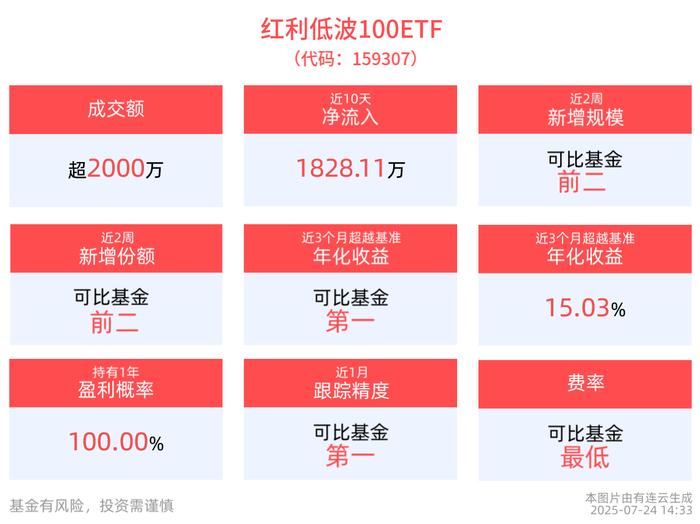
Core Viewpoint - The low volatility dividend strategy is gaining traction among investors due to its relatively high and stable returns in a low-interest-rate environment, making it an attractive investment opportunity [3][4]. Group 1: Market Performance - As of July 24, 2025, the CSI Low Volatility Dividend 100 Index (930955) increased by 0.04%, with notable gains from constituent stocks such as Zhongshan Public Utilities (000685) up 4.26% and Yuyuan Holdings (600655) up 3.64% [3]. - The Low Volatility Dividend 100 ETF (159307) has seen a weekly increase of 2.51% as of July 23, 2025 [3]. - The ETF's trading volume was 22.45 million yuan with a turnover rate of 2.12% [3]. Group 2: Fund Flows and Growth - The Low Volatility Dividend 100 ETF experienced a significant scale increase of 41.67 million yuan over the past two weeks, ranking second among comparable funds [4]. - The ETF's share count grew by 23 million shares in the same period, also ranking second among comparable funds [4]. - The ETF has attracted a total of 18.28 million yuan in net inflows over the last ten trading days [4]. Group 3: Performance Metrics - The Low Volatility Dividend 100 ETF achieved a net value increase of 21.69% over the past year, ranking first among comparable funds [5]. - The ETF's maximum drawdown this year was 6.18%, indicating lower risk compared to its benchmark [5]. - The ETF's Sharpe ratio was 1.13 as of July 18, 2025, ranking it first among comparable funds, indicating high returns for the level of risk taken [5]. Group 4: Fee Structure and Tracking Accuracy - The management fee for the Low Volatility Dividend 100 ETF is 0.15%, and the custody fee is 0.05%, both of which are the lowest among comparable funds [6]. - The ETF has a tracking error of 0.067% over the past month, indicating the highest tracking precision among comparable funds [6]. Group 5: Index Composition - The CSI Low Volatility Dividend 100 Index includes 100 stocks characterized by high liquidity, consistent dividends, high dividend yields, and low volatility [6]. - As of June 30, 2025, the top ten weighted stocks in the index accounted for 20.14% of the total index weight, including companies like Jizhong Energy (000937) and Shanxi Coking Coal (000983) [6].
稳健投资的“新宠”?红利低波ETF(512890)近5个交易日资金净流入4.8亿元
Xin Lang Ji Jin· 2025-07-24 04:12
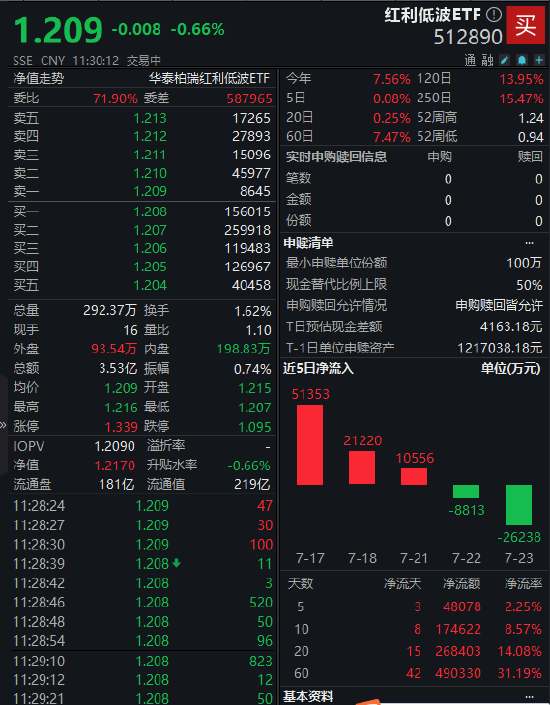
Core Viewpoint - The performance of the Hongli Low Volatility ETF (512890) reflects a resilient investment strategy amid market fluctuations, with significant net inflows indicating investor confidence in the fund's long-term viability [1][3]. Group 1: ETF Performance - On July 24, the Hongli Low Volatility ETF (512890) decreased by 0.66%, with a latest price of 1.209 yuan and a turnover rate of 1.62% [1]. - The ETF recorded a net inflow of 4.8 billion yuan over the past five trading days and 17.46 billion yuan over the past ten trading days [1]. - As of July 23, 2025, the circulating scale of the ETF reached 220.12 billion yuan [1]. Group 2: Market Trends and Strategy - The Hongli Low Volatility Index rose by 6.78% in the second quarter, showcasing the strategy's resilience and adaptability in the current market [3]. - The core logic driving the sustained rise of the dividend strategy in recent years has been the decline in risk-free interest rates, suggesting that the strategy's effectiveness is likely to remain stable unless significant changes occur [3]. - The upcoming earnings disclosure period in the third quarter, combined with external tariff disturbances, may lead to a decrease in risk appetite among investors [4]. Group 3: Investment Opportunities - For investors seeking stable returns and low-risk volatility, the Hongli Low Volatility ETF (512890) and its linked funds (including A Class 007466, C Class 007467, I Class 022678, Y Class 022951) are recommended as viable investment options [4].
二季度公募基金增持银行股 持仓总市值环比增长约27%
Zheng Quan Ri Bao· 2025-07-23 17:06
Core Viewpoint - The banking sector has seen significant inflows from institutional funds, particularly public funds, in 2023, indicating a positive market sentiment towards bank stocks driven by various factors including policy effects and a focus on underweighted sectors [1][3]. Group 1: Fund Inflows and Holdings - As of the end of Q2 2023, public funds' total market value of holdings in bank stocks reached 205.37 billion yuan, a 27% increase from 161.61 billion yuan in Q1 2023 [2]. - China Merchants Bank remains the top holding among public funds, with 966 funds holding shares worth 75.82 billion yuan; other significant holdings include Industrial Bank, Industrial and Commercial Bank of China, and Jiangsu Bank, each exceeding 10 billion yuan in total market value [2]. - Public funds have notably increased their holdings in several national joint-stock banks, with Minsheng Bank seeing the largest increase of 582 million shares, followed by Industrial Bank and CITIC Bank with increases of 332 million shares and 260 million shares, respectively [2]. Group 2: Market Conditions and Strategies - The increase in public fund holdings in bank stocks is attributed to two main factors: the gradual realization of policy effects leading to asset price stabilization and a renewed focus on underweighted sectors following the release of the "Action Plan for Promoting High-Quality Development of Public Funds" in May [3]. - Active equity funds and passive index funds have both increased their holdings in bank stocks, with active equity funds holding 4.87% of bank stocks by the end of Q2 2023, the highest level since Q2 2021, reflecting a significant increase of 1.12 percentage points from Q1 2023 [3]. Group 3: Performance and Outlook - The banking sector index has risen over 18% year-to-date as of July 23, 2023, with some individual stocks showing even greater gains, indicating strong market support for bank stocks [5]. - Analysts believe that the banking sector's valuation is likely to continue recovering, supported by stable market conditions and improving fundamentals, with a focus on the banks' net interest margins and asset quality [5][6]. - The overall stability of core banking operations is expected to support the sector's fundamentals, with positive signals from interest margin and funding costs anticipated to reflect in the sector's revenue performance [6].




