财政赤字

Search documents
炸了!美国数据一出炉,特朗普坐立难安!美专家已发出严厉警告
Sou Hu Cai Jing· 2025-08-04 04:57
Group 1 - The U.S. labor market shows signs of weakness, with non-farm payrolls adding only 73,000 jobs in August, significantly below the expected 110,000, marking the lowest figure since October of the previous year [1] - The Labor Department revised down the job numbers for May and June, reducing them by a total of 258,000 jobs, which contributed to an increase in the unemployment rate from 4.1% to 4.2% [1] - The federal government has been cutting jobs, with 12,000 positions eliminated in July alone, totaling 84,000 job cuts for the year [1] Group 2 - Analysts have noted that the current economic state is characterized by stagnation, with no hiring or layoffs occurring, described as "half-dead" [2] - The significant job cuts in federal agencies, including over 80,000 positions in the Department of Education, have contributed to the employment decline [4] - The cumulative downward revision of non-farm payroll data since 2023 has exceeded 1.7 million jobs, raising concerns about the accuracy of previous employment reports [4] Group 3 - Investor Jim Rogers has expressed extreme pessimism about the U.S. economy, warning of an impending "great crisis" due to the massive national debt [9] - Rogers draws parallels between the current U.S. situation and the historical debt crisis faced by the UK in 1976, emphasizing the importance of debt repayment [9] - He believes the prolonged bull market in U.S. stocks, which has lasted since 2009, is unsustainable and warns of a severe downturn when the market eventually corrects [9] Group 4 - Rogers has shifted his investment focus away from U.S. stocks, holding only stocks from China, which he views as a rapidly rising global power with significant potential, particularly in tourism [8][12] - He highlights the importance of China's Belt and Road Initiative, suggesting it will reshape global economic and political landscapes [8]


赤字危机加剧市场割裂!高盛预警:美债美元承压,美股韧性凸显
Zhi Tong Cai Jing· 2025-07-31 07:09
Core Insights - Goldman Sachs expresses concerns over the sustainability of U.S. debt due to a large fiscal deficit, which is putting pressure on long-term U.S. Treasury bonds and the dollar exchange rate. However, there are signs that the U.S. stock market may continue to rise strongly [1] Economic Outlook - Goldman Sachs' chief economist Jan Hatzius forecasts a year-on-year GDP growth of approximately 1% for the fourth quarter, with a recession risk estimated at 30%, double the historical average. Economic growth is expected to remain slow [2] - Despite minimal price impact from import tariffs so far, core inflation is projected to rise by about 1 percentage point this year, exceeding 3%, which will pressure consumer spending that is already stagnant [2] Fiscal Deficit Impact - The current U.S. budget deficit is around $2 trillion, approximately 6-7% of GDP, at a historical high outside of recession periods. Concerns over the deficit are starting to affect the prices of long-term U.S. government bonds, leading investors to demand higher returns [2][3] - The view on U.S. Treasury bonds as a safe haven asset is being questioned, as their performance has not aligned with expectations in recent months [3] Investment Sentiment - Goldman Sachs' global co-head of banking and markets, Ashok Varadhan, notes that U.S. Treasury yields have risen, making them attractive to private investors, contrasting with the negative real interest rates seen during the global financial crisis to the COVID-19 pandemic [3] - Varadhan anticipates a steepening of the U.S. Treasury yield curve as the Federal Reserve lowers policy rates, raising questions about the adequacy of data to support either minor or significant monetary policy easing [3] Currency and Asset Valuation - Due to fiscal concerns, many investors are becoming more pessimistic about the dollar, with Goldman Sachs predicting further depreciation. However, the U.S. is not alone in facing large budget deficits among developed markets [4] - Varadhan suggests that the value of assets like gold and Bitcoin may rise relative to fiat currencies [4] Stock Market Outlook - Despite rising deficits potentially challenging long-term U.S. Treasury yields, net stimulus measures may boost GDP growth in the short term. Significant investments in artificial intelligence could help maintain corporate earnings resilience [5] - Varadhan remains strongly bullish on the U.S. stock market, emphasizing the importance of regulatory easing and the ability to attract top talent to the labor market for economic growth [5]

一文读懂各类政府债券:国债、特别国债、地方政府债、专项债、一般债、再融资债券的区别和联系
Sou Hu Cai Jing· 2025-07-31 01:33
Group 1 - Bonds are debt securities issued by governments, financial institutions, and corporations to raise funds, promising to pay interest at a certain rate and repay the principal under agreed conditions [1] - The most common types of bonds include fixed-rate bonds, floating-rate bonds, and zero-coupon bonds, which can be traded in the market, forming a bond market [1] - Government bonds are issued to cover government expenditures, invest in public works, and manage fiscal deficits, with investors receiving interest during the holding period and principal at maturity [1] Group 2 - Different types of government bonds include national bonds, special national bonds, ultra-long special national bonds, special bonds, general bonds, and refinancing bonds, each with unique characteristics regarding issuance, purpose, and management [2] - National bonds are issued by the central government to raise fiscal funds, typically to cover deficits or invest in public infrastructure and key projects [3] - Special national bonds are issued for specific policies and purposes, not suitable for ordinary investors, and do not require budget arrangements for repayment [4] Group 3 - Ultra-long special national bonds have a maturity of over 10 years and are used for long-term strategic projects, with a planned issuance scale of 1.3 trillion yuan in 2025 for major strategic implementations and key area security capability construction [5] - Local government bonds are issued by local governments to raise funds for local construction, categorized into general and special bonds, with the latter being used for specific projects with expected returns [6][9] - General bonds are issued to cover public fiscal deficits, while special bonds are for projects with certain returns, repaid through corresponding government fund revenues [9] Group 4 - Refinancing bonds are issued to raise funds for repaying existing debts and adjusting debt structures, with a focus on repaying old debts rather than funding new projects [9][10] - Special refinancing bonds have evolved to allow funds to be used for repaying existing local debts, including hidden debts, thus becoming an important tool for local debt management [10]

美国第二季度GDP年化季率超预期
Sou Hu Cai Jing· 2025-07-30 13:05
Group 1 - The core point of the article is that the U.S. economy showed resilience in the second quarter, with GDP growth rebounding from -0.5% to 3%, surpassing expectations of 2.4% [2] - The ADP employment figures for July also improved significantly, rising from a previous loss of 23,000 jobs to a gain of 104,000 jobs, indicating a strong recovery in the job market [2] - Despite the positive data, there is considerable uncertainty regarding the sustainability of this economic recovery, with potential risks from various factors including trade policies and high federal interest rates [2] Group 2 - The article expresses skepticism about the longevity of the economic rebound, suggesting that the greater risk may be an accelerated economic downturn rather than inflation concerns [2] - The U.S. economy faces significant negative pressures, including high fiscal deficits and increasing debt levels, which could undermine recovery efforts [2] - The possibility of "black swan" events negatively impacting the U.S. economy is acknowledged, adding to the cautious outlook on future economic performance [2]
【环球财经】纽约金价29日小幅收涨 结束“四连跌”
Xin Hua Cai Jing· 2025-07-30 00:54
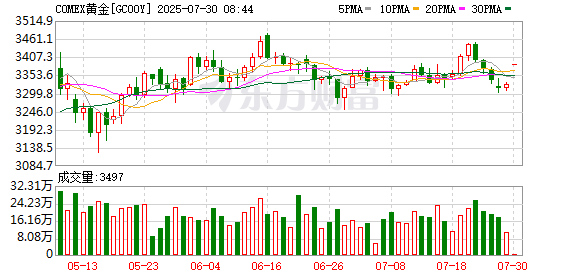
美联储公开市场委员会本月议息会议结果即将于北京时间7月31日凌晨出炉。市场普遍预计美联储本月 将维持基准联邦基金利率区间不变。但市场分析人士表示,美联储任何鸽派信号都可能对金价构成支 撑。且从长期来看,市场分析人士依然看好黄金,并表示随着美联储走向鸽派的道路更加清晰,美元可 能走软,而不断增长的财政赤字也将继续增强黄金作为硬资产的吸引力。 消息面上,美国劳工部29日发布的月度职位空缺和劳动力流动调查(JOLTS)报告显示,美国6月份职 位空缺降至744万个,低于5月份的771万个。经济学家此前预测该数字将降至751万个。 当天9月交割的白银期货价格上涨5.5美分,收于每盎司38.385美元,涨幅为0.14%。 (文章来源:新华财经) 当天原油价格上涨和美国国债收益率小幅下降为黄金提供了支撑,助力金价结束了此前连续四个交易日 的下跌。 由于美国加大对俄罗斯的施压,国际油价29日大幅上涨,布伦特原油和WTI原油双双收高超3%。 不过,由于美国与日本、欧洲达成贸易协定缓解了贸易战担忧,金价近期承压回落,29日盘中一度回踩 测试3300美元关口支撑。市场分析人士认为,在美联储就未来降息提供指引之前,金价可能仍将维持区 ...
IMF:大幅调高中国今年经济增速预期,美国通胀预计将持续高于2%目标水平
Di Yi Cai Jing Zi Xun· 2025-07-29 08:33
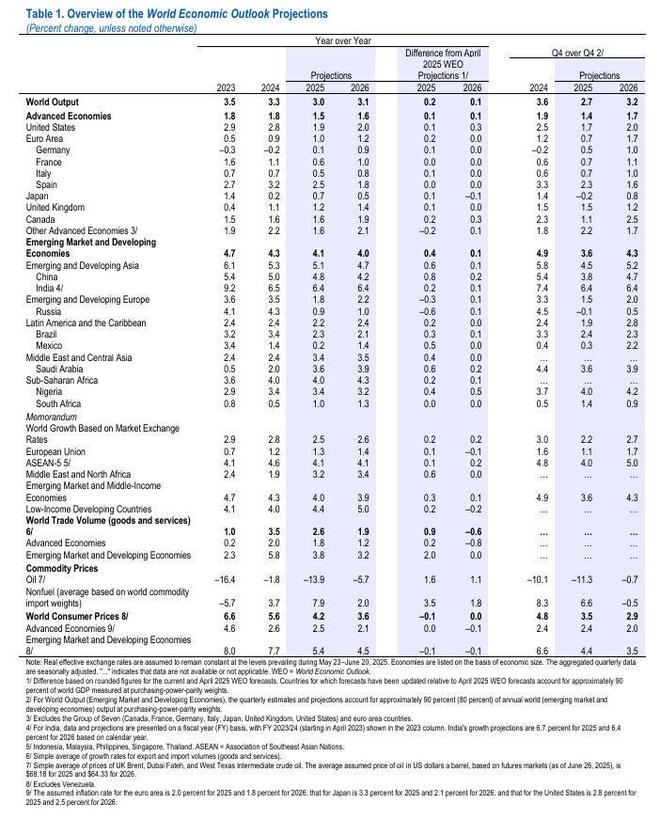
在7月29日发布的最新《世界经济展望》(WEO)报告中,国际货币基金组织(IMF)将全球经济情况 描述为"在持续的不确定性中,保持脆弱的韧性"。 IMF预计2025年全球经济增长率为3.0%,2026年为3.1%,分别比2025年4月WEO的预测调高0.2个和0.1 个百分点。IMF称,这反映出由于加征关税的预期,全球经济活动提前的水平强于此前预期。 此外,IMF预计全球整体通胀率将在2025年降至4.2%,在2026年降至3.6%,与4月预测相似,但各经济 体间的通胀水平仍将存在明显分化,比如IMF预测美国的通胀率将保持在目标水平之上,其他大型经济 体的通胀率则将更低。 IMF建议,全球政策需要通过缓和紧张局势、维护价格和金融稳定、恢复财政缓冲和实施急需的结构性 改革,从而带来信心、可预测性和可持续性。 | 1001 0401 1 091 | | | | | | | | | | | --- | --- | --- | --- | --- | --- | --- | --- | --- | --- | | Difference from April | | | | | | | | 04 over 04 2/ ...
申万期货品种策略日报:贵金属-20250729
Shen Yin Wan Guo Qi Huo· 2025-07-29 05:14
Report Summary 1. Report Industry Investment Rating - No information provided in the given content regarding the industry investment rating. 2. Core View of the Report - With recent progress in trade negotiations, the US dollar index has strengthened, leading to a continuous decline in gold prices. Amid the overall rise and fall of commodities, silver has also corrected. Before the new tariff deadline, there has been a peak in negotiations. After the US reached a trade agreement with Japan and a 15% tariff agreement with the EU (lower than previous expectations), risk aversion has cooled. Trump has been pressuring the Fed to cut interest rates, but the expectation of a July rate cut remains low, and the market is focusing on whether there will be a rate cut in September. The rebound of US CPI has further cooled the short - term rate cut expectation, and the market is watching this week's non - farm payrolls performance. Although US economic data shows that the impact of tariff policies is smaller than feared, the subsequent impact may gradually increase. The implementation of the "Big and Beautiful" bill continues to boost the expectation of the US fiscal deficit, and the People's Bank of China has been continuously increasing its gold holdings. The long - term drivers for gold still provide support, but the high price makes upward movement hesitant. Overall, gold and silver are likely to continue to show a volatile performance [4]. 3. Summary by Related Catalogs Futures Market - **Prices and Changes**: The current prices of沪金2510 and沪金2512 are 770.68 and 772.84 respectively, with price drops of - 4.10 and - 4.16, and declines of - 0.53% and - 0.54%. The current prices of沪银2510 and沪银2512 are 9201.00 and 9218.00 respectively, with price drops of - 11.00 and - 16.00, and declines of - 0.12% and - 0.17%. [2] - **Positions and Volumes**: The positions of沪金2510 and沪金2512 are 209675 and 112653 respectively, and the trading volumes are 256019 and 31873 respectively. The positions of沪银2510 and沪银2512 are 398421 and 210928 respectively, and the trading volumes are 1203307 and 160014 respectively. [2] - **Spot Premiums**: The spot premiums of沪金2510 and沪金2512 are 0.90 and - 1.26 respectively, and those of沪银2510 and沪银2512 are - 15.00 and - 32.00 respectively. [2] Spot Market - **Prices and Changes**: The previous closing prices of Shanghai Gold T + D and London Gold were 771.58 and 764.91 respectively, with price drops of - 2.03 and - 3.94, and declines of - 0.26% and - 0.51%. The previous closing price of London Gold (in dollars per ounce) was 3314.18, with a price drop of - 22.04 and a decline of - 0.66%. The previous closing price of Shanghai Silver T + D was 9186.00, with a price drop of - 186.00 and a decline of - 1.98%. The previous closing price of London Silver (in dollars per ounce) was 38.15, with a price increase of 0.02 and an increase of 0.04%. [2] - **Differences and Ratios**: The current values of沪金2512 - 沪金2510 and沪银2512 - 沪银2510 are 2.16 and 17 respectively. The spot gold - to - silver ratio is 84.00. The ratios of Shanghai Gold to London Gold and Shanghai Silver to London Silver are 7.24 and 7.49 respectively. [2] Inventory - **Changes**: The inventories of Shanghai Futures Exchange gold and COMEX gold remain unchanged at 30,258 kilograms and 38,034,038 respectively. The inventories of Shanghai Futures Exchange silver and COMEX silver have increased by 21,015.00 kilograms and 1375881 respectively. [2] Related Variables - **Index and Yield Changes**: The current values of the US dollar index, Standard & Poor's Index, US Treasury yield, Brent crude oil, and the US dollar - to - RMB exchange rate are 98.6694, 6389.77, 4.42, 69.6, and 7.1835 respectively, with increases of 1.02%, 0.02%, 0.45%, 0.01%, and 0.21% respectively compared to the previous values. [2] Derivatives - **Position Changes**: The positions of spdr gold ETF and SLV silver ETF have increased by 1.00 tons. The net positions of CFTC speculators in silver have increased by 481, while those in gold have decreased by 1451. [2] Market News - **Trade Negotiations**: On July 28 local time, the economic and trade teams of China and the US held economic and trade talks in Stockholm, Sweden, aiming to translate the important consensus of the two heads of state into specific policies and actions, implement the consensus of the Geneva economic and trade talks and the London framework, and promote the healthy development of China - US economic and trade relations. [3] - **Trump's Statements**: Trump may impose a unified tariff of 15% - 20% on imported goods from countries that have not negotiated separate trade agreements with the US. He is also disappointed with Putin and is shortening the 50 - day deadline for Russia and Ukraine to reach an agreement. If no agreement is reached, the US will implement "secondary sanctions". [3] - **US Treasury Borrowing**: The US Treasury has significantly raised its estimate of federal borrowing for this quarter to $1 trillion, mainly due to the impact of the debt ceiling. It now expects the net borrowing from July to September to be $1.01 trillion, up from the April forecast of $554 billion. [3] - **European Central Bank**: European Central Bank hawkish official Kazimir said that the ECB is not in a hurry to lower borrowing costs again. Unless there is a major unexpected economic turn, the reason for action in September is not sufficient. [3]
帮主郑重:新高背后暗流汹涌,超级周定调下半年!
Sou Hu Cai Jing· 2025-07-29 00:24
Group 1 - The U.S. stock market has reached new historical highs, with the S&P 500 hitting 6401 points and the Nasdaq reaching 21202 points, yet the market reaction has been surprisingly calm [1][3] - The recent 15% tariff agreement between the U.S. and EU is perceived as a temporary pause rather than a resolution, with the U.S. benefiting significantly from the deal [3][4] - The S&P 500 has experienced a remarkable V-shaped recovery, gaining 23% in just 89 trading days, resulting in a market capitalization increase of $10 trillion, driven largely by Nvidia's performance [4][6] Group 2 - 83% of S&P 500 companies exceeded earnings expectations in Q2, indicating strong corporate profitability despite economic challenges [4][5] - The forward P/E ratio of the S&P 500 has surged to 23, significantly above historical averages, raising concerns about market complacency and potential risks [5][6] - Major tech companies, including Meta, Microsoft, Amazon, and Apple, are set to report earnings this week, which could significantly influence market sentiment [6][7] Group 3 - The U.S. LNG producers are among the first winners from the U.S.-EU tariff agreement, with stock prices soaring due to a $750 billion energy procurement commitment from the EU [7] - Tesla has secured a $16.5 billion chip contract with Samsung, indicating strong demand for its AI chips and further solidifying its market position [7] - European companies are facing mixed results, with some experiencing sales declines due to retail price wars and rising production costs from tariffs [7]

刚刚!美国财政部,重大决定!
凤凰网财经· 2025-07-27 12:59
Group 1 - The U.S. government has allowed citizens to make voluntary donations to help reduce the national debt through Venmo and PayPal, expanding payment options beyond traditional bank transfers and credit cards [1][2] - As of July 25, the U.S. national debt has reached a record $36.7 trillion, an increase of 87% from $19.59 trillion in 2010 [2] - The donation program, which has been in place since 1996, has raised only $67.3 million, representing a mere 0.0002% of the current national debt [1][2] Group 2 - Concerns about the sustainability of U.S. debt are growing, with hedge fund founder Ray Dalio warning of increasing risks of a fiscal crisis unless urgent policy changes are made [3][4] - Dalio suggests that the U.S. should aim to reduce the federal deficit to 3% of GDP, a level last maintained during the Clinton administration, to stabilize markets and control interest expenses [4] - The recent "Big and Beautiful" tax and spending bill is projected to increase the federal deficit by approximately $3.4 trillion over the next decade, raising concerns about the long-term fiscal outlook [5] Group 3 - The U.S. Congressional Budget Office estimates that the new tax and spending bill will lead to a direct spending reduction of about $1.1 trillion and a revenue decline of approximately $4.5 trillion, exacerbating the fiscal deficit [5] - Fitch Ratings has downgraded the outlook for 25% of U.S. industries to "negative," citing increased uncertainty and anticipated prolonged high interest rates [5] - The U.S. stock market has reached new highs, but there are concerns about the sustainability of this growth due to excessive liquidity from the Federal Reserve and the Treasury, which may lead to a market correction [6]

刚刚!美国财政部,重大决定!
券商中国· 2025-07-27 08:00
Core Viewpoint - The U.S. government is allowing citizens to make voluntary donations through Venmo and PayPal to help reduce the national debt, which has reached a record $36.7 trillion, amid growing concerns about debt sustainability [2][6]. Group 1: National Debt and Donation Program - As of July 25, the U.S. national debt has surged to $36.7 trillion, a significant increase of 87% from $19.59 trillion in 2010 [6]. - The donation program, named "Gifts to Reduce the Public Debt," has been in existence since 1996 but has only raised $67.3 million, which is a mere 0.0002% of the current national debt [3][6]. - The expansion of payment options to include popular P2P platforms aims to lower the operational threshold for small donations [6][7]. Group 2: Concerns Over Debt Sustainability - There is increasing market concern regarding the sustainability of U.S. debt, with hedge fund founder Ray Dalio warning of a growing risk of a fiscal crisis unless urgent policy changes are made [4][8]. - Dalio suggests that the U.S. is approaching a critical point where it may need to issue new debt just to pay interest on existing debt, potentially leading to systemic collapse [8]. - The U.S. Treasury's decision to promote public donations has been met with skepticism regarding its effectiveness in addressing the substantial fiscal deficit [7]. Group 3: Legislative Impact on Fiscal Policy - The "Big and Beautiful" tax and spending bill signed by President Trump is projected to increase the fiscal deficit by approximately $3.4 trillion over the next decade [10]. - The Congressional Budget Office estimates that this legislation will lead to a direct spending reduction of about $1.1 trillion and a revenue decline of approximately $4.5 trillion [10]. - Rating agency Fitch has downgraded the outlook for U.S. credit due to increased policy risks, projecting that the debt-to-GDP ratio could rise to 135% by 2029 [12]. Group 4: Market Implications - The increase in fiscal deficit is expected to exacerbate concerns about the sustainability of U.S. debt, with potential implications for high-yield bonds and leveraged loans [12]. - Recent market research indicates that the liquidity provided by the Federal Reserve and the Treasury has significantly influenced stock market valuations, raising questions about the sustainability of these high valuations [12][13]. - The disconnect between stock market valuations and productivity growth is attributed to liquidity distortions rather than fundamental economic strength, suggesting potential risks for risk assets in the near term [13].