高端制造

Search documents
A股:新股元创股份公布中签结果,中签号码有3.92万个,股民中签难于上青天!
Sou Hu Cai Jing· 2025-12-11 01:28
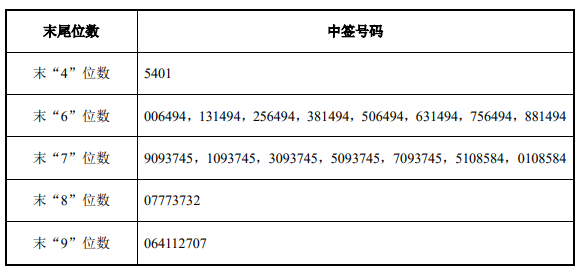
Group 1 - The core viewpoint of the news highlights the challenges faced by retail investors in the current IPO market, where the chances of winning a lottery for new shares are extremely low despite the strong performance of new stocks on their debut [1][3]. - The recent IPO of Yuan Chuang Co., Ltd. saw a total of 39,200 winning numbers, with each winning number allowing the purchase of 500 shares, indicating a high level of interest from retail investors [1][3]. - The overall market is experiencing a strong upward trend, with the index reaching 3,900 points, contributing to the significant gains seen in new stocks, although many retail investors feel excluded from these opportunities due to the concentration of capital among institutional investors [3][4]. Group 2 - The stock market is characterized by extreme polarization, where over 80% of trading volume is concentrated in about 50 "star stocks," leading to a misleading perception of market stability for ordinary retail investors [4]. - The dominance of quantitative trading and AI-driven strategies has created a challenging environment for human investors, who struggle to compete against algorithms that operate without emotional biases and react in milliseconds [6]. - In this new market ecosystem, the focus for ordinary investors should shift from trying to outperform the market to learning how to navigate trends with discipline and strategic asset allocation [6].

A股延续结构性行情 海南自贸港与地产板块领涨
Shang Hai Zheng Quan Bao· 2025-12-10 17:57
◎记者 徐蔚 12月10日,A股市场呈现指数分化的结构性走势。截至收盘,上证指数微跌0.23%,报3900.50点,险守 3900点整数关口;深证成指午后翻红,逆势上涨0.29%,报13316.42点;创业板指微跌0.02%,报 3209.00点。全市场成交额为1.79万亿元,较前一个交易日缩量1260亿元,超2400只个股上涨,板块轮动 特征显著。 中银证券研报表示:基本面承压叠加"十五五"规划建议表态偏向积极,未来地产优化政策落地的空间打 开。对未来地产行业的修复有一定信心。从地产标的来看,一方面,流动性安全、重仓高能级城市、产 品力突出的房企或更具备α属性;另一方面,在新消费时代下,提前布局新业态、新模式、新场景的商 业地产公司,有望率先走出重围。 此外,零售板块延续强势表现,永辉超市、中央商场、茂业商业等多只个股涨停。消息面上,全国零售 业创新发展大会12月9日至10日在北京举行。商务部副部长盛秋平表示,"十五五"时期,要把零售业作 为培育完整内需体系、做强国内大循环的关键着力点,推动行业转向品质驱动、服务驱动,实现高质量 发展。 数据显示,"十四五"以来,零售业对促进消费和投资的贡献巨大。2024年 ...

“设备+材料”双轮驱动,欧克科技开辟高端制造第二曲线
Zheng Quan Shi Bao Wang· 2025-12-10 08:51
Core Viewpoint - Ok Technology (001223.SZ) demonstrates strong confidence in its "Equipment + Materials" strategy, showcasing rapid advancement and broad prospects in solid-state batteries and lithium battery equipment, while emphasizing the importance of investor rights and core value creation [1] Group 1: Financial Performance - In the first three quarters of 2025, the company achieved revenue of 737 million yuan, a year-on-year increase of 128.5% [1] - The net profit excluding non-recurring items reached 85.01 million yuan, reflecting a year-on-year growth of 902.34%, indicating robust growth momentum [1] Group 2: Product Development - The company has established a business structure covering three core products: intelligent equipment for household paper, film materials, and intelligent equipment for new energy lithium batteries, facilitating a transformation from a paper equipment manufacturer to a high-tech enterprise [1] - Through its subsidiary Jiangxi Youze New Materials, the company has entered the high-performance polyimide film (PI film) market, which is essential for flexible electronics, new energy batteries, and semiconductor packaging [2] - Research indicates that PI films can significantly enhance the stability and energy density of solid-state batteries, achieving energy densities of up to 300 Wh/kg, surpassing traditional lithium-ion batteries [2] Group 3: Industry Position and Future Outlook - The company has successfully developed a series of new energy equipment, including wet and dry lithium battery separator equipment, laying a solid foundation for its deep involvement in the lithium battery industry chain [2] - The management has confirmed that solid-state battery equipment has been produced and is undergoing customer validation, positioning the company to benefit from the growing demand for energy storage driven by the dual carbon transition [2] - The company has initiated a 1.5 billion yuan industry fund with partners to support its strategic development and enhance its competitive edge in high-end intelligent equipment and new materials [3] - With the dual drive of "Equipment + Materials" and the capital empowerment from industry funds, the company aims to deepen its core business and continuously create value for investors [3]
邵阳液压(301079.SZ):拟购买新承航锐100%股份
Ge Long Hui A P P· 2025-12-09 13:22
Core Viewpoint - Shaoyang Hydraulic (301079.SZ) plans to acquire 100% equity of Xincheng Hangrui from 33 shareholders through a combination of share issuance and cash payment, with a transaction price of 600 million yuan, excluding the amount for raising matching funds [1] Group 1: Acquisition Details - The acquisition involves issuing shares and cash to shareholders, with a total transaction price of 600 million yuan [1] - The company will also issue shares to no more than 35 specific investors to raise matching funds [1] Group 2: Target Company Overview - The target company specializes in the R&D, production, and sales of metal forgings and castings, recognized as a high-tech enterprise [1] - Its main products include various types of free forgings, ring forgings, die forgings, and castings, which are widely used in energy, aviation, aerospace, and shipping industries [1] Group 3: Strategic Implications - This transaction marks a significant step for the company in the high-end manufacturing and core component sector, expanding its product range in high-end manufacturing [1] - The acquisition enhances the company's strategic layout in the high-end manufacturing industry, aligning with its development strategy [1]
上海市国际股权投资基金协会唐葵:PE机构需强化全周期赋能能力
Zhong Guo Jing Ying Bao· 2025-12-09 08:39
Core Insights - The 18th Shanghai International Private Equity Forum (2025SIPEF) highlighted the active state of China's M&A market driven by policy support, industry consolidation, a slowdown in IPO exits, and globalization efforts [1] - Private equity (PE) firms are encouraged to enhance their full-cycle empowerment capabilities to address governance and operational challenges posed by controlling transactions [1] - Future PE mergers and acquisitions will focus on deepening collaboration across the industrial chain, fostering technological innovation, and expanding global presence [1] Investment Opportunities - The Shanghai International Private Equity Fund Association released a list of the "Top 50 Most Investable Startups in Shanghai for 2025," showcasing companies in cutting-edge fields such as artificial intelligence, life sciences, high-end manufacturing, and digital economy [1] - The selection process involved multiple rounds of screening and professional evaluation, emphasizing startups with core technologies, innovative models, and high growth potential [1] - This list serves as a precise investment guide for private equity firms and signals the strong vitality and immense potential of Shanghai's technological innovation landscape [1]
火热的科技行情下,还有没有被低估的标的?
Zhong Guo Ji Jin Bao· 2025-12-09 00:39
在全球科技叙事持续的背景下,A股科技板块继续震荡上涨,中证TMT指数2025年以来涨幅达36.95%,而随着行情的快速攀升,相关领域的 估值已处于历史中高水平,投资者难免有些"恐高"情绪。 截至2025年11月18日。中证TMT指数2020-2024年、2025年上半年涨跌幅依次为14.03%、3.69%、-30.86%、3.54%、18.83%、4.29%。指数数 据仅供参考,不作为任何投资建议或收益暗示。指数过往涨幅不预示其未来表现,也不代表跟踪该指数的指数基金未来业绩。 那么,当下投资科技创新领域,还有哪些估值相对合理、性价比较高的选择?创业板综合指数是值得关注的标的之一,当前PE(TTM)为 66.07倍,低于近10年72倍左右的平均值,仍处于近10年56%左右的分位水平。 截至2025年11月18日。 提及创业板市场,除了投资者熟知的创业板指、创业板50指数,其实创业板综合指数也是核心指数之一,且对创业板具有更广泛的覆盖面和 更全面的代表性。目前,创业板综合指数的成份股、总市值为1344只、17.17万亿元,分别占创业板市场的97%、99%。 截至2025年11月18日。 从多方面来看,创业板综合指 ...
大摩闭门会:前瞻经济会议,布局老登新登
2025-12-08 15:37
大摩闭门会:邢自强、Laura Wang:前瞻经济会议,布 局老登新登 251208_原文 2025 年 12 月 08 日 12:23 发言人 00:04 54321。大家上午好,欢迎来到 1 周一度的大摩宏观策略谈,我是 Robin 邢自强。正好在北京出差,恰逢 这个礼拜会召开政治局会议和中央经济工作会议。所以这几周大家也注意到了,我们也是频繁的在北京往 返,甚至过周末,参与了一些体制内和体制外对于经济工作会议的座谈会约解读。所以今天的主题也是前 瞻经济工作会议布局新登老登股票。我会简短一点抛砖引玉。 发言人 00:48 我们的首席策略是 lara 和经济学家监利坐镇香港,在和我们覆盖新的 AI 产业的硬件的差异,会来判断现在 关于中美的 AI 泡沫之争对于投资股票的影响。我们覆盖一些老的板块,但最近也是重新焕发青春的。比如 说保险这些行业的分析师 rick,他也是我们非常优秀的年轻的冉冉身体的明星分析师,也会给大家带来这 些老灯值得配置的原因。我想今年 25 年大部分的投资者已经接近收官了。现在反复问我们的不外乎就是最 后一个会议,中央经济工作会议的政策定调,对一些地产的政策促进,消费政策的落地节奏的判 ...

南方基金:震荡中的信号:是迷雾还是曙光?
Sou Hu Cai Jing· 2025-12-08 02:25
回顾11月,全球市场在中美贸易会晤预期升温、美联储降息预期反复、AI泡沫担忧加剧等多重扰动下 震荡加剧。 这些信号,让不少朋友开始疑惑:当前市场是在酝酿风险,还是在积蓄动能? 今天,局长就带大家拆解这些"矛盾"背后的逻辑,并聊聊如何在震荡中保持定力。 一、市场为何总要"蹲下"震荡? 市场并非总是一路上扬,"蹲下"震荡实属常态,是消化浮筹、积蓄新动能的过程。 回顾历史,无论是2014年还是2019年,在大的趋势行情启动前,市场都经历过类似的"中场休息"。 2014年7月至11月,沪指在2000-2200点区间横盘近三个月。期间经济数据低迷与改革预期交织,直至11 月21日央行降息为市场注入强心针,开启了一轮波澜壮阔的牛市。 2019年初,市场在中美贸易摩擦与资本市场改革预期中震荡两个月,最终在政策支持与外部缓和下走出 震荡,迎来科技主线崛起。 当前,上证指数在关键点位反复博弈,可视为四中全会后"政策真空期"的蓄势。许多投资者感觉"热点 轮动比翻书还快",这恰恰是震荡市的典型特征——缺乏清晰单一的主线,资金在各板块间试探。从历 史经验看,这种震荡往往在为下一次风格选择做准备。 但需注意,当前经济修复路径与产业格局 ...
公募跨年布局各有“心思” 翻倍基净值波动普遍收窄
Zheng Quan Shi Bao· 2025-12-07 19:08
Group 1 - The core viewpoint of the articles highlights the mixed strategies of public funds as they approach year-end, with some aiming to preserve gains while others seek to boost performance in the limited time remaining [1][3][5] - As of December 5, 22 actively managed equity funds have achieved over 100% annual returns, with the top performer, Yongying Technology Smart A, boasting a return of 202.13% [2][3] - The performance gap between the top funds is significant, with Yongying Technology Smart A outperforming the second-place fund by over 50 percentage points, indicating a competitive landscape for year-end rankings [3][4] Group 2 - The difficulty of achieving additional gains as year-end approaches is emphasized, with market volatility and liquidity concerns being key factors [5][6] - Recent market trends show a shift from high-growth stocks to a focus on valuation and profit quality, influenced by institutional investment patterns [6][7] - The upcoming policy meetings in December are expected to be critical for market movements, with historical data suggesting price fluctuations around these events [7][8] Group 3 - The market is experiencing structural differentiation, with sectors like artificial intelligence, semiconductor equipment, and lithium resources performing well, while traditional real estate and consumer sectors lag [8] - Analysts suggest that the growth trend has room for expansion, but structural shifts and increased volatility are anticipated, with a potential focus on new investment opportunities in the energy and chemical sectors [8]
一周快讯丨广州天使母基金招GP;300亿,北京智算并购基金完成注册;首期15亿,国泰海通中际旭创产业基金完成备案
FOFWEEKLY· 2025-12-07 05:59
Group 1 - Multiple mother funds have been established or announced in regions such as Guangdong, Hubei, Hunan, Fujian, and Zhejiang, focusing on sectors like artificial intelligence, low-altitude economy, biomedicine, semiconductors, and high-end manufacturing [2] - The Fujian (Xiamen) Social Security Science and Technology Innovation Fund has signed and launched with an initial scale of 20 billion [3][12] - The Guangzhou Angel Mother Fund aims for a target scale of 10 billion, focusing on key technology innovation areas and supporting emerging industries in Guangzhou [4] Group 2 - The Wuhan Hongshan District Government Investment Fund has expanded to 10 billion, emphasizing early-stage investments in hard technology sectors [5][6] - The Changsha Wangcheng Mother Fund has announced the selection of sub-fund management institutions, with a total scale of 5 billion [7][8] - The Ningbo Low-altitude Economy Fund has been established with a total scale of 1 billion, focusing on the low-altitude safety industry chain [11] Group 3 - The Beijing Jingguochuang Smart Computing M&A Fund has been registered with a scale of 30 billion, primarily funded by Beijing Guoguan [13] - The Shanghai Smart Computing Leading Private Fund has been established with a scale of approximately 5.04 billion [14] - Three new quality productivity M&A funds in Fujian have been launched, with a target scale of 2.5 billion [15] Group 4 - The Southern Power Grid Industrial Fund has been established with a total scale of 14 billion, focusing on new power system construction [16][17] - The Guotai Junan Zhongji Xuchuang Industrial Fund has completed registration with an initial scale of 1.5 billion, targeting AI infrastructure and applications [18] - The Zhejiang Intelligent Ship Fund has been established with a total scale of 500 million, aimed at promoting the intelligent transformation of the shipbuilding industry [19] Group 5 - The Hefei Jiantou Zhongying Fuyun Equity Investment Fund has been signed, with a scale of 1 billion, marking the first AIC fund in Anhui [20] - The Shaanxi Lituo Xinxin Technology Innovation Fund has been approved as a QFLP pilot fund with a scale of 185 million [21] - The Suqian Kaichuang Runxin M&A Fund has been registered with a scale of 2 billion, focusing on quality real estate and infrastructure projects [22] Group 6 - The Hohhot Biomedicine Industry High-Quality Development Fund has been established with an initial scale of 500 million, focusing on high-tech achievements in biomedicine [23] - The Fudan University Overseas Investment Fund has been launched with a target scale of 100 million USD, aimed at supporting early-stage projects in various innovative fields [24][26] - The South Pole Electric Commerce Co., Ltd. plans to invest up to 50 million in a new equity investment partnership [27] Group 7 - Four private equity investment institutions have successfully issued a second batch of science and technology innovation bonds, totaling approximately 930 million [28]