
资产荒

Search documents
两市成交额破3万亿,三大指数继续“狂飙”
Huan Qiu Lao Hu Cai Jing· 2025-08-25 09:52
Group 1 - The trading volume in the Shanghai and Shenzhen markets exceeded 3 trillion yuan, reaching 3.14 trillion yuan, marking the second highest record after 3.45 trillion yuan on October 8, 2024 [1] - A-shares have seen a continuous increase in trading volume, with over 1 trillion yuan for 63 consecutive trading days and above 2 trillion yuan for 9 consecutive days, setting historical records [1] - Major A-share indices rose significantly, with the Shanghai Composite Index up 1.51% to 3883.56 points, a cumulative increase of over 25% since the low in April, approaching the 4000-point mark [1] Group 2 - There is a notable shift in asset allocation among residents, with a decrease in bank deposits and an increase in non-bank financial institution deposits, indicating a movement of funds from traditional savings to capital markets [2] - The number of new A-share accounts opened in July reached 1.9636 million, a nearly 71% increase year-on-year, reflecting strong interest from new investors [2] - Institutional investors are also increasing their participation, with a significant rise in their allocation to ETF and index-enhanced funds, contributing to the market's upward momentum [2] Group 3 - The A-share market is benefiting from multiple favorable factors, including ongoing capital market reforms, a slowdown in IPOs, and a tightening of refinancing, which collectively reduce market burdens [3] - Monetary policy remains accommodative, with continued foreign capital inflows providing ample liquidity to the market [3] - The improvement in the mid-year performance of listed companies, particularly in technology and consumer sectors, supports the ongoing market rally [3]
高股息和科技成长双管齐下 “哑铃策略”或仍适配当下行情
Cai Fu Zai Xian· 2025-08-25 05:20
Core Viewpoint - The Shanghai Composite Index has reached a 10-year high, closing at 3825.76 points on August 22, raising concerns about market overheating and sustainability of the rally [1] Group 1: Market Trends - The insurance capital has been actively increasing its stake in the market, with nearly 30 instances of stake increases recorded in 2025, the highest in four years [1] - The focus of these investments is primarily on low-valuation, high-dividend sectors such as banking, public utilities, and energy [1] - The ongoing low interest rate environment and "asset shortage" are driving funds towards high-dividend stocks, particularly in the banking sector [1] Group 2: Investment Strategies - A "barbell" investment strategy is recommended for ordinary investors, balancing low-volatility, high-dividend sectors with high-growth technology sectors [2] - The Huian Zhongzheng Dividend Low Volatility 100 Index Fund is being launched, which tracks a diversified index focused on low volatility and high dividend yield [2] - The index includes stocks from 23 primary industries, mainly concentrated in banking, transportation, and coal, providing a solid equity base for investors [2] Group 3: Fund Performance - Huian Fund offers several high-performing products to help investors capitalize on market trends, including funds focused on AI and technology micro-cap stocks [3] - The Huian Growth Preferred Mixed Fund has received five-star ratings from both China Merchants Securities and Guotai Junan Securities, focusing on AI-related assets [4] - The Huian Multi-Factor Mixed Fund utilizes a quantitative investment approach combined with active equity research to adapt to current market styles and future industry trends [4]
科技主题行情持续扩散,双创龙头ETF(159603)涨超3%,科创综指ETF天弘(589860)涨超2%,创业板ETF天弘(159977)涨超1.7%
2 1 Shi Ji Jing Ji Bao Dao· 2025-08-25 02:45
Group 1 - A-shares main indices showed strong performance with technology themes expanding, highlighted by significant gains in popular ETFs such as the Double Innovation Leader ETF (159603) and the Sci-Tech Comprehensive Index ETF Tianhong (589860) [1] - The Double Innovation Leader ETF (159603) closely tracks the CSI Innovation and Entrepreneurship 50 Index, which selects 50 large-cap emerging industry companies from the Sci-Tech and Growth Enterprise boards, reflecting the overall performance of representative emerging industry stocks [1] - The Sci-Tech Comprehensive Index ETF Tianhong (589860) tracks the Sci-Tech Comprehensive Index, covering approximately 97% of the Sci-Tech board's market capitalization, with a focus on small-cap hard technology companies, showcasing strong growth attributes [1] Group 2 - The Growth Enterprise Board ETF Tianhong (159977) tracks the Growth Enterprise Board Index, which consists of 100 representative companies, reflecting the operational status of the Growth Enterprise market with a high proportion of emerging industries and high-tech enterprises [2] - Federal Reserve Chairman Jerome Powell indicated a potential shift towards interest rate cuts, suggesting that current conditions may require policy adjustments due to risks in employment growth [2] - Market expectations for a September rate cut have increased significantly following Powell's remarks, with a focus on the sustainability of incremental capital sources as a key factor for market performance [2] Group 3 - Financing balances have exceeded 2 trillion, reaching a historical high, with insurance funds continuing to increase holdings in financial stocks, indicating a positive market sentiment and the entry of incremental capital [3] - The initial phase of an "innovation bull market" is expected to extend towards financial sectors and technology industries, particularly in robotics, computing power, and innovative pharmaceuticals [3]

国泰海通:业绩增长与增量资金入市共振 继续看好非银板块
智通财经网· 2025-08-25 01:49
Group 1 - The core viewpoint is that the non-bank sector is expected to see significant investment opportunities due to high growth in performance and increased capital inflow from residents [1] - The insurance sector is projected to continue its growth in the first half of 2025, driven by a decrease in preset interest rates and improved value rates due to the integration of reporting [1] - Consumer finance companies have shown high growth in performance in the first half of the year, supported by a rapid decline in funding costs, indicating strong investment opportunities in this sector [1] Group 2 - The average daily trading volume of stock funds reached 28,700 billion yuan this week, up from 23,842 billion yuan previously, with a year-on-year increase of 81.96% [2] - As of August 22, 2025, the underwriting scale for IPOs and private placements reached 7,386.12 billion yuan, while corporate bonds and convertible bonds financing scales were 145.91 billion yuan and 338.27 billion yuan respectively [2] - The balance of margin financing and securities lending reached 21,468 billion yuan as of August 21, 2025, with a financing balance of 21,320 billion yuan [2] Group 3 - The insurance industry reported a total premium income of 37,350 billion yuan for the first half of 2025, reflecting a year-on-year growth of 5.3% [3] - The total assets of the insurance industry reached 39.22 trillion yuan, with a growth rate of 9.23% compared to the beginning of the year [3] - The net assets of the insurance industry increased to 3.75 trillion yuan, showing a growth rate of 12.91% since the beginning of the year [3]

中金:存款搬家如何影响A股表现?
中金点睛· 2025-08-25 00:27
Core Viewpoint - The article discusses the emerging trend of "deposit migration" among residents in China, which is contributing to increased activity in the A-share market, as evidenced by the recent rise in the Shanghai Composite Index and trading volumes [2][3]. Summary by Sections Deposit Migration Trends - Recent data indicates that from 2022 to 2024, residents' cumulative new deposits reached 48.7 trillion yuan, with a 47.6% increase in savings deposits, outpacing nominal GDP growth [2]. - In July, there was a year-on-year decrease of 0.8 trillion yuan in new resident deposits, while non-bank financial institutions saw an increase of 1.4 trillion yuan, reflecting a shift in deposit preferences [2]. - The growth rate of household demand deposits has rebounded to 6.8% as of July 2025, while time deposit growth has declined from 14.9% to 11.5% [2]. Reasons for Deposit Migration - The macro liquidity environment is relatively loose, with the 10-year government bond yield below 1.8% and the 1-year LPR at 3%, making traditional savings less attractive [3]. - The A-share market has become more appealing due to a lack of high-yield investment options, with the dividend yield of A-shares remaining significantly higher than that of 10-year government bonds [3]. - The market has shown signs of recovery, with the total return of the Wind All A Index exceeding various cost lines, indicating a positive earning effect that attracts new investors [3]. Historical Performance During Deposit Migration - Historically, periods of deposit migration have correlated with upward trends in the A-share market, as seen in 2009 and 2014-2015 [4]. - Specific sectors tend to outperform during these periods, such as technology and non-bank financials, driven by macroeconomic trends and policy support [4]. - The article notes that deposit migration often occurs after a market rally, highlighting the importance of earning effects in driving investor behavior [4]. Future Outlook - The trend of deposit migration is expected to continue, with potential funds available for market entry estimated between 5 to 7 trillion yuan [5]. - The article suggests focusing on sectors with high growth potential and performance validation, such as AI, innovative pharmaceuticals, and military industries, as well as financial services that benefit from increased market activity [5].


兴业期货日度策略-20250821
Xing Ye Qi Huo· 2025-08-21 12:46
1. Report Industry Investment Ratings - Bullish: Equity Index [2] - Cautiously Bearish: Treasury Bonds, Coke, Coking Coal, Carbonate Lithium [2][7] - Bearish: Iron Ore, Rebar, Hot - Rolled Coil, Soda Ash, Float Glass, Crude Oil [6][7] - Bullish: Rubber [8] - Sideways: Gold, Copper, Aluminum, Alumina, Nickel, Industrial Silicon, Polysilicon, Methanol, Polyolefins, Cotton [5][8] 2. Core Views - The equity index is on an upward trend with continuous inflow of funds and clear long - term narratives, so a long - position strategy should be maintained [2]. - The bond market is under pressure due to the strong stock market and lack of new positive factors [2]. - Soda ash is in an oversupply situation, and short - position strategies are recommended [7]. - Rubber's fundamentals are improving, and long - position strategies should be continued [3][8]. - Gold is in a high - level sideways pattern, and attention should be paid to the Fed's interest - rate decisions [5]. - Silver maintains a long - position pattern, and the Fed's interest - rate decisions are the focus [5]. - Copper prices are supported in the medium - to long - term by tight mine supply, and short - term attention should be paid to the Fed's monetary policy [5]. - Aluminum and alumina prices are in a sideways pattern, with limited downward space for alumina and clear medium - term support for aluminum [5]. - Nickel prices are in a narrow - range sideways pattern, and selling call options is recommended [5]. - Carbonate lithium supply is abundant, and prices are under pressure [6]. - Polysilicon prices may decline due to the need for market - oriented elimination of backward production capacity [6]. - Rebar prices are under pressure, and selling out - of - the - money call options is recommended [6]. - Hot - rolled coil prices are expected to be sideways, and attention should be paid to the spread between hot - rolled coil and rebar and molten iron transfer [6]. - Iron ore prices are under pressure in the short term, and the 01 contract is expected to trade in the range of [750, 810] [6]. - Coke prices are mainly sideways, and coking coal prices are under pressure [7]. - Float glass prices are under downward pressure, and short - position strategies for near - term contracts are recommended [7]. - Crude oil prices are relatively resilient, and previous short positions can be gradually closed if there are no further negative factors [7]. - Methanol prices may continue to rebound if the arrival volume does not increase significantly [8]. - The L - PP spread is expected to continue to widen [8]. - Cotton demand is weak currently, and the market is waiting for the peak season [8]. 3. Summary by Related Catalogs Financial Futures - **Equity Index**: The Shanghai Composite Index hit a ten - year high, and the bullish sentiment is rising. With continuous capital inflow and clear long - term narratives, the upward trend is clear, and long positions should be held [2]. - **Treasury Bonds**: The bond market is weak, affected by the strong stock market. Without new positive factors, the bearish pattern continues [2]. Commodity Futures - **Soda Ash**: The industry has an oversupply situation. With the possible commissioning of new devices, supply pressure will increase, and previous short positions in SA601 should be held [3][7]. - **Rubber**: The fundamentals are improving, with stable demand and slow raw - material production increase. Long positions in RU2601 should be held [3][8]. - **Precious Metals** - **Gold**: Prices are in a high - level sideways pattern. The Fed's interest - rate decisions and the speech at the Jackson Hole Symposium are key factors [5]. - **Silver**: Maintains a long - position pattern, and the Fed's interest - rate decisions are the focus [5]. - **Non - Ferrous Metals** - **Copper**: Supply is tight in the medium - to long - term, and short - term attention should be paid to the Fed's monetary policy and the US dollar trend [5]. - **Aluminum and Alumina**: Alumina has an overcapacity situation but low valuation, and aluminum has clear medium - term support. Both are in a sideways pattern [5]. - **Nickel**: Supply is abundant, demand is in the off - season, and prices are in a narrow - range sideways pattern. Selling call options is recommended [5]. - **Lithium and Silicon** - **Carbonate Lithium**: Supply is abundant, and prices are under pressure. Aggressive investors can hold previous short positions lightly [6]. - **Industrial Silicon and Polysilicon**: Industrial silicon supply is abundant, and polysilicon prices may decline due to market - oriented elimination of backward production capacity [6]. - **Steel and Iron** - **Rebar**: Fundamentals are under pressure, and selling out - of - the - money call options in RB2510C3300 is recommended [6]. - **Hot - Rolled Coil**: Prices are expected to be sideways, and attention should be paid to the spread between hot - rolled coil and rebar and molten iron transfer [6]. - **Iron Ore**: Prices are under pressure in the short term, and the 01 contract is expected to trade in the range of [750, 810] [6]. - **Coal and Coke** - **Coke**: Prices are mainly sideways, affected by environmental protection policies on both supply and demand sides [7]. - **Coking Coal**: Prices are under pressure due to weakening demand from steel and coke enterprises [7]. - **Soda Ash and Glass** - **Soda Ash**: Maintains an oversupply situation, and previous short positions in the 01 contract should be held [7]. - **Float Glass**: Prices are under downward pressure, and short - position strategies for near - term contracts are recommended [7]. - **Energy** - **Crude Oil**: Prices are relatively resilient, and previous short positions can be gradually closed if there are no further negative factors [7]. - **Chemicals** - **Methanol**: Prices may continue to rebound if the arrival volume does not increase significantly [8]. - **Polyolefins**: The L - PP spread is expected to continue to widen [8]. - **Agricultural Products** - **Cotton**: Demand is weak currently, and the market is waiting for the peak season [8]. - **Rubber**: The fundamentals are improving, and long positions should be held [3][8].
30次举牌、6400亿新增入市 保险资金在买什么
经济观察报· 2025-08-21 12:29
Core Viewpoint - Insurance funds have significantly increased their investments in the stock market, with over 640 billion yuan entering the market in the first half of the year, marking a historical high and surpassing the total new investment for the previous year [1][3][9]. Group 1: Investment Trends - In the first half of 2025, insurance funds added over 640 billion yuan to the stock market, with 390 billion yuan in Q1 and 250 billion yuan in Q2 [1][9]. - The stock investment balance of insurance funds reached 3.07 trillion yuan, accounting for 8.47% of total assets, the highest since 2022 [4][8]. - The total market capitalization of A-shares surpassed 100 trillion yuan, with the Shanghai Composite Index reaching a 10-year high of 3787.98 points [2][3]. Group 2: Increased Activity in Stock Purchases - There has been a notable wave of stock purchases by insurance funds, with 30 instances of shareholding increases recorded this year, second only to 62 instances in 2015 [5][15]. - The investment focus has shifted towards high-dividend sectors, particularly in the banking and consumption sectors, with significant activity in Hong Kong-listed banks [16][17]. Group 3: Reasons for Increased Investment - The increase in stock market investment by insurance funds is attributed to the need for stable returns to match long-term liabilities, especially in a low-interest-rate environment [20][22]. - Regulatory changes have facilitated this trend, allowing insurance companies to allocate more funds to equity investments [24][25]. - The shift in investment strategy is also influenced by the need to mitigate risks associated with traditional fixed-income assets, which have seen declining returns [21][23]. Group 4: Future Outlook - The insurance industry is expected to continue increasing its equity investments, with a focus on sectors that provide stable cash flows and dividends [20][22]. - The ongoing regulatory support and the need for better asset-liability matching will likely sustain this trend in the coming years [24][25].

金价偏空 虚拟货币分流黄金市场
Bei Jing Shang Bao· 2025-08-21 11:16
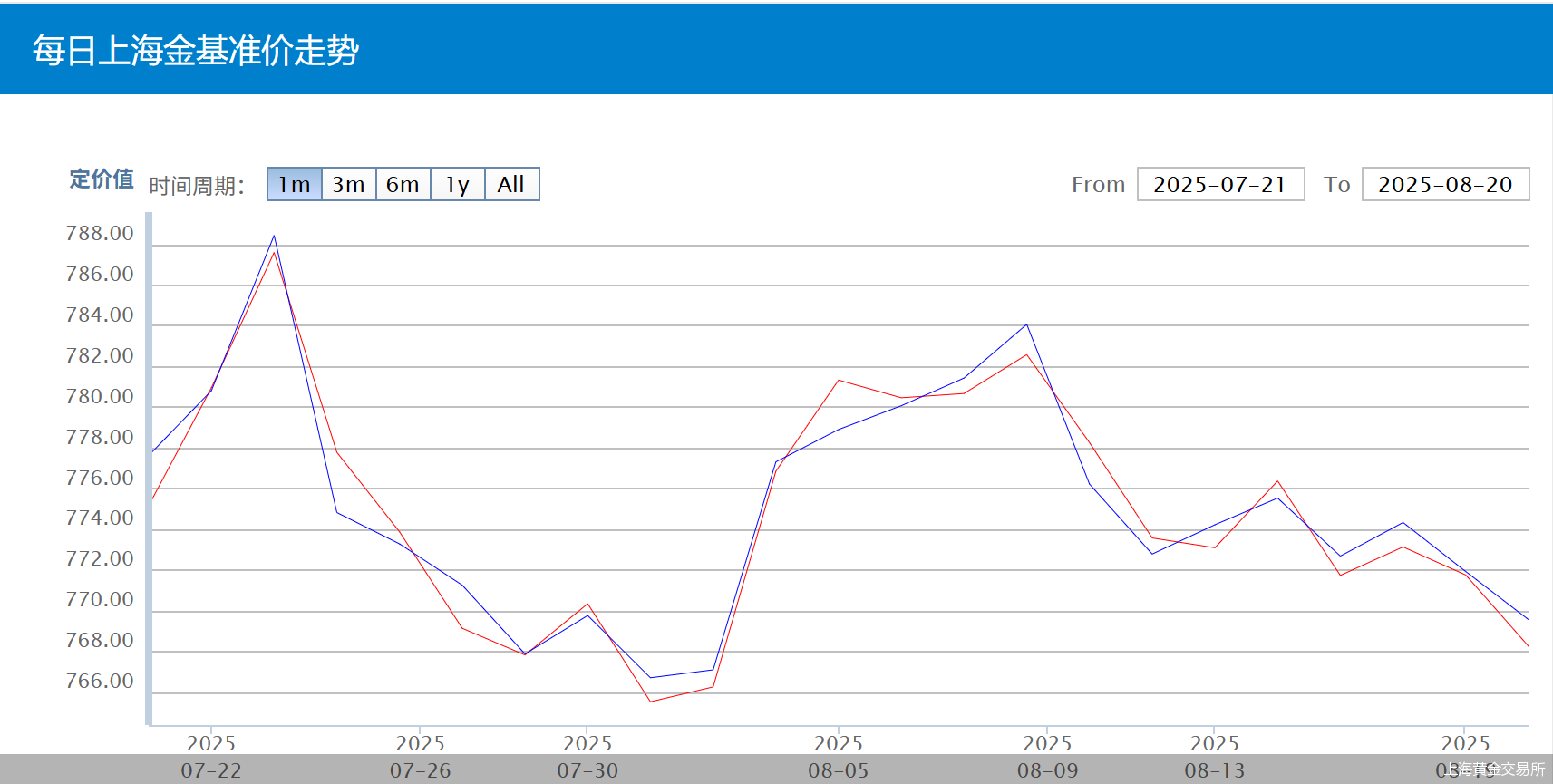
Core Viewpoint - The gold market is experiencing downward pressure on prices due to a combination of factors including increased supply, reduced demand for safe-haven assets, and competition from virtual currencies [1][4][5]. Price Trends - As of August 21, the price of gold in the Shanghai Gold Exchange was 771.83 CNY per gram, a slight increase from the previous day's closing price of 770.24 CNY per gram [1]. - London gold prices were reported at 3344.34 USD per ounce, down 2.41 USD from the previous day, reflecting a decline of 0.07% [1]. - Compared to the peak prices earlier in the year, both international and domestic gold prices have shown a downward trend, with London gold prices dropping over 55 USD per ounce in two weeks and Shanghai gold prices decreasing over 46 CNY per gram since April [4]. Market Dynamics - The decline in gold prices is attributed to a reduction in demand for safe-haven assets due to easing geopolitical tensions, leading to lower investment in gold [4][5]. - The rise of virtual currencies, perceived as stable alternatives to gold, is diverting investment away from the gold market, further weakening its demand [5]. - Concentrated selling by gold holders facing liquidity pressures has exacerbated the downward trend in gold prices, disrupting the supply-demand balance [5]. Future Outlook - Despite the current downward trend, there are indications that the gold market may still present opportunities in the long term, with potential for price fluctuations and upward movement [5]. - Analysts suggest that while short-term price declines may continue, the overall long-term outlook for gold remains positive, especially in the context of a global monetary system that may favor gold as a valuable asset [5].
平安举牌人寿、太保玄机
阿尔法工场研究院· 2025-08-21 01:38
Core Viewpoint - Ping An's recent stake acquisitions in insurance central enterprises' H-shares reflect a strategic shift towards financial investment amid an "asset shortage," while also signaling a balanced regulatory focus away from the banking sector [4][14]. Group 1: Recent Actions - In a span of one week, Ping An and its asset management company acquired a total of 140 million shares of China Pacific Insurance (CPIC), raising their stake to 5.04%, triggering a mandatory disclosure [6]. - Shortly after, Ping An's stake in China Life Insurance also reached 5.04%, indicating a coordinated investment strategy [6][8]. Group 2: Market Reactions - The market responded positively, with investors interpreting Ping An's actions as a sign of confidence in the insurance sector, leading to a rise in stock prices for CPIC and China Life [8]. - Analysts speculated that these moves could signal a turning point for the industry, suggesting that if leading firms are investing, the worst may be over for the sector [8]. Group 3: Underlying Reasons - The primary motivation behind Ping An's acquisitions is attributed to a financial investment need driven by an "asset shortage," as traditional investment avenues like bonds are yielding insufficient returns [10][14]. - The choice of H-shares over A-shares, which are trading at a larger discount, further emphasizes the focus on maximizing investment efficiency rather than pursuing strategic mergers or acquisitions [13]. Group 4: Financial Strategy - Ping An's use of Other Comprehensive Income (OCI) accounting allows for high-dividend stocks' dividends to be recognized as profit, aligning with regulatory requirements while enhancing financial reporting [11]. - The precise control of ownership at 5.04% suggests a deliberate strategy to send a signal to the market rather than merely a routine investment [13]. Group 5: Regulatory Context - By shifting investments from banks to insurance companies, Ping An aims to alleviate regulatory scrutiny associated with high stakes in the banking sector, presenting a more balanced investment profile [14]. - This strategic pivot reflects a broader change in investment logic, moving from long-term mergers to financial investments and industry positioning [15].


沪指光头中阳续创十年新高,量能萎缩会否成上攻阻力?
Xin Lang Cai Jing· 2025-08-20 23:49
Market Performance - The Shanghai Composite Index reached a nearly 10-year high, closing at 3766.21 points, up 1.04% on August 20, with the Shenzhen Component Index and the ChiNext Index also showing gains [1] - Despite the index gains, trading volume decreased to 240.82 billion yuan, down 180.2 billion yuan from the previous trading day, indicating a potential caution in market momentum [1][2] Market Trends and Predictions - Analysts suggest that the market remains strong, with the potential to challenge the 3800-point mark, although there are concerns about volume divergence at high levels [2][3] - The current market environment is characterized by low interest rates and a shift in household investment behavior towards equities, which may support market momentum [3] Sector Analysis - The liquor sector, particularly the white wine segment, has shown significant recovery, with the white wine index rising 3.66% on August 20, and most constituent stocks reporting gains [4] - The white wine industry is expected to benefit from a combination of policy support and seasonal demand, with analysts predicting a recovery in both valuation and earnings [5][6] Investment Recommendations - Investment advisors recommend focusing on large-cap leading stocks across various industries, particularly in technology and sectors with favorable economic conditions [1][3] - The white wine sector is highlighted as having potential for further growth, especially for leading companies that are adjusting their market strategies in response to changing consumer behavior [5][6]