东数西算

Search documents
直真科技:定增申请获审核通过 拟募资6.62亿元加码自智网络与算力网络布局
Sou Hu Cai Jing· 2025-12-12 11:59
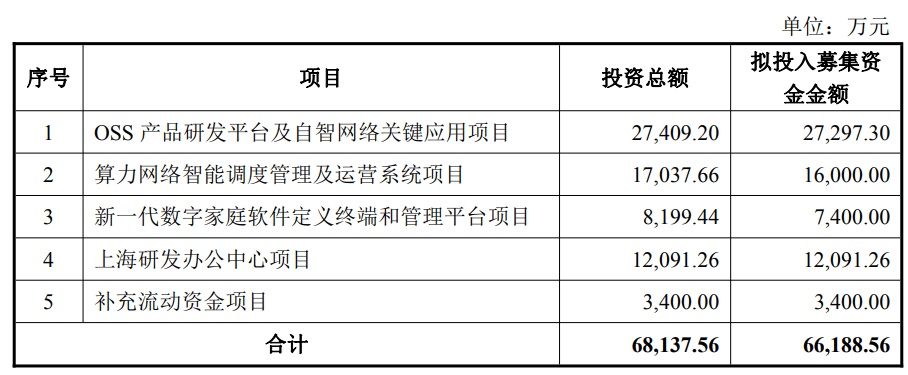
Core Viewpoint - The company plans to raise up to 662 million yuan through a targeted stock issuance, focusing on the development of OSS product platforms and intelligent network applications, aiming to strengthen its core business competitiveness and explore new growth opportunities in line with the digital transformation trend in the telecommunications industry [1]. Fundraising Details - The total investment amount for the projects is 6.813756 billion yuan, with the raised funds allocated as follows: 2.73 billion yuan for OSS product R&D and intelligent network applications, 1.6 billion yuan for intelligent scheduling management systems, 740 million yuan for next-generation digital home software-defined terminals, 1.21 billion yuan for the Shanghai R&D office center, and 340 million yuan for working capital [3][4]. - The issuance will target no more than 35 qualified investors, with a maximum of 31.2 million shares to be issued, accounting for 30% of the company's total share capital before issuance [3]. Project Allocation - 2.73 billion yuan will enhance 15 existing OSS products to improve automation and intelligence in network operations [4]. - 1.6 billion yuan will develop nine product modules, including a computing controller, to support the "East Data West Computing" strategy [4]. - 740 million yuan will introduce SDN technology for home gateway management, aiding telecom operators in upgrading their digital home services [4]. - 1.21 billion yuan will be used for the construction of the Shanghai R&D office center to improve the working environment and attract talent [4]. - 340 million yuan will optimize the capital structure and support business expansion [4]. Company Position - As a core supplier in the OSS field for telecom operators, the company has a strong foothold in the ICT management sector, serving major operators like China Mobile and China Telecom, with software development and technical services accounting for over 95% of revenue from January to September 2025 [4].

一场终极博弈!美国芯片或将会输给中国算力?
Sou Hu Cai Jing· 2025-12-12 10:34
Core Viewpoint - The article discusses the potential for China to surpass the United States in the AI race due to its superior energy infrastructure, particularly in electricity generation and distribution, which is crucial for powering AI technologies [1][6][12]. Energy Power Dynamics - Historically, energy resources have dictated global power dynamics, with the UK leveraging coal during the Industrial Revolution and the US establishing dominance through oil post-World War II [3][4]. - The control of essential energy resources has consistently allowed nations to shape global economic rules and maintain hegemony [4]. Current AI and Energy Landscape - The development of artificial intelligence is accelerating industrial productivity, with AI capable of enhancing manufacturing efficiency by over 30% and significantly reducing drug development timelines [6]. - Electricity has become the core energy resource in the AI era, as the computational power required for AI applications is heavily reliant on substantial electricity supply [6][10]. China's Strategic Advantages - China has implemented forward-looking strategies, such as the Renewable Energy Law in 2005, leading to a significant increase in renewable energy capacity, with a projected total of 2.22 billion kilowatts by October 2025 [8]. - The establishment of a high-capacity power transmission network (UHV) has enabled efficient long-distance electricity distribution, addressing energy shortages in eastern regions while utilizing western renewable resources [9][10]. Data and Computational Power - The "East Data West Computing" initiative allows for the transfer of data from energy-rich western regions to data-intensive eastern cities, enhancing computational efficiency and reducing costs [9][10]. - This system not only alleviates energy shortages in major cities but also optimizes the use of renewable resources, positioning China as a leader in energy and computational power [10]. Comparison with the United States - The US faces challenges with an aging and fragmented energy infrastructure, which hampers its ability to compete effectively in the AI and energy sectors [12]. - The reliance on private sector solutions has led to disparities in energy access, particularly affecting vulnerable communities during extreme weather events [12]. Future Implications - China's advancements in energy and computational power may lead to a new global economic landscape where computational services become a major export, enhancing China's influence in global trade [13]. - The Belt and Road Initiative could evolve to include integrated solutions that combine computational power and industry knowledge, further solidifying China's position in the global technology sector [13]. - The shift in economic power dynamics may result in new rules of engagement, with computational power becoming a critical factor in international relations and economic negotiations [14].
山东投资:“三权联动”助力长三角数字基建,1亿元授信赋能“算力引擎”建设
Sou Hu Cai Jing· 2025-12-12 03:21
Core Viewpoint - Shandong Investment Co., Ltd. is providing a comprehensive credit facility of 100 million yuan to support the construction of the Nantong Big Data Cloud Computing Center project, which aligns with the national "East Data West Computing" strategy and promotes digital infrastructure development in the Yangtze River Delta region [1] Group 1: Project Financing - The Nantong Big Data Cloud Computing Center project will cover an area of approximately 29,200 square meters and aims to build 3,000 high-power cabinets, focusing on high computing power and low energy consumption for sectors like big data, industrial internet, artificial intelligence, and the Internet of Things [2] - To address funding pressures for purchasing essential equipment like diesel generators and UPS systems, Jinding Leasing and Lushin Huijin designed a comprehensive credit solution combining debt, equity, and asset rights [2] - Jinding Leasing provided 60 million yuan through direct leasing, while Lushin Huijin contributed 40 million yuan via trust funding, effectively bridging the funding gap for equipment procurement and project operation [2] Group 2: Risk Management - The project exemplifies cross-licensing collaboration within the Shandong Investment system, establishing a robust risk control framework through a three-tiered mechanism of asset, equity, and decision-making rights [3] - Jinding Leasing retains ownership of the equipment, while Lushin Huijin exercises decision-making authority through equity pledges and joint management of certificates, ensuring a veto power over financing and guarantee matters [3] Group 3: Economic Impact - As a key service industry project in Jiangsu Province, the first phase of the Nantong IDC project will provide 1,000 high-power cabinets, significantly enhancing computing power supply in the Yangtze River Delta [4] - The project will directly support advanced technology fields such as AI training, cloud computing, and big data, while also empowering the digital transformation of manufacturing and finance sectors, accelerating the implementation of industrial internet and smart city applications [4] - Shandong Investment is committed to supporting key areas like green economy, digital economy, and rural revitalization through innovative financial products and collaborative mechanisms, reflecting its dedication to the new infrastructure strategy [4]

理解算力,才能理解数字社会
Ren Min Ri Bao· 2025-12-11 21:56
Core Insights - Computing power has become a buzzword, with its potential to change societal rhythms being compared to the steam engine and the electric grid [1] - The discourse around computing power includes terms like "East Data West Calculation," "supercomputing centers," and "AI chips," indicating its growing importance in corporate decision-making [1] - The computing power ecosystem is characterized by interdependence and evolution, relying on various factors such as energy support, institutional participation, commercial investment, talent cultivation, and data supply [1] Industry Perspective - The book aims to provide a problem-oriented discussion on how computing power integrates into societal operations, shapes industrial logic, and participates in public decision-making [1] - The focus is on the process of trend formation rather than specific product updates, emphasizing structural changes and relational reorganization [1] - Key considerations include the fairness, efficiency, and security of computing power access, which are crucial for the operational baseline of society [1] Audience Engagement - The book is designed for a broader audience, not just programmers or managers, offering an entry point into the "computational society" [2] - Readers are encouraged to interpret the content through their own perspectives and experiences, validating the logical structure presented [2] - Understanding the computing power-driven society is essential for individuals to better comprehend their own positions and directions within it [2]
美媒探访内蒙古:中国AI的一张“王牌”,藏在这里
Guan Cha Zhe Wang· 2025-12-11 14:21
Core Viewpoint - China is gaining a significant advantage in the global AI competition due to its vast electricity resources and lower energy costs, which are crucial for powering AI data centers and models [1][4][5]. Group 1: Electricity Supply and Demand - China has the world's largest power grid, with electricity generation growth from 2010 to 2024 exceeding that of all other regions combined [1]. - In 2022, China's electricity generation was more than double that of the United States, with some Chinese data centers paying less than half the electricity costs of their U.S. counterparts [1]. - By 2030, China is projected to invest approximately $560 billion in electricity grid projects, a 45% increase compared to the previous five years [2]. - Morgan Stanley predicts that U.S. data centers may face a power shortfall of 44 gigawatts in the next three years, equivalent to New York State's summer electricity demand [5]. Group 2: Renewable Energy Initiatives - Inner Mongolia is becoming a hub for renewable energy, with thousands of wind turbines and over 100 data centers either operational or under construction [1][11]. - China's "East Data West Computing" initiative aims to utilize the abundant electricity resources in the west to meet the AI demands of the densely populated east [5]. - The country has invested over $50 billion in expanding its electricity grid since 2021, focusing on renewable energy sources like wind, solar, and hydropower [6]. Group 3: Cost Competitiveness - Low electricity costs in China enable AI companies like DeepSeek to develop high-quality AI models at lower prices compared to U.S. competitors [4]. - Data centers in China can secure electricity at rates as low as $0.03 per kilowatt-hour, while U.S. markets often pay between $0.07 and $0.09 [8]. Group 4: Economic Impact - The GDP of Ulanqab in Inner Mongolia has grown by 50% over the past five years, with electricity consumption by data centers and IT services increasing more than sevenfold [13]. - Major tech companies, including Apple, Alibaba, and Huawei, have established data centers in Ulanqab, contributing to local economic growth [13]. Group 5: Challenges in the U.S. - The U.S. faces challenges in modernizing its electricity grid due to complex permitting processes and insufficient transmission capacity, which hinder its position as a global AI leader [8][9]. - Environmental concerns are rising, with over 230 environmental organizations calling for a nationwide pause on new data center constructions due to high energy consumption and water usage [9][10].

1ms城市算网 智联天府共筑西部算力新高地
Zheng Quan Ri Bao Wang· 2025-12-11 13:42
Core Insights - The acceleration of the 1ms urban computing network construction is crucial for implementing the "High-Quality Development Action Plan for Computing Power Infrastructure" and is a key measure for optimizing regional computing power resource allocation under the "East Data West Computing" national strategy [1][2] Group 1: Urban Computing Network Development - The urban computing network is identified as a core carrier of computing power infrastructure, significantly impacting traditional industry upgrades and the cultivation of new ecosystems [1] - The China Academy of Information and Communications Technology (CAICT) has been conducting industry research and standard formulation around the 1ms urban computing network, continuously promoting the enhancement of urban computing network capabilities [1] - The construction of the 1ms urban computing network is becoming a vital link between national strategies and local development, with a focus on building a low-latency, high-reliability, and secure development system [1] Group 2: Sichuan Province's Computing Power Industry - Sichuan Province has established a comprehensive computing power industry development system based on the "Chuan-Yu Integration, All-Area Coordination, and Green Low-Carbon" development positioning [2] - The provincial government is actively promoting the supply-demand matching of the computing power industry and facilitating deep cooperation through various supportive policies [2] - Sichuan's computing power industry is advancing through a systematic and large-scale approach to infrastructure construction, with significant achievements in computing power center clusters and multi-level latency circles [2]
AI会引发能源危机吗?
Cai Jing Wang· 2025-12-11 12:34
Core Insights - The article discusses the dual role of AI as both an energy consumer and an energy efficiency enhancer, highlighting the potential for AI applications to significantly reduce energy consumption over time despite its immediate energy demands [1][2]. Group 1: AI's Energy Consumption - AI's energy demand is growing rapidly, with data centers projected to consume 1.5% of global electricity by 2024, amounting to approximately 415 TWh, with the U.S. accounting for 45% of this consumption [4]. - The International Energy Agency forecasts that global data center electricity consumption will more than double by 2030, reaching around 945 TWh, driven primarily by AI and other digital services [4]. - In the U.S., data centers are expected to contribute nearly half of the electricity demand growth from now until 2030, surpassing the total electricity consumption of energy-intensive industries like aluminum and cement [4][5]. Group 2: AI's Role in Energy Efficiency - AI can act as a "savings tool" in the real economy by optimizing energy supply systems, improving industrial processes, and enhancing efficiency in sectors like transportation and construction [1]. - AI technologies are being developed to reduce energy consumption during model training and inference, with innovations such as the "Mixture of Experts" (MoE) architecture leading to a 70% reduction in training energy consumption [1][6]. - Companies like Tencent and Google are actively pursuing green energy initiatives, with Tencent aiming for 100% renewable energy by 2030 and Google exploring hourly matching of renewable energy supply [9][10]. Group 3: Innovations in Energy Supply and Consumption - AI is enhancing energy supply systems by improving predictive accuracy and operational strategies, particularly in renewable energy sectors [11][12]. - In industrial applications, companies are using AI to optimize processes, resulting in significant energy efficiency gains, such as a 3% improvement in energy use at ArcelorMittal's Luxembourg plant [14]. - AI applications in transportation and building management are also yielding substantial energy savings, with logistics companies reducing fuel costs by 20% through route optimization [15][16]. Group 4: Future Prospects and Challenges - The relationship between AI's energy consumption and its potential for energy savings is complex, with short-term increases in energy use expected before long-term savings materialize [19][20]. - The development of fusion energy technology is seen as a potential long-term solution for providing zero-carbon energy to support AI's growth [21]. - The article emphasizes the need for a balanced approach to AI deployment, ensuring that energy efficiency gains are realized while managing the immediate energy demands of AI systems [23].
中国的 AI 战略:从全球最大电网获取廉价电力
Sou Hu Cai Jing· 2025-12-11 10:13
Core Insights - The article discusses China's competitive advantage in the global AI race, primarily through its vast electricity resources and infrastructure, which significantly outpace those of the United States [1][2][3]. Group 1: Electricity Production and Infrastructure - China has the world's largest power grid, with electricity production growth from 2010 to 2024 exceeding that of all other regions combined [1]. - In 2022, China's electricity generation was more than double that of the United States [1]. - By 2030, China is expected to invest approximately $560 billion in power grid projects, a 45% increase from the previous five years [1]. - China currently has a power generation capacity of 3.75 terawatts, more than double that of the United States [6]. Group 2: Data Center Development - China's data centers benefit from low electricity costs, with prices as low as 3 cents per kilowatt-hour, compared to 7 to 9 cents in the U.S. [7]. - The "East Data West Computing" initiative aims to utilize the abundant electricity resources in western China to meet the AI-driven demands of the eastern regions [3][8]. - By 2030, China's data centers are projected to consume electricity equivalent to the total consumption of France [3]. Group 3: AI Development and Challenges - The electricity advantage allows Chinese AI companies, such as DeepSeek, to develop high-quality AI models at lower costs than their U.S. counterparts [2]. - The U.S. data centers may face a power shortage of 440 gigawatts in the next three years, posing a significant challenge to the country's AI ambitions [2]. - Chinese companies are attempting to overcome domestic chip performance limitations by bundling multiple chips together, although this requires substantial power [2][11]. Group 4: Government Initiatives and Investments - The Chinese government has invested over $50 billion since 2021 to build the world's largest ultra-high voltage transmission network [5]. - Local governments in regions like Ulanqab are prioritizing the establishment of new data centers to attract investment and create jobs [8][10]. - Ulanqab's GDP has grown by 50% over the past five years, with electricity consumption for data centers and IT services increasing by over 700% [10]. Group 5: Future Prospects and Competition - Analysts predict that the shortage of high-end chips in China will persist for several years, impacting its ability to compete effectively [16][17]. - The ongoing AI competition provides China with opportunities to narrow the gap with the U.S. as it continues to develop its electricity and data center capabilities [18].

降息落地后的布局窗口:算力龙头工业富联的价值机遇
Sou Hu Cai Jing· 2025-12-11 09:20
Core Viewpoint - The stock price of Industrial Fulian is experiencing volatility despite strong fundamentals and increasing demand for computing power, raising questions about whether this is a risk signal or an investment opportunity as the Federal Reserve's interest rate decisions unfold [1] Group 1: Industry Dynamics - The computing power industry is currently benefiting from a confluence of favorable policies, technological advancements, and surging demand, marking a significant growth phase [2] - Major global economies are prioritizing AI computing infrastructure, with initiatives like China's "East Data West Computing" project and various subsidies for enterprise-level AI deployments bolstering hardware demand [2] - The demand explosion is evident as leading cloud service providers engage in a "computing power arms race," with companies like Microsoft and Google expanding their AI infrastructure to support new applications [2] Group 2: Company Performance - Industrial Fulian has a leading market share of over 40% in high-end AI server manufacturing, with its GB300 server production exceeding market expectations [3] - Recent reports suggest that orders for the NVL72 cabinets have been secured until 2027, aligning with industry forecasts of extended order visibility for top ODM manufacturers [3] - The company's rising inventory levels and strong order visibility serve as key indicators for sustained future performance [3] Group 3: Market Sentiment and Valuation - Despite positive fundamentals, Industrial Fulian's stock has faced recent fluctuations due to external factors, including the Federal Reserve's monetary policy and overall market conditions [4] - The current market volatility is seen as a temporary emotional disturbance rather than a reflection of the company's performance, with signs of stabilization in the semiconductor and computing sectors [4] - The company's stock valuation has adjusted to a reasonable range, significantly below institutional target prices, enhancing its margin of safety for long-term investors [4]

四川1ms城市算网加速成型 重塑算力运载新格局
Huan Qiu Wang Zi Xun· 2025-12-11 06:24
Core Insights - The article emphasizes the importance of computing power as a core driver for urban smart transformation and industrial upgrading in the context of the booming digital economy [1] - The implementation of the "1ms Urban Computing Network" is highlighted as a key initiative to enhance efficient computing power transportation, aligning with national strategies and reshaping urban development models [1][2] Group 1: Development Plans and Strategies - The "High-Quality Development Action Plan for Computing Power Infrastructure" aims to improve the efficient transportation capacity of computing power, with latency requirements set at no more than 1ms for major urban computing infrastructures and 5ms for national hub nodes [1] - Sichuan province is leveraging the "East Data West Computing" national strategy to break regional computing barriers and transform computing resources into public services for cities [1][2] Group 2: Technological Innovations - Sichuan's 1ms Urban Computing Network integrates advanced technologies such as all-optical switching (OXC), 400G transmission, and intelligent scheduling to achieve direct access to computing resources [4] - The network's architecture includes a three-tier structure (core, inner ring, outer ring) to create a unified computing network across Chengdu and 20 other cities, achieving latency under 1ms for major data centers [6] Group 3: Role of Telecom Operators - Major telecom operators are leading the construction of the 1ms Urban Computing Network, utilizing their extensive network resources and technical capabilities to ensure comprehensive coverage and efficient scheduling of computing resources [5] - Sichuan Telecom plans to invest approximately 180 million yuan to build 300 PFLOPS of domestic computing power by 2025, with a goal to exceed 1 EFLOPS by 2026 [7] Group 4: Industry Applications and Impact - The 1ms Urban Computing Network significantly empowers various industries, enabling real-time data collection, analysis, and feedback in smart manufacturing scenarios [9] - The network supports advanced manufacturing processes, as demonstrated by the success of companies like Lynk & Co, which utilizes low-latency networks for quality management and production efficiency [11][12] Group 5: Future Directions - Despite the achievements, there is a call for continued efforts to build a low-latency, high-reliability, and secure computing network development system [14] - Future initiatives will focus on enhancing service capabilities, promoting technological innovations, and fostering collaborative ecosystems among government, enterprises, academia, and research institutions [14]