社会融资规模

Search documents
前三季度社会融资增量突破30万亿元
Qi Huo Ri Bao Wang· 2025-10-15 19:30
Core Insights - The People's Bank of China reported that in the first three quarters, RMB loans increased by 14.75 trillion yuan, and the total social financing scale increased by 30.09 trillion yuan, which is 4.42 trillion yuan more than the same period last year [1] - The growth in social financing reflects strong financial support for the real economy, with government bonds and on-balance-sheet loans being the main contributors [1][2] - The broad money supply (M2) grew by 8.4% year-on-year, while narrow money (M1) increased by 7.2%, indicating improved liquidity and efficiency in the financial system [3] Group 1: Social Financing and Loans - In September, RMB loans increased by 1.29 trillion yuan, and social financing increased by 35.34 billion yuan, maintaining a robust growth trend [1] - The structure of new loans shows an improvement, with short-term corporate loans increasing by 250 billion yuan, while bill financing decreased by 471.2 billion yuan [2] - The overall loan balance growth rate was 6.6%, which is significantly higher than the nominal GDP growth rate, indicating strong support for the macroeconomic recovery [2] Group 2: Monetary Supply and Policy Outlook - The M1 and M2 growth rates indicate a narrowing gap, reflecting increased activity in corporate operations and a recovery in personal consumption [3] - The central bank is expected to implement a new round of interest rate cuts and reserve requirement ratio reductions by the end of the year to stimulate financing demand [4] - A policy tool worth 500 billion yuan is set to be released in October, which may further support credit expansion and boost infrastructure investment [3]
M1、M2“剪刀差”刷新年内低值 多项金融数据释放积极信号
Shang Hai Zheng Quan Bao· 2025-10-15 18:35
Core Insights - The central bank's financial statistics for the first three quarters indicate that key financial indicators continue to grow faster than the economy, demonstrating solid support for the real economy [2][3] Financial Indicators - As of the end of September, the stock of social financing, M2 (broad money), and RMB loan balances grew by 8.7%, 8.4%, and 6.6% year-on-year, respectively [2] - The M1 (narrow money) and M2 "scissors difference" narrowed to 1.2 percentage points, reflecting increased business activity and a recovery in personal investment and consumption demand [2][4] Social Financing - The cumulative social financing increment for the first three quarters reached 30.09 trillion yuan, an increase of 4.42 trillion yuan compared to the same period last year [3] - Government bond issuance played a significant role in boosting social financing, with net financing of government bonds amounting to 11.46 trillion yuan, up by 4.28 trillion yuan year-on-year [3] Loan Structure - By the end of September, the RMB loan balance was 270.39 trillion yuan, reflecting a year-on-year growth of 6.6% [6] - The proportion of RMB loans to the real economy in the total social financing stock decreased by 1.3 percentage points to 61.1%, while the government bond balance's share increased by 2.1 percentage points to 21.2% [3] Deposit Trends - In the first three quarters, household deposits increased by 12.73 trillion yuan, while non-bank financial institution deposits rose by 4.81 trillion yuan [5] - The growth in household deposits has slowed from previous highs, while non-bank deposits continue to grow rapidly, indicating a potential shift of household funds into the capital market [5] Interest Rates - The weighted average interest rate for newly issued corporate loans was approximately 3.1%, down about 40 basis points year-on-year, while the rate for personal housing loans was also around 3.1%, down about 25 basis points [7] - The sustained low interest rates indicate a generally ample supply of credit resources, meeting the financing needs of the real economy effectively [7] Economic Outlook - Analysts expect that the moderately loose monetary policy will continue to support the real economy strongly in the fourth quarter, alongside active fiscal policies [7]

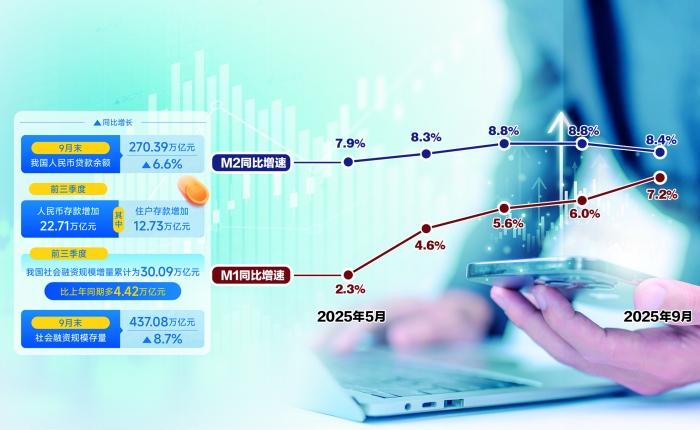
前三季度社融增量突破30万亿 新增贷款14.75万亿
Zheng Quan Shi Bao· 2025-10-15 18:05
Core Insights - The People's Bank of China reported that the total social financing (TSF) exceeded 30 trillion yuan in the first three quarters of this year, indicating a significant increase in financial support for the economy [1] - The growth rate of TSF and broad money supply (M2) remains high, suggesting a conducive monetary environment for economic recovery [1] - The proportion of RMB loans in the TSF increment has decreased to 48%, highlighting the rapid development of direct financing channels [2] Financial Statistics - In the first three quarters, the total social financing increment reached 30.09 trillion yuan, an increase of 4.42 trillion yuan compared to the same period last year [1] - RMB loans increased by 14.75 trillion yuan, while RMB deposits rose by 22.71 trillion yuan [1] - By the end of September, TSF stock grew by 8.7% year-on-year, and M2 increased by 8.4%, both higher than the previous year [1] Government and Corporate Financing - Net financing from government bonds amounted to 11.46 trillion yuan, up by 4.28 trillion yuan year-on-year, indicating strong government support [1] - Corporate bond financing also increased, with net financing reaching 1.57 trillion yuan, supported by favorable policies and low issuance rates [1] - The share of net financing from government and corporate bonds rose to 43% in the first three quarters [1] Loan Dynamics - The average interest rate for newly issued corporate loans was approximately 3.1%, down by about 40 basis points year-on-year [3] - The average interest rate for new personal housing loans was also around 3.1%, lower by 25 basis points compared to the previous year [3] - The growth rate of new RMB loans in September was 6.6%, but adjusted for local special bond replacement, the growth rate was approximately 7.7% [2] Monetary Indicators - The narrow money supply (M1) growth rate increased to 7.2% by the end of September, a significant rise from earlier in the year [3] - The "scissors gap" between M1 and M2 narrowed to 1.2 percentage points, indicating improved business activity and consumer demand [3] - The recent changes in M1 statistics now include both corporate and personal demand deposits, reflecting a more comprehensive view of liquidity in the market [3] Asset Reallocation - The phenomenon of "deposit migration" reflects a reallocation of resident assets in response to changing yield rates across different financial markets [4] - This migration indicates that funds are moving from lower-yielding assets to higher-yielding ones, influenced by interest rate changes [4] - The occurrence of "deposit migration" and "reflow" has been noted throughout 2023, suggesting ongoing shifts in investment behavior [4]
信贷结构持续优化 多组金融数据释放积极信号
Sou Hu Cai Jing· 2025-10-15 16:28
Group 1: Monetary Supply and Economic Indicators - As of the end of September, the narrow money supply (M1) increased by 7.2% year-on-year, significantly up from a low of 0.1% at the end of February, indicating a positive trend in economic activity [1][2] - The broad money supply (M2) reached 335.38 trillion yuan, growing by 8.4% year-on-year, which is 1.5 percentage points higher than the same period last year [1] - The total social financing stock was 437.08 trillion yuan, with a year-on-year growth of 8.7%, reflecting a robust financial environment conducive to economic recovery [3] Group 2: Social Financing and Direct Financing - In the first three quarters of the year, the total social financing increment was 30.09 trillion yuan, which is 4.42 trillion yuan more than the previous year, driven by increased government bond issuance and improved corporate financing channels [3][4] - Government bonds accounted for a significant portion of social financing, with net financing of approximately 11.46 trillion yuan in the first three quarters, supporting various economic initiatives [3] Group 3: Loan Growth and Structure - The balance of RMB loans reached 270.39 trillion yuan by the end of September, with a year-on-year growth of 6.6%, and the growth rate adjusted for local special bond replacement was around 7.7% [5][6] - In the first three quarters, RMB loans increased by 14.75 trillion yuan, with household loans rising by 1.1 trillion yuan and corporate loans increasing by 13.44 trillion yuan [6] - The structure of loans is improving, with inclusive small and micro loans growing by 12.2% and manufacturing medium to long-term loans increasing by 8.2%, both outpacing overall loan growth [7]
前三季度新增社融超30万亿元
Bei Jing Shang Bao· 2025-10-15 15:54
Core Insights - The People's Bank of China released financial statistics for the first three quarters of 2025, indicating a robust growth in loans and deposits, with total social financing exceeding 30.09 trillion yuan [1][8] - The report reflects a stable credit environment and an ongoing adjustment in monetary policy, suggesting that there is ample room for moderate easing without immediate concerns about high inflation [1][3] Loan and Deposit Growth - As of the end of September, the balance of RMB loans reached 270.39 trillion yuan, with a year-on-year growth of 6.6% [2] - In the first three quarters, RMB loans increased by 14.75 trillion yuan, with household loans rising by 1.1 trillion yuan and corporate loans increasing by 13.44 trillion yuan [2][3] - The total RMB deposits increased by 22.71 trillion yuan, with household deposits contributing 12.73 trillion yuan [6] Monetary Supply and Policy - The M2 money supply stood at 335.38 trillion yuan, growing by 8.4% year-on-year, while M1 grew by 7.2% [5][7] - The "scissors gap" between M1 and M2 has narrowed to 1.2 percentage points, the lowest since 2021, indicating increased activity in the economy [7] - The current monetary policy remains moderately accommodative, supporting economic recovery and growth [9] Social Financing and Economic Support - The total social financing scale reached 437.08 trillion yuan, with a year-on-year growth of 8.7% [1][8] - In September, the new social financing amounted to 35.34 billion yuan, reflecting a slight decrease compared to the previous year [8] - The structure of social financing shows a shift towards more diversified financing channels, with loans accounting for about 48% of the new social financing, while government and corporate bonds accounted for approximately 43% [9]
前三季度社会融资规模增量超30万亿元 金融对实体经济支持力度稳固
Zheng Quan Ri Bao· 2025-10-15 15:46
Core Insights - The People's Bank of China reported that by the end of September, the growth rates of social financing scale, M2 money supply, and RMB loan balances significantly exceeded economic growth, indicating strong financial support for the real economy [1][7]. Financing and Monetary Policy - As of September 30, 2025, the social financing scale reached 437.08 trillion yuan, with a year-on-year growth of 8.7%. The total increment in social financing for the first three quarters was 30.09 trillion yuan, which is 4.42 trillion yuan more than the same period last year [2]. - The increase in RMB loans to the real economy was 14.54 trillion yuan, which is a decrease of 851.2 billion yuan compared to the previous year. In contrast, net financing from government bonds was 11.46 trillion yuan, an increase of 4.28 trillion yuan year-on-year [2][3]. Credit Growth and Structure Optimization - In the first three quarters, RMB loans increased by 14.75 trillion yuan, with household loans rising by 1.1 trillion yuan and corporate loans increasing by 13.44 trillion yuan. The balance of RMB loans reached 270.39 trillion yuan, reflecting a year-on-year growth of 6.6% [4]. - The structure of credit is continuously optimizing, with inclusive small and micro loans growing by 12.2% and medium to long-term loans in the manufacturing sector increasing by 8.2% [4]. Monetary Supply and Economic Indicators - By the end of September, M2 stood at 335.38 trillion yuan, with a year-on-year growth of 8.4%. The narrow money (M1) balance was 113.15 trillion yuan, growing by 7.2% [7]. - The recent increase in M1 growth rate is attributed to the activation of corporate and household deposits, indicating improved business activity and consumer demand [7]. Future Economic Outlook - Experts suggest that the current monetary policy will continue to support the real economy, with fiscal policies also playing a significant role. The effects of previous measures aimed at boosting consumption and improving livelihoods are expected to gradually manifest [7][8]. - The large scale of financial resources is effectively meeting the financing needs of the real economy, but achieving rapid growth may be challenging due to the shift towards high-quality economic development [8].
社融增量超30万亿,M1-M2“剪刀差”刷新年内低值,个人投资消费需求回暖
Bei Jing Shang Bao· 2025-10-15 15:28
Core Viewpoint - The People's Bank of China (PBOC) released financial statistics for the first three quarters of 2025, indicating a stable growth in loans and deposits, with a focus on the effectiveness of monetary policy in supporting the economy [1][9]. Financial Data Summary - As of the end of September, the total RMB loans increased by 14.75 trillion yuan, while RMB deposits rose by 22.71 trillion yuan, and the cumulative increase in social financing exceeded 30.09 trillion yuan [1][9]. - The balance of RMB loans reached 270.39 trillion yuan, with a year-on-year growth of 6.6% [3][10]. - The broad money supply (M2) stood at 335.38 trillion yuan, reflecting a year-on-year growth of 8.4% [6][10]. Loan and Deposit Analysis - In the first three quarters, household loans increased by 1.1 trillion yuan, while corporate loans rose by 13.44 trillion yuan [3][4]. - In September alone, RMB loans increased by 1.29 trillion yuan, with a seasonal increase of 700 billion yuan compared to the previous month [3][4]. - The average interest rate for newly issued corporate loans was approximately 3.1%, down 40 basis points year-on-year [4][5]. Social Financing Insights - The total social financing scale reached 437.08 trillion yuan by the end of September, with a year-on-year growth of 8.7% [10][11]. - The increase in social financing for the first three quarters was 30.09 trillion yuan, which is 4.42 trillion yuan more than the same period last year [9][11]. - The proportion of loans in the total social financing decreased to about 48%, while government and corporate bond financing increased to approximately 43% [11][12]. Monetary Policy Outlook - The current monetary policy remains moderately accommodative, with expectations for potential interest rate cuts and reserve requirement ratio reductions by the end of the year [11][12]. - The financial data indicates that monetary policy is effectively supporting economic recovery, with a focus on maintaining a balance between loan growth and economic stability [12].
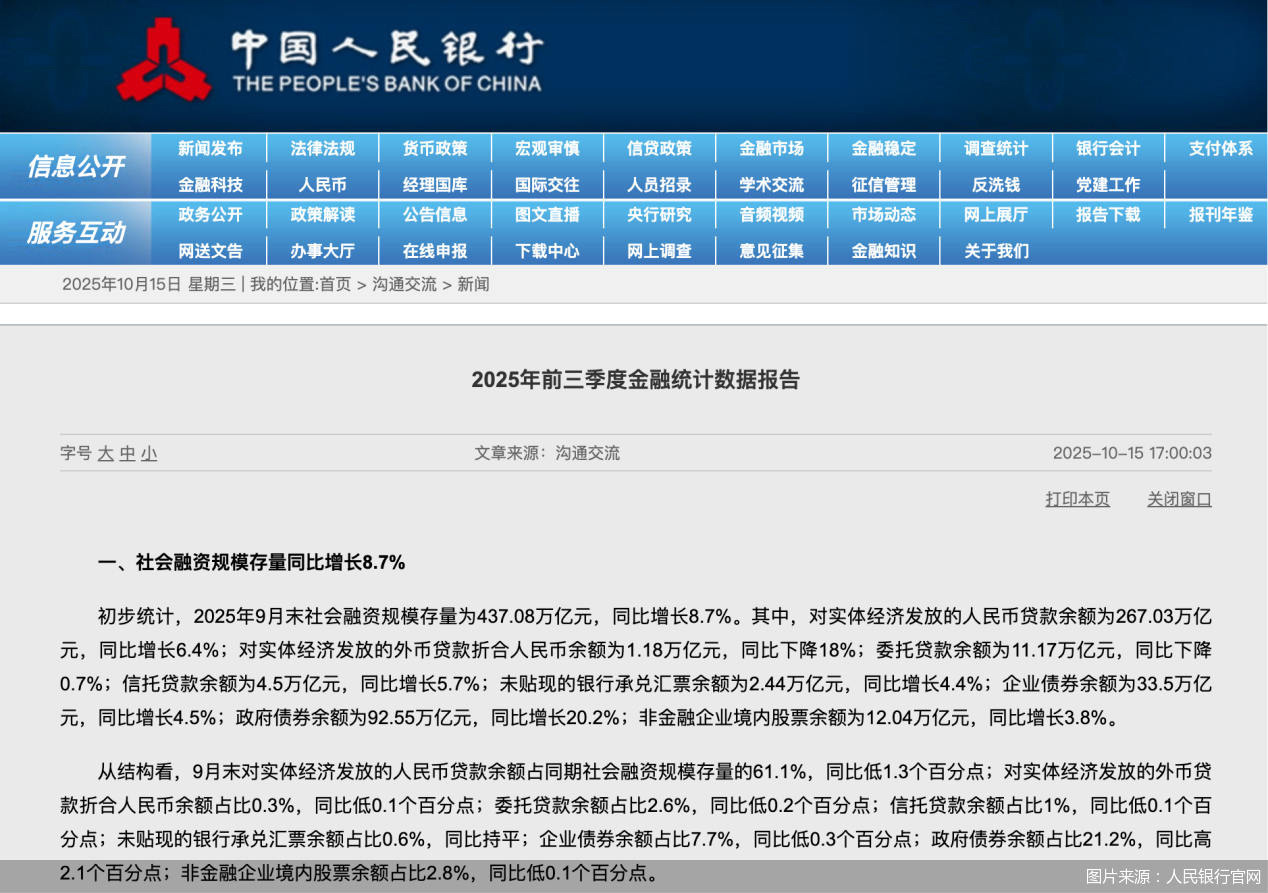
2025年前三季度社会融资规模增量累计为30.09万亿元
Zhong Guo Jing Ying Bao· 2025-10-15 15:03
中经记者 谭志娟 北京报道 10月15日,央行公布数据显示,初步统计,2025年9月末社会融资规模存量为437.08万亿元,同比增长 8.7%。2025年前三季度社会融资规模增量累计为30.09万亿元,比上年同期多4.42万亿元。9月末,广义 货币(M2)同比增长8.4%,增速较上月末低0.4个百分点;狭义货币(M1)同比增长7.2%,增速较上月末高 1.2个百分点。 民生银行首席经济学家温彬认为,从金融数据可以看出,9月末广义货币余额和社会融资规模增速均保 持较高水平,均高于经济增速,持续为经济回升向好创造适宜的货币金融环境。同时,今年以来,M1 与M2剪刀差也明显收敛,反映出企业生产经营活跃度提升、个人投资消费需求回暖等积极信号。 东方金诚首席宏观分析师王青也称,根据外部环境波动、经济增长动能变化、物价水平走势,以及更大 力度推动房地产市场止跌回稳的要求,四季度货币政策还会保持支持性立场,主要发力点是降低企业和 居民融资成本,增加信贷可获得性,进而大力提振内需,有效对冲四季度外需波动可能对宏观经济运行 带来的冲击。 (编辑:朱会珊 审核:朱紫云 校对:张国刚) 展望未来,温彬认为,预计5000亿元新型政策 ...
【广发宏观钟林楠】如何看待9月信贷、M1与非银存款的变化
郭磊宏观茶座· 2025-10-15 14:37
Core Viewpoint - The article discusses the social financing (社融) data for September, highlighting a slight increase in financing and a mixed performance across various components, indicating a cautious economic recovery and the need for structural optimization in credit policies [1][7]. Summary by Sections Social Financing Overview - In September, social financing increased by 3.5 trillion yuan, slightly above the market expectation of 3.3 trillion yuan, but down 229.7 billion yuan year-on-year, showing improvement from a previous decline of 465.5 billion yuan [1][7]. - The stock growth rate of social financing was 8.7%, a slight decrease of 0.1 percentage points from the previous month [1][7]. Credit and Financing Components - Entity credit increased by 1.6 trillion yuan, down 366.2 billion yuan year-on-year, which is better than August but weaker than the same periods in March and June [8]. - Government bond financing rose by 1.2 trillion yuan, down 347.1 billion yuan year-on-year, primarily due to a high base from the previous year [2][11]. - Corporate bond financing increased by 105 billion yuan, up 2.031 trillion yuan year-on-year, attributed to a low base from the previous year [3][12]. Monetary Aggregates - M1 growth rate was 7.2%, up 1.2 percentage points from the previous month, with a 1.9 trillion yuan increase, the highest for the same period in five years [4][13]. - M2 growth rate was 8.4%, down 0.4 percentage points from the previous month, mainly due to a significant reduction in non-bank deposits [5][15]. Economic Outlook and Policy Implications - The overall liquidity situation has improved, driven by fiscal pre-positioning and increased foreign exchange settlements, but the internal credit cycle has not yet visibly recovered [6][16]. - Key areas to watch include the effectiveness of new policy financial tools, potential new industry policies from upcoming important meetings, and the possibility of early issuance of local government debt limits for 2026 [6][16].

新华财经晚报:现货黄金突破4200美元
Xin Hua Cai Jing· 2025-10-15 14:17
Domestic News - The National Development and Reform Commission announced a plan to establish 28 million charging facilities nationwide by the end of 2027, providing over 300 million kilowatts of public charging capacity to meet the charging needs of more than 80 million electric vehicles, aiming for a doubling of charging service capacity [2] - In September, the Consumer Price Index (CPI) rose by 0.1% month-on-month and fell by 0.3% year-on-year, while the core CPI, excluding food and energy, increased by 1.0% year-on-year, marking the fifth consecutive month of growth. The Producer Price Index (PPI) remained flat month-on-month and decreased by 2.3% year-on-year, with the decline narrowing by 0.6 percentage points from the previous month [2] Financial Data - As of the end of September, the broad money supply (M2) stood at 335.38 trillion yuan, growing by 8.4% year-on-year. The narrow money supply (M1) was 113.15 trillion yuan, up by 7.2% year-on-year, and the currency in circulation (M0) reached 13.58 trillion yuan, increasing by 11.5% year-on-year [3] - The weighted average interest rate for new loans to enterprises was approximately 3.1% in September, down about 40 basis points year-on-year, while the rate for new personal housing loans was also around 3.1%, down about 25 basis points year-on-year, indicating sustained low loan rates [3] - The total social financing scale increased by 30.09 trillion yuan in the first three quarters of 2025, which is 4.42 trillion yuan more than the same period last year, with a year-on-year growth of 8.7% as of the end of September [3] Commodity Market - Spot gold prices surged past $4200 per ounce for the first time in history, with a daily increase of over 1.4%. The price of domestic gold jewelry also rose significantly, with some prices exceeding 1235 yuan per gram [4]