
财政政策

Search documents
【真灼港股名家】美股周一延续跌势,中央经济工作会议日前举行
Sou Hu Cai Jing· 2025-12-16 02:13
Market Overview - US stock market continued its downward trend with technology stocks underperforming, leading to declines in all three major indices [2] - The US dollar remains weak, with the 10-year Treasury yield falling to 4.17%, while gold prices show strong performance and oil prices are under pressure [2] - Hong Kong pre-market securities generally declined, indicating a likely lower opening for the market [2] - The mainland Chinese stock market also saw declines, with the Shanghai Composite Index closing down 0.5% and trading volume decreasing [2] - The overall market sentiment in Hong Kong is cautious, with blue-chip stocks generally declining and expectations for the index to test support at 25,200 points, while resistance is seen at 26,000 points [2] Industry Insights - The Central Economic Work Conference emphasized the need for high-quality development and a new development pattern for the upcoming year, focusing on stabilizing economic growth and enhancing policy effectiveness [3] - Key priorities include expanding domestic demand, optimizing supply, and ensuring stability in employment, enterprises, and market expectations [3] - The conference highlighted the importance of maintaining a proactive fiscal policy with a fiscal deficit rate around 4% and a focus on managing local fiscal difficulties [3] - Monetary policy will remain moderately accommodative, with an emphasis on supporting economic stability, reasonable price recovery, and enhancing liquidity [3] - The market anticipates that the economic growth target will remain around 5% for the next year, with no strong measures expected to stimulate the macro economy [3]


投资于物和投资于人紧密结合 明年财政政策“工具箱”有望进一步扩容
Zhong Guo Zheng Quan Bao· 2025-12-15 21:39
Group 1 - The core viewpoint of the articles emphasizes the effectiveness of proactive fiscal policies in supporting major national strategies, expanding domestic demand, stabilizing growth, and improving people's livelihoods in 2025 and the continuation of these policies into 2026 [1][2][3]. Group 2 - In 2025, significant fiscal measures included the allocation of 800 billion yuan in special bonds to support major projects, which involved 1,459 projects in key areas such as ecological restoration and transportation infrastructure [2]. - The consumer goods replacement policy led to a 26.5% increase in sales revenue for home appliances and a 20.3% increase for communication retail in the first eleven months of 2025 [2]. - The fiscal spending since the 14th Five-Year Plan has directed over 70% towards improving people's livelihoods, indicating a strong focus on social welfare [2]. Group 3 - The fiscal policy has played a crucial role in boosting consumption and expanding investment, contributing to the achievement of economic and social development goals [3]. - Investment in human capital through subsidies for childcare and education is seen as essential for high-quality development and improving residents' living standards [3]. Group 4 - The government plans to optimize expenditure structures and enhance financial support for major national strategies, focusing on investments in human capital and expanding domestic demand [4]. - The Ministry of Finance has outlined strategies to promote income growth and optimize income distribution to stimulate consumption [4]. Group 5 - Experts suggest that policies aimed at expanding domestic demand, such as the consumer goods replacement policy, may need optimization to avoid diminishing returns [5]. - There is potential for expanding the subsidy range to include new consumption-related products, such as AI products and electric vehicle charging stations [6]. Group 6 - The government aims to leverage various types of government bond funds to support major projects and enhance the effectiveness of fiscal policies [7]. - Optimizing project reserves and expanding the fiscal "toolbox" are seen as ways to improve the effectiveness of investment policies [8].
明年财政政策“工具箱”有望进一步扩容
Zhong Guo Zheng Quan Bao· 2025-12-15 20:19
Core Viewpoint - The article emphasizes the effectiveness of proactive fiscal policies in 2025, which have supported major national strategies, expanded domestic demand, stabilized growth, and improved people's livelihoods. It anticipates continued expansionary fiscal policies in 2026, focusing on both material and human investments [1][2]. Group 1: Fiscal Policy Effectiveness - In 2025, proactive fiscal policies significantly supported major national strategies, with 800 billion yuan allocated for "two重" construction and 1,880 billion yuan for equipment upgrades, leading to a 10.7% year-on-year increase in machinery and equipment purchases from January to November [1]. - Increased spending in the livelihood sector was noted, with sales in supported retail sectors growing by 26.5% and 20.3% year-on-year, respectively, from January to November [1]. - Over 70% of national fiscal spending since the start of the "14th Five-Year Plan" has been directed towards improving people's livelihoods, according to the Minister of Finance [1]. Group 2: Investment in People and Material - Fiscal policies in 2025 met expectations in material investments, while policies aimed at human investments, such as childcare subsidies and free preschool education, contributed to high-quality population development [2]. - The combination of material and human investments is seen as essential for high-quality development and improving residents' living standards, creating a virtuous cycle of new demand and supply [2]. Group 3: Future Policy Directions - The Ministry of Finance plans to optimize spending structures and enhance financial support for major national strategies, focusing on increasing funding for human investments and expanding domestic demand [3][4]. - Policies supporting "two重" and "two新" will continue, with an emphasis on utilizing government bond funds and increasing central budget investments to stabilize and boost investment [5]. - Experts suggest that optimizing project reserves and expanding the fiscal "toolbox" will enhance the effectiveness of material investment policies [5][6].
G7两国央行政策罕见背离,汇市这一“高确定性”交易却遭颠覆!
Jin Shi Shu Ju· 2025-12-15 13:14
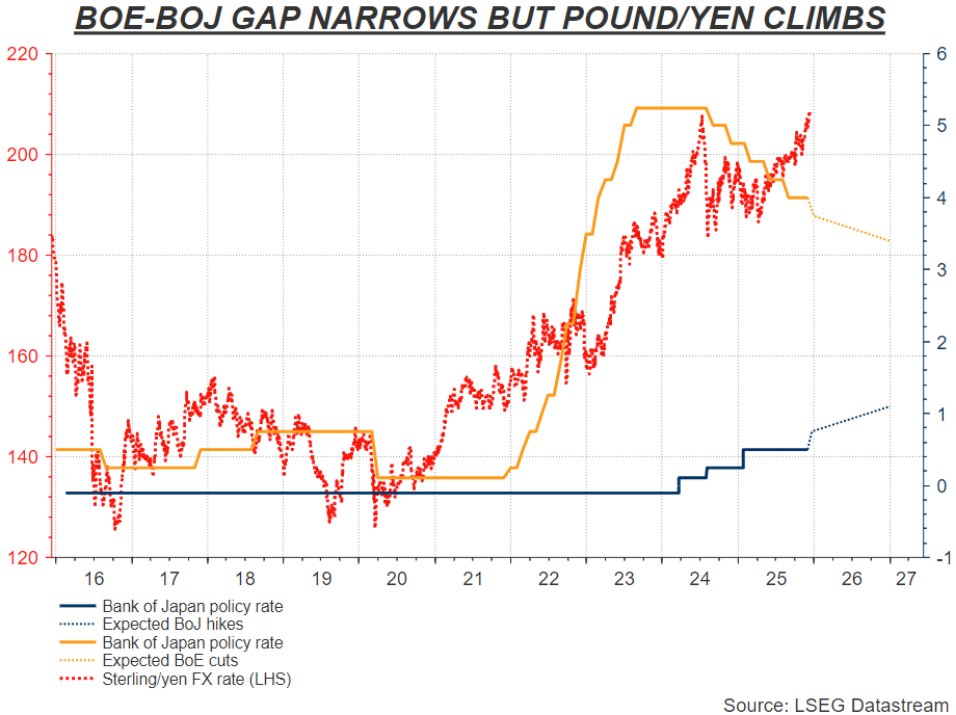
Group 1 - The G7 central banks are taking opposite actions regarding interest rates, with a focus on shorting the GBP/JPY exchange rate as a seemingly risk-free bet [2] - The GBP/JPY exchange rate has been rising despite the narrowing interest rate differential between the UK and Japan, which has decreased by 165 basis points since mid-last year [4][5] - The bond market reflects a similar trend, with the 2-year yield differential between UK and Japanese bonds halving since mid-2023, yet the GBP/JPY exchange rate has increased by 14% during the same period [6] Group 2 - The "real" yield differential has also narrowed, with the inflation-adjusted 5-year yield differential contracting by about 60 basis points [8] - The GBP/JPY exchange rate has cumulatively risen over 1% in the past 18 months and rebounded approximately 5% since mid-year, reaching its strongest level in 17 years [9] - The weakening of the yen is a significant factor, with the yen's effective exchange rate index dropping 30% since the pandemic, while the pound's effective exchange rate index has increased by 10% since 2020 [10] Group 3 - The OECD forecasts indicate that the GDP growth rates for the UK and Japan will be roughly equal this year, with slight acceleration for the UK in the next two years [12] - Diverging fiscal policies are playing a crucial role in the exchange rate movements, with the UK tightening its fiscal policy while Japan is initiating another round of government spending [15] - Japanese investors are major players in cross-border capital flows, holding nearly one-third of UK government bonds, with significant purchases occurring during political turmoil in Japan [17]
中央经济工作会议学习心得:更加注重政策效率
ZHONGTAI SECURITIES· 2025-12-15 12:36
Investment Rating - The industry investment rating is "Increase" (maintained) [2][21] Core Insights - The external environment and major power competition remain important starting points for policy, with increased confidence in addressing internal and external issues [4][11] - Fiscal policy will maintain a stable and more proactive stance, with a focus on domestic demand and innovation [4][12] - Monetary policy will continue to be moderately loose, emphasizing flexible decision-making and policy efficiency [4][12] - The regulatory approach for small and medium financial institutions has shifted from "risk resolution" to "quality improvement" [4][18] Summary by Sections Overall Thoughts - The report emphasizes that the external environment and major power competition are crucial for economic policy, with a more confident outlook on both internal and external challenges [4][11] Fiscal Policy - The fiscal policy will continue to be more proactive, focusing on maintaining stability. The emphasis will be on domestic demand and innovation, with a potential tightening of tax incentives and subsidies [4][12][18] Monetary Policy - The monetary policy will remain moderately loose, with a focus on flexible and efficient decision-making. The use of various policy tools, including adjustments to reserve requirements and interest rates, will be prioritized [4][12][18] Financial Regulation - The regulatory focus for small and medium financial institutions has transitioned to enhancing quality rather than merely resolving risks, indicating a shift towards reform and consolidation in the sector [4][18] Investment Recommendations - Investment strategies for bank stocks have shifted from "pro-cyclical" to "weak-cyclical," with a focus on high-dividend stability during economic downturns. Recommendations include regional banks with strong certainty and large banks with high dividends [4][20]






11月经济数据点评:化解供强需弱矛盾需进一步扩大内需
Western Securities· 2025-12-15 11:52
Economic Growth Trends - In November, industrial value added grew by 4.8% year-on-year, slightly down from 4.9% in October[1] - The service production index increased by 4.2% year-on-year in November, a decrease from 4.6% in October[1] - Overall economic growth momentum has weakened, with both industrial and service sectors falling below 5% growth since Q4[1] Consumer Spending and Retail Performance - Social retail sales grew by only 1.3% year-on-year in November, down from 2.9% in October[1] - Online retail sales increased by 1.5% year-on-year in November, significantly lower than the 4.9% growth in October[1] - The "Double Eleven" shopping festival saw reduced consumer engagement, impacting retail performance[1] Investment and Real Estate Market - Fixed asset investment fell by 2.6% cumulatively from January to November, with a 12% decline in November alone[2] - Real estate development investment dropped by 30.3% year-on-year in November, indicating a worsening trend[2] - The sales area of commercial housing decreased by 17.3% year-on-year in November, with sales revenue down by 25.1%[2] Policy Recommendations - The central economic work conference emphasized the need for stronger domestic demand to address the supply-demand imbalance[3] - Plans for 2026 include more proactive fiscal and monetary policies to stimulate consumption and stabilize investment[3] - Risks include potential trade frictions and continued declines in the real estate market, which may affect policy effectiveness[3]
中国续当全球经济“稳定器”
Guo Ji Jin Rong Bao· 2025-12-15 10:51
Group 1 - China's strong export performance provides greater space for policy operations, with fiscal efforts expected to play a key role in addressing global economic uncertainties [1][6] - The Central Economic Work Conference outlined key tasks for 2026, emphasizing the need for a strong domestic market, innovation-driven growth, and coordinated development [3][4] - The focus on domestic demand indicates a potential reduction in external contributions to economic growth, necessitating macro policies aimed at boosting consumption and investment [4] Group 2 - The monetary policy will continue to be moderately accommodative, with the central bank likely to implement gradual interest rate cuts and reserve requirement ratio reductions [5] - Structural monetary policies will be optimized to support key sectors such as technology innovation, manufacturing upgrades, and green development [5] - The fiscal policy will remain proactive, with an emphasis on maintaining necessary fiscal deficits and optimizing expenditure structures to address local fiscal challenges [5] Group 3 - Global monetary policy paths are diverging, with the U.S. Federal Reserve recently lowering interest rates while other major economies like the Eurozone and the UK are expected to maintain or even increase rates [7][11][12] - Emerging markets may benefit from a weaker dollar and potential further rate cuts by the Federal Reserve, creating more room for local central banks to implement supportive monetary policies [14] - The economic outlook for emerging markets varies, with some countries like Brazil and India expected to maintain robust growth due to strong domestic demand [14]
短端宽松托底长端博弈政策预期
Hua Lian Qi Huo· 2025-12-15 10:04
期货交易咨询业务资格:证监许可【2011】1285号 华联期货国债年报 短端宽松托底 长端博弈政策预期 从业资格号:F03117664 交易咨询号:Z0022772 审核:姜世东,从业资格号:F03126164,交易咨询号:Z0020059 请务必阅读正文后的免责声明。本报告的信息均来自已公开信息,关于信息的准确性与完整性,建议投资者谨慎判断,据此入市,风险自担。 20251215 作者:石舒宇 0769-22116880 请务必阅读正文后的免责声明。本报告的信息均来自已公开信息,关于信息的准确性与完整性,建议投资者谨慎判断,据此入市,风险自担。 年度观点及策略 请务必阅读正文后的免责声明。本报告的信息均来自已公开信息,关于信息的准确性与完整性,建议投资者谨慎判断,据此入市,风险自担。 年度观点 请务必阅读正文后的免责声明。本报告的信息均来自已公开信息,关于信息的准确性与完整性,建议投资者谨慎判断,据此入市,风险自担。 • 2025年货币政策基调延续"适度宽松" ,但更强调精准施策与预期管理,货币政策从总量刺激转向结构性支持与存量效能 释放,重点支持科技创新、普惠小微与消费领域,同时重申防范资金空转与汇率超调 ...
瑞达期货国债期货日报-20251215
Rui Da Qi Huo· 2025-12-15 08:58
Report Industry Investment Rating - No relevant information provided Core Viewpoints - On December 15, 2025, the Treasury bond spot yields on the ultra - long end weakened significantly, with the 2 - 7Y maturity yields rising about 0.5 - 1.5bp, and the 10Y and 30Y yields rising about 1.55bp and 3.05bp to 1.86% and 2.28% respectively. Treasury bond futures weakened collectively, with the TS, T, TF, and TL main contracts falling 0.01%, 0.03%, 0.12%, and 0.99% respectively. The weighted average rate of DR007 oscillated around 1.44%. [4] - Domestically, in November, industrial added - value increased year - on - year, social retail sales slowed marginally, fixed - asset investment continued to shrink, and the unemployment rate remained stable. November's financial data showed structural differentiation. With the boost of direct financing, the increase in aggregate social financing exceeded expectations; credit continued to weaken, with household loans being the main drag, and the medium - and long - term investment demand of enterprises remained weak. Affected by the base effect, the growth rates of M1 and M2 declined, and the M1 - M2 gap widened again. In November, CPI continued to improve, rising 0.7% year - on - year; the marginal slowdown of the anti - involution effect led to a slight expansion of the year - on - year decline in PPI. [4] - In terms of news, the December Politburo meeting pointed out that next year's economic work should continue to implement a more active fiscal policy and a moderately loose monetary policy, give play to the integrated effect of existing and incremental policies, and increase counter - cyclical and cross - cyclical adjustment. The Fed cut interest rates by 25 basis points as expected in December, the third rate cut this year. The Fed said that the current unemployment rate has risen slightly, but inflation remains high, and the future interest - rate path will be decided based on economic data. [4] - Overall, the December Central Economic Work Conference and Politburo meeting set a positive tone. Next year's fiscal and monetary policies will continue the loose tone, and the expectation of loose money has increased. However, the uncertainty of the market about the implementation rhythm of reserve requirement ratio cuts and interest - rate cuts has increased. In the short term, there is a lack of new information guidance, and the sentiment in the bond market remains weak, and it may continue the adjustment trend in the short term. [4] Summary by Related Catalogs 1. Futures Market - **Futures Prices and Volumes**: The closing prices of T, TF, TS, and TL main contracts were 107.870 (-0.12%), 105.785 (-0.03%), 102.454 (-0.01%), and 111.530 (-0.99%) respectively. The trading volumes of T, TF, TS, and TL main contracts were 101,896 (up 4,380), 78,602 (up 3,843), 36,811 (up 3,534), and 160,418 (down 8,058) respectively. [2] - **Futures Spreads**: Multiple futures spreads changed, such as the TL2603 - 2606 spread decreased by 0.03 to -0.22, and the T03 - TL03 spread increased by 0.83 to -3.66. [2] - **Futures Positions**: The main contract positions of T, TF, TS, and TL all increased, with changes of 851, 2,976, 2,279, and 3,039 respectively. The net short positions of T and TL decreased by 2,271 and 704 respectively, while those of TF and TS increased by 235 and 503 respectively. [2] 2. CTD Bonds - The net prices of several CTD bonds changed, with most showing a downward trend, such as 250018.IB (6y) decreasing by 0.0792 to 100.2498, except for 230002.IB (2y) which increased by 0.0104 to 102.6436. [2] 3. Active Treasury Bonds - The yields of active Treasury bonds with different maturities increased, with 1y remaining unchanged at 1.3875%, 3y increasing by 0.50bp to 1.4150%, 5y increasing by 2.00bp to 1.6150%, 7y increasing by 2.75bp to 1.7275%, and 10y increasing by 2.75bp to 1.8425%. [2] 4. Short - term Interest Rates - The silver - pledged overnight rate decreased by 1.44bp to 1.2856%, the Shibor overnight rate decreased by 0.50bp to 1.2740%, the silver - pledged 7 - day rate increased by 5.00bp to 1.5100%, the Shibor 7 - day rate decreased by 1.90bp to 1.4320%, the silver - pledged 14 - day rate decreased by 3.00bp to 1.4900%, and the Shibor 14 - day rate increased by 0.20bp to 1.5110%. [2] 5. LPR Rates - The 1 - year and 5 - year LPR rates remained unchanged at 3.00% and 3.5% respectively. [2] 6. Open - market Operations - The issuance scale of open - market operations was 130.9 billion yuan, the maturity scale was 122.3 billion yuan, and the interest rate was 1.4% for 7 days. Additionally, on December 15, the central bank carried out a 600 - billion - yuan 6 - month (182 - day) outright reverse - repurchase operation. [2][3] 7. Macroeconomic Data - In November, China's social消费品 retail总额 was 438.98 billion yuan, a year - on - year increase of 1.3%. From January to November, it was 4,560.67 billion yuan, a 4.0% increase. Fixed - asset investment (excluding rural households) from January to November decreased by 2.6% year - on - year. The added - value of industrial enterprises above designated size in November increased by 4.8% year - on - year. The national urban survey unemployment rate in November was 5.1%, unchanged from the previous month. [2] - In November, the sales prices of commercial residential buildings in 70 large and medium - sized cities decreased month - on - month overall, and the year - on - year decline widened. [3]

利率周报(2025.12.08-2025.12.14):中央经济工作会议定调26年经济工作-20251215
Hua Yuan Zheng Quan· 2025-12-15 08:02
1. Report Industry Investment Rating - No industry investment rating is provided in the report [1] 2. Report Core Viewpoints - The Central Economic Work Conference held from December 10 - 11 adjusted macro - policy implementation paths and key task statements. Fiscal policy will continue to be active, and monetary policy will be moderately loose with more flexible use of tools. Key tasks in multiple fields have changed significantly [2][10] - In 2026, the bond market may perform better than expected. Policy rates are predicted to drop by about 20BP, with a possible 10BP cut in Q1. The 30Y Treasury yield may fall below 2%. Currently, it is recommended to focus on the allocation value of 5Y bank capital bonds and ultra - long - term interest - rate bonds [4][85] 3. Summary by Directory 3.1 Macro News - The Central Economic Work Conference pointed out that China's economy faces challenges such as external impacts and domestic supply - demand imbalance. Macro - policies will be more proactive, with new implementation paths and adjustments in key tasks across various fields [2][10] - In November 2025, the stock of social financing increased by 8.5% year - on - year. The balance of M1 was 112.9 trillion yuan (+4.9% yoy), M0 was 13.7 trillion yuan (+10.6% yoy), and M2 was 337.0 trillion yuan (+8% yoy) [4][26] - The Federal Reserve cut the federal funds rate target range by 25 basis points to 3.5% - 3.75% on December 10, the third consecutive 25 - basis - point cut since September [4][30] 3.2 Meso - level High - frequency Data 3.2.1 Consumption - As of December 7, the daily average retail and wholesale volume of passenger cars decreased by 32.3% and 39.8% year - on - year respectively. As of December 12, the 7 - day national box office revenue increased by 190.6% year - on - year. As of December 5, the retail volume and total of three major home appliances decreased by 24.7% and 46.1% year - on - year respectively [36][41] 3.2.2 Transportation - As of December 7, port container throughput increased by 5.9% year - on - year, postal express pick - up and delivery volume increased by 5.4% and 4.0% respectively, while railway freight volume and highway truck traffic decreased by 2.0% and 0.4% respectively. As of December 12, the average subway passenger volume in first - tier cities increased by 3.7% year - on - year [43][46] 3.2.3 Industrial Operating Rate - As of December 10 - 12, the operating rates of various industries showed mixed trends. For example, the blast furnace operating rate of major steel enterprises increased by 0.3pct year - on - year, while the asphalt operating rate decreased by 1.0pct year - on - year [48] 3.2.4 Real Estate - As of December 12, the 7 - day commercial housing transaction area in 30 large - and medium - sized cities decreased by 33.7% year - on - year. As of December 5, the second - hand housing transaction area in 9 sample cities decreased by 49.0% year - on - year [53][56] 3.2.5 Prices - As of December 12, the average wholesale prices of pork, northern port thermal coal, and WTI crude oil decreased year - on - year and compared to four weeks ago. The average wholesale prices of vegetables and 6 key fruits increased year - on - year and compared to four weeks ago [60] 3.3 Bond and Foreign Exchange Markets - On December 12, overnight Shibor and some short - term interest rates decreased. Most Treasury yields declined, while the yields of some government - backed bonds and local government bonds showed mixed trends. The yields of US, Japanese, British, and German 10 - year Treasury bonds increased. The US dollar - RMB exchange rate decreased [69][71][77] 3.4 Investment Recommendations - Due to changes in macro - policies and key tasks at the Central Economic Work Conference and the current situation of the bond market, it is expected that the bond market will perform better in 2026. It is recommended to focus on the allocation value of 5Y bank capital bonds and ultra - long - term interest - rate bonds [83][85]