适度宽松的货币政策

Search documents
降准降息可期!央行2026年政策定调 非银流动性机制有望破题
Di Yi Cai Jing· 2026-01-06 13:04
Monetary Policy - The People's Bank of China (PBOC) has set a focus on promoting high-quality economic development and reasonable price recovery as key considerations for monetary policy in 2026, utilizing various tools such as reserve requirement ratio (RRR) cuts and interest rate reductions flexibly and efficiently [1][2] - The 2026 monetary policy will have two main directions: aggregate policy and structural policy, aiming to maintain ample liquidity and relatively loose social financing conditions to align the growth of social financing and money supply with economic growth and price level expectations [2][3] Exchange Rate Management - The PBOC aims to maintain the stability of the RMB exchange rate at a reasonable and balanced level while preventing excessive fluctuations, with the RMB showing a strong recovery at the beginning of 2026 [4][5] - Analysts expect a moderate appreciation of the RMB in 2026, supported by a weak US dollar trend and external conditions being relatively favorable [4][6] Financial Risk Prevention - The PBOC has prioritized the resolution of financial risks in key areas, including financing platform debts and small financial institutions, and proposed mechanisms to provide liquidity support to non-bank financial institutions under specific scenarios [7][8] - The exploration of liquidity support mechanisms for non-bank institutions is seen as a proactive response to potential systemic risks, given the increasing scale and importance of these institutions in the financial system [7][8]


一图速览|中国人民银行2026年工作会议
Xin Lang Cai Jing· 2026-01-06 12:49
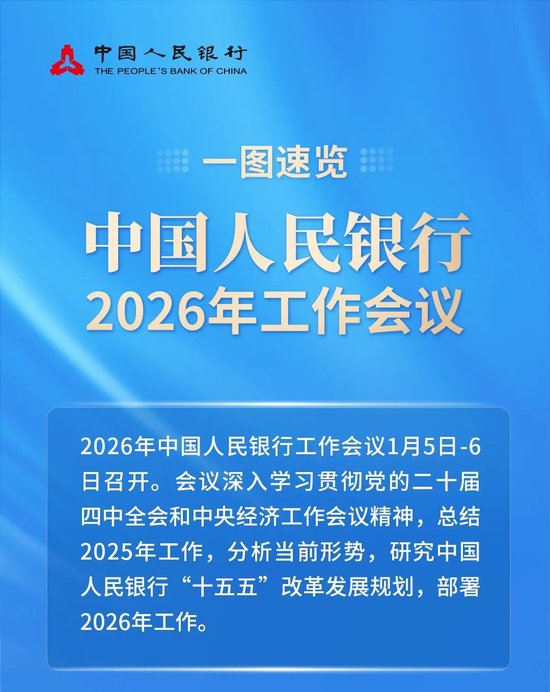
Core Viewpoint - The People's Bank of China (PBOC) held its 2026 work meeting to summarize 2025's work, analyze the current situation, and plan for the "14th Five-Year Plan" reform and development, focusing on monetary policy and financial stability. Group 1: Review of 2025 Key Work - The PBOC emphasized the need to improve the central bank system and develop key work on six core elements, monetary policy, macro-prudential policy framework, and financial market development [2][35]. - A package of monetary policies was launched, utilizing tools such as lowering the reserve requirement ratio and open market operations to maintain ample liquidity [3][37]. - The PBOC aims to reduce the comprehensive financing costs for society [39]. Group 2: International Financial Cooperation - The PBOC will continue to engage in global governance initiatives and deepen bilateral financial cooperation, focusing on global financial and regional security networks [5][41]. - Active participation in the G20 and strengthening global macroeconomic policy coordination is a priority [6][42]. Group 3: Financial Services and Risk Management - The PBOC is enhancing the quality of financial services, particularly in technology innovation and support for small and micro enterprises, with over 700 entities issuing technology innovation bonds exceeding 1.5 trillion yuan [46][47]. - Financial risks in key areas are being effectively mitigated, with a focus on managing debt risks of financing platforms [48][63]. Group 4: Financial Market Opening and Regulation - The PBOC is advancing high-level financial openness, optimizing the management system for foreign financial institutions, and enhancing the interconnectivity of domestic and foreign markets [49][51]. - Strengthening regulatory enforcement in financial markets and combating illegal activities is a key focus [65]. Group 5: Enhancing Financial Management and Services - The PBOC is accelerating the legislative process for important financial laws and enhancing the financial statistical system [52][72]. - Continuous improvement of the digital currency management system and support for personal credit restoration policies are being implemented [52][57].
央行、外汇局最新会议,继续实施适度宽松的货币政策
Zheng Quan Shi Bao· 2026-01-06 12:16
Core Viewpoint - The People's Bank of China (PBOC) emphasizes the continuation of a moderately accommodative monetary policy for 2026, focusing on enhancing financial services for high-quality economic development and deepening financial reforms and higher-level opening-up [3] Group 1: PBOC's Key Work Areas for 2026 - The PBOC will focus on seven key areas, including the flexible and efficient use of various monetary policy tools such as reserve requirement ratio (RRR) cuts and interest rate reductions [3][4] - The PBOC aims to prevent excessive fluctuations in the exchange rate and optimize mechanisms like "Bond Connect" and "Swap Connect" [3][4] - The central bank will enhance financial support for key sectors such as domestic demand, technological innovation, and small and micro enterprises [4] Group 2: Financial Risk Management - The PBOC will leverage macro-prudential management to mitigate financial risks in key areas and strengthen regulatory enforcement in financial markets [4] - A mechanism will be established to provide liquidity to non-bank institutions under specific scenarios [4] Group 3: Financial Reform and Opening-Up - The PBOC will continue to optimize the "Bond Connect" and "Swap Connect" mechanisms and support the construction of Shanghai as an international financial center [4] - The central bank will facilitate the use of the Renminbi in trade and investment and improve cross-border financial services [4] Group 4: Foreign Exchange Management - The State Administration of Foreign Exchange (SAFE) aims to create a more convenient, open, secure, and intelligent foreign exchange management system in 2026 [7] - Key tasks include deepening foreign exchange facilitation reforms and steadily advancing high-level institutional opening in the foreign exchange sector [8] - SAFE will support the development of new trade formats like cross-border e-commerce and enhance trade credit reporting management [8]
降准降息可期!央行2026年政策定调,非银流动性机制有望破题
Di Yi Cai Jing Zi Xun· 2026-01-06 12:15
Group 1: Monetary Policy Direction - The People's Bank of China (PBOC) emphasizes promoting high-quality economic development and reasonable price recovery as key considerations for monetary policy in 2026, utilizing various tools such as reserve requirement ratio (RRR) cuts and interest rate reductions flexibly and efficiently [1][2] - The 2026 monetary policy will focus on both total and structural policies, maintaining ample liquidity and relatively loose social financing conditions to align the growth of social financing and money supply with economic growth and price level expectations [2][3] Group 2: Exchange Rate Management - The PBOC aims to maintain the stability of the RMB exchange rate at a reasonable and balanced level while preventing excessive fluctuations, with recent trends showing a strong recovery of the RMB against the USD [4][5] - Analysts predict that the RMB may experience moderate appreciation in 2026, supported by a favorable external environment, including the ongoing easing cycle of the Federal Reserve [4][6] Group 3: Financial Risk Prevention - The PBOC identifies the resolution of financial risks in key areas as a top priority for 2026, with measures to address risks related to financing platforms, small financial institutions, and financial markets [7] - A proposed mechanism for providing liquidity support to non-bank financial institutions in specific scenarios aims to enhance the financial stability framework, responding to potential systemic pressures [7][8]
2026年适度宽松的货币政策将着力服务经济高质量发展
Yang Shi Wang· 2026-01-06 12:11
Core Viewpoint - In 2026, China will continue to implement a moderately accommodative monetary policy, focusing on promoting stable economic growth and reasonable price recovery as key considerations for monetary policy [1] Group 1: Monetary Policy Implementation - The People's Bank of China will flexibly and efficiently utilize various monetary policy tools such as reserve requirement ratio (RRR) cuts and interest rate reductions to maintain ample liquidity [1] - The aim is to keep social financing conditions relatively loose and guide reasonable growth in the total financial volume and balanced credit allocation [1] Group 2: Support for Key Areas - The 2026 monetary policy will emphasize enhancing financial services for high-quality development of the real economy, improving the structural monetary policy tool system [1] - There will be increased financial support for key areas such as expanding domestic demand, technological innovation, and small and micro enterprises [1] Group 3: Financial Market Development - The People's Bank of China will continue to deepen high-level financial market opening, facilitating the use of the Renminbi in trade and investment [1] - Improvements will be made to the infrastructure for cross-border use of the Renminbi [1]
央行明确今年七大重点工作!信号很大
21世纪经济报道· 2026-01-06 11:59
Core Viewpoint - The People's Bank of China (PBOC) has outlined seven key tasks for 2026, focusing on strict governance, a moderately loose monetary policy, enhancing financial services for high-quality economic development, managing financial risks, deepening financial reforms and opening up, promoting global financial governance reform, and improving financial management and service capabilities [1]. Group 1: Monetary Policy - The PBOC emphasizes the importance of promoting high-quality economic development and reasonable price recovery as key considerations for monetary policy, utilizing various tools like reserve requirement ratio (RRR) cuts and interest rate reductions to maintain ample liquidity and guide reasonable growth in social financing and credit [4]. - The monetary policy framework is shifting towards a price-oriented approach, with future adjustments aimed at enhancing the effectiveness of monetary policy transmission through better coordination among various interest rates [5][6]. - The PBOC is expanding the coverage of explicit corporate loan comprehensive financing costs, benefiting many small and medium-sized enterprises through a pilot program that clarifies all costs associated with loans [6][7]. Group 2: Exchange Rate Management - The PBOC aims to maintain the stability of the RMB exchange rate at a reasonable and balanced level, with recent trends showing the RMB strengthening against the USD, indicating a need for careful monitoring to prevent excessive fluctuations [7][8]. - Experts suggest that the focus should be on structural adjustments and expanding domestic demand to enhance the certainty of the domestic economic cycle, which is essential for achieving long-term stability of the RMB exchange rate [8].
央行明确今年七大重点工作
新华网财经· 2026-01-06 11:52
——继续实施好适度宽松的货币政策。灵活高效运用降准降息等多种货币政策工具,保持流动性充裕,保持社会融资条件相对宽松,引导 金融总量合理增长、信贷投放均衡。 2026年中国人民银行工作会议1月5日-6日召开。会议以习近平新时代中国特色社会主义思想为指导,深入学习贯彻党的二十届四中全会和 中央经济工作会议精神,总结2025年工作,分析当前形势,研究中国人民银行"十五五"改革发展规划,部署2026年工作。中国人民银行 党委书记、行长潘功胜出席会议并讲话,朱鹤新、曲吉山、宣昌能、陆磊、陶玲、邹澜出席会议。 要点速览: ——完善结构性货币政策工具体系;高质量建设和发展债券市场"科技板"。 ——建立在特定情景下向非银机构提供流动性的机制性安排,发挥好两项支持资本市场的货币政策工具作用。 ——加强对银行间债券市场、货币市场、外汇市场、票据市场、黄金市场及有关衍生品的监督管理。 ——进一步提升金融管理和服务能力。稳妥实施好一次性个人信用修复政策。 —— 强化虚拟货币监管,持续打击相关违法犯罪活动;深化科技管理与创新应用;稳步发展数字人民币。 会议认为, 2025年以来,面对复杂严峻的国内外经济金融形势,中国人民银行坚决落实党 ...
央行明确今年七大重点工作,解读来了→
Xin Lang Cai Jing· 2026-01-06 11:51
Core Viewpoint - The People's Bank of China (PBOC) is set to continue its moderately accommodative monetary policy in 2026, focusing on supporting high-quality economic development and addressing financial risks while enhancing financial services [1][12][20]. Group 1: Key Tasks for 2026 - The PBOC has outlined seven key tasks for 2026, including the promotion of strict party governance, the continuation of a moderately accommodative monetary policy, and the enhancement of financial services for high-quality economic development [1][12][15]. - The tasks also include the prudent resolution of financial risks in key areas, the deepening of financial reform and opening-up, the active promotion of global financial governance reform, and the improvement of financial management and service capabilities [2][3][14][15]. Group 2: Monetary Policy and Economic Support - The PBOC's monetary policy has been supportive, with a series of policies implemented to boost market confidence and stabilize economic operations [15][16]. - In 2025, the monetary policy effectively supported the steady recovery of the real economy, with a focus on maintaining liquidity and optimizing the structure of financial support [16][18]. - The overall financing scale and broad money supply growth are expected to exceed nominal GDP growth by about 1 time [5][16]. Group 3: Interest Rates and Financing Costs - The PBOC has lowered policy interest rates, resulting in a decrease in the average interest rates for new loans, with corporate loans at approximately 3.1%, down about 30 basis points year-on-year [17][18]. - The decline in comprehensive financing costs reflects a relatively loose monetary condition, which has facilitated effective financing demand from the real economy [18][19]. Group 4: Structural Adjustments in Financing - The PBOC has increased the quotas for re-lending to support technological innovation and consumption, with specific allocations of 300 billion yuan for technology and 500 billion yuan for consumption and elderly care [7][18]. - As of November 2025, the balance of various loans in renminbi reached 271 trillion yuan, with a year-on-year growth of 6.4%, indicating a focus on key economic sectors [7][18]. Group 5: Transparency in Financing Costs - The pilot program for disclosing comprehensive financing costs for enterprises aims to clarify the costs associated with loans, helping businesses understand their financial obligations better [10][22]. - This initiative is expected to reduce the overall financing costs for enterprises, enhancing their financial decision-making capabilities [22][23].
央行、外汇局最新会议!继续实施适度宽松的货币政策
Zheng Quan Shi Bao Wang· 2026-01-06 11:51
Core Viewpoint - The People's Bank of China (PBOC) emphasizes the continuation of a moderately accommodative monetary policy for 2026, focusing on enhancing financial services for high-quality economic development and deepening financial reforms and higher-level opening-up [1][2]. Monetary Policy - The PBOC will implement various monetary policy tools, including reserve requirement ratio (RRR) cuts and interest rate reductions, to maintain ample liquidity and support balanced credit growth [2][3]. - The central bank aims to keep the RMB exchange rate stable at a reasonable level while preventing excessive fluctuations [2][3]. Financial Services - The PBOC plans to improve the financial support framework for key areas such as domestic demand, technological innovation, and small and micro enterprises [3]. - There will be a focus on enhancing the bond market, particularly the "technology board," and increasing credit support for consumer services and agriculture [3][4]. Financial Risk Management - The PBOC will strengthen macro-prudential management and financial stability measures, including establishing mechanisms for providing liquidity to non-bank institutions under specific scenarios [3][4]. - Continuous efforts will be made to combat illegal activities in financial markets and enhance regulatory enforcement [3][4]. Financial Reform and Opening-Up - The PBOC will optimize mechanisms like "Bond Connect" and "Swap Connect," support the construction of Shanghai as an international financial center, and facilitate the use of RMB in trade and investment [3][4]. - The central bank encourages more eligible foreign entities to issue Panda bonds [3][4]. Foreign Exchange Management - The State Administration of Foreign Exchange (SAFE) aims to create a more convenient, open, secure, and intelligent foreign exchange management system in 2026 [5][6]. - Key tasks include deepening foreign exchange facilitation reforms, supporting the development of new trade formats like cross-border e-commerce, and enhancing the management of trade credit reporting [6]. External Risk Mitigation - SAFE will strengthen macro-prudential management and expectation management to maintain a stable foreign exchange market amid external shocks [6].
央行明确2026年重点工作:灵活高效运用降准降息等多种货币政策工具
华尔街见闻· 2026-01-06 11:49
Core Viewpoint - The article emphasizes the importance of continuing a moderately loose monetary policy to support economic growth and stabilize financial markets, while also enhancing financial services and risk management [3][8]. Group 1: Monetary Policy Implementation - The central bank will maintain a flexible and efficient use of various monetary policy tools, such as reserve requirement ratio cuts and interest rate reductions, to ensure ample liquidity and relatively loose financing conditions [1][9]. - A structural monetary policy tool system will be improved, including the development of a "technology board" in the bond market to support capital market growth [2][9]. - The central bank aims to keep the social financing scale and money supply growth aligned with economic growth and price level expectations, ensuring a stable RMB exchange rate [9][10]. Group 2: Financial Services and Support - Financial services will be enhanced to support high-quality economic development, with a focus on improving the financial policy framework and evaluation systems [9][10]. - The central bank will optimize financial support for key areas such as technology innovation, small and micro enterprises, and consumer services, while also increasing the issuance of technology innovation bonds [5][9]. - A one-time personal credit repair policy will be implemented to assist individuals in rebuilding their credit efficiently [7][10]. Group 3: Risk Management - The central bank will continue to address debt risks associated with financing platforms and will promote the orderly exit of these platforms [10]. - Financial market monitoring and regulatory enforcement will be strengthened to combat illegal activities and ensure market stability [6][10]. - A macro-prudential management and financial stability framework will be further developed to enhance risk identification and early correction capabilities [10][11]. Group 4: Financial Reform and Opening Up - The central bank will deepen financial reform and promote a higher level of openness in financial markets, including optimizing mechanisms for bond and currency swaps [10][11]. - Efforts will be made to enhance cross-border financial services and facilitate the use of RMB in international trade and investment [11][12]. - The central bank will actively participate in global financial governance reforms and strengthen cooperation with international financial organizations [11][12].