
美债收益率

Search documents
2025年8月4日,国内黄金9995价格多少钱一克?
Sou Hu Cai Jing· 2025-08-04 00:54
Core Viewpoint - The recent surge in gold prices is driven by disappointing U.S. employment data, rising interest rate cut expectations, trade tensions, and a weakening dollar, creating a favorable environment for gold as a safe-haven asset [3][4]. Group 1: Factors Influencing Gold Prices - U.S. non-farm payrolls for July increased by only 73,000, significantly below expectations, leading to a surge in market expectations for a Federal Reserve rate cut from 38% to 90% for September, with some predicting a 50 basis point cut [3]. - The imposition of high tariffs by the U.S. on products from Canada, Brazil, and India has triggered a global stock market decline, increasing demand for gold as a traditional safe-haven asset amid rising market uncertainty [3]. - A 1.39% drop in the U.S. dollar index, the largest decline since April, along with a significant drop in U.S. Treasury yields, has reduced the opportunity cost of holding gold, further supporting its price [3]. Group 2: Future Outlook for Gold - In the short term, if the Federal Reserve cuts rates as expected and trade issues persist, gold prices are likely to continue rising [4]. - However, if upcoming U.S. economic data exceeds expectations or if Federal Reserve officials adopt a hawkish stance, a price correction may occur [4]. - Long-term factors such as global economic uncertainty, geopolitical tensions, and central bank gold purchases are expected to support gold prices, allowing for sustained high-level fluctuations and potential further increases [4].
宏观海外周报:美国关税再度抬升,非农大幅下修-20250803
HTSC· 2025-08-03 14:20
Economic Overview - The U.S. GDP growth for Q2 was revised up to 3.0%, exceeding expectations of 2.6%, with net exports contributing 5 percentage points[5] - The Atlanta Fed's GDP Now forecast indicates a slight decrease in Q3 GDP growth to 2.1%[3] - The final domestic private purchases growth (consumption + investment) fell by 0.7 percentage points to 1.2%[5] Employment Data - July non-farm payrolls increased by only 74,000, significantly below the expected 104,000, with prior months' data revised down by 258,000[5] - Initial jobless claims decreased by 23,000 to 193,000, better than the expected 211,000, indicating no significant layoffs yet[3] - The unemployment rate rose by 0.1 percentage points to 4.2%, primarily due to a drop in labor force participation[5] Inflation and Monetary Policy - The core PCE inflation for June was reported at 2.6%, above the expected 2.5%, indicating persistent inflationary pressures[5] - The Federal Reserve maintained the benchmark interest rate at 4.25%-4.5% during the July FOMC meeting, with a hawkish tone from Powell[6] Market Reactions - U.S. stock indices fell, with the S&P 500, Nasdaq, and Dow Jones down by 2.4%, 2.2%, and 2.9% respectively[7] - The U.S. dollar index rose by 1% to 98.7, while the euro and yen depreciated by 2.8% and 2.1% respectively[7] Commodity Prices - COMEX gold prices increased by 1.9% to $3,399.8 per ounce, while Brent crude oil rose by 1.8% to $69.7 per barrel[7]
招商宏观:非农数据断层 9月降息预期回归
智通财经网· 2025-08-03 01:09
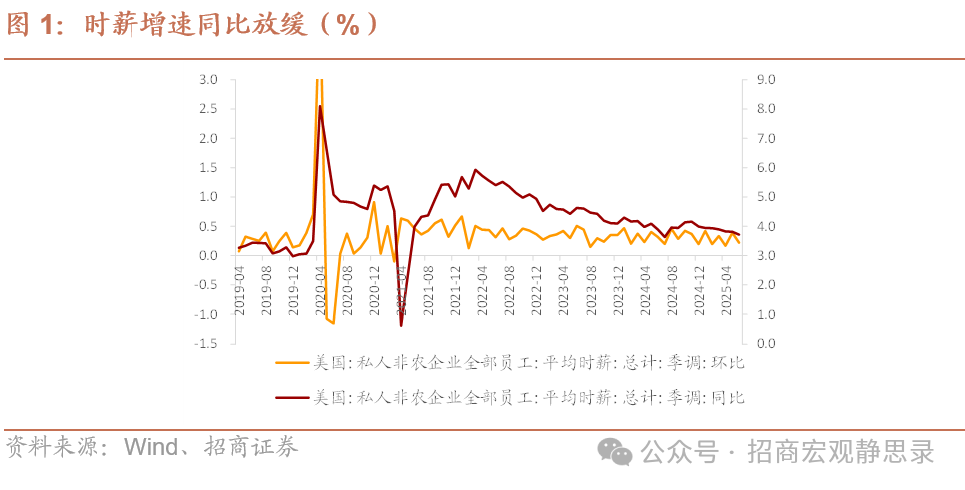
Core Viewpoint - The report from China Merchants Securities indicates that the U.S. non-farm payroll data for July significantly underperformed expectations, with a notable downward revision of previous values, suggesting a faster cooling of labor market demand compared to supply. The government sector shifted from a contributor to a detractor, while manufacturing and business services showed weakness [1]. Employment Data - In July, the U.S. non-farm payrolls added 73,000 jobs, falling short of the market expectation of 104,000. The previous month's data was drastically revised down from an initial 147,000 to just 14,000, with a total downward revision of 258,000 jobs over the past two months [1][2]. - The unemployment rate rose to 4.2%, up from 4.1% in the previous month [1][3]. Sector Performance - The government sector recorded a loss of 10,000 jobs, with federal government job losses expanding to 12,000. The manufacturing sector also saw a decline of 11,000 jobs, while business services lost 14,000 jobs [2][4]. - In contrast, the retail sector added 16,000 jobs, and healthcare and social assistance saw an increase of 73,000 jobs [2][4]. Labor Market Dynamics - The labor force participation rate decreased for three consecutive months, reaching 62.2%. The participation rate for the prime working age group (25-54 years) fell to 83.4% [3]. - The U3 unemployment rate increased to 4.2%, while the broader U6 unemployment rate rose to 7.9% [3]. Wage Growth and Economic Indicators - Hourly wage growth continued to slow, with a year-on-year increase of 3.7% and a month-on-month increase of 0.2% [4]. - Following the release of the non-farm data, the U.S. dollar index fell back to around 98.9, and the yield on the 2-year Treasury note dropped by 22.6 basis points to approximately 3.7% [4].

两年期美债收益率于美国非农日跌超3个基点
news flash· 2025-08-01 16:35
Group 1 - The German 10-year bond yield decreased by 1.6 basis points to 2.679% on August 1, with a notable drop after the release of the US non-farm payroll report and the ISM manufacturing index [1] - The 2-year German bond yield fell by 3.5 basis points to 1.929%, with a total decline of 2.0 basis points for the week [1] - The 30-year German bond yield increased by 1.2 basis points to 3.189%, but experienced a cumulative drop of 1.8 basis points for the week [1] Group 2 - The yield spread between the 2-year and 10-year German bonds rose by 1.856 basis points to +74.612 basis points, with a total decline of 1.874 basis points for the week [1]
美债收益率涨跌不一,10年期美债收益率跌0.20个基点
Mei Ri Jing Ji Xin Wen· 2025-07-31 22:28
(文章来源:每日经济新闻) 每经AI快讯,当地时间7月31日,美债收益率涨跌不一,2年期美债收益率涨1.24个基点报3.953%,3年 期美债收益率涨1.41个基点报3.897%,5年期美债收益率涨0.70个基点报3.967%,10年期美债收益率跌 0.20个基点报4.366%,30年期美债收益率跌0.30个基点报4.896%。 ...
10年期美债收益率周四跌约1.8个基点,两年期美债收益率7月份累涨将近22个基点
news flash· 2025-07-31 20:02
Group 1 - The core point of the article highlights the fluctuations in U.S. Treasury yields, with the 10-year benchmark yield decreasing by 1.79 basis points to 4.3521% at the end of trading on July 31, while experiencing a cumulative increase of 12.41 basis points in July [1] - The 10-year yield rose from 4.1852% to a peak of 4.4933% between July 1 and July 16, followed by a partial retracement and a high-level oscillation since July 7 [1] - The two-year Treasury yield fell by 0.20 basis points to 3.9386%, with a cumulative increase of 21.93 basis points in July, showing significant movement on July 3 and subsequent high-level fluctuations within the range of 3.6946% to 3.9587% [1]
2025年二季度美国GDP数据点评:“抢进口”效果反转,推动美Q2增速超预期
CMS· 2025-07-31 02:57
Economic Growth - The initial estimate of the US GDP growth rate for Q2 2025 is 3.0%, a significant increase from the previous value of -0.5%[1] - Net exports contributed 5.0 percentage points to GDP growth, reversing the previous drag of 4.6 percentage points[1] Consumer Spending - Personal consumption expenditures (PCE) grew at an annualized rate of 1.4% in Q2 2025, up from 0.5% in the previous quarter, contributing 1.0 percentage point to GDP growth[1] - Goods consumption increased to 2.2% from 0.1%, while services consumption rose to 1.1% from 0.6%[1] Investment Trends - Non-residential fixed investment recorded a growth of 1.9%, down from 10.3%, contributing 0.3 percentage points to GDP growth[1] - Residential investment declined by 4.6%, worsening from a previous decline of 1.3%, detracting 0.2 percentage points from GDP growth[1] Inventory and Government Spending - Inventory investment negatively impacted GDP growth by 3.2 percentage points, a shift from a positive contribution of 2.6 percentage points in the previous quarter[1] - Government spending contributed 0.1 percentage points to GDP growth, with federal government spending detracting 0.2 percentage points[1] Trade Dynamics - The trade deficit for May 2025 was recorded at $71.517 billion, with a goods trade deficit of $96.423 billion and a services trade surplus of $25.994 billion[1] - The impact of "import rush" has diminished, leading to a rapid narrowing of the trade deficit, which has now become a contributor to GDP growth[1]
7月FOMC:鲍威尔鹰派发言打压降息预期
HTSC· 2025-07-31 02:13
Monetary Policy Decisions - The Federal Reserve maintained the benchmark interest rate at 4.25%-4.5% during the July meeting, with two members voting against this decision, marking the first such occurrence since 1993[1] - The statement shifted from a dovish tone to a more hawkish stance, with Powell emphasizing the strength of the labor market and the distance of inflation from the target[1][2] Economic Outlook - Powell acknowledged the economy's growth has moderated, with the assessment changing from "expand at a solid pace" to "moderated"[1][2] - The probability of a rate cut in September dropped to 45%, down from previous expectations, reflecting a cumulative decline of 7 basis points in rate cut expectations for the year[1][3] Market Reactions - Following the announcement, the 2-year and 10-year Treasury yields rose by 6 basis points and 2 basis points, reaching 3.94% and 4.37% respectively[1] - The US Dollar Index increased by 0.4% to 99.8, while the S&P 500 and gold prices fell by 0.8% and 0.9% to $3324 per ounce respectively[1] Employment and Inflation Insights - Powell highlighted a solid labor market but admitted to existing downside risks, with hiring slowing and labor supply decreasing[2][3] - Tariffs are contributing to inflation, with companies expected to gradually pass on costs to consumers, keeping inflation slightly above the Fed's target even when excluding tariff impacts[2] Future Rate Cut Considerations - The potential for a rate cut in September hinges on economic data from July and August, particularly employment and inflation metrics[3] - If employment data weakens or tariff impacts on inflation are less than expected, the Fed may still consider rate cuts in the September meeting[3]
鲍威尔避免给出9月利率指引,美债收益率上涨
news flash· 2025-07-30 19:11
Core Insights - Powell avoided providing clear guidance on the September interest rate decision, leading to a sell-off in U.S. Treasuries and an increase in yields [1] - The market had initially expected the Federal Reserve to cut rates in the September meeting, but Powell's comments shifted expectations [1] Market Reaction - Following Powell's remarks, the yield on the 10-year U.S. Treasury rose from 4.342% to 4.378% [1]
美联储主席鲍威尔表示劳动力市场并未走弱后,美债收益率走高。
news flash· 2025-07-30 18:49
Core Viewpoint - Federal Reserve Chairman Jerome Powell indicated that the labor market has not weakened, leading to an increase in U.S. Treasury yields [1] Group 1 - The statement from Powell suggests confidence in the resilience of the labor market, which may influence monetary policy decisions [1] - The rise in U.S. Treasury yields reflects market reactions to Powell's comments, indicating expectations of sustained economic strength [1]