美联储降息

Search documents
黄金:不好意思,我又反弹了!前一日大跌后,深夜黄金又大涨突破5040美元
Sou Hu Cai Jing· 2026-02-14 01:14
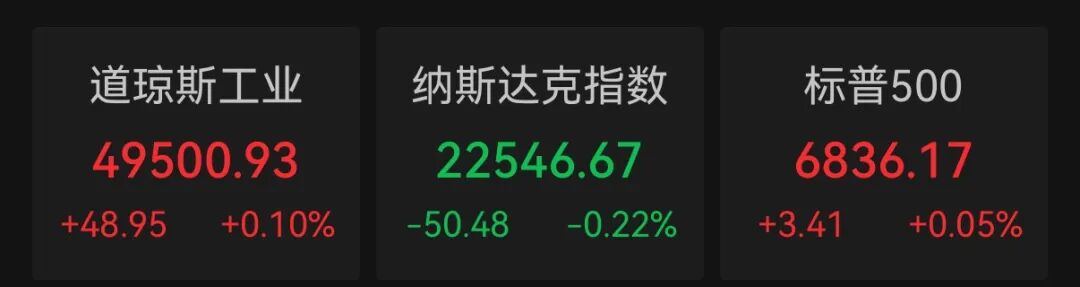
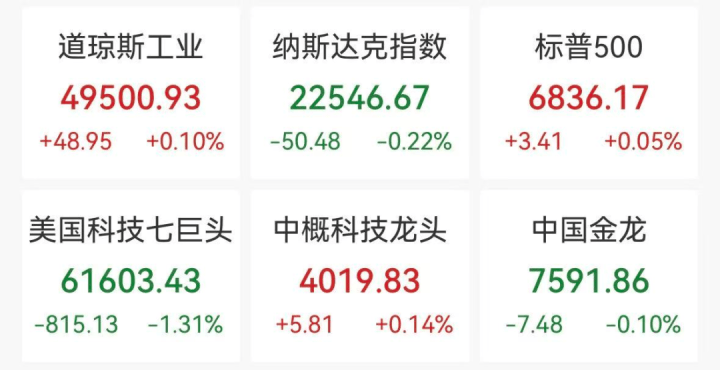
Group 1 - The core CPI year-on-year rate in the US fell from 2.7% to 2.4%, the lowest since May 2025, while the core CPI year-on-year rate decreased from 2.6% to 2.5%, the lowest since March 2021, both aligning with market expectations [1] - Following the CPI data release, the probability of the Federal Reserve easing policies in June increased to 69% from 63%, with traders estimating a 50% chance of a third rate cut this year [1] - The expected rate cut by the Federal Reserve in 2026 rose to 61 basis points from 58 basis points prior to the CPI announcement [1] Group 2 - The Dow Jones Industrial Average rose by 0.1% to close at 49,500.93, while the S&P 500 increased by 0.05% to 6,836.17, and the Nasdaq Composite fell by 0.22% to 22,546.67 [2] - Major technology stocks mostly declined, with Apple and Nvidia dropping over 2%, while Facebook and Google fell more than 1%, and Tesla saw a slight increase of 0.09% [2] - The Philadelphia Semiconductor Index rose by 0.66%, with notable gains in Applied Materials (over 8%) and ARM (over 2%), despite an initial drop of nearly 1% at the market open [2] Group 3 - Gold stocks performed strongly, with notable increases in companies such as Coeur Mining (over 7%), Harmony Gold, and Kinross Gold (over 6%), while Barrick Gold rose by over 5% [3] - The Nasdaq Golden Dragon China Index fell by 0.10%, with Tencent Music rising over 4% and Yum China increasing by over 3%, while JinkoSolar and Alibaba saw declines of over 2% [3] - Gold and silver prices surged, with gold closing at $5,042.808 per ounce, marking a daily increase of over 2.4%, and silver reaching $77.338 per ounce after a rise of over 5% [4][6]

古尔斯比暂不支持现阶段降息 美国1月CPI同比2.4%仍未达美联储2%通胀目标
Sou Hu Cai Jing· 2026-02-14 01:14
古尔斯比提到,通胀已连续超过4年半高于目标水平,在开启降息前必须看到通胀切实改善,而非被动 等待其自行好转。他暗示,在联邦基金利率达到中性利率水平前,美联储仍存在进一步降息空间,但当 前首要任务是推动通胀回落。 美国1月通胀数据公布后,交易员加大押注美联储2026年内降息超过两次。美联储下次货币政策会议将 于3月17日至18日召开,据CME"美联储观察"显示,当前市场认为美联储3月维持利率不变的概率为 90.2%,降息25个基点的概率为9.8%。 同日公布的美国1月消费者价格指数(CPI)年率录得2.4%,创2025年5月以来新低,低于市场预期的 2.5%;剔除食品和能源成本后的核心CPI同比上涨2.5%,创2021年3月以来新低,符合市场预期。尽管 通胀数据较预期温和,但仍未达到美联储设定的2%目标。 古尔斯比指出,受关税影响的商品价格已得到控制,但服务业通胀尚未得到遏制,且并非由关税推 动。"更令人担忧的是,我们仍看到服务业通胀居高不下,而这类通胀往往具有持续性。"他同时表示, 希望关税对通胀的影响已达峰值,且最终被证明为暂时性影响。 当地时间周五,美国芝加哥联储主席古尔斯比明确表示,暂不支持现阶段降息, ...
道指标普录得3个月最差单周,黄金夺回5000美元
Di Yi Cai Jing Zi Xun· 2026-02-14 01:07
2026.02.14 本文字数:1770,阅读时长大约3分钟 作者 | 第一财经 樊志菁 周五美股涨跌互现,通胀数据降温支撑了市场对美联储降息的预期,科技股仍然面临AI 相关担忧引发 的剧烈波动。截至收盘,道指涨48.95点,涨幅0.10%,报49500.93点,纳指跌0.22%,报22546.67点,标 普500指数涨0.05%,报6836.17点。 本周道指累计下跌1.28%,纳指跌1.49%,标普500指数跌1.45%。 标普500指数本周录得去年11月以来最大单周跌幅,道琼斯工业平均指数也将迎来去年11月以来最深周 度跌幅。芝加哥期权交易所波动率指数(VIX)早盘一度触及 22.40 点高位,突破20的关键心理关口。 | 道琼斯工业平均 纳斯达克 | 标普500 | | --- | --- | | 49500.93 22546.67 | 6836.17 | | +48.95 +0.10% -50.48 -0.22% +3.41 +0.05% | | 【热门股表现】 明星科技股跌多涨少。特斯拉涨0.09%,微软跌0.13%,亚马逊跌0.41%,日线九连阴创近20年最差纪 录,谷歌,Meta跌超1%,英伟 ...
道指标普录得3个月最差单周,黄金夺回5000美元
第一财经· 2026-02-14 01:00
作者 | 第一财经 樊志菁 周五美股涨跌互现,通胀数据降温支撑了市场对美联储降息的预期,科技股仍然面临AI 相关担忧引 发的剧烈波动。截至收盘,道指涨48.95点,涨幅0.10%,报49500.93点,纳指跌0.22%,报22546.67 点,标普500指数涨0.05%,报6836.17点。 本周道指累计下跌1.28%,纳指跌1.49%,标普500指数跌1.45%。 标普500指数本周录得去年11月以来最大单周跌幅,道琼斯工业平均指数也将迎来去年11月以来最深 周度跌幅。芝加哥期权交易所波动率指数(VIX)早盘一度触及 22.40 点高位,突破20的关键心理关 口。 【热门股表现】 2026.02. 14 本文字数:1770,阅读时长大约3分钟 纽约斯巴达资本证券公司首席市场经济学家彼得・卡迪略表示:"归根结底,这是一份不错的数据。 它表明我们虽然未达到美联储2%的通胀目标,但通胀并未加速,或许在关税带来的通胀压力方面, 我们开始看到一丝曙光。压力依然存在,但正在缓和。" Osaic首席市场策略师菲尔・布兰卡托表示:"对市场和即将上任的美联储主席凯文・沃什来说,这应 是利好消息。这虽只是一个月的数据,但如果趋 ...
不支持降息!美联储古尔斯比CPI出炉后“放鹰”
Feng Huang Wang· 2026-02-14 01:00
Core Viewpoint - Chicago Fed President Goolsbee indicates that he does not support interest rate cuts until inflation shows more progress towards the Fed's 2% target [1][2] Inflation Data - The January Consumer Price Index (CPI) in the U.S. recorded a year-on-year rate of 2.4%, the lowest since May 2025, and below market expectations of 2.5% [1] - The core CPI, excluding food and energy, rose by 2.5% year-on-year, marking the lowest level since March 2021, which met expectations [1] Concerns on Inflation - Goolsbee expresses concerns about persistent service sector inflation, which he believes has not been contained and is not driven by tariffs [2] - He suggests that while there are signs of improvement in inflation, there are still underlying worries, particularly regarding service sector prices [2] Interest Rate Outlook - Goolsbee hints at further room for rate cuts before reaching what he considers a neutral interest rate, which neither stimulates nor suppresses economic growth [2] - Following the release of January inflation data, traders increased bets that the Fed may cut rates more than twice within 2026 [2] - The next Fed meeting is scheduled for March 17-18, with a 9.8% probability of a 25 basis point cut and a 90.2% probability of maintaining current rates [2]
新一轮俄美乌会谈即将举行!特朗普证实,部署第二艘航母!国内金属市场节前普遍收跌
Qi Huo Ri Bao· 2026-02-14 00:45
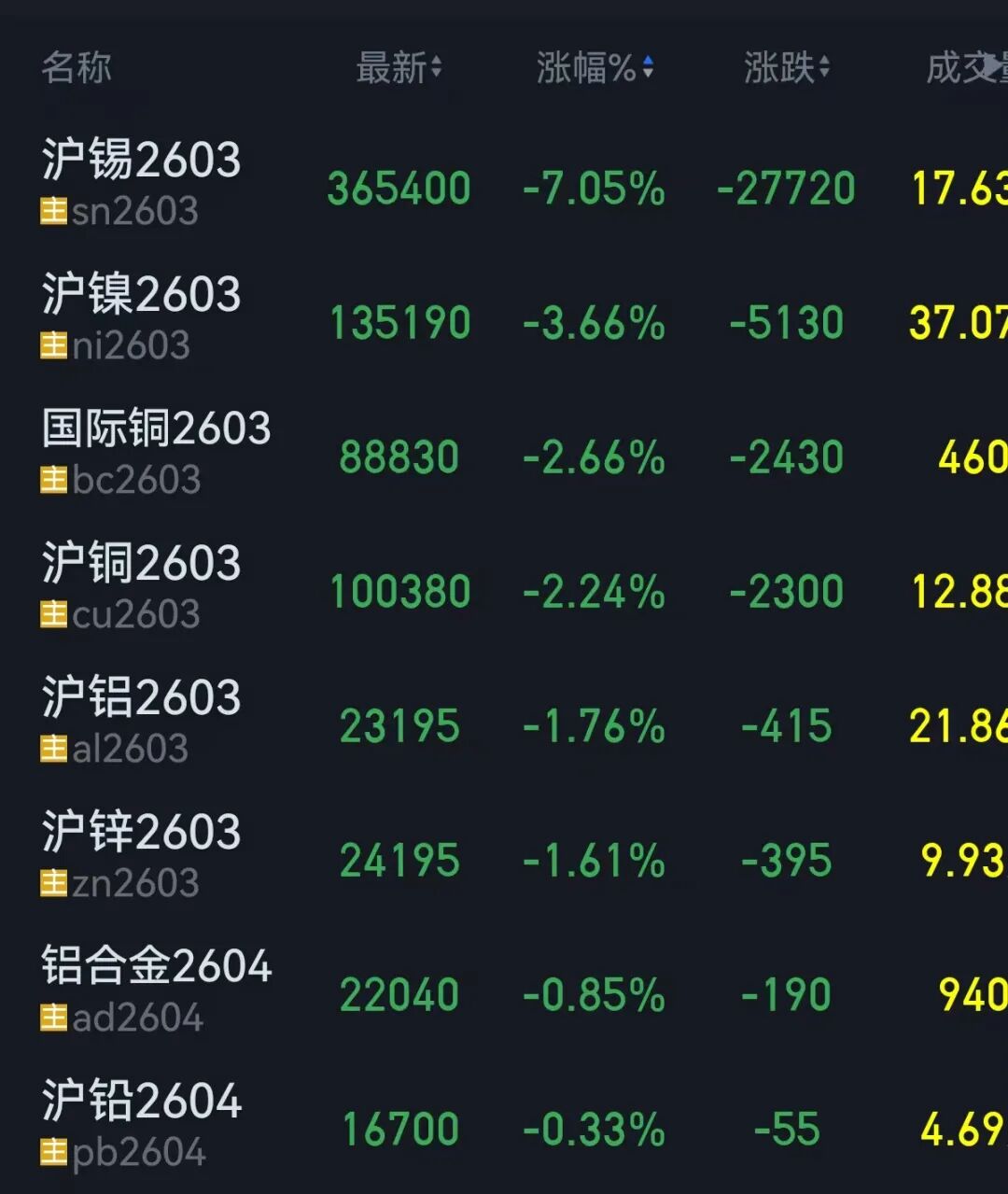
Market Performance - COMEX gold futures rose by 2.17% to $5050.50 per ounce, while COMEX silver futures increased by 1.98% to $77.180 per ounce [2] - The U.S. stock market showed mixed results, with the Dow Jones up 0.10%, the Nasdaq down 0.22%, and the S&P 500 up 0.05%. Notably, major tech stocks like Apple and Nvidia fell over 2% [3] Domestic Metal Market - The domestic metal market experienced a general decline before the Spring Festival, with significant drops in prices for tin and silver. Specifically, Shanghai gold futures fell by 1.61% to 1110.10 yuan per gram, and Shanghai silver futures dropped by 5.52% to 19782 yuan per kilogram [4][6] - The decline in gold and silver prices is attributed to weakened market sentiment and risk appetite, exacerbated by a significant drop in U.S. stocks [6] Employment Data Impact - The U.S. non-farm payroll data for January showed an increase of 130,000 jobs, significantly exceeding the market expectation of 70,000. This data alleviated concerns about a deteriorating job market and reduced the perceived necessity for the Federal Reserve to lower interest rates in the short term [7] - However, the total projected job growth for 2025 was revised down by 898,000, indicating that one month's data may not be sufficient to determine a trend reversal in the job market [7] Gold and Silver Market Outlook - Analysts suggest that the gold and silver markets are currently in a "rebalancing" phase, with prices expected to remain volatile in the short term. However, long-term factors such as high global debt and geopolitical tensions are likely to support upward price movements for gold and silver [8] - The upcoming U.S. PCE and GDP data during the holiday period are anticipated to significantly influence market pricing for U.S. economic conditions and inflation [8]
【环球财经】通胀低于预期 纽约股市三大股指13日涨跌不一
Xin Hua Cai Jing· 2026-02-14 00:28
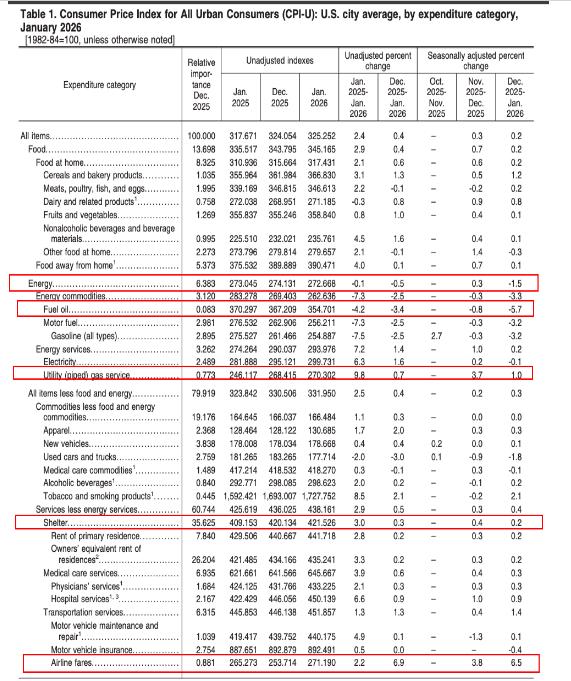
新华财经纽约2月13日电(记者刘亚南)由于对通胀的担忧缓解而对人工智能冲击的担忧持续,纽约股 市三大股指13日走势起伏,收盘涨跌不一。 截至当天收盘,道琼斯工业平均指数比前一交易日上涨48.95点,收于49500.93点,涨幅为0.10%;标准 普尔500种股票指数上涨3.41点,收于6836.17点,涨幅为0.05%;纳斯达克综合指数下跌50.477点,收于 22546.671点,跌幅为0.22%。 板块方面,标普500指数十一大板块七涨四跌。公用事业板块和房地产板块分别以2.69%和1.48%涨幅领 涨,通信服务板块和科技板块分别以0.76%和0.52%跌幅领跌。 美国劳工部当日盘前发布的数据显示,美国1月份消费者价格指数环比上涨0.2%,而市场共识预期和前 月涨幅均为0.3%;该指数1月同比上涨2.4%,低于市场共识预期的2.5%和前月的2.7%,为2025年5月以 来的最低水平。1月食品价格指数环比增加0.2%,低于前月的0.3%,1月能源价格指数环比下降1.5%, 而前月则为环比增加0.3%。 扣除食品和能源,美国1月核心消费者价格指数环比上涨0.3%,符合市场预期,高于前月的0.2%;该核 心指数 ...
黄金、白银大涨!
证券时报· 2026-02-14 00:28
Group 1 - The U.S. stock indices closed mixed on February 13, with the Dow Jones Industrial Average up 0.1% at 49,500.93 points, the S&P 500 up 0.05% at 6,836.17 points, and the Nasdaq down 0.22% at 22,546.67 points. For the week, the Dow Jones fell 1.23%, the S&P 500 fell 1.39%, and the Nasdaq fell 2.1% [1] - The U.S. CPI data released showed a year-on-year increase of 2.4% in January, down from 2.7% in December, and below the economist's expectation of 2.5%. The core CPI rose 2.5% year-on-year and 0.3% month-on-month [4] - Following the CPI report, traders increased their bets on the Federal Reserve cutting interest rates three times this year, with a 50% chance of a rate cut by the end of the year [4][5] Group 2 - International precious metal futures saw widespread gains, with COMEX gold futures rising 2.33% to $5,063.80 per ounce and COMEX silver futures up 2.10% to $77.27 per ounce [2][7] - The rise in precious metal prices is attributed to multiple factors, including increased expectations for Federal Reserve rate cuts and a decline in the U.S. dollar index, enhancing the attractiveness of precious metals [8] - The oil market showed mixed results, with U.S. crude oil futures down 0.05% at $62.81 per barrel and Brent crude oil futures up 0.24% at $67.68 per barrel [9]
峰回路转?核心CPI创四年新低 美联储新帅首秀降息概率升至七成
Di Yi Cai Jing· 2026-02-14 00:23
数据好于预期 当地时间周五(13日),美国劳工统计局(BLS)公布,1月CPI环比上涨0.2%,低于去年12月未修正 的0.3%涨幅。CPI年率从2.7%回落至2.4%,创2025年5月以来新低,市场预期中值2.5%。1月未季调核 心CPI环比上涨0.3%,符合预期,较12月的0.2%小幅回升。年率从2.6%回落至2.5%,创2021年3月以来 新低,符合市场预期。核心CPI上升部分源于年初一次性涨价,劳工统计局用于剔除季节性波动的季节 调整模型,尚未完全覆盖此类一次性调价影响。 受汽油价格走低、租金通胀放缓影响,美国 1月消费者物价指数(CPI)涨幅低于预期,市场定价显 示,6月再次成为今年美联储政策调整的热门窗口。不过考虑到关税、美元贬值和服务价格等因素影 响,美联储在夏季前重启降息的不确定性依然存在。 政策前景如何 白宫对整体通胀放缓表示欢迎,一名发言人在社交媒体发文称:"美联储早该实施的降息,将进一步为 美国经济注入强劲动力。" 但对就业市场与物价承受力感到焦虑的美国民众,对特朗普总统的经济治理表现越发不满。爱德华·琼 斯投资策略高级经济学家詹姆斯·麦卡恩表示:"整体来看,数据表明当前物价压力仍略偏高 ...
美联储降息预期升温 金银价格上涨
Zhong Guo Zheng Quan Bao· 2026-02-14 00:22
当地时间2月13日,美国劳工统计局公布的CPI数据显示当前通胀水平较为温和,推动市场对美联储6月降息的预期升温。受此影响,贵金属价格明显走 高。截至当日收盘,美国三大股指涨跌不一,大型科技股整体承压,国际油价小幅上行。 美股收盘涨跌不一 受通胀数据影响,当地时间2月13日,美国股市表现分化。Wind数据显示,截至当日收盘,三大股指涨跌不一,道指上涨0.1%,标普500指数上涨0.05%, 纳指下跌0.22%。 美国劳工统计局当日公布的数据显示,1月CPI环比上涨0.2%、同比上涨回落至2.4%。随着通胀压力边际缓解,根据芝商所(CME)美联储观察工具,市 场对美联储6月降息的预期有所增强。 大型科技股整体承压。万得美国科技七巨头指数下跌1.31%。其中,苹果、英伟达跌超2%,Meta、谷歌母公司Alphabet-C跌逾1%,亚马逊、微软小幅下 跌,特斯拉微涨0.09%。 降息预期推动贵金属价格走高 降息预期升温叠加避险需求回升,推动贵金属价格走高。截至北京时间6:03,伦敦金现货价格涨2.41%,报5042.808美元/盎司,盘中最高报5046.261美元/ 盎司;COMEX黄金期货价格涨2.3%,报5062 ...