美元霸权

Search documents
美国至9月20日当周初请失业金人数下降
Sou Hu Cai Jing· 2025-09-26 09:04
9月25日公布的数据显示,美国至9月20日当周初请失业金人数从前值23.2万人下降至21.8万人。不过,有机构指 出,美国最新的初请失业金人数的下降是在特朗普总统的移民政策造成就业市场劳动力人数下降基础上企业担 心招聘困难而减少裁员的情况下产生的结果。 JerryZang 免责声明:本文内容及观点仅供参考,不构成任何投资建议。投资者据此操作,风险自担。一切有关市场的准 确信息,请以相关官方公告为准。市场有风险,投资需谨慎。 同日公布的美国第二季度GDP年化季率终值从初值3.30%上修到3.8%。这反映出美国经济在今年第二季度的增长 相当强劲。不过,这似乎与前期制造业和就业市场的疲软相左。 美联储主席鲍威尔和一些机构的分析师都曾指出,当前美国经济面临的压力不小,存在下行风险。这不仅是特 朗普总统的关税政策给美国经济带来的不确定性影响造成的,更是美国经济深层次矛盾的反映,也是美元信用 透支的体现。 实际上,对于拥有强大的美元体系并能够影响全球经济的方方面面的美国而言,真正能够在短期导致美国经济 出现大动荡,能够造成美元信用下降的只有美国自己。正所谓"祸起萧墙"。 成也萧何败也萧何。美国经济在过往的一个世纪的辉煌源 ...


输入性通胀不可避免
Hu Xiu· 2025-09-26 00:27
Core Viewpoint - The article discusses the recent surge in copper prices and reflects on the broader implications of monetary policy and commodity price fluctuations, particularly in the context of historical events and economic cycles. Group 1: Commodity Price Trends - The article highlights the cyclical nature of commodity prices, noting that significant drops in prices often begin with gold, which is tied to the dollar's value [3][5][21] - It references the historical context of commodity price movements, including the rise of oil prices post-911 and the subsequent financial crises that have influenced market dynamics [2][10][19] Group 2: Monetary Policy and Economic Impact - The discussion includes the role of the Federal Reserve in managing economic crises through monetary policy, emphasizing that the printing of money does not necessarily lead to inflation if managed correctly [13][22][23] - It points out that the Federal Reserve's actions have historically aimed to prevent asset price collapses, indicating a strategic approach to maintaining economic stability [19][23] Group 3: Geopolitical Considerations - The article suggests that geopolitical events, such as conflicts in the Middle East, have been manipulated to serve financial interests, impacting global commodity prices [7][8][10] - It also mentions the relationship between the U.S. and Russia during periods of high oil prices, indicating how financial incentives can shape international relations [9][10]
难怪美高层在联大情绪失控,克宫突然向全球宣布:与邻国达成“史无前例”的战略合作
Sou Hu Cai Jing· 2025-09-25 03:55
Group 1 - The U.S. high-level speech at the United Nations sparked significant discussion due to its excessive duration and emotional instability, leading to widespread speculation about the underlying reasons [1] - The Kremlin announced an unprecedented energy strategic cooperation agreement, which poses a major challenge to U.S. global hegemony [3] Group 2 - The agreement includes two key components: a trillion-level energy trade conducted entirely in rubles and another country's currency, completely excluding the U.S. dollar; and a joint development of Arctic LNG projects, controlling the Arctic as an "energy golden waterway" [5] - This cooperation disrupts the long-standing U.S. strategy of "energy binding to the dollar," which has allowed the U.S. to easily extract global wealth through dollar-denominated oil transactions [5] Group 3 - According to CNBC estimates, after the agreement is implemented, at least 30% of international energy transactions may shift to non-dollar currencies, potentially ending the U.S. practice of "printing money for resources" [6] - The cooperation complicates the situation for Europe, which, after the Russia-Ukraine conflict, was forced by the U.S. to decouple from Russian energy while paying high prices for U.S. LNG, generating over 20 billion euros in annual profits for the U.S. [6] - Following this cooperation, Russian oil and gas will be directly supplied to partner countries, making it difficult for Europe to negotiate prices, leading to rising energy costs and public dissatisfaction while still paying high "energy taxes" to the U.S. [6]
东盟将黄金交中国保存?敲响美元终极丧钟,人民币国际化关键一步
Sou Hu Cai Jing· 2025-09-24 15:15
Core Viewpoint - The significant increase in international gold prices, from $1,800 to $3,800, indicates a shift in the global financial order, with gold being re-emphasized as a natural currency amid declining reliance on the US dollar [1][15]. Group 1: Historical Context of Dollar Dominance - The Bretton Woods system established the dollar's dominance by tying it to gold, making it the global hard currency [3]. - The US leveraged military power to enforce the "petrodollar" system, compelling oil-producing countries to transact in dollars, thus sustaining dollar hegemony [3]. - The weakening of US influence in the Middle East and the weaponization of finance have prompted countries to seek alternatives to the dollar [3][15]. Group 2: China's Role in Gold Custody - China is positioning itself as a "gold custodian" for other nations, allowing them to store sovereign gold in China, thereby enhancing its influence in the global gold market [5]. - The People's Bank of China has been accumulating gold, with reserves projected to reach 73.61 million ounces by February 2025, as a strategy to bolster the credibility of the renminbi [7]. Group 3: Renminbi's Position and Misinterpretations - Despite a reported 5.13% decrease in renminbi payments, the currency is still used in over 54% of China's trade, with many transactions bypassing SWIFT in favor of the CIPS system [9]. - The renminbi has become the third-largest financing and payment currency globally, following the euro and dollar, reflecting its growing importance [9]. Group 4: Future Financial Landscape - China's gold custody initiative is not aimed at replicating the Bretton Woods system but rather establishing a new framework for a decentralized global currency system [11]. - ASEAN countries are responding positively to China's gold custody offer, seeking to reduce dependence on the dollar and create a financial system independent of US influence [13]. - The rise in gold prices and China's actions signal a transition towards a multi-currency system, where currencies are linked to real economic value rather than centralized control [15][17].
欠债30万亿美元,却是最强大的发达国家!美元霸权如何收割全球?
Sou Hu Cai Jing· 2025-09-24 14:02
Core Viewpoint - The article discusses how the United States, despite its massive debt of $30 trillion, remains a dominant global power due to the influence of the US dollar, which allows it to benefit from global wealth accumulation and consumption [1]. Group 1: Historical Context of the Dollar - The US dollar's historical link to gold established its position as the world's leading currency, as it was once directly convertible to gold, making it a trusted medium for international trade [3][5]. - The US capitalized on global conflicts, particularly during the World Wars, to accumulate gold reserves by selling military supplies to warring nations [8]. - In 1971, the US decoupled the dollar from gold, allowing for unlimited dollar printing, which was later supported by a deal with Saudi Arabia to conduct oil transactions exclusively in dollars [13][15]. Group 2: Economic Mechanisms and Impacts - The US's strategy involves printing large amounts of money, which can lead to inflation and devaluation of the dollar, impacting other countries holding dollar reserves [11][20]. - The influx of "hot money" into emerging markets can create temporary economic booms, but when the US capital withdraws, it often leads to economic collapse in those countries [22][24]. - The article describes this dynamic as a form of "financial colonialism," where the economic sovereignty of target countries is compromised by US monetary policy [26]. Group 3: Global Response and "De-dollarization" - Many countries are exploring alternatives to the dollar, with 42 nations researching digital currencies to reduce reliance on the US dollar [28][30]. - Initiatives like the establishment of trade mechanisms using local currencies, such as the euro for trade with Iran, signify a shift away from dollar dominance [32]. - Russia and China are leading efforts in "de-dollarization," with increasing use of their currencies in bilateral trade, particularly in energy transactions [35][37]. Group 4: Future Outlook - While the dollar's dominance remains strong, the article suggests that ongoing efforts towards "de-dollarization" could gradually weaken its position, especially as countries seek to mitigate the impacts of US monetary policy [38][40]. - The potential decline of the dollar's status could lead to significant changes in global economic dynamics, reducing the ability of the US to leverage its currency for global influence [42][44].
37万亿国债压垮美国?年利息超军费,多家银行倒闭,收割计划失败
Sou Hu Cai Jing· 2025-09-24 11:26
刷新闻是不是越看越懵?俄乌还在打,巴以没停火,朝韩关系又紧张,伊朗和以色列也时不时互扔导 弹。但说真的,这些顶多算"大戏前的群演互殴",真正的主角就俩,那就是中国和美国。 大家肯定特关心经济啥时候能回暖,工资啥时候能涨,手里的钱啥时候能更值钱。想知道答案?得先把 这场"对手戏"的套路看明白,不然真等机会来了都抓不住。 相信很多人都还记得这两个关键日子,2022年2月24日俄乌冲突正式爆发,不到一个月,2022年3月美联 储就宣布加息。这时间点凑得也太巧了,根本不是巧合,就是美国精心写的"收割剧本"。 美国先是在欧洲家门口"放鞭炮",故意拱火让俄乌打起来。欧洲本来安安稳稳的,一打仗产业和资本立 马慌了,就像遇到火灾的游客,赶紧找安全地方躲。放眼全球,最安全的就中国和美国,这些资本自然 想往这俩地方跑。 美国哪能容忍资本跑到中国来?赶紧亮出"加息"这张牌,相当于在全球挂出"存钱利息翻倍"的招牌。简 单说就是告诉全世界:把钱放我这,能赚更多,快来!这一招直接导致全球陷入"钱荒"。 美国这套路可不是第一次用,堪称"金融收割机",从上世纪80年代开始,拉丁美洲、日本、东南亚、苏 联,挨个被它"薅羊毛",每次都摧枯拉朽。 ...
特朗普当了两回总统,终于发现一个问题:只要不跟中国对着干,美国就还是超级大国
Sou Hu Cai Jing· 2025-09-22 16:45
更离谱的是,美国农民首当其冲。中国反制关税一上来,美国大豆出口直接被砍掉一大块,2019年美国不得不拿出280亿美元补贴农民。这钱哪来的?税 收。说白了还是美国老百姓埋单。 企业也没好到哪去。根据美小企业联合会的调研,到2025年,美国中小企业因为关税,每家每年平均多花12万美元成本。你想象一下,一个本来利润就不厚 的中小厂商,多背这么个负担,怎么活? 再说科技公司。2020年开始美国限制高端芯片卖中国,表面上看是要卡中国脖子。结果中国市场占了英伟达和高通接近一半收入,一刀切下去,他们的财报 直接掉头。高通2023年在中国的收入比上一年少了将近20%,股价也跟着跌。研发经费一紧,反过来影响他们自己在全球的竞争力。 你有没有发现,美国这几年跟中国硬刚,最后受伤的好像都是自己人? 我这两天翻了下数据,2018年特朗普发动贸易战的时候,对中国商品加税超过3000亿美元。他当时说要减少逆差,结果到2024年,美国对华逆差依然有3500 亿美元。美商务部的数据摆在那,这笔账怎么算都不像是赢。 所以特朗普2025年再上台,看财政部报告的时候才皱眉。因为他终于发现,这不是在维护超级大国的地位,而是在消耗超级大国的底子。 美 ...
东大持续抛售3800亿美债;特朗普公开警告:美国政府有可能停摆!
Sou Hu Cai Jing· 2025-09-22 15:00
Core Insights - The urgency of the U.S. in Sino-U.S. trade negotiations is highlighted by significant Chinese sales of U.S. Treasury bonds, with China selling approximately $53.7 billion (about 382 billion RMB) in the first seven months of the year [1][2][3] - In July alone, China sold $25.7 billion (approximately 182.9 billion RMB) in U.S. Treasuries, bringing its total holdings down to $730.7 billion, the lowest level since 2019 [1][3] Group 1 - China's large-scale reduction of U.S. Treasury holdings has reached a new low not seen since 2009, indicating a significant shift in international capital flows [2][3] - The reduction in U.S. Treasury holdings by China could exacerbate market fears and potentially trigger a wave of selling, impacting U.S. fiscal stability and the dominance of the dollar [5][6] - The U.S. government is facing budgetary challenges, with a potential government shutdown looming if bipartisan agreement on the budget is not reached by the October 1 deadline [5][6] Group 2 - The reliance of the U.S. on borrowing is acknowledged, with measures such as tariffs and budget cuts being proposed to address fiscal issues, but these may not be sufficient to resolve underlying economic problems [7] - A call for comprehensive domestic reform and a cooperative global approach is suggested as necessary for the U.S. to stabilize its economic situation [7]
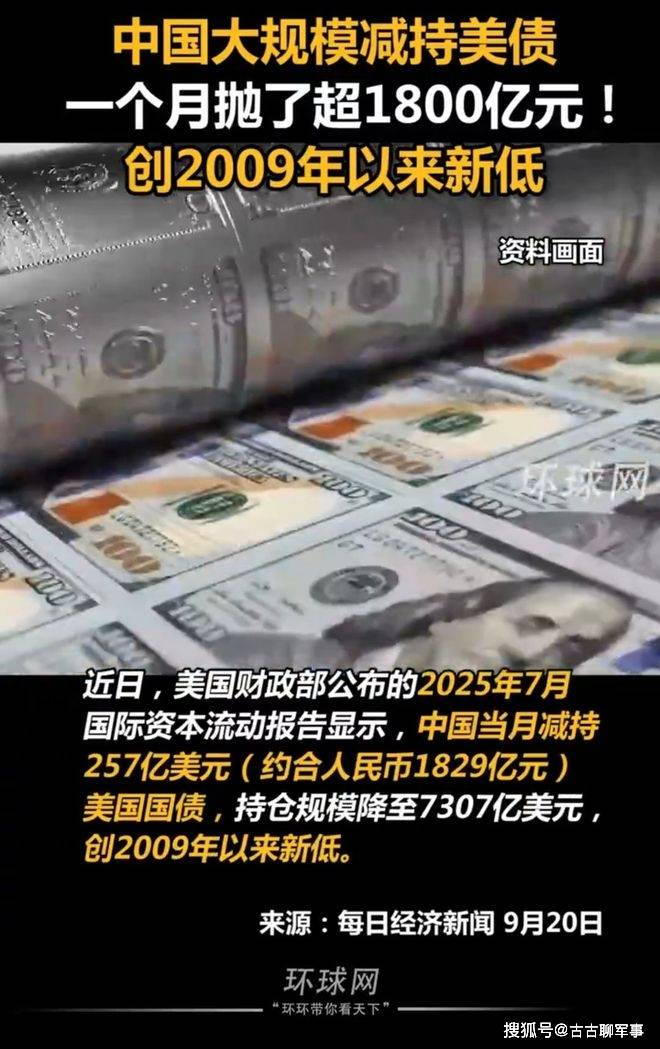
中国抛售257亿美债,特朗普发出警告,美国政府或在10月1号关门
Sou Hu Cai Jing· 2025-09-22 08:51
Group 1 - China has sold $53.7 billion in U.S. Treasury bonds in the first seven months of this year, with a significant sale of $25.7 billion in July alone, bringing its total holdings to $730.7 billion, the lowest in nearly 16 years [1][3] - The U.S. national debt has exceeded $37 trillion, and the country relies on issuing bonds to finance its operations, which raises concerns about the sustainability of this approach [3][5] - The potential for a sell-off of U.S. Treasuries by major holders like China could lead to increased market panic and a loss of international trust in U.S. debt, threatening the dollar's dominance [3][5] Group 2 - The ongoing budget negotiations between the U.S. Democratic and Republican parties have reached a stalemate, with President Trump warning of a government shutdown if a budget is not passed by October 1 [7] - The U.S. House has passed a temporary funding bill, but it was halted in the Senate, raising concerns about the implications of a government shutdown on domestic stability and law enforcement [7][9] - China's actions in selling U.S. debt reflect a strategic shift in the economic battle with the U.S., moving from trade and technology to financial arenas, indicating a growing confidence in its position [9][10]
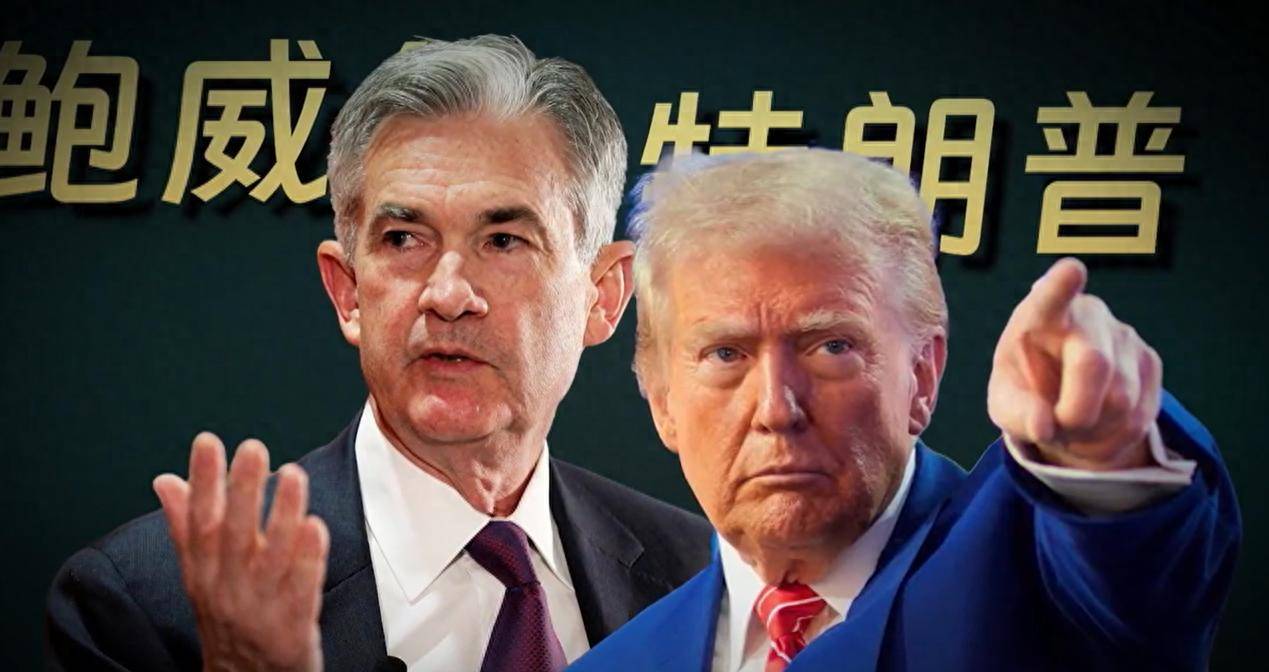
美国打响"降息内战",50年美元霸权恐崩塌!你的钱袋子还安全吗?
Sou Hu Cai Jing· 2025-09-22 07:43
这是真正影响全球80亿人生计的大事件! 美联储时隔9个月终于宣布降息,直降25个基点。此刻,全球资本巨头、华尔街大佬以及无数人的心跳,都因这一数字彻底改变。全球经济、你我手中的存 款、股票、未来的物价、油价,甚至未来世纪的趋势,都因美联储此次降息发生巨变。 这次美联储降息与以往大不相同——美国正因降息爆发近50年来最大规模的"天王山之战",特朗普对阵鲍威尔,美联储对阵最高领袖。 美联储的独立性正面临有史以来最强大的挑战——特朗普。延续50年霸权的美元货币体系,可能在特朗普的"励精图治"下被推向深渊。 这场降息究竟是好是坏?它会带来什么影响?房子能买了吗?股票会涨吗?手中纸币的购买力会大幅贬值吗?这场降息为何成为美国的"天王山之战"? 要回答这些问题,需从最基础的问题入手:被传得神乎其神的美联储究竟是什么? 美联储全称美国联邦储备系统,通俗来说就是美国版的央行,负责发行和管理美元、维护美国金融稳定。它是全球金融体系中为数不多带有半私有化特征的 巨型机构。 不少博主称"美联储被神秘大佬操控,是世界主宰",但这种说法很片面——经过上百年演化,美联储早已摆脱资本大佬的直接控制。 看美联储的架构便知:其银行实体由12家 ...