赛事经济

Search documents
赛事经济蓬勃发展 体育总局:积极支持“浙BA”等群众赛事
Zhong Guo Jing Ying Bao· 2025-08-20 23:18
Core Insights - The rise of community sports events like "Su Chao," "Village Super," and "Zhe BA" has significantly boosted local economies and consumer spending, becoming new engines for economic growth [1][2][5] - The National Sports Administration supports the integration of mass sports and competitive sports, aiming to revitalize the "three major ball sports" through community events [1][2] Group 1: Economic Impact of Sports Events - "Su Chao" has attracted over 1 million spectators, generating approximately 379.6 billion yuan in revenue across various sectors, marking a 42.7% year-on-year increase [3][4] - The "Zhe BA" basketball league has drawn 778,800 attendees during its preliminary phase, leading to a total consumption of 6.03 billion yuan [4] - The "Village Super" event in Guizhou has created nearly 200 billion yuan in tourism revenue over two years, showcasing its potential as a local economic driver [5] Group 2: Government Support and Policy Initiatives - The "14th Five-Year Plan" emphasizes the construction of a sports event system, promoting the integration of sports with culture, tourism, and commerce [2][6] - The National Sports Administration has introduced four industry standards and plans to release a national standard for safety assessments in mass sports events, enhancing the regulatory framework [6] - Future policies will focus on enriching event offerings, enhancing brand influence, and fostering coordination between events and industries to stimulate consumption and economic growth [6]
多地足球联赛相继开幕 体育消费潜力加速释放
Zheng Quan Shi Bao· 2025-08-20 18:28
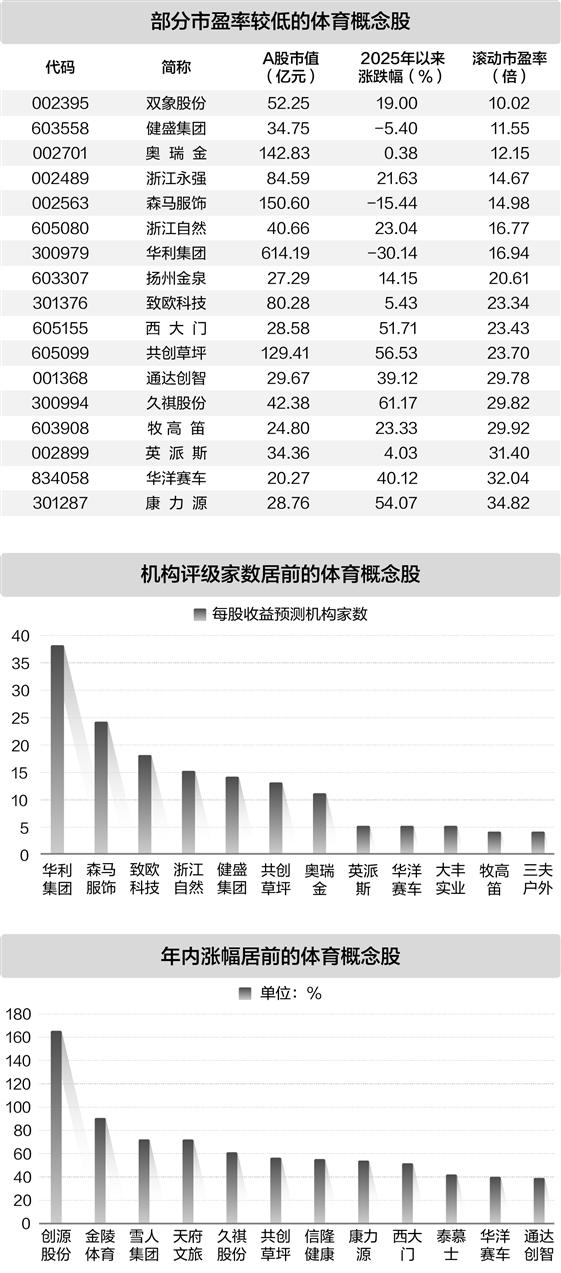
Core Viewpoint - The sports industry is emerging as a new highlight for economic growth, with significant potential in event-driven economies and increased market attention on sports concept stocks [5]. Group 1: Sports Concept Stocks with Low Price-to-Earnings Ratios - Seven sports concept stocks have rolling price-to-earnings ratios below 20 times, including companies like 双象股份 (10.02), 健盛集团 (11.55), and 奥瑞金 (12.15) [12][13]. - 双象股份 is noted for having the lowest rolling price-to-earnings ratio at 10.02 times, with an expected net profit of 1.15 billion to 1.5 billion yuan for the first half of the year, representing a year-on-year growth of 128.1% to 197.53% [13]. Group 2: Institutional Ratings and Earnings Forecasts - 华利集团 has the highest institutional attention, with 38 institutions issuing reports on the stock, followed by 森马服饰, 致欧科技, and others [13]. - The earnings forecast for the first half of the year indicates that nine companies are expected to be profitable, with 华利集团 reporting a net profit of 1.664 billion yuan, despite a year-on-year decline of 11.42% [12][13]. Group 3: Growth of Sports Events and Consumption - The launch of various city football leagues across multiple regions, such as the 江苏省城市足球联赛, is expected to stimulate local consumption and economic activity [6][7][8][9]. - The sports industry has seen an average annual growth rate of over 10% in total scale during the "14th Five-Year Plan" period, with events like "苏超" significantly boosting local economies [10][11]. Group 4: Future Potential of the Sports Industry - The sports industry is anticipated to have substantial growth potential, driven by both demand-side initiatives and supply-side reforms [11]. - The integration of sports consumption with tourism, culture, and entertainment is expected to further enhance consumer engagement and spending [11].


运河观察|百天“苏超”激活江苏消费经济新引擎
Sou Hu Cai Jing· 2025-08-20 14:25
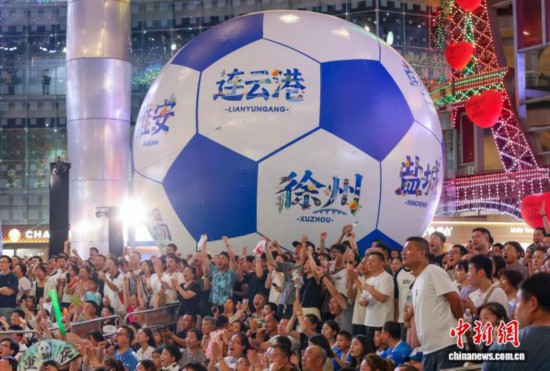
Group 1: Core Insights - The "Su Super" league has significantly boosted consumer spending in Jiangsu, generating 38 billion yuan in economic activity [2] - The league has become a focal point for local businesses, driving foot traffic and sales in various sectors [3][4] - The event has transformed into a powerful economic engine, enhancing both consumption and industrial upgrades across Jiangsu [9] Group 2: Consumer Impact - Local businesses have leveraged the "Su Super" event to attract customers, with promotions linked to ticket holders leading to increased sales [3] - The number of visitors to live viewing events reached 7.15 million, a 13.03% increase year-on-year, with sales exceeding 4.04 billion yuan, up 10.22% [4] - The event has created a vibrant ecosystem of "core venues + all-region consumption," stimulating local economies [4] Group 3: Industrial Upgrades - The surge in football-related activities has activated Jiangsu's manufacturing sector, particularly in football production and logistics [5] - Companies like Suqian Jingcheng Sports Goods Co. are seeing increased domestic demand for football equipment, with an annual production of 2 million footballs, 80% of which are exported [5] - Technological advancements in sports infrastructure, such as the development of environmentally friendly artificial turf, are being driven by the demand generated from the league [6] Group 4: Broader Economic Effects - The "Su Super" league has influenced various local markets, with cities like Suzhou leading in air conditioning and fans, while Xuzhou excels in barbecue supplies [8] - The event has expanded its influence beyond sports, integrating with local commerce through initiatives like the "Su Goods Carnival" and online consumption platforms [8] - The league has also facilitated international engagement by inviting foreign executives to matches, enhancing the city's global profile [8]
百天“苏超”为江苏消费经济注入强劲动能
Zhong Guo Xin Wen Wang· 2025-08-20 01:00
Group 1: Economic Impact of "Su Super" - The "Su Super" season has significantly boosted Jiangsu's consumption economy, generating 38 billion yuan in multi-scenario consumption across the province [1] - During the period from August 15 to August 17, the total customer flow in Nanjing reached 7.1483 million, a year-on-year increase of 13.03%, with total sales exceeding 4.044 billion yuan, up 10.22% [4] Group 2: Consumer Engagement and Local Business Growth - Local businesses have capitalized on the influx of visitors, with small shops seeing increased sales; for example, a duck shop in Nanjing reported a surge in sales due to promotional offers linked to "Su Super" tickets [3] - A cultural and creative company in Nanjing reported selling over 10,000 units of its official merchandise in July alone, indicating a strong consumer response to the event [3] Group 3: Industrial Upgrades and Manufacturing - The "Su Super" event has stimulated the local manufacturing sector, particularly in football production, with cities like Nantong leading in football receipt volumes [6] - Companies specializing in sports equipment, such as a manufacturer of artificial turf, are experiencing increased demand for high-quality sports facilities due to the rising popularity of football [7] Group 4: Broader Economic Ecosystem - The event has created a multi-layered economic ecosystem, integrating core venues with widespread consumption, enhancing the overall economic landscape of Jiangsu [4][9] - Various sectors, including cooling products and food services, have seen increased activity, with specific cities leading in categories such as air conditioning and barbecue supplies [6][9]
国家体育总局:截至2024年底体育领域国家级专精特新“小巨人”企业达146家
Zheng Quan Ri Bao· 2025-08-19 23:30
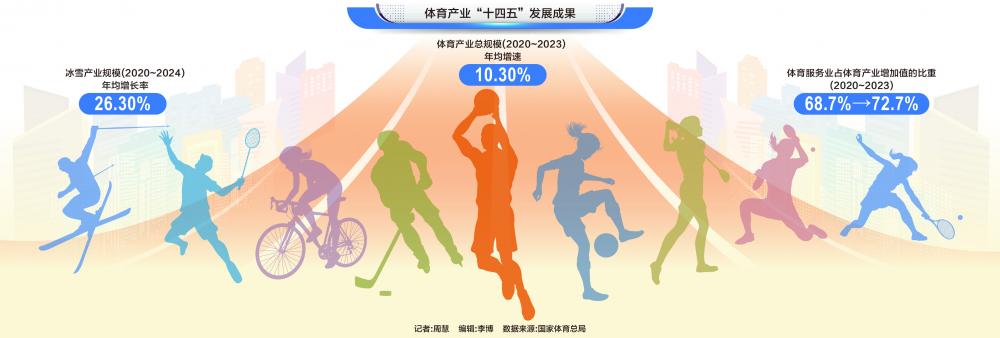
Core Insights - The sports industry in China has shown a steady growth with an average annual growth rate exceeding 10% over the past five years, reaching a total scale of 3.67 trillion yuan in 2023, with a value added of 1.49 trillion yuan [1] Economic Contribution - The value added of the national sports industry has grown at an average annual rate of 11.6%, accounting for 1.15% of GDP in 2023, moving closer to becoming a pillar industry [1] - The ice and snow industry has expanded from 381.1 billion yuan in 2020 to 970 billion yuan in 2024, with an average annual growth rate of 26.3% [1] - The total sports consumption in 40 pilot cities has increased by over 100 billion yuan from 2020 to 2023, indicating a continuous release of sports consumption potential [1] Structural Quality Improvement - The structure of the sports industry is improving, with the sports service sector, led by competition performance and fitness leisure, increasing its share of the industry's value added from 68.7% in 2020 to 72.7% in 2023 [2] - The number of national-level specialized and innovative "little giant" enterprises in the sports sector is expected to reach 146 by the end of 2024, more than doubling from the end of 2022 [2] - High-tech products such as carbon fiber bicycles and smart fitness equipment are increasingly entering households, enhancing innovation and competitiveness in the sports manufacturing sector [2] Outdoor Sports Industry Development - The online consumption of outdoor sports is projected to reach approximately 200 million participants and over 300 billion yuan in total consumption by 2024 [2] - As of 2024, there are 171,800 fitness trails totaling 407,500 kilometers, and 2,055 flying and automotive camps across the country [3] - The water sports industry is expected to see participation exceed 120 million people, with a market size of 438.6 billion yuan, reflecting an 18.7% year-on-year growth [3] Event-Driven Economic Impact - In the first half of this year, key sporting events in seven provinces generated over 16 billion yuan in related consumption, averaging over 30 million yuan per event, playing a significant role in expanding domestic demand [4] - The National Sports Administration plans to develop policies to promote event economics, enhance event supply, and strengthen the coordination between events and the industry [4]
体育服务消费市场正在崛起
2 1 Shi Ji Jing Ji Bao Dao· 2025-08-19 23:09
Core Insights - The sports industry has become a significant driver of economic growth in China, with an average annual growth rate exceeding 10% over the past five years [1] - The value added by the sports industry has grown at an average rate of 11.6% since the start of the 14th Five-Year Plan, reaching 1.15% of GDP in 2023, moving closer to becoming a pillar industry [1][6] - The ice and snow industry is projected to grow from 381.1 billion yuan in 2020 to 970 billion yuan by 2024, reflecting an annual growth rate of 26.3% [1] Sports Events Economy - The popularity of grassroots events like "Su Chao" and "Village Super" has surged, with significant media attention and public engagement [3] - In the first half of the year, key events in seven regions generated over 16 billion yuan in related consumption, averaging over 30 million yuan per event [3] - Major events like the Hangzhou Asian Games have led to consumption increases of over 40% in surrounding areas [4] Infrastructure and Accessibility - Jiangsu province's robust economic strength and infrastructure have facilitated the success of large-scale sports events, with many cities equipped with large-capacity sports venues [5] - The government has invested 5.65 billion yuan to support the opening of public sports venues, enhancing community access to sports facilities [5] Transformation of the Sports Industry - The sports service sector's contribution to the sports industry's value added has increased from 68.7% in 2020 to 72.7% in 2023, indicating a shift towards service-oriented growth [6] - The number of national-level "specialized, refined, distinctive, and innovative" small giant enterprises in the sports sector has more than doubled to 146 by the end of 2024 [6] Consumer Trends and Market Dynamics - The rise of domestic manufacturing has significantly reduced costs for sports products, such as carbon fiber bicycles, making them more accessible to consumers [7][8] - The diversification of sports consumption patterns is evident, with increased participation in events like marathons and local sports activities [8] - The number of events is expected to rise from 699 to 749, with participant numbers increasing from 6.05 million to 7.05 million in 2023-2024 [8]
奋力迈向体育强国
Jing Ji Ri Bao· 2025-08-19 22:04
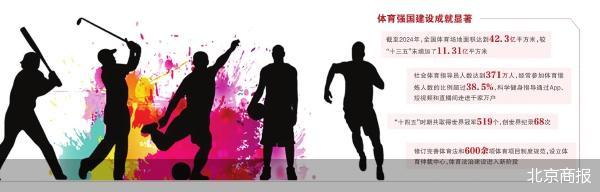
Core Insights - The article highlights the achievements in building a sports power during the "14th Five-Year Plan" period in China, emphasizing the growth of mass fitness and the integration of sports with various sectors [1][2]. Group 1: Mass Fitness Development - During the "14th Five-Year Plan" period, mass fitness has seen significant progress, with national sports venue area reaching 4.23 billion square meters, an increase of 1.131 billion square meters compared to the end of the "13th Five-Year Plan" [2] - The "2025 National Fitness Day" recently held saw over 22,000 events with more than 11 million participants, indicating a growing trend of public engagement in fitness activities [2] - The rise of local competitions, such as "village competitions" and "city competitions," has fostered community engagement and consumption, promoting a culture of fitness and health [2] Group 2: Sports Event Economy - The "14th Five-Year Plan" period has witnessed numerous large-scale sports events that enhance city image and stimulate consumption, with 511 monitored events in seven regions generating over 16 billion yuan in related consumption [4] - The sports event market is expanding, with ticket sales for popular events like CBA and WTT seeing significant demand, and the China Open tennis tournament generating over 80 million yuan in ticket revenue last year [4] - The integration of sports events with culture, commerce, and tourism is creating a "golden combination" for driving consumption and expanding domestic demand [5] Group 3: Competitive Sports Achievements - China's competitive sports have achieved remarkable success on the international stage, with an increase in Olympic qualification projects from 21 to 24, reflecting balanced development across various sports [6][7] - The "633" development strategy aims to strengthen six key sports while enhancing the competitiveness of foundational sports and revitalizing team sports [7][8] - Competitive sports are seen as a catalyst for promoting mass sports and youth engagement, contributing to economic and social development [8]
国家体育总局数据显示,截至2024年底——体育领域国家级专精特新“小巨人”企业达146家
Zheng Quan Ri Bao· 2025-08-19 17:25
Core Insights - The sports industry in China has shown a steady growth with an average annual growth rate exceeding 10% over the past five years, reaching a total scale of 3.67 trillion yuan in 2023, with a value added of 1.49 trillion yuan [1][2] - The contribution of the sports industry to the GDP has increased, with a value added growth rate of 11.6% annually, accounting for 1.15% of GDP in 2023, moving closer to becoming a pillar industry [1][2] - The ice and snow industry has experienced significant growth, expanding from 381.1 billion yuan in 2020 to 970 billion yuan by 2024, with an average annual growth rate of 26.3% [1] Industry Structure and Quality - The structure of the sports industry is improving, with the sports service sector, led by competition and performance industries, increasing its share of the industry's value added from 68.7% in 2020 to 72.7% in 2023 [2] - The number of national-level specialized and innovative "little giant" enterprises in the sports sector is expected to reach 146 by the end of 2024, more than doubling since 2022 [2] - The application of advanced materials and technologies in sports is enhancing product innovation and competitiveness, with high-tech products like carbon fiber bicycles and smart fitness equipment becoming more common [2] Outdoor Sports Development - The outdoor sports industry is projected to see approximately 200 million online consumers and a total consumption exceeding 300 billion yuan by 2024 [2] - As of 2024, there are 171,800 fitness trails totaling 407,500 kilometers, and 2,055 flying and automotive camps across the country, indicating a growing infrastructure for outdoor activities [3] - The participation in water sports is expected to surpass 120 million people, with the industry scale reaching 438.6 billion yuan, reflecting an 18.7% year-on-year growth [3] Event-Driven Economic Impact - In the first half of this year, key sporting events in seven provinces generated over 16 billion yuan in sports and related consumption, averaging over 30 million yuan per event, highlighting the role of sports in boosting domestic demand [4] - The government plans to develop policies to promote event economics, enhance event supply, and strengthen the coordination between events and the industry to further stimulate consumption and economic growth [4]
国家体育总局数据显示 截至2024年底——体育领域国家级专精特新“小巨人”企业达146家
Zheng Quan Ri Bao· 2025-08-19 16:40
Core Insights - The sports industry in China has shown a steady growth with an average annual growth rate exceeding 10% over the past five years, reaching a total scale of 3.67 trillion yuan in 2023, with a value added of 1.49 trillion yuan [1][2] Industry Growth - The value added of the national sports industry has grown at an average annual rate of 11.6%, accounting for 1.15% of GDP in 2023, moving closer to becoming a pillar industry [1][2] - The ice and snow industry has expanded from 381.1 billion yuan in 2020 to 970 billion yuan in 2024, with an average growth rate of 26.3% [1] Sports Consumption - In 40 pilot cities for sports consumption, the total sports consumption of residents increased by over 100 billion yuan from 2020 to 2023, indicating a continuous release of sports consumption potential [1] - The outdoor sports industry is projected to have approximately 200 million online consumers and a total consumption exceeding 300 billion yuan in 2024 [2] Structural Quality Improvement - The structure of the sports industry is improving, with the sports service industry, led by competition performance and fitness leisure, increasing its share of the industry's value added from 68.7% in 2020 to 72.7% in 2023 [2] - By the end of 2024, the number of national-level specialized and innovative "little giant" enterprises in the sports sector is expected to reach 146, more than doubling since the end of 2022 [2] Outdoor Sports Development - As of 2024, there are 171,800 fitness trails totaling 407,500 kilometers, and 2,055 flying and automotive camps across the country [3] - The water sports participation is expected to exceed 120 million people, with an industry scale reaching 438.6 billion yuan, reflecting an 18.7% year-on-year growth [3] Event-Driven Economic Impact - In the first half of this year, key events in seven provinces, including Hebei, Zhejiang, and Fujian, generated over 16 billion yuan in sports and related consumption, averaging over 30 million yuan per event [4] - The National Sports Administration plans to develop policies to promote event economics, enhance event supply, and strengthen the coordination between events and the industry [4]
激活消费“强引擎” 赛事经济将迎新政策
Bei Jing Shang Bao· 2025-08-19 16:16
Core Insights - The sports industry in China has become a new highlight for economic development, with an average annual growth rate exceeding 10% over the past five years [1][3] - The sports service industry, led by competition performance and fitness leisure sectors, has rapidly grown, increasing its share of the sports industry's added value from 68.7% in 2020 to 72.7% in 2023 [1][4] - The National Sports Administration plans to develop policy documents to promote event economics, enhance event supply, and strengthen the coordination between events and industries [1][8] Industry Growth - The total scale of China's sports industry reached 3.67 trillion yuan in 2023, with an average growth rate of 10.3% [3] - The added value of the sports industry has been growing at an annual rate of 11.6%, reaching 1.49 trillion yuan in 2023, and accounting for 1.15% of GDP [5] - The ice and snow industry is projected to grow from 381.1 billion yuan in 2020 to 970 billion yuan by 2024, with an annual growth rate of 26.3% [5] Event-Driven Economic Impact - In the first half of the year, 511 key events across seven regions generated over 16 billion yuan in related consumption, averaging over 30 million yuan per event [6] - Major events like the Hangzhou Asian Games have significantly boosted local consumption, with surrounding areas experiencing growth rates exceeding 40% during the event [7] - The integration of sports events with tourism and commerce has created a "golden combination" for driving consumption and expanding domestic demand [7][8] Policy and Structural Support - The new sports law has established a dedicated chapter for the sports industry, leading to the formulation of specialized plans and the issuance of 84 sports standards [3][4] - The number of national-level "specialized, refined, distinctive, and innovative" small giant enterprises in the sports sector is expected to exceed 146 by the end of 2024, more than doubling since 2022 [4] - The introduction of 81 national holiday sports tourism routes and various outdoor sports routes has enhanced regional resource development and collaborative growth [4]