
产业链供应链安全

Search documents
美国宣布将对中方加征100%关税!刚刚,商务部回应:对于关税战,中方不愿打,但也不怕打
Sou Hu Cai Jing· 2025-10-12 04:50
Group 1 - China has implemented export controls on rare earth materials, citing the importance of these materials in military applications and the need to maintain global peace and regional stability [2][3] - The export controls are not a ban; applications that meet regulations will be approved, and China aims to facilitate compliant trade through various measures [3] - The Chinese government has assessed the potential impact of these measures on supply chains and believes the effects will be limited [2][3] Group 2 - In response to China's export controls, the U.S. announced a 100% tariff on related items and export controls on key software, which China views as a double standard [3][4] - The U.S. has expanded its export control list significantly, with over 3,000 items compared to China's list of just over 900, which China argues disrupts international trade order [3][4] - China has expressed strong opposition to the U.S. actions, emphasizing the need for dialogue and cooperation to resolve trade disputes [4][5] Group 3 - The U.S. plans to impose port fees on Chinese vessels starting October 14, which China claims violates WTO rules and the U.S.-China maritime agreement [4][5] - China's countermeasures against the U.S. port fees are described as necessary defensive actions to protect its industries and ensure fair competition in international shipping [5]

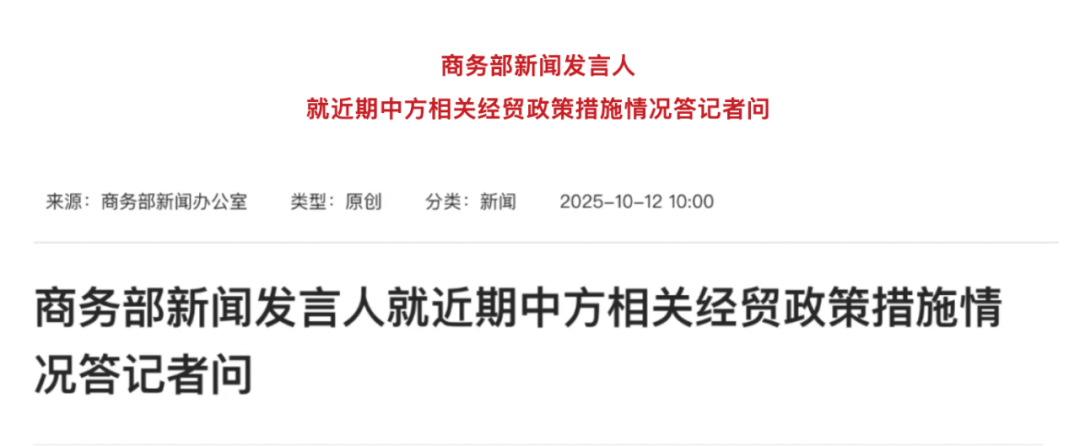
“对于关税战,中方立场是一贯的,不愿打,但也不怕打”
第一财经· 2025-10-12 02:38
Core Viewpoint - The article discusses China's recent export control measures on rare earth materials, emphasizing the government's commitment to national security and international obligations while maintaining a willingness to engage in dialogue with other countries [2][3][4]. Group 1: Export Control Measures - China has implemented export control measures on rare earth materials as a legitimate action to enhance its export control system in response to global instability and military applications of these materials [2]. - The export control is not a ban; applications that meet regulations will be approved, and China aims to facilitate compliant trade through various measures [3]. - The government has conducted thorough assessments of the potential impacts on supply chains and believes these impacts will be minimal [3]. Group 2: U.S. Response and Trade Tensions - The U.S. announced a 100% tariff on Chinese rare earth exports and additional export controls on key software, which China views as a double standard and an abuse of export controls [4]. - Since the Madrid economic talks, the U.S. has introduced numerous restrictions against Chinese entities, significantly affecting thousands of Chinese companies [5]. - China opposes the U.S. actions, asserting that high tariffs are not the correct approach to bilateral relations and emphasizes the need for dialogue to resolve differences [6]. Group 3: Maritime and Shipping Issues - The U.S. plans to impose port fees on Chinese vessels starting October 14, which China claims violates WTO rules and the U.S.-China maritime agreement [4][7]. - In response, China has decided to impose special port fees on U.S. vessels as a necessary defensive measure to protect its legitimate rights and maintain fair competition in international shipping [7].
商务部回应美将我多家实体列入出口管制清单
Xin Hua Wang· 2025-10-11 00:28
商务部新闻发言人10日表示,美方不断泛化国家安全概念,滥用出口管制措施,滥施长臂管辖,对包括 中国企业在内的多家实体实施穿透性制裁。美方此举严重损害企业合法权益,破坏全球产业链供应链安 全稳定,中方对此坚决反对。中方敦促美方尽快纠正错误做法,并将采取必要措施,坚决维护中国实体 的合法权益。 当天,有记者问:美东时间2025年10月8日,美商务部宣布将多家中国实体列入出口管制"实体清单", 请问中方对此有何评论?商务部新闻发言人作出上述回应。 ...
商务部强化稀土出口管制 稀土企业加码投资整合 龙头股业绩预增
Zheng Quan Shi Bao Wang· 2025-10-09 13:43
Core Viewpoint - The Chinese government has strengthened export controls on certain rare earth materials and technologies, particularly those with military and semiconductor applications, following earlier restrictions implemented in April 2023. This has led to a significant increase in the stock prices of companies in the rare earth sector, as they begin to receive export licenses and expand investments in the industry [1][2][4]. Group 1: Export Control Measures - On October 9, the Ministry of Commerce announced enhanced export controls on rare earth materials and related technologies, specifically targeting military and semiconductor uses [1][2]. - The new export control mechanism includes a dual reporting system for end-users and end-uses, particularly for applications in advanced semiconductor manufacturing [2][3]. - The measures aim to protect national security and align with international practices regarding dual-use items [3]. Group 2: Market Reactions and Company Performance - Following the announcement of the export controls, the A-share rare earth sector index surged over 8%, with companies like Jinli Permanent Magnet and Northern Rare Earth seeing significant stock price increases [4]. - Jinli Permanent Magnet reported a projected net profit of 505 million to 550 million yuan for the first three quarters, reflecting a year-on-year growth of 157% to 179% [4]. - Several rare earth companies have begun to receive export licenses, allowing their international business to gradually recover [4][6]. Group 3: Strategic Investments and Acquisitions - Tianhe Magnetic Materials plans to invest 850 million yuan in high-performance rare earth permanent magnet and equipment manufacturing projects [5]. - Shenghe Resources completed the acquisition of Peak Rare Earths Limited, which includes a significant stake in a rare earth mine in Tanzania, with the transaction value adjusted to approximately 916.5 million yuan due to rising rare earth prices [5]. - Companies are actively expanding their domestic market presence to mitigate the impact of international market pressures and enhance their competitive positioning [6][7].
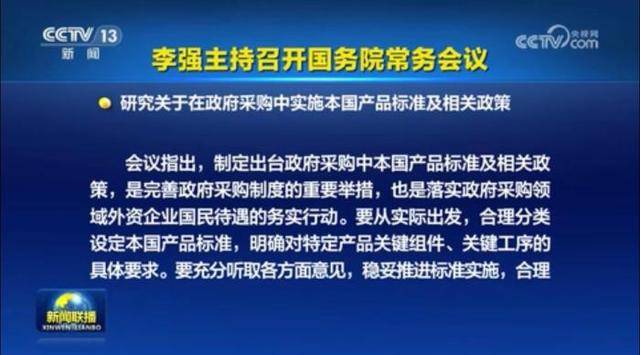
政府采购新规强化公平竞争,对内外资一视同仁
Sou Hu Cai Jing· 2025-09-20 10:25
Core Viewpoint - The recent government procurement policy changes in China signify a move towards deeper institutionalization and standardization of the procurement system, emphasizing the implementation of domestic product standards and related policies [1][4]. Group 1: Policy Implementation - The State Council meeting on September 19 highlighted the importance of establishing domestic product standards in government procurement as a key measure to improve the procurement system and ensure fair treatment for foreign enterprises [1][4]. - The Ministry of Finance plans to solicit public opinions on the draft notice regarding domestic product standards and implementation policies in government procurement by December 2024 [3]. Group 2: Market Impact - The new policies are expected to have a profound impact on the government procurement market, which exceeds 3 trillion yuan, having grown from 100.9 billion yuan in 2002 to 3.6399 trillion yuan in 2021, increasing its share of fiscal expenditure from 4.6% to 10.1% [5]. - In 2023, the national government procurement scale was reported at 3.39296 trillion yuan, indicating a slight decline in recent years [6]. Group 3: Classification and Transition - The meeting proposed a reasonable classification approach to set domestic product standards, suggesting that specific requirements for key components and processes will be established based on industry characteristics rather than a one-size-fits-all domestic production ratio [6]. - The policy emphasizes a reasonable transition period to support enterprises in preparing for industrial layout and investment plans, with different industries potentially receiving varying adjustment times [7][8]. Group 4: Fair Competition - The policy aims to ensure equal treatment for all types of enterprises, including state-owned, private, and foreign companies, as long as they meet the domestic product standards, aligning with the ongoing reforms to optimize the business environment in China [8]. - The establishment of clear domestic product standards is seen as a prerequisite for fair treatment of foreign enterprises, ensuring that all products produced within China are treated equally [8]. Group 5: International Context - The new government procurement policy reflects a significant step in China's reform and opening-up process, balancing national economic security with a commitment to expanding openness, similar to practices in developed countries like the U.S., Japan, and the EU [8]. Group 6: Future Outlook - With the implementation of these policies, the government procurement market is expected to become more standardized, transparent, and open [9].
发挥我国经济韧性强的优势统筹发展和安全(深入学习贯彻习近平新时代中国特色社会主义思想·学习《习近平经济文选》第一卷专家谈)
Ren Min Ri Bao· 2025-08-13 21:50
Core Viewpoint - Accelerating the construction of a new development pattern that prioritizes domestic circulation while promoting mutual reinforcement between domestic and international circulation is a strategic deployment to grasp the initiative for future development [1][2][3]. Group 1: Economic Resilience - China's economy demonstrates strong resilience, which is emphasized by Xi Jinping's repeated assertions regarding the country's economic potential and flexibility [1][8]. - The resilience of the economy is crucial for achieving high-quality development and ensuring a stable and secure environment for growth [5][8]. Group 2: Development and Security - The current strategic decision to accelerate the construction of a new development pattern is aimed at balancing development and security amidst various risks and challenges [2][5]. - High-quality development is identified as the primary task for building a modern socialist country and enhancing national security [3][5]. Group 3: Supply and Demand Dynamics - Achieving a smooth economic cycle relies on the strength and balance of both supply and demand sides, necessitating coordinated efforts to enhance economic vitality and mitigate risks [4][8]. - Continuous deepening of supply-side structural reforms is essential to enhance the resilience and safety of supply chains [4][8]. Group 4: Innovation and Technology - Emphasizing technological innovation is critical for national security and economic resilience, with a focus on achieving self-reliance in key technologies [7][12]. - The contribution of technological progress to economic growth is increasing, with significant advancements in various fields such as artificial intelligence and renewable energy [12][13]. Group 5: Open Economy - The new development pattern is characterized by an open domestic and international dual circulation, enhancing the interaction between domestic and international markets [6][13]. - Expanding foreign trade and investment is vital for maintaining economic stability and fostering growth [13][14]. Group 6: Institutional Strength - The unique economic system of China, which combines public and private ownership, is a key factor in maintaining economic resilience and promoting development [14][15]. - The governance structure and the leadership of the Communist Party are fundamental to effectively managing the economy and ensuring sustainable development [17].
策略周评20250803:十五五规划产业布局猜想【勘误版】
Soochow Securities· 2025-08-03 07:37
Group 1 - The report emphasizes the importance of focusing on domestic development amidst external uncertainties, suggesting that the core idea of "concentrating efforts on one's own affairs" will continue to be reflected in the 15th Five-Year Plan [2] - The upcoming 15th Five-Year Plan is expected to include significant themes such as the construction of a national unified market, technological innovation leading to new productive forces, digital economy and artificial intelligence, and high-quality urban development [4][5] - The report predicts that the focus on "anti-involution" in market competition will be a key aspect of the 15th Five-Year Plan, with an emphasis on optimizing market competition order and regulating local investment attraction [5] Group 2 - The urbanization strategy is shifting from rapid growth to stable development, with a focus on quality improvement and efficiency enhancement in existing urban areas, as indicated by recent central government meetings [6] - Technological innovation is expected to lead the development of new productive forces, moving away from traditional industries and focusing on advanced production factors [7] - The integration of artificial intelligence with the digital economy is anticipated to be a major theme in the 15th Five-Year Plan, highlighting the role of AI in driving high-quality economic development [10] Group 3 - The report highlights the need for enhancing domestic demand, particularly in the context of improving income distribution and social security systems, which are expected to release significant consumption potential [11] - Large-scale infrastructure projects are likely to be prioritized in the 15th Five-Year Plan, with specific mentions of major water conservancy, transportation, and energy projects [12][30] - The necessity of ensuring supply chain security and addressing technological bottlenecks in key areas such as semiconductor manufacturing is emphasized, with expectations for continued support in these sectors in the upcoming plan [13] Group 4 - The report suggests that the 15th Five-Year Plan will focus on the development of future industries, including advanced manufacturing, new materials, and future energy technologies [25][27] - Cultural development and enhancing national cultural soft power are expected to be significant components of the 15th Five-Year Plan, aligning with the goal of building a "cultural power" by 2035 [19] - The construction of a community with a shared future for mankind and strengthening multilateral diplomatic relations are anticipated to be included in the 15th Five-Year Plan, particularly in the context of the Belt and Road Initiative [20]
十五五规划产业布局猜想勘误版
Soochow Securities· 2025-08-03 03:32
Core Viewpoints - The report emphasizes the importance of focusing on domestic development amidst external uncertainties, suggesting that the core idea of "concentrating efforts to do our own things well" will continue to be reflected in the 15th Five-Year Plan [2] - The 15th Five-Year Plan is expected to include around 20 chapters, with potential standalone themes such as "National Unified Market Construction," "Technological Innovation Leading New Quality Productivity Development," "Digital Economy and Artificial Intelligence," and "High-Quality Urban Development" [3] - The report anticipates a shift in urban development focus from rapid growth to quality improvement and efficiency enhancement, indicating that the 15th Five-Year Plan will likely continue this trend [4] National Unified Market Construction - The concept of "anti-involution" in supply-side policies is expected to be further developed in the 15th Five-Year Plan, with a focus on optimizing market competition order and regulating local investment attraction [3] Technological Innovation - The report highlights the significance of "new quality productivity," which aims to break away from traditional economic growth models and focus on high-tech, high-efficiency, and high-quality development [5] Digital Economy and AI - The integration of artificial intelligence with the digital economy is anticipated to be a key theme in the 15th Five-Year Plan, with AI serving as a core engine for driving high-quality economic development [7] Domestic Demand and Consumption - The report notes that domestic demand is becoming increasingly important, with significant potential for consumer spending to be released, particularly in the service sector [8] Investment in Infrastructure - The 15th Five-Year Plan is expected to outline significant investments in large-scale infrastructure projects, including major water conservancy, transportation, and energy projects [9][19] Supply Chain Security - The necessity for enhancing supply chain security and addressing technological bottlenecks in critical areas such as semiconductor manufacturing is highlighted as a priority in the upcoming plan [10] Industrial Upgrading and Future Industries - The report suggests that the 15th Five-Year Plan will focus on upgrading traditional industries and fostering emerging industries, with an emphasis on high-end, green, and intelligent development [11][12] Modern Infrastructure Development - The report anticipates that the 15th Five-Year Plan will continue to prioritize modern infrastructure development, particularly in new infrastructure and transportation sectors [13] Cultural Development - The promotion of cultural confidence and the enhancement of national cultural soft power are expected to be included in the 15th Five-Year Plan, aligning with the goal of building a "cultural strong nation" [14] International Relations - The report indicates that the 15th Five-Year Plan will likely address the construction of a community with a shared future for mankind, emphasizing the importance of multilateral diplomatic relations [15]
国家发改委:扎实维护粮食、能源、产业链供应链等重点领域安全
Zheng Quan Shi Bao Wang· 2025-07-31 11:25
Core Points - The National Development and Reform Commission (NDRC) emphasizes the need for comprehensive coordination and balance to stabilize employment and ensure the safety of key sectors such as food, energy, and supply chains [1] - The NDRC highlights the importance of ensuring energy supply during peak summer and winter seasons while prioritizing the safety of people's lives [1] - There is a focus on enhancing safety production and disaster prevention measures, as well as addressing risks in key industries [1] - The implementation of policies to support enterprises and improve basic public services, particularly for the elderly and children, is underscored [1] - Efforts to stabilize the supply and prices of essential goods for the public are being intensified [1]
国家发改委:扎实维护粮食、能源、产业链供应链等重点领域安全 加大民生商品保供稳价工作力度
news flash· 2025-07-31 11:17
Core Viewpoint - The National Development and Reform Commission emphasizes the importance of maintaining the safety of key areas such as food, energy, and supply chains while enhancing efforts to stabilize prices and ensure the supply of essential goods [1] Group 1: Economic Stability Measures - The commission highlights the need for comprehensive coordination and balance to stabilize employment [1] - There is a focus on strengthening the safety of food, energy, and supply chains [1] - Efforts will be made to ensure energy and electricity supply during peak summer and winter seasons [1] Group 2: Public Safety and Support Policies - The safety of people's lives is prioritized, with an emphasis on enhancing production safety and disaster prevention [1] - There is a commitment to addressing risks and hidden dangers in key industries [1] - The implementation of policies to assist enterprises and improve basic public services, particularly for vulnerable groups, is reinforced [1] Group 3: Price Stabilization Efforts - The commission plans to increase efforts in ensuring the supply and stabilizing the prices of essential goods [1] - There is a focus on improving services for the elderly and children as part of the broader public welfare initiatives [1]