产能治理

Search documents
10月经济前瞻:渐行渐缓,蓄势明年
Hua Xia Shi Bao· 2025-11-07 05:54
Group 1: Industrial Production and Economic Trends - Industrial production showed signs of slowdown in October, with expected year-on-year growth of 5.3% for industrial added value [2] - Manufacturing demand has weakened due to pre-holiday demand release and international trade uncertainties, with the new orders index dropping to 48.8% [3] - The service sector experienced an increase in activity, with the business activity index rising to 50.2%, driven by holiday-related consumption [3] Group 2: Consumer Retail and Spending - Social retail sales are projected to grow by 2.8% year-on-year in October, a slight decline from the previous 3% [4] - The effectiveness of the trade-in policy for consumer goods has diminished, compounded by reduced fiscal support, leading to pressure on retail sales [5] - The restaurant and alcohol retail sectors are expected to remain under pressure due to regulatory measures affecting public spending [5] Group 3: Investment Trends - Fixed asset investment is anticipated to decline by 0.9% year-on-year from January to October, with manufacturing investment growth at 4.0% and real estate investment down by 14.1% [7] - Manufacturing investment is expected to improve slowly, with recent developments in US-China trade negotiations potentially boosting investor confidence [8] - Infrastructure investment is projected to stabilize, with new policy financial tools fully deployed, indicating a potential recovery in construction activity [12] Group 4: Export and Trade Dynamics - October export growth is expected to be 3.2%, with imports at 1.6%, reflecting a shift towards non-US markets [17] - China's share in non-US markets has increased, with significant growth in exports to Africa and Latin America [18] - The trade cycle between investment and exports to non-US countries is strengthening, particularly in manufacturing sectors [19] Group 5: Price Trends and Inflation - Consumer price index (CPI) is expected to show a slight increase to 0.1% year-on-year, while producer price index (PPI) is projected to decline by 2.6% [20] - Pork prices remain weak, contributing to overall low inflationary pressures, while oil prices are also under pressure due to global supply dynamics [21][22] - Core CPI is anticipated to maintain a recovery trend, supported by holiday consumption and promotional activities [22] Group 6: Employment and Labor Market - The urban unemployment rate is expected to stabilize at 5.1%, with ongoing government efforts to support job creation for graduates [24] - Employment policies are focused on stabilizing job opportunities, particularly for vulnerable groups such as migrant workers [24][25] Group 7: Financial Data and Monetary Policy - Social financing is projected to increase by 750 billion, with a decline in new loans expected at 1 trillion [26][27] - The M2 money supply growth is anticipated to decrease to 8.1%, reflecting weak demand for credit and a shift towards non-bank financial products [28] - Future monetary policy is expected to balance financial stability with support for the real economy, with a focus on gradual adjustments rather than aggressive tightening [29]


规上工业产能利用率回升,反内卷成效初显
Di Yi Cai Jing· 2025-10-22 13:29
Core Insights - The recent data from the National Bureau of Statistics indicates a positive improvement in industrial enterprise prices and profits, reflecting the initial effects of anti-involution policies [1] - The capacity utilization rate for large-scale industrial enterprises in Q3 2025 reached 74.6%, an increase of 0.6 percentage points from Q2, although it is still down 0.5 percentage points year-on-year [1][2] - The anti-involution measures aim to address chaotic competition in various industries, with a focus on enhancing quality and promoting technological innovation [1][6] Capacity Utilization - In Q3 2025, 21 out of 41 major industrial sectors saw a month-on-month increase in capacity utilization, with a recovery rate of 51.2% [2] - The mining sector's capacity utilization was 72.5%, manufacturing at 74.8%, and utilities at 74.3% [2] - Notable increases in capacity utilization were observed in the automotive and electrical machinery sectors, with rises of 2 and 1.4 percentage points, respectively [2][3] Profit and Price Trends - From January to August 2025, profits of large-scale industrial enterprises shifted from a year-on-year decline of 1.7% to a growth of 0.9%, reversing a downward trend since May [3] - The Producer Price Index (PPI) for September showed a year-on-year decline of 2.3%, but the rate of decline narrowed by 0.6 percentage points compared to the previous month [3] - The steel industry has returned to profitability, with raw material manufacturing profits increasing by 22.1% year-on-year [3] Policy Measures - The newly revised Anti-Unfair Competition Law has been implemented, marking a significant step in regulating chaotic competition and promoting fair market practices [1][6][7] - The National Development and Reform Commission has emphasized the need to strengthen capacity governance in key industries, particularly in new energy vehicles and photovoltaics [1][6] - Recent announcements from regulatory bodies focus on maintaining fair market pricing and preventing disorderly competition through various measures [7][8] Industry Outlook - The anti-involution policies are expected to gradually alleviate price deflation pressures, particularly in traditional industries facing dual pressures of demand contraction and supply optimization [5] - The emphasis on innovation and green transformation aims to enhance competitiveness across both emerging and traditional sectors [5][6] - The current phase of demand insufficiency is identified as a fundamental cause of the ongoing involution, necessitating a strategic focus on expanding domestic demand [9]
2025年9月宏观数据解读:9月经济:增速放缓但目标无忧
ZHESHANG SECURITIES· 2025-10-20 11:46
Economic Growth - Q3 GDP growth rate was 4.8%, down from 5.2% in the previous quarter, with nominal GDP growth at 3.7% compared to 3.9%[1] - The contribution of final consumption, gross capital formation, and net exports to GDP growth was 56.6%, 18.9%, and 24.5% respectively[14] - Q4 economic growth is expected to slightly decline to 4.7%, but achieving the annual growth target of around 5% is considered feasible[15] Industrial Production - In September, industrial added value increased by 6.5% year-on-year, exceeding market expectations, with a month-on-month growth of 0.64%[3] - The capacity utilization rate for industrial enterprises was 74.6% in Q3, up 0.6 percentage points from Q2[21] - High-tech manufacturing added value grew by 9.6% year-on-year, contributing 24.7% to overall industrial growth[20] Consumer Spending - Retail sales of consumer goods in September grew by 3%, down from 3.4% in the previous month, marking the fourth consecutive month of decline[4] - The "trade-in" policy supported certain categories, but overall consumer spending is expected to remain under pressure in Q4 due to reduced fiscal support[32] - The restaurant sector saw a weak performance, with dining revenue growing only 0.9% year-on-year[33] Investment Trends - From January to September, fixed asset investment (excluding rural households) decreased by 0.5%, marking the first negative cumulative data since August 2020[7] - Real estate development investment fell by 13.9%, while manufacturing investment grew by 4.0%[43] - Infrastructure investment in the electricity, heat, and water production and supply sector increased by 15.3% year-on-year, contributing 1.1 percentage points to overall investment growth[42] Employment and Policy - The urban surveyed unemployment rate in September was 5.2%, showing a slight decline, aided by policies supporting employment for college graduates[8] - The government is gradually prioritizing expanding domestic demand and consumption, indicating a shift towards counter-cyclical measures[34]
宏观政策发力叠加产能治理显效,10月PPI同比降幅有望进一步收窄|宏观晚6点
Sou Hu Cai Jing· 2025-10-18 20:59
Group 1 - The core viewpoint is that specialized and innovative "little giant" enterprises in China have shown a positive trend in development, with sales revenue increasing by 8.2% year-on-year in the first three quarters of the year, which is an acceleration of 4.1 percentage points compared to 2024 [1] - High-tech manufacturing enterprises within this category have experienced even stronger growth, with sales revenue rising by 11.8% year-on-year [1] Group 2 - The adjustment of the duty-free shopping policy for travelers in Hainan will take effect on November 1, 2025, introducing new categories of goods such as pet supplies and portable musical instruments [2] - The category of "home air purifiers and accessories" has been reclassified to "small household appliances," which now includes items like robotic vacuum cleaners and vacuum cleaners [2] - The category of "wearable devices and other electronic consumer products" has been broadened to "electronic consumer products," adding digital photography and videography equipment and accessories, as well as mini drones [2]
“十五五”规划前瞻:历史篇+内需篇
2025-10-16 15:11
Summary of the Conference Call on the 15th Five-Year Plan Industry or Company Involved - The conference call discusses the upcoming 15th Five-Year Plan (2026-2030) in China, focusing on strategic directions in technology innovation, domestic demand, and emerging industries. Core Points and Arguments 1. **Continuation of Strategic Directions**: The 15th Five-Year Plan will extend and deepen the strategic directions of the 14th Five-Year Plan, particularly in technology innovation and new productive forces, aiming for a target of at least 20% of GDP from strategic emerging industries [1][11]. 2. **Focus on Domestic Demand**: Policies will emphasize consumption upgrades and investment structure optimization, aiming to release consumption potential through improved supply quality and international standards [1][4]. 3. **Support for Emerging Industries**: The plan will promote cluster development in new-generation information technology, high-end equipment, and biotechnology, with special funding and financing channels to support specialized and innovative enterprises [1][12]. 4. **Capacity Governance**: The plan will address overcapacity issues in industries like new energy vehicles and photovoltaics by enforcing strict environmental and energy consumption standards [1][13]. 5. **Public Service and Income Distribution Reform**: The plan aims to equalize basic public services and reform income distribution to reduce preventive savings in education, healthcare, and elderly care, thereby releasing more consumption capacity [1][16]. 6. **Investment Focus**: Short-term policies may lead to sector rotation effects, with funds potentially shifting from infrastructure to tourism and hospitality sectors, while long-term investments will focus on digital economy, high-end manufacturing, new energy, and the silver economy [3][17]. 7. **Challenges in Consumption**: Despite significant progress in cultivating new consumption drivers, consumption contribution to economic growth has weakened, dropping from 80% to 52% by Q2 2025 [3][9]. 8. **Investment Targets**: Most investment indicators are on track, but some energy security and social welfare targets have not met expectations, such as the nuclear power generation capacity completion rate of 68.8% [3][10]. 9. **Technological Innovation and R&D**: The plan will increase the proportion of basic research in R&D funding and enhance support for national laboratories and high-level universities [1][11]. 10. **Quality Supply and Consumption Upgrade**: The plan aims to improve supply quality to meet consumption upgrade demands, establishing a quality grading certification system [1][14]. Other Important but Possibly Overlooked Content 1. **Historical Context of Five-Year Plans**: The evolution of China's Five-Year Plans from 1953 to the present reflects a shift from rapid economic growth to a focus on quality and efficiency [5][6]. 2. **Impact on Capital Markets**: Historical data suggests that while immediate impacts on stock markets may be limited, long-term policy implementations can significantly drive market performance, particularly in technology sectors [8]. 3. **Social Welfare Opportunities**: There are notable opportunities in social welfare sectors, particularly in elderly care and health management, which may see increased investment and development [3][17].
9月中国PPI同比降幅收窄 部分行业产能治理见效
Zhong Guo Xin Wen Wang· 2025-10-15 08:54
Core Insights - In September, China's Producer Price Index (PPI) decreased by 2.3% year-on-year, with the decline narrowing by 0.6 percentage points compared to the previous month [1] - The effects of macroeconomic policies are becoming evident, leading to positive price changes in certain industries [1] Industry Analysis - The price declines in several industries have narrowed, indicating effective capacity management and improved market competition. The following industries saw reduced year-on-year price declines: - Coal processing: down 8.3 percentage points - Black metal smelting and rolling: down 3.4 percentage points - Coal mining and washing: down 3.0 percentage points - Photovoltaic equipment and components manufacturing: down 2.4 percentage points - Battery manufacturing: down 0.5 percentage points - Non-metallic mineral products: down 0.4 percentage points - The combined downward impact on PPI from these six industries decreased by approximately 0.34 percentage points compared to the previous month [1] Price Trends - Structural upgrades and the release of consumer potential have led to price increases in related industries: - Aircraft manufacturing: up 1.4% year-on-year - Electronic special materials manufacturing: up 1.2% year-on-year - Wearable smart devices manufacturing: up 0.1% year-on-year - Policies aimed at boosting consumption are showing effects, with prices for arts and crafts and ceremonial goods rising by 14.7% year-on-year, and nutritional food manufacturing prices increasing by 1.8% year-on-year [1] Month-on-Month Analysis - The improvement in supply-demand structure has stabilized prices in certain industries: - Coal processing prices increased by 3.8% month-on-month - Coal mining and washing prices rose by 2.5% month-on-month - Black metal smelting and rolling prices increased by 0.2% month-on-month - Non-metallic mineral products and lithium-ion battery manufacturing prices decreased by 0.4% and 0.2% month-on-month, respectively, with declines narrowing by 0.6 and 0.3 percentage points compared to the previous month [2]
核心CPI同比涨幅连续5个月扩大,“反内卷”带动相关行业价格改善
Di Yi Cai Jing· 2025-10-15 02:16
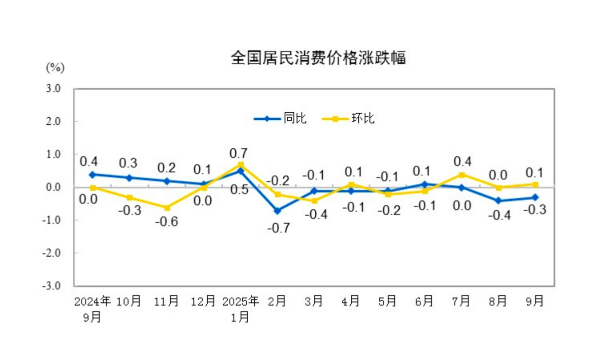
Core Insights - The Consumer Price Index (CPI) and Producer Price Index (PPI) have shown a narrowing decline in September, benefiting from low base effects and the effectiveness of anti-involution and consumption promotion policies [1][3]. CPI Analysis - In September, the CPI increased by 0.1% month-on-month, while the year-on-year decline was 0.3%, a reduction of 0.1 percentage points from the previous month [1]. - The core CPI, excluding food and energy, rose by 1.0% year-on-year, marking the first return to a 1% increase in nearly 19 months [1][3]. - Food prices fell by 4.4%, contributing significantly to the overall CPI decline, with the tail effect accounting for approximately -0.8 percentage points of the CPI change [3]. PPI Analysis - The PPI remained flat month-on-month for two consecutive months, with a year-on-year decline of 2.3%, narrowing by 0.6 percentage points from the previous month [1][5]. - Factors contributing to the PPI's performance include improved supply-demand structures and the impact of international oil price declines on domestic oil-related industries [5]. - Certain industries, such as coal processing and black metal smelting, saw reduced year-on-year price declines, contributing to a decrease in the overall PPI decline by approximately 0.34 percentage points [5]. Industry Trends - The modernization of the industrial system and the release of consumption potential have led to price increases in related industries, with aircraft manufacturing prices rising by 1.4% and electronic materials by 1.2% year-on-year [6]. - Policies aimed at boosting consumption are showing effects, with significant price increases in high-quality and upgraded consumer goods, such as a 14.7% rise in arts and crafts products [6]. - Analysts predict that the year-on-year decline in PPI may narrow to below -2.0% in the fourth quarter due to various supportive policies and market conditions [6].
丁爽:产能治理中的进与退|国庆大咖谈
Di Yi Cai Jing· 2025-10-04 01:15
Group 1 - The core viewpoint emphasizes the need to reduce excess manufacturing capacity while expanding effective capacity in the service sector to mitigate economic downturn risks and promote structural transformation [1][2] - China's manufacturing capacity has significantly exceeded domestic demand, leading to intensified competition and prolonged low price levels, with nominal GDP growth lagging behind actual GDP expansion [1][2] - The government has implemented capacity governance and anti-involution measures since July to prevent redundant investments and curb excess capacity, which helps break the negative cycle of falling prices and weakened demand [1][2] Group 2 - The long-term potential for the development of China's service industry is substantial, with its GDP share around 55%, significantly lower than the nearly 70% in developed countries [3] - There is strong demand and insufficient supply in various service sectors such as communication, education, healthcare, and tourism, necessitating further market opening to increase service capacity [3] - Policy measures should focus on breaking industry monopolies, lowering entry barriers, and opening up to private and foreign enterprises to fully unleash the potential of service supply and consumption [3]
中金:工企利润修复路径探究
Hua Er Jie Jian Wen· 2025-09-23 13:09
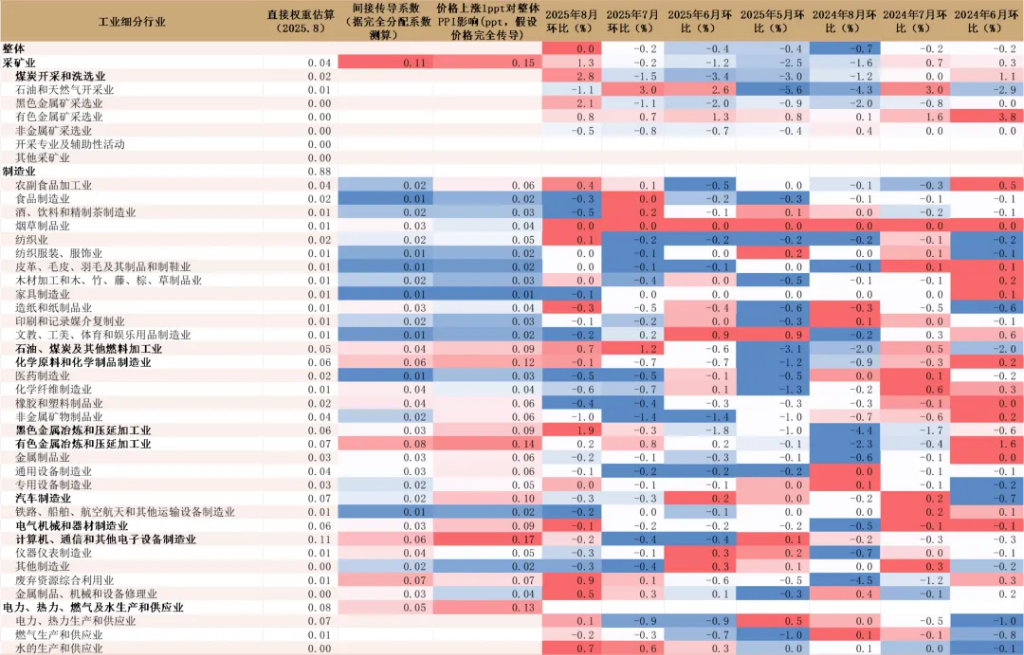
Core Viewpoint - The government has initiated comprehensive rectification of excessive competition across multiple industries since the second half of last year, aiming to promote the recovery of industrial product prices, restore industry profitability, and optimize industrial structure. In August, the PPI (Producer Price Index) showed signs of stabilization, but investment and commodity consumption have significantly slowed, indicating weak growth momentum in terminal demand [1][2]. Group 1: Supply-Side Dynamics - The current capacity governance emphasizes legal compliance and is characterized by a steady pace of capacity reduction, with a focus on exiting excess low-end outdated capacities in industries such as coal, steel, and photovoltaics. Policies are dense in these sectors, which directly influence the sustainability of price recovery [4][5]. - Approximately 60% of industries are currently at historical profit margins below the 40th percentile, indicating a need for improvement in asset turnover and overall revenue growth to enhance asset return rates [4][6]. - The PPI's fluctuation is significantly influenced by industries such as mining, non-ferrous and ferrous metal smelting, and chemical manufacturing, with notable price increases in coal and water supply sectors [3][4]. Group 2: Demand-Side Challenges - Economic momentum weakened in August, and the effectiveness of stimulus policies on consumer goods is uncertain, particularly as the replacement cycle for durable goods is long, which may diminish the impact of such policies [5][6]. - Real estate and infrastructure investments remain crucial for growth, but both sectors have shown negative year-on-year changes, with real estate down by 12.9% and infrastructure up by only 5.4% in the first eight months of the year [6][8]. - The recovery in the real estate market is expected to take time, and the effectiveness of existing PPP projects and new financial tools will be critical for stabilizing infrastructure investment in the fourth quarter [6][8]. Group 3: Price Transmission and Industry Specifics - The price transmission from upstream to downstream industries is contingent on terminal demand conditions, with structural demand in specific sectors like steel and photovoltaics showing potential for marginal recovery [5][9]. - The analysis of price transmission in the black building materials chain indicates significant price declines in raw materials, while the photovoltaic sector has experienced varied price movements, reflecting the complexities of market dynamics [9][10].
产业链超预期!拒绝内卷,上岸!9月16日直播回顾
鑫椤锂电· 2025-09-17 07:51
Core Viewpoint - The article emphasizes the robust development momentum of the battery industry chain and the significant potential for growth driven by favorable policies and market demand [3][4][9]. Group 1: Industry Transformation - The "anti-involution" policy has led to profound changes in multiple key industrial sectors, including new energy vehicles, photovoltaics, and steel [3]. - Despite self-regulatory proposals from industry associations, achieving capacity elimination requires top-level design and continuous policy implementation [3]. Group 2: Market Opportunities - The new energy vehicle and energy storage markets are experiencing unprecedented growth opportunities due to supportive policies [4]. - The "Automobile Industry Stabilization Growth Work Plan (2025-2026)" aims for new energy vehicle sales to reach 15.5 million units in 2025, a year-on-year increase of approximately 20% [4]. Group 3: Market Data - From January to August 2025, the cumulative production of passenger vehicles exceeded 8.85 million units, a year-on-year increase of 33.5% [5]. - The penetration rate of new energy vehicles surged from 5.4% in 2020 to 55.3% in August 2025 [5]. Group 4: Global Battery Market - The global battery market is showing strong growth, with August 2025 battery production reaching 198.42 GWh, of which lithium iron phosphate accounted for 72.34% [7]. - The global lithium battery production from January to August 2025 increased by 48.86% year-on-year, with an estimated annual growth of 39% [7]. Group 5: Key Materials - Production of key materials in the battery industry, such as cathode materials, anode materials, electrolytes, and separators, has significantly increased [8]. - The production of lithium iron phosphate and iron phosphate has seen notable year-on-year growth, indicating strong market demand for cost-effective battery materials [8]. Group 6: Future Technologies - Solid-state batteries are gaining attention as the core technology for the next generation of batteries, supported by significant policy backing [9]. - The Ministry of Industry and Information Technology has highlighted solid-state batteries alongside artificial intelligence and chips in its growth action plan, underscoring their importance in China's new energy strategy [9].