算力国产化

Search documents
盛科通信(688702):2025年半年报点评:Q2毛利率继续提升,看好公司深度受益于算力国产化
Soochow Securities· 2025-08-29 02:04
Investment Rating - The investment rating for the company is "Accumulate" (maintained) [1] Core Views - The company has shown significant improvement in Q2 performance, with revenue reaching 280 million yuan, a year-on-year increase of 2.5% and a quarter-on-quarter increase of 27.8%. The net profit attributable to the parent company was a loss of 10 million yuan, which represents a year-on-year reduction in loss of 83.3% and a quarter-on-quarter reduction in loss of 44.1% [7] - The gross margin for the first half of 2025 increased by 9.2 percentage points to 46.7%, with Q2 gross margin reaching 48.8%, up 4.7 percentage points quarter-on-quarter, primarily due to supply chain and product structure optimization [7] - The company is successfully introducing high-end chip clients, enhancing its competitiveness. Its product line covers mid to high-end products, including switching capacities from 100Gbps to 25.6Tbps and port speeds from 100M to 800G, catering to various application fields [7] - The company is increasing its R&D investment, which reached 240 million yuan in the first half of 2025, a year-on-year increase of 6.8%, with an R&D expense ratio of 47.1% [7] - The company is expected to benefit significantly from the domestic computing power wave, with long-term growth potential as its high R&D investment is likely to convert into orders and market share [7] Financial Forecasts - The company's total revenue is projected to reach 1,245 million yuan in 2025, with a year-on-year growth of 15.04% [8] - The net profit attributable to the parent company is expected to improve from a loss of 170 million yuan in 2025 to a profit of 138.36 million yuan in 2027 [8] - The earnings per share (EPS) is forecasted to be -0.04 yuan in 2025, turning positive at 0.08 yuan in 2026 and 0.34 yuan in 2027 [8]

ETF盘中资讯|科创人工智能为何遭遇调整?589520盘中跌近2%?AI亟需自主可控!资金迎来逢跌布局机会?
Sou Hu Cai Jing· 2025-08-26 02:38
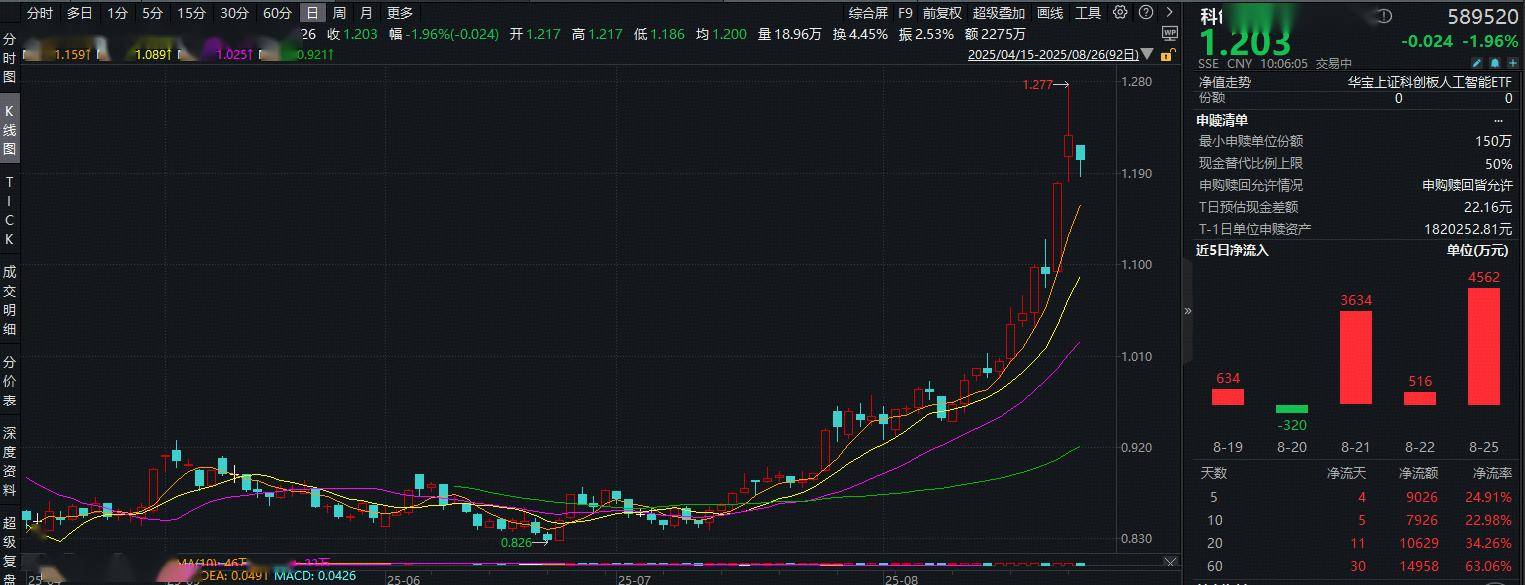
Core Viewpoint - The domestic AI industry chain, particularly the Sci-Tech Innovation Artificial Intelligence ETF (589520), is experiencing market adjustments, with significant fluctuations in key stocks, reflecting both market sentiment and individual stock performance [1][3]. Group 1: Market Performance - On August 26, the Sci-Tech Innovation Artificial Intelligence ETF (589520) saw a decline of 1.96%, with major components like Chipone Technology dropping over 8% and Cambricon Technologies falling more than 3% [1]. - The ETF attracted 45.62 million yuan in a single day on August 25, accumulating 150 million yuan over the past 60 days, indicating strong capital inflow into domestic AI alternatives [1]. Group 2: Stock Adjustments - The adjustment in the ETF is attributed to the decline of major weighted stocks, particularly Cambricon Technologies and Chipone Technology, which faced significant sell-offs [3]. - The decline in Chipone Technology is linked to a large discounted share sale by its shareholders, although this is not indicative of the company's business deterioration [3]. Group 3: Domestic Chip Development - The development of domestic computing chips is characterized by two main technical routes: one focusing on GPGPU compatibility with NVIDIA's CUDA, and the other aiming to establish an independent ecosystem outside of NVIDIA's influence [4][5]. - The domestic computing market share is expected to grow significantly, driven by product advancements and the increasing competitiveness of domestic manufacturers [5]. Group 4: Market Outlook - Analysts predict that the urgency for domestic computing chip replacement will continue to rise, with expectations of a doubling market capacity by 2025 due to rapid growth in domestic demand [5]. - The AI chip market is anticipated to expand significantly, with local brands like Cambricon expected to capture a 40% market share by 2025, driven by increased demand for inference and training computing power [5].

科创人工智能为何遭遇调整?589520盘中跌近2%?AI亟需自主可控!资金迎来逢跌布局机会?
Xin Lang Ji Jin· 2025-08-26 02:24
Core Viewpoint - The domestic AI industry chain, particularly the Sci-Tech Innovation Artificial Intelligence ETF (589520), is experiencing a market correction, with significant fluctuations in component stocks, reflecting both market dynamics and investor sentiment towards AI domestic alternatives [1][3][4]. Group 1: Market Performance - On August 26, the Sci-Tech Innovation Artificial Intelligence ETF (589520) saw a decline of 1.96%, with major component stocks like Chipone Technology dropping over 8% and Cambricon Technologies falling more than 3% [1]. - Despite the market downturn, the ETF attracted significant capital inflow, with 45.62 million yuan on August 25 and a total of 150 million yuan over the past 60 days, indicating strong investor interest in AI domestic alternatives [1][3]. Group 2: Stock Dynamics - The decline in the ETF is attributed to the performance of major weighted stocks, particularly Cambricon Technologies and Chipone Technology, which faced sell-offs due to shareholder actions rather than fundamental business deterioration [3]. - Analysts emphasize that the reduction in shareholding does not equate to a decline in business fundamentals, as Chipone Technology maintains competitive strength in the AI chip sector [3]. Group 3: Industry Trends - The development of domestic computing chips is characterized by two main technological routes: one focusing on GPGPU compatibility with NVIDIA's CUDA, and the other aiming to establish an independent ecosystem outside of NVIDIA's influence [3]. - The growth of the domestic computing market share is driven by product advancements and the narrowing gap with NVIDIA, alongside improvements in the domestic computing ecosystem [3]. Group 4: Future Outlook - First Shanghai Securities projects that the market size for NVIDIA's graphics cards in China will exceed 10 billion USD by 2024, capturing 70-80% of the market share, while domestic computing demand is expected to double by 2025 [4]. - Donghai Securities anticipates that the demand for AI chips will surge, with local brands like Cambricon expected to capture 40% of the market share by 2025 due to increased R&D and supportive industry policies [4]. - The emphasis on self-sufficiency in AI technology is crucial, with the Sci-Tech Innovation Artificial Intelligence ETF (589520) positioned to benefit from the acceleration of domestic AI industry development [4].


688256,逼近“千元股”
Shang Hai Zheng Quan Bao· 2025-08-14 05:12
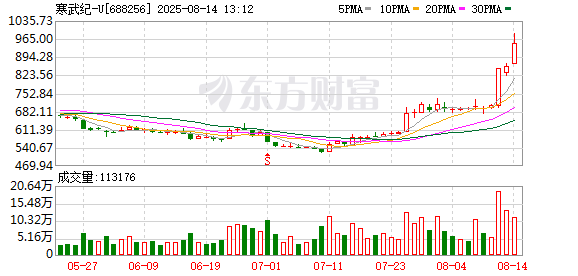
Market Overview - The Shanghai Composite Index broke through 3700 points for the first time since December 2021, with a midday increase of 0.20% [2] - The total trading volume across the Shanghai, Shenzhen, and Beijing markets reached 1.4313 trillion CNY, an increase of 103 billion CNY from the previous day [2] Semiconductor Sector - Semiconductor stocks showed strong performance, with notable gains from companies such as Longtu Photo Mask (+17.22%), Haiguang Information (+9.97%), and Cambricon Technologies (+9.89%) [4][5] - Cambricon Technologies reached a historical high with a market capitalization exceeding 400 billion CNY, with its stock price hitting 985 CNY during trading [6][8] Brain-Computer Interface Sector - Brain-computer interface concept stocks experienced a surge, with companies like Innovent Medical hitting the daily limit for the fifth time in eight days [12][13] - A report by the China Academy of Information and Communications Technology highlighted the significant potential of brain-computer interface technology, predicting rapid advancements and applications in various fields by 2027 [13] Insurance Sector - The insurance sector led the market with a 2.74% increase, driven by companies such as China Pacific Insurance (+4.66%) and New China Life Insurance (+3.53%) [16] - China Ping An's recent acquisition of approximately 1.74 million shares of China Pacific Insurance indicates a strategic financial investment, reflecting confidence in the insurance sector's growth potential [18] - Analysts expect the insurance sector to benefit from improved asset-liability management and favorable market conditions, enhancing long-term investment value [19][20]


助力算力国产化 愿意做上下游的“连接器”——专访新华三集团高级副总裁徐润安
Shang Hai Zheng Quan Bao· 2025-08-13 17:49
Core Insights - The development of AI large models has transformed the entire industry, creating numerous opportunities and a vibrant market [2] - Xinhua San Group is focusing on a "computing power × connectivity" strategy to provide comprehensive ICT infrastructure and solutions for digital transformation in various industries [2][7] - The company is actively promoting the localization of computing power, with over one-third of its current computing power sourced from domestic chips [2][7][8] Computing Power - User demand for computing power has shifted from simply acquiring it to effectively utilizing it, leading to a focus on efficiency and heterogeneous computing [3] - The DeepSeek integrated machine targets customers with budgets below 300,000 yuan, facilitating quick access to AI applications for those lacking technical expertise [4] - The introduction of the edge AI box aims to lower the barriers for users, providing a more affordable option for smaller businesses and individual users [4] Networking - The rise of AI large models is driving the rapid development of intelligent computing centers, with networking becoming a critical focus area [5] - Networking is evolving from being a mere accessory to computing power to becoming a multiplier of computing capabilities, necessitating research into how AI can leverage networking and storage [5][6] - The transition to Ethernet as a mainstream choice for AI server clusters is highlighted, with its efficiency meeting the communication needs of high-density computing clusters [5] Company Strategy - Xinhua San has launched the new H3C UniPoD series of super-node servers, enhancing performance, density, and efficiency through advanced interconnect technology [7] - The company emphasizes a comprehensive approach to domestic computing power localization, collaborating with nearly all local chip manufacturers [7][8] - The establishment of the Turing Town aims to create a collaborative ecosystem among computing power manufacturers, system integrators, and independent software vendors, facilitating the adaptation and validation of domestic GPU capabilities [8]

清华系团队再获资本青睐,清程极智卡位国产算力生态
2 1 Shi Ji Jing Ji Bao Dao· 2025-07-15 08:11
Core Insights - Qingcheng Jizhi, a leading player in the AI infrastructure sector, has successfully completed a new financing round exceeding 100 million yuan, marking its third round of funding within a year [1][3] - The investment was led by a prominent industry player, with participation from various influential capital sources in the computing power industry, indicating strong market interest in AI infrastructure [1][4] - The CEO of Qingcheng Jizhi highlighted that the funding will enhance the company's capabilities in product development, ecosystem building, and market expansion [2][4] Company Overview - Qingcheng Jizhi was established in December 2023 and focuses on developing intelligent computing system software, acting as a crucial link between intelligent computing and applications [3][6] - The company is led by a team from Tsinghua University, with its CEO being a PhD graduate from the same institution [3][6] Financing Strategy - The company has adopted a "small steps, quick runs" financing strategy due to the rapid changes in the AI infrastructure industry and the high demand for cash flow to support product development [4][6] - This strategy has attracted multiple investors who are optimistic about the company's technological capabilities [4][5] Technological Advancements - Qingcheng Jizhi's software solutions provide a full-stack approach to optimize underlying computing power, enhancing model training and inference efficiency while reducing costs for AI application development [6][7] - The company has developed the "Bagualu" high-performance model training system, which has shown significant acceleration in training tasks on large-scale domestic computing clusters [6][7] - The "Chitu" inference engine has been optimized for domestic computing power, achieving low latency and high throughput, thus supporting diverse application scenarios [6][7] Market Demand - The demand for computing power in the AI market has shifted from primarily training large models to a significant increase in inference power requirements [7][8] - Qingcheng Jizhi is addressing the diverse needs of clients, from small enterprises seeking cost-effective solutions to large organizations requiring comprehensive computing power solutions [8]
山西证券研究早观点-20250528
Shanxi Securities· 2025-05-28 00:24
Group 1: Agricultural Sector Insights - The agricultural sector's performance saw a decline, with the HuShen 300 index down by 0.18% and the agriculture, forestry, animal husbandry, and fishery sector down by 0.36% during the week of May 19-25, 2025 [4] - Pig prices showed a mixed trend, with the average price of external three yuan pigs in Sichuan, Guangdong, and Henan at 14.05, 15.39, and 14.25 yuan per kilogram respectively, reflecting a week-on-week change of -2.09%, +0.65%, and -3.72% [4] - The report highlights the potential recovery in the feed industry due to declining upstream raw material prices and improving downstream farming conditions, particularly for Hai Da Group, which is expected to see an upward trend in its business fundamentals [4] Group 2: AI Computing Industry Insights - The AI computing industry is experiencing sustained high demand, particularly from the internet and intelligent computing centers, with a rapid push for domestic procurement of AI computing power [6] - Major domestic AI chip manufacturers like Huawei, Haiguang Information, and Cambricon are accelerating their performance and capacity breakthroughs, with Huawei's Ascend 910B chip being comparable to NVIDIA's A100 [6] - The AI server market is projected to grow significantly, with IDC forecasting that the market size will reach 25.3 billion USD by 2028, driven by strong demand from domestic internet companies and intelligent computing centers [6]
院士专家:算力产业链国产化替代工作紧迫
Guan Cha Zhe Wang· 2025-05-21 10:04
Core Viewpoint - The recent developments in China's semiconductor industry, including new regulations and export restrictions from the U.S., highlight the urgent need for domestic computing power localization as a critical choice for various sectors in China [1]. Group 1: Domestic Computing Power Development - The "2024 China Computing Power Development Report" indicates that by 2024, the total scale of computing power centers in China will exceed 8.3 million standard racks, with a total computing power of 246 EFLOPS, ranking among the top globally [2]. - Experts emphasize the importance of confidence in domestic computing facilities, asserting that they possess international competitiveness and should be actively utilized [2]. - A "research first" strategy is proposed to overcome the bottlenecks in the application of domestic computing power, particularly in commercial sectors where cost pressures exist [2]. Group 2: High-Performance Computing (HPC) Significance - High-performance computing centers, with vast storage and advanced processing capabilities, are crucial for scientific research and innovation in fields such as engineering simulation and genetic analysis [3]. - The advancement of domestic high-performance computing has significantly improved capabilities in areas like cosmic simulations, enhancing the precision of research [3]. Group 3: Systematic Innovation for Competitiveness - Experts argue that surpassing foreign counterparts in domestic computing power requires systematic innovation rather than relying on individual devices or metrics [4]. - The urgency for domestic computing power localization is underscored by recent restrictions on access to key biomedical databases for Chinese users, highlighting the need for a robust domestic supply chain [4]. Group 4: Policy and Ecosystem Development - The establishment of a domestic computing ecosystem is deemed essential, with suggestions for collaboration between manufacturers and research institutions to create open-source communities [7]. - Strong policy measures are advocated to ensure the successful implementation of domestic computing power solutions, as voluntary efforts may not suffice [7].

发展国产算力要自信敢用,院士专家热议算力国产化路径
Bei Jing Ri Bao Ke Hu Duan· 2025-05-20 10:03
Core Insights - The increasing global supply chain risks for high-performance computing highlight the importance of domestic computing capabilities in China's information industry and other sectors [1][3] - Experts emphasize the need for confidence in domestic computing facilities, innovative systems, and collaborative ecosystems to build a self-sufficient computing framework [1][3] Group 1: Domestic Computing Development - The "2024 China Computing Development Report" indicates that the total scale of computing centers in use will exceed 8.3 million standard racks, with a total computing capacity of 246 EFLOPS, ranking among the top globally [3] - Despite the large total computing capacity, the contribution of domestic computing facilities remains low, necessitating a shift in mindset to utilize domestic technology confidently [3][4] - Zhang Yunquan suggests a "research-first" strategy to overcome bottlenecks in the adoption of domestic computing technologies, particularly in commercial sectors facing cost pressures [3][4] Group 2: High-Performance Computing Significance - High-performance computing centers play a crucial role in advanced research fields such as scientific computation, engineering simulation, and genetic analysis, making their domestic development vital for sustainable innovation [4] - Domestic high-performance computing clusters, such as those developed by Sugon, can seamlessly integrate with mainstream software ecosystems, addressing over 95% of migration issues [4] - The recent restrictions by the U.S. National Institutes of Health on access to core biomedical databases for countries including China underscore the urgency of domestic computing capabilities [4][5] Group 3: Innovation and Collaboration - Achieving innovation in domestic computing requires attention to foundational theories, as highlighted by Chen Runsheng, who notes the efficiency of the human brain compared to large AI computing clusters [5] - Recommendations include forming open-source communities among domestic manufacturers and research institutions to foster iterative innovation while adhering to international standards [5] - Collaborative efforts across academia, industry, and application sectors are essential to identify common algorithms and optimize chip design and software development for broader domestic adoption [5]
院士专家共商算力国产化破局之道:呼吁突破底层创新瓶颈
Huan Qiu Wang Zi Xun· 2025-05-19 04:17
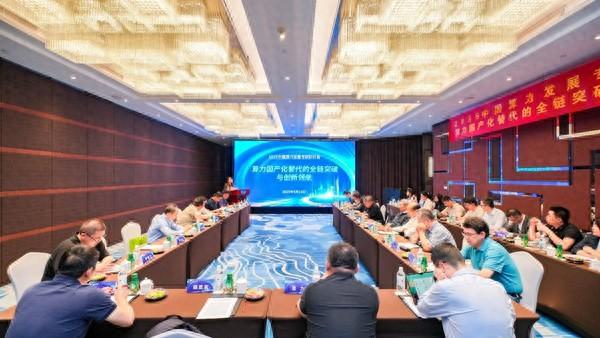
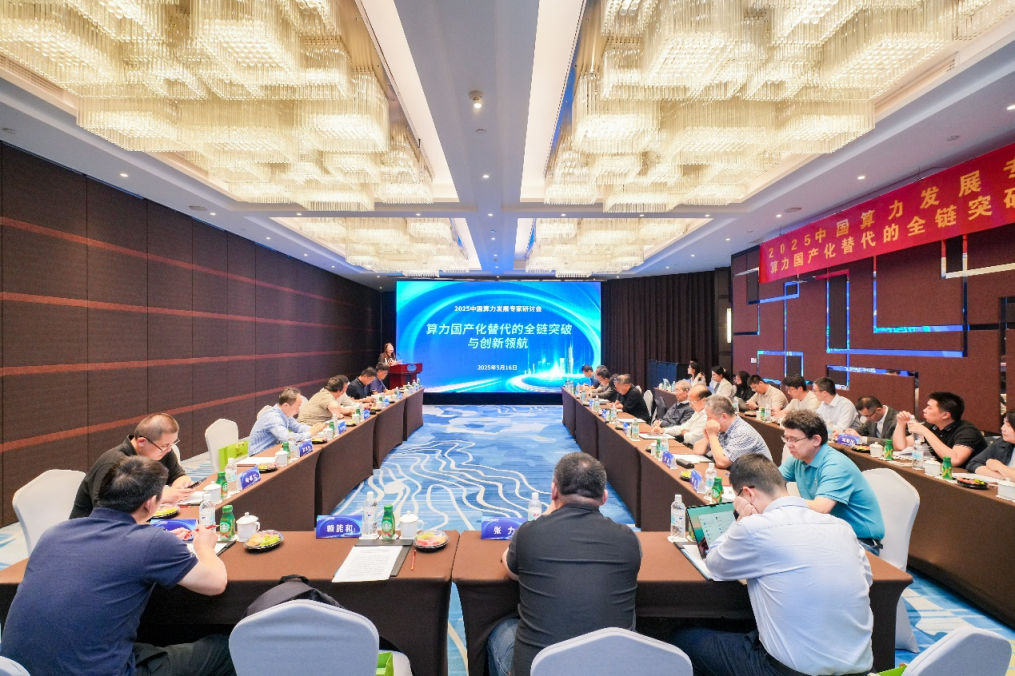
Core Insights - The conference focused on the theme of "full-chain breakthroughs and innovative leadership in domestic computing power replacement" to provide strategic guidance for building a self-controlled computing power system [1] Group 1: Current State of Domestic Computing Power - China's total computing power has reached 246 EFLOPS, with over 8.3 million standard racks, maintaining a leading position globally, but the contribution of domestic computing facilities needs to be improved [3] - Zhang Yunqiang emphasized that domestic computing power has international competitiveness and highlighted the need to establish confidence in reuse [3] Group 2: Innovation Strategies - Chen Runsheng pointed out that domestic computing power is not just a competition of single devices but a comprehensive contest of system capabilities, stressing the importance of basic theoretical research [4] - Cheng Yaodong proposed a "three-step" strategy for implementation: 1) Compatibility with international mainstream ecosystems, 2) Development of domestic unique capabilities, 3) Upgrading the entire chain through leading applications [4] Group 3: Ecosystem Development - Zhai Jidong suggested that domestic manufacturers should collaborate with research institutions to build open-source communities for iterative innovation while adhering to international standards [5] - Lai Neng revealed the critical role of policy enforcement in achieving self-controlled computing facilities in the oil industry under a three-year domestic policy push [5] Group 4: Consensus Among Experts - Experts agreed that to achieve the rise of domestic computing power, mechanisms like "ranking and leadership" should be used to overcome bottlenecks in chip manufacturing, while leveraging large scientific devices and research institutions to create a positive feedback loop in technology application [6]