美联储扩表

Search documents
国联民生:鲍威尔的降息“妥协”?
Xin Lang Cai Jing· 2025-12-10 23:52
川阅全球宏观 作为今年美联储的收官会议,市场肯定会尽一切可能"窥探"联储明年政策取向和空间。结合纽约联储行 长威廉姆斯等官员此前的鸽派信号,以及市场对降息的高度一致预期,本次会议如期降息25个基点几乎 没有悬念。而市场核心分歧在于,鲍威尔在会议上的表态将为后续的政策路径提供何种指引。 但与市场预期相反的是,无论是鲍威尔还是点阵图等并未展现出更明显的"鹰"派倾向。鲍威尔宣布重新 购买短债,并且延续此前降息论调,美联储将根据经济数据逐次会议作出决策,货币政策并未设定固定 路径;而点阵图相较9月也呈现一定的"鸽"派分布。会议后,美股和贵金属受到提振大涨,美元和美债 收益率则一度走弱。但无论如何,就当前的利率水平来看,美联储的降息门槛已经明显提高,明年上半 年美联储将进入一定的观望期,节奏将明显放缓,而围绕美联储独立性的政治大戏也将正式拉开帷幕。 首先,本次会议最值得关注的地方在于,美联储将重新购买短债。美联储将于12月12日开始的30天内购 买400亿美元国库券,购买规模预计会在几个月内保持高位。尽管美联储已宣布于12月1日停止缩表,但 银行体系准备金水平仍显不足,货币市场利率维持高位。美联储此举有助于为货币市场重 ...



中金:美联储降息趋于放缓,扩表先行
中金点睛· 2025-12-10 23:51
中金研究 美联储如预期在12月会议上降息25个基点,但反对降息的官员增至两人[1],显示进一步降息的门槛正在抬高。与此同时,鲍威尔的表态并不强硬[2], 加之美联储宣布将启动短期国库券(T-bills)购买操作,帮助缓和了市场的担忧。此前被充分计入的"鹰派降息"预期出现反转,加剧了市场波动。展望 未来,鉴于经济与就业仍面临下行压力,我们预计美联储或将在2026年继续降息;但考虑到通胀粘性犹存,降息节奏趋于放缓。1月可能按兵不动,下 一次降息或在3月。 美联储如期降息,两名官员反对降息。 正如市场所期待的那样,美联储于12月再次降息25个基点。这一决策并非一致观点,共有三名官员提出不同意 见,堪萨斯联储主席施密德与芝加哥联储主席古尔斯比认为应该按兵不动,而美联储理事米兰则继续认为应该降息50个基点。与上次会议相比,认为不应 该继续降息的人数增加至两人。这表明,美联储内部对于是否需要降息分歧加剧。 明年或继续降息,但短期阻力将增加。 展望未来,市场真正关心的问题在于美联储能否在2026年继续降息。根据最新公布的利率点阵图[3],共有12名官 员认为应继续降息,较上次会议增加1人,另有7名官员倾向不再降息,其中3人 ...

美联储政策观察:鲍威尔的“鹰”派降息剧本?
Guolian Minsheng Securities· 2025-12-10 15:11
邮箱:taochuan@glms.com.cn 邮箱:linyan@glms.com.cn 邮箱:shaoxiang@glms.com.cn 美联储政策观察 鲍威尔的"鹰"派降息剧本? glmszqdatemark 2025 年 12 月 10 日 研究助理:武朔 执业证书:S0590125110064 邮箱:wushuo@glms.com.cn [Table_Author] 分析师:陶川 分析师:林彦 分析师:邵翔 执业证书:S0590525110006 执业证书:S0590525110007 执业证书:S0590525120004 相关研究 本公司具备证券投资咨询业务资格,请务必阅读最后一页免责声明 证券研究报告 1 作为今年美联储的收官会议,12 月议息后的政策走向已成为当前市场核心焦点。 结合纽约联储行长威廉姆斯等官员此前的鸽派信号,以及市场对降息的高度一致 预期,本次会议如期降息 25 个基点的概率较高。而市场核心分歧在于,鲍威尔在 会议上的表态将为后续的政策路径提供何种指引。 我们认为,鲍威尔很可能在会议上释放更多"鹰"派信号,毕竟在连续降息后, 美联储的政策空间也已经愈发有限,且快速降息使得短期 ...
和讯投顾郑镇华:大分歧窗口,防守策略不变!
Sou Hu Cai Jing· 2025-12-10 12:40
今天下午指数探底回升,短线调整结束了吗?和讯投顾郑镇华分析。第一个,短线的探底回升是属于 3880点的第一个支撑的,支撑小反弹目前调整没有结束,特别是在中旬到月底之间,市场的弱势格局没 有变化,但是短线有两个因素对市场有直接影响,第一个是外部因素,美联储的降息预期,还有他的是 不是进一步的扩表对市场有较大影响。 第二个是咱们这边,比如说下午的房地产板块的回升,主要对于房地产贴息的影响,特别是重要会议会 不会再明确告诉大家,要不要降息或者降准那对市场会有影响,如果有的话那重磅利好市场可能还会再 上一下,如果没有的话,那我认为下面还有个二次牵连过程,特别是3850~3860这个重要支撑位置。极 端情况下3830如果月底到这些点位的话出现信号了。 ...
【环球财经】美联储12月议息会议分裂或加剧 市场大幅波动或成常态
Sou Hu Cai Jing· 2025-12-10 10:26
Core Viewpoint - The Federal Reserve is expected to lower interest rates by 25 basis points in December, bringing the policy rate to 3.5%-3.75%, amid increasing internal divisions and potential signals to pause future rate cuts [1][2][3]. Group 1: Interest Rate Expectations - Market has nearly fully priced in a 25 basis point rate cut for December, with a focus on the Fed's internal disagreements and future monetary policy expectations [1][2]. - The probability of a December rate cut fluctuated significantly, dropping below 30% after hawkish comments from Fed officials but rebounding due to weak employment data and dovish remarks [2][3]. - Analysts expect the Fed to signal a pause in rate cuts, emphasizing that rates are close to neutral levels [5][6]. Group 2: Internal Fed Dynamics - Among the 12 voting members of the FOMC, 5 have expressed opposition or skepticism towards further rate cuts, while 4 members support the cut [3][4]. - The decision hinges on the stance of three key leaders who have not yet made their positions clear, which could sway the vote towards a 7:5 majority in favor of the cut [5][6]. Group 3: Economic Indicators - The labor market is showing signs of weakness, with a reported decrease of 32,000 jobs in November, and the unemployment rate rising from 4.1% to 4.4% over three months [2][3]. - Inflation in the service sector is stabilizing, but wage growth continues to outpace productivity growth, potentially undermining economic momentum [3][6]. Group 4: Future Projections - The Fed is expected to adjust its economic forecasts, likely raising growth predictions while lowering inflation expectations, maintaining guidance for rate cuts in 2026-2027 [7][8]. - Economists predict that the Fed may cut rates again in June and July 2026, with a final rate target of 3.00%-3.25% [7][8]. Group 5: Market Reactions - The anticipation of rate cuts is expected to lead to increased market volatility, with the potential for the dollar index to rise if the Fed's stance is more hawkish than expected [9][10]. - The Fed's internal divisions may lead to unpredictable market reactions, as the focus shifts to the predictability of policy decisions rather than the policies themselves [11].
美联储降息遇上日本加息,人民币竟成意外走强?这波操作太狠了
Sou Hu Cai Jing· 2025-12-09 17:40
Core Viewpoint - The article discusses the contrasting monetary policies of the US and Japan, highlighting the potential market impacts of Japan's anticipated interest rate hike and the US Federal Reserve's expected rate cut. Group 1: Japan's Monetary Policy - Japan's central bank is expected to raise interest rates by 25 basis points on December 19, following a strong indication from Governor Kazuo Ueda [1][7] - The market's expectation for Japan's rate hike increased significantly from 50% to over 70% after Ueda's statement, with the 2-year Japanese government bond yield rising by 3 basis points [7] - Previous rate hikes in Japan have been managed with better communication, reducing panic in the markets compared to the sudden hike in July 2024 [5][7] Group 2: Impact on Currency and Global Markets - The anticipated rate hike in Japan aims to strengthen the yen, which has been weak against the dollar, thus alleviating imported inflation pressures [9] - The US Federal Reserve has cut rates by a total of 75 basis points since September, leading to a decline in the dollar index from around 100 to approximately 98 [9] - The depreciation of the dollar has lessened external pressure on the Chinese yuan, which has only slightly declined by 1.77% against the dollar this year [9] Group 3: Effects on A-shares and Hong Kong Market - The strengthening of the yuan is expected to enhance the attractiveness of Chinese assets to foreign investors, as they can purchase more assets with converted dollars [13] - The Hong Kong market, particularly the Hang Seng Tech Index, has shown signs of recovery as the dollar weakens, making dollar-denominated assets more valuable in yuan terms [11] - The upcoming Central Economic Work Conference is anticipated to set a positive tone for economic policies, historically leading to an increase in market indices [13] Group 4: Bond Market Dynamics - The bond market, particularly the 30-year government bonds, has seen declines due to changing market expectations regarding interest rate cuts by the Chinese central bank [15] - Despite recent declines, there is potential for support in the bond market due to expectations of further rate cuts in the coming year [15][16] - The emphasis on "macro-prudential management" by the central bank suggests a focus on preventing financial risks, indicating lower volatility for government bonds [16] Group 5: Investment Strategy Outlook - The article suggests a potential shift in investment focus from bonds to equities, driven by the expected strengthening of the yuan and global liquidity conditions [18] - Investors are advised to monitor key upcoming meetings, including the Federal Reserve's meeting on December 11 and the Central Economic Work Conference, for insights into future policy directions [18] - Recommendations include reallocating funds from government bonds to sectors benefiting from yuan appreciation and policy expectations, such as resource, technology, and dividend-paying stocks [18]
中欧基金付倍佳:明年港股有盈利估值双击的机会
Zheng Quan Shi Bao Wang· 2025-12-09 06:05
Core Viewpoint - The Hong Kong stock market is expected to experience a dual boost from earnings and valuations in the coming year [1] Group 1: Liquidity Perspective - The anticipated expansion of the Federal Reserve's balance sheet is viewed positively for Hong Kong stocks [1] - A downward trend in the dollar cycle is expected to enhance overseas liquidity, benefiting the Hong Kong market [1] Group 2: Fundamental Perspective - There is an expectation for a turning point in the Producer Price Index (PPI) domestically next year [1] - Certain assets are anticipated to have opportunities for earnings upgrades [1]
中金:流动性的新变化
Sou Hu Cai Jing· 2025-12-07 23:58
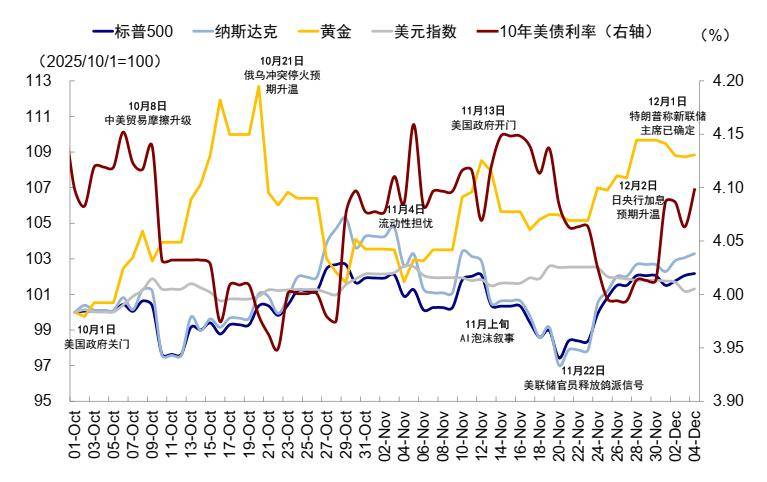
Group 1 - Since the end of October, investor risk appetite has decreased, leading to pressure on global risk assets, with the S&P, Nasdaq, and Hang Seng Tech experiencing maximum declines of 5.1%, 7.3%, and 12.6% respectively [1] - The decline is attributed to concerns over the AI bubble, tight liquidity in the repurchase market, and fluctuating expectations regarding Federal Reserve interest rate cuts [1][4] - For technology stocks, which are sensitive to liquidity, breakthroughs in AI trends or significant improvements in liquidity are necessary for market recovery [4] Group 2 - The upcoming FOMC meeting on December 11 is crucial, as the market has priced in an 88% probability of a 25 basis point rate cut, but the tone of the Fed's statements and the dot plot will significantly influence market direction [4][5] - The Bank of Japan's potential rate hike on December 19 raises concerns about liquidity disruptions, reminiscent of last year's events [4][47] - The nomination of a new Federal Reserve chair, expected early next year, will also impact future rate cut expectations and market sentiment [20][21] Group 3 - Recent fluctuations in rate cut expectations have been driven by mixed signals from Fed officials, with a notable shift towards dovish comments in late November [5][8] - The current economic indicators, such as the ISM manufacturing PMI remaining in contraction for eight consecutive months and a significant drop in ADP employment figures, suggest a need for rate cuts to stimulate demand [8][10] - The Fed's ability to cut rates is supported by the current inflation data, which indicates that tariff impacts on inflation are less severe than previously feared [13][14] Group 4 - The Fed's balance sheet has decreased from a peak of $9 trillion to $6.5 trillion, and stopping the balance sheet reduction is expected to improve liquidity [32][33] - If the Fed resumes balance sheet expansion, it could provide additional liquidity to the market, which is crucial for risk asset performance [32][33] - The Treasury General Account (TGA) has also seen a reduction, which is expected to further release liquidity into the market [41][42] Group 5 - Concerns about the Bank of Japan's rate hike are heightened, but the impact is expected to be limited compared to last year's events due to different market conditions [47][50] - The potential for a liquidity shock exists if multiple negative factors converge, such as a hawkish Fed statement and disappointing employment data [50][57] - Overall, while short-term liquidity conditions are uncertain, a medium-term trend towards easing is anticipated, especially with the new Fed chair and potential balance sheet expansion [58]
中金:流动性的新变化
中金点睛· 2025-12-07 23:42
Core Viewpoint - Since the end of October, investor risk appetite has decreased, leading to pressure on global risk assets, with the S&P, Nasdaq, and Hang Seng Tech experiencing maximum declines of 5.1%, 7.3%, and 12.6% respectively. This is attributed to concerns over the AI bubble, tight liquidity in the repurchase market, and fluctuating expectations regarding Federal Reserve interest rate cuts [2][4]. Group 1: Market Conditions and Liquidity - The current market, particularly for liquidity-sensitive tech stocks, requires either breakthroughs in AI industry trends or significant improvements in liquidity for any upward movement [4]. - A series of events affecting liquidity is anticipated in the coming month, including the FOMC meeting on December 11, where an 88% probability of a rate cut is priced in, but the market will be attentive to any hawkish statements or discussions about restarting balance sheet expansion [4][5]. - The Bank of Japan's interest rate decision on December 19 is also a concern, as it may echo last year's liquidity "storm" [4]. Group 2: Federal Reserve Rate Cuts - The expectation for a December rate cut is well established, with the focus on the dot plot and statements from the Fed. A return to neutral rates may require three cuts [5][7]. - Recent data indicates a need for rate cuts due to high current rates suppressing traditional demand, with the ISM manufacturing PMI in contraction for eight consecutive months and a significant drop in consumer confidence [7][11]. - The Fed's ability to cut rates is supported by recent inflation data, which suggests that tariff impacts on inflation are less significant than previously feared, with consumer exposure to tariffs at only 11% [13][15]. Group 3: New Fed Chair Nomination - The upcoming nomination of a new Fed chair is critical, with Kevin Hassett being the frontrunner. His potential policies may lean towards more dovish stances while maintaining some restraint to preserve the Fed's independence [20][21]. - If Hassett is appointed, he may advocate for more aggressive rate cuts than currently anticipated, which could stimulate the economy but also raise concerns about the Fed's independence [27][28]. - The market is closely monitoring how the new chair will balance the need for rate cuts with the preservation of the Fed's autonomy, as excessive dovishness could lead to fears of political influence over monetary policy [20][27]. Group 4: Market Implications - The potential for the Fed to restart balance sheet expansion could significantly enhance market liquidity and support financial assets. The cessation of balance sheet reduction and the potential for further expansion are expected to improve liquidity conditions [29][30]. - The overall financial liquidity in the U.S. is projected to expand by 7%-14% in 2026, which is likely to have a positive correlation with U.S. equities [37][41]. - The anticipated actions of the Fed and the new chair could lead to fluctuations in U.S. Treasury yields and the dollar, with short-term pressures expected but a long-term recovery likely if independence is maintained [54][55].

莲华资产洪灏:2026年美股将会先涨后跌,美联储即将重启扩表推高风险资产
Xin Lang Cai Jing· 2025-12-07 14:17
Core Viewpoint - The U.S. stock market is expected to rise initially and then decline, primarily due to the ongoing liquidity cycle [1][4]. Group 1: U.S. Economic Conditions - The U.S. dollar is expected to weaken significantly as a necessary measure to attract capital back to the U.S. and invest in American manufacturing, given the high labor and operational costs [3][6]. - The upcoming change in the Federal Reserve chairmanship next year is anticipated to impact monetary policy, with current short-term funding markets being very tight, leading to short-term interest rates exceeding the Fed's benchmark rate [3][6]. - The Federal Reserve is likely to lower interest rates soon, as it has no other viable options, and this decision is seen as inevitable [3][6]. Group 2: Federal Reserve's Monetary Policy - The Federal Reserve has abandoned its plan to reduce its balance sheet, which currently stands at approximately $6 trillion, due to issues arising in the repurchase market [3][6]. - A new round of balance sheet expansion by the Federal Reserve is expected, potentially reaching new heights, which will likely result in an increase in risk asset prices [3][6]. - The current market conditions suggest that shorting risk assets may not be cost-effective, as there is a belief that risk assets will experience both upward and downward movements [3][6].