AI军备竞赛

Search documents
中美经贸磋商利好落地后市场或如何演绎?
ZHONGTAI SECURITIES· 2025-11-03 05:30
Report Overview - Report Title: Credit Business Weekly Report - Date: November 3, 2025 - Research Institute: Zhongtai Securities Research Institute - Analysts: Xu Chi, Zhang Wenyu 1. Report Industry Investment Rating - Not provided in the report 2. Report Core Views - The positive outcome of the China-US economic and trade consultations and the continuous advancement of domestic reform policies have released dual positive signals, boosting market confidence. Future policies and market trends are expected to revolve around the core logic of "great power competition," benefiting the continuous development of domestic and global asset trends [8]. - Investment suggestions focus on three main lines: geopolitical competition (gold, military, rare earths, non-ferrous metals, etc.), technological competition (AI - related sectors), and supply - chain reconstruction (power equipment, polysilicon, etc.) [8]. 3. Summary by Relevant Catalogs Market Observation: Market Changes after the Positive Outcome of China - US Economic and Trade Consultations Market Performance - A - share major indices showed a "high - then - low" pattern last week. The CSI 300, STAR 50, and ChiNext Index rose in the first half - week and fell in the second half. The CSI 300 and STAR 50 ended the week down 0.43% and 3.19% respectively, while the ChiNext Index rose 0.5%. The CSI 2000 rose 0.95%. The large - cap growth index showed the most obvious "high - then - low" pattern, while the small - cap growth style was strongly supported. The technology sector declined, while the manufacturing and cyclical sectors were stronger [6]. - In terms of sectors, the technology sector declined due to unmet expectations in some aspects, while the manufacturing sector was supported by the "15th Five - Year Plan" and the cyclical sector benefited from geopolitical factors. Non - ferrous metals, steel, and agriculture, forestry, animal husbandry, and fishery performed well [6]. Capital Flow - ETF funds showed net inflows, with funds for the CSI 300, CSI 500, STAR 50, and ChiNext Index turning from outflows to inflows. The CSI 2000 had a continuous and accelerating inflow, and only the dividend index had a small net outflow. Northbound funds increased significantly, leveraged funds grew steadily, and the margin balance reached a new high on October 29. The pressure of major shareholder reduction remained low [7]. Market Review Market Performance - Most major market indices rose last week, with the CSI 1000 having the largest increase of 1.18%. Among the large - category industry indices, the material index and industrial index performed better, rising 2.98% and 1.36% respectively, while the financial index and information technology index performed weakly, falling 1.43% and 0.93% respectively [9][17]. - Among the 30 Shenwan primary industries, 19 industries rose. The power equipment, non - ferrous metals, and steel industries had relatively large increases of 4.29%, 2.56%, and 2.55% respectively, while the communication, beauty care, and banking industries had relatively large declines of 3.59%, 2.21%, and 2.16% respectively [19]. Trading Volume - The average daily trading volume of the Wind All - A Index last week was 23253.35 billion yuan (previous value: 17973.14 billion yuan), at a relatively high historical level (94.10% in the three - year historical quantile) [22]. Valuation Tracking - As of October 31, 2025, the valuation (PE_TTM) of the Wind All - A Index was 22.01, a decrease of 0.58 from the previous week, at the 89.20% quantile in the past five - year history. Among the 30 Shenwan primary industries, 18 industries' valuations (PE_TTM) were repaired [27].
焦虑的贝索斯,决定先裁30000人
虎嗅APP· 2025-10-30 10:01
Core Viewpoint - Amazon is initiating its largest-ever layoff, cutting approximately 30,000 corporate employees, primarily affecting white-collar workers rather than warehouse staff, in response to a combination of pandemic-related overstaffing and competitive pressures from the AI arms race [4][5][12]. Group 1: Layoff Details - The layoff will occur in two phases: an initial cut of 14,000 employees followed by a second wave in January 2025, potentially affecting an additional 16,000 or more [12][15]. - As of October 27, 2025, the total number of layoffs in the tech industry has reached over 128,000, with Amazon's actions accounting for about 25% of this total [10][11]. Group 2: AI Competition and Market Position - Amazon's layoffs are partly attributed to the decline in demand post-pandemic, which led to an overstaffing situation as the company doubled its workforce during the pandemic [16][17]. - The company faces increasing pressure from competitors like Microsoft and Google, whose cloud services are growing at significantly higher rates (Microsoft Azure at 39% and Google Cloud at 32%) compared to Amazon Web Services (AWS) at 17.5% [19][20]. - Concerns about AWS's competitive position in the AI space have prompted Amazon's leadership, including founder Jeff Bezos, to express worries about falling behind in the AI race [21][22]. Group 3: Automation and Workforce Transformation - Amazon is pursuing a significant automation strategy, aiming to replace over 500,000 employees with robots and increase automation in operations to 75% [31][33]. - The company has already made substantial investments in robotics, starting with the acquisition of Kiva in 2012, and plans to replicate highly automated warehouses globally by 2027 [35][36]. Group 4: Impact on Employment Landscape - A recent study indicates that the AI wave is disproportionately affecting mid-level white-collar workers, particularly those with average qualifications, while top-tier and low-tier workers are less impacted [42][48]. - The layoffs at Amazon reflect this trend, with significant cuts in HR and entry-level technical positions, which are more susceptible to automation [51][52]. Group 5: Management and Cultural Shifts - The layoffs extend to middle and senior management, with a directive to reduce labor costs by 10% to 15%, indicating a shift in Amazon's management culture towards a leaner structure [65][66]. - CEO Andy Jassy's push for efficiency and reduction of bureaucratic layers is evident in the current restructuring efforts, which aim to streamline decision-making processes [24][66]. Group 6: H-1B Visa Holders and Workforce Dynamics - The layoffs have particularly impacted H-1B visa holders, who face significant challenges in finding new employment within the 60-day grace period after being laid off [76][79]. - Amazon's simultaneous hiring of foreign workers while laying off domestic employees has raised concerns and criticisms regarding its labor practices [80].



近3年主动权益基金的投研较量 大小公募机构各展所长
Zheng Quan Ri Bao Wang· 2025-10-30 05:45
Core Insights - The A-share market has shifted from a downward trend in 2023 to a structural market deepening by 2025, providing opportunities for active equity funds to demonstrate their research capabilities [1] - As of September 30, 22 fund companies achieved an arithmetic average return of over 30% in active stock investment over the past three years, highlighting the ability of active equity funds to navigate a differentiated market [1] - Smaller public funds have outperformed larger institutions by leveraging flexible strategies and focused sectors, while larger institutions have overcome scale limitations through systematic research capabilities [1] Fund Performance - The active equity fund landscape has evolved from single-point breakthroughs to a diversified product system, catering to varied investor needs with both long-term stability and short-term flexibility [2] - Notably, 26 active equity products from Nuoan Fund have doubled their returns since inception, with 15 products achieving an annualized return exceeding 10% [2] - The success of these funds is attributed to accurate industry trend predictions and proactive investment strategies, exemplified by Nuoan Fund's focus on AI and semiconductor sectors [2] Investment Strategies - Smaller institutions have achieved success by focusing on niche technology sectors, allowing for agile responses to industry changes [3] - Larger institutions maintain sensitivity to industry trends through comprehensive research systems, avoiding performance dilution from scale while achieving long-term stable returns [3]
焦虑的贝索斯,决定先裁30000人
3 6 Ke· 2025-10-30 02:11
Group 1 - Amazon is initiating its largest-ever layoffs, cutting approximately 30,000 corporate employees, primarily affecting white-collar workers rather than warehouse staff [6][11] - The layoffs are part of a broader trend in the tech industry, with around 128,000 tech employees laid off this year, and Amazon's actions account for about a quarter of this total [9][11] - The layoffs are driven by a combination of post-pandemic adjustments and pressures from the AI arms race, as Amazon seeks to streamline operations and enhance efficiency through automation and robotics [14][19] Group 2 - Amazon Web Services (AWS) is experiencing a slowdown in growth, with a 17.5% year-over-year revenue increase in Q2, compared to competitors like Microsoft Azure and Google Cloud, which saw growth rates of 39% and 32% respectively [14][15] - The company is facing pressure to integrate AI solutions more effectively, as competitors have built robust AI ecosystems that AWS lacks, leading to concerns about its market position [15][18] - CEO Andy Jassy has emphasized the need to reduce management layers and improve decision-making efficiency, indicating that many repetitive and process-driven jobs will be automated [19][22] Group 3 - Amazon plans to automate operations significantly, aiming to replace over 500,000 employees with robots and increase automation levels to 75% in its warehouses [23][27] - The company has already made substantial investments in automation technology, including the acquisition of Kiva and the development of highly automated warehouses [27][28] - This shift towards automation is seen as essential for maintaining competitive advantage in the retail and logistics sectors, as rivals also leverage AI to optimize their operations [28] Group 4 - The impact of AI on the job market is uneven, with middle-tier employees facing the greatest risk of displacement, while top-tier and low-tier workers remain relatively secure [29][31] - Research indicates that companies adopting AI are reducing their hiring for entry-level positions more significantly than those that do not, exacerbating job polarization [31][32] - Amazon's layoffs reflect this trend, with significant cuts in HR and entry-level software engineering roles, highlighting the vulnerability of mid-level talent [33][39] Group 5 - The layoffs extend to middle management, with a directive to reduce personnel costs by 10%-15%, affecting even senior positions [41][43] - This approach aligns with Jassy's goal of reducing bureaucratic layers and streamlining operations, indicating a shift in corporate culture towards efficiency [43][44] - The layoffs have raised concerns among H-1B visa holders, who face job insecurity and potential deportation if they cannot find new employment within a limited timeframe [49][51]

盘后重挫超8%!Meta三季度业绩不及预期,一次性税费致季度盈利暴跌83%,预计明年资本支出大增
美股IPO· 2025-10-29 22:58
Core Viewpoint - Meta's third-quarter net profit plummeted by 83% year-on-year, primarily due to a one-time non-cash tax expense of $15.93 billion resulting from the U.S. tax reform, which raised the effective tax rate to 87% from 12% in the same period last year [1][3][5] Financial Performance - Revenue for the third quarter reached $51.24 billion, a 26% year-on-year increase, while net profit fell from $15.69 billion to $2.71 billion [3][5] - Earnings per share (EPS) was reported at $1.05, significantly below market expectations of $6.68, but adjusted EPS, excluding the tax impact, was $7.25, exceeding expectations [5] - Operating profit margin decreased from 43% to 40%, with total costs rising by 32% year-on-year [5][13] - Free cash flow stood at $10.6 billion, with cash reserves of $44.5 billion [5][15] Business Progress - Daily active users reached 3.54 billion, an 8% year-on-year growth, with ad impressions increasing by 14% and average ad prices rising by 10% [4][10] - Q4 revenue guidance is set between $56 billion and $59 billion, aligning with market expectations [6][14] Strategic Adjustments - Significant capital expenditures are anticipated, with projections for 2026 potentially exceeding $80-85 billion, driven by infrastructure investments and AI talent costs [12][13] - The CFO indicated that the growth in capital expenditures for 2026 will significantly surpass that of 2025, which was already projected at $70-72 billion [13] Future Outlook - Concerns arise regarding the Reality Labs division, which is expected to see a decline in hardware revenue in Q4 due to last year's product launches and preemptive stocking by retailers [14] - Despite a solid financial position, the key issue lies in whether investors are willing to support an unclear return cycle for AI investments, as indicated by the post-earnings drop of over 8% [15]


不请投行,不请律所:OpenAI“独立完成”1.5万亿美元的交易
Hua Er Jie Jian Wen· 2025-10-27 09:49
Core Insights - OpenAI's CEO Sam Altman and his core executive team have led a significant chip supply deal valued at $1.5 trillion, bypassing external advisors to expedite the process [1][2] - The urgency of the AI arms race has overshadowed traditional business prudence, with OpenAI prioritizing chip acquisition over financial and legal details [2] Group 1: Transaction Leadership - Altman envisioned the partnerships, while CFO Sarah Friar and President Greg Brockman executed the structural design and governance arrangements [3] - Brockman, a founding member since 2015, and Friar, who joined from Nextdoor, played crucial roles in ensuring financing support for these transactions [3] - Hoeschele leads a small team focused on enhancing computational supply to meet Altman's ambitious goal of 1 gigawatt per week [4] Group 2: CoreWeave Model - OpenAI's recent negotiations stem from a $11.9 billion agreement with CoreWeave, which has since expanded to over $22 billion, reflecting a significant increase in CoreWeave's stock price [5] - Subsequent deals often initiated by chip companies seeking collaboration highlight the trust established between Altman and his counterparts [5] Group 3: Direct Engagement with Chip Giants - OpenAI and Nvidia reached a deal without external advice, with Nvidia agreeing to invest up to $100 billion in exchange for OpenAI's commitment to spend up to $350 billion on chips [6] - The agreement with AMD followed years of discussions, resulting in AMD granting OpenAI warrants to purchase up to 10% of its shares at a nominal price [6] - OpenAI's $300 billion partnership with Oracle originated from a chance opportunity when a data center site became available [7] Group 4: Expansion of Advisory Team - Altman has expanded his advisory team by hiring Mike Liberatore, former CFO of xAI, to lead financing efforts for AI infrastructure [8]


不请投行、不请律所,OpenAI“独立完成”高达1.5万亿美元的交易,“专注算力,财务细节稍后再谈”
Hua Er Jie Jian Wen· 2025-10-27 00:13
Core Insights - OpenAI's CEO Sam Altman and his core executive team completed a $1.5 trillion chip supply deal with minimal external advisory involvement, raising market interest [1] - The urgency of the AI arms race has overshadowed traditional business prudence, leading OpenAI to prioritize securing chips over addressing financial and legal details [2] - Altman’s vision was supported by a small team led by CFO Sarah Friar and President Greg Brockman, who focused on structuring and governance of the deals [3] Team Dynamics - The core team, including CFO Sarah Friar and President Greg Brockman, played crucial roles in integrating and executing the transactions [3] - Greg Brockman, a founding member of OpenAI, has a background in fintech and is recognized for his ability to navigate complex situations [3] - Sarah Friar, with experience in high-profile financial roles, ensured that the deals received necessary funding support [3] Strategic Partnerships - OpenAI's recent deals stem from a model tested with CoreWeave, which involved a $11.9 billion agreement for computing power in exchange for equity [5] - The partnership with Nvidia includes a potential investment of up to $100 billion in exchange for a commitment to spend up to $350 billion on chips [7] - OpenAI's collaboration with Oracle began unexpectedly when a data center became available, showcasing the company's agility in seizing opportunities [8] Direct Negotiations - OpenAI engaged directly with chip manufacturers like Nvidia and AMD without seeking external advice, relying on established relationships [7] - AMD provided OpenAI with warrants to purchase up to 10% of its shares at a nominal price in exchange for chip purchases [7] - The approach of bypassing traditional advisory roles aimed to streamline negotiations and reduce confrontational dynamics [5]
Meta裁员后续:田渊栋被过河拆桥,姚顺雨等集体「抢人」
机器之心· 2025-10-24 06:26
Core Insights - Meta has laid off approximately 600 positions in its AI department, affecting teams such as FAIR and AI products, with significant implications for the company's internal structure and strategy [1][6][8] Group 1: Layoff Details - The layoffs included the team led by Tian Yuandong, which has raised questions about the reasons behind the cuts, including performance issues related to the Llama 3 and Llama 4 models [4][6] - Employees affected by the layoffs will receive 16 weeks of severance pay, plus additional compensation based on their tenure, with Tian Yuandong reportedly receiving eight months' salary [6][7] Group 2: Internal Dynamics - The layoffs reflect a chaotic internal research structure at Meta, where competition for resources between research teams and product-oriented teams has been a long-standing issue [6][18] - The restructuring is seen as a move to strengthen Alexandr Wang's position within Meta's AI strategy, as the company aims to streamline its operations [6][8] Group 3: Financial Context - Meta had previously raised its total expenditure forecast for 2025 to between $114 billion and $118 billion, indicating a significant increase in AI-related spending expected to continue into 2026 [7] Group 4: Industry Impact - The layoffs at Meta have sparked a talent acquisition race among tech companies, with many firms actively seeking to recruit displaced employees [12][16] - The situation highlights the competitive landscape in the AI sector, where companies are vying for top talent amid rapid advancements and changes in strategy [18][19]

赚100亿,烧1万亿,OpenAI算力神话:英伟达撒钱、AMD送股、全硅谷陪跑
3 6 Ke· 2025-10-09 03:51
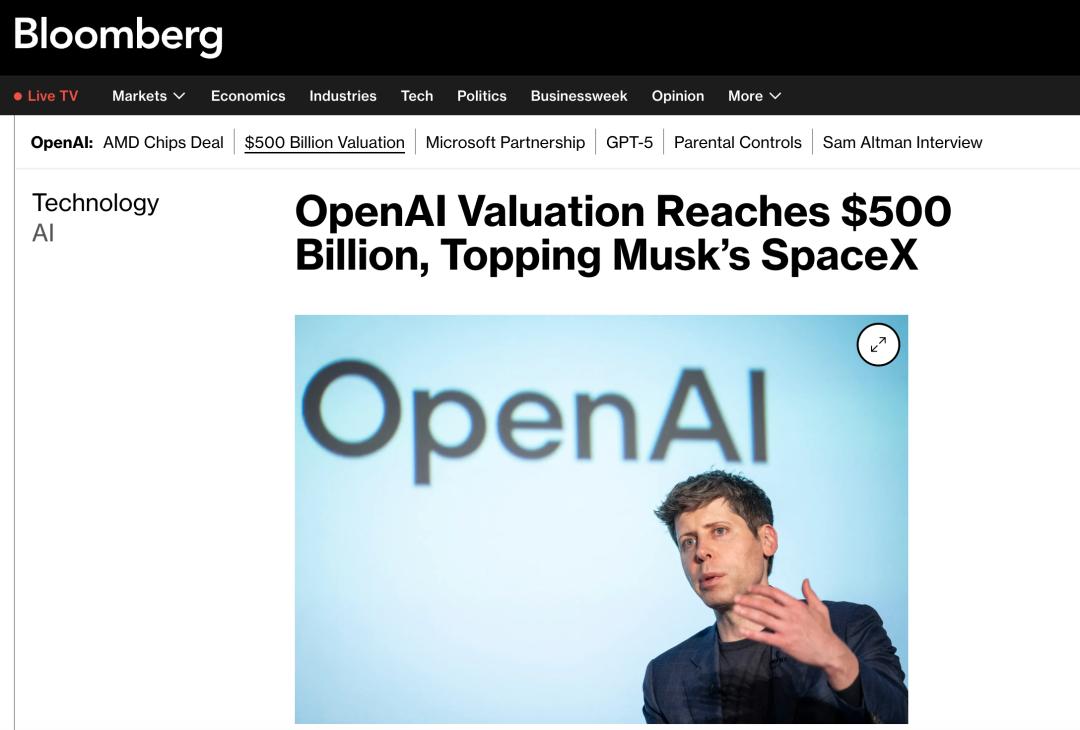
Core Insights - OpenAI's valuation is projected to soar to $500 billion by 2025, surpassing SpaceX and becoming the highest-valued unicorn globally, driven by a massive investment in computational power [1][3][9] - The company is expected to generate approximately $130 billion in revenue by 2025, with a significant increase from $4 billion in 2024 [1][9] - OpenAI is at the center of a global "AI arms race," with plans to deploy 20GW of computational power over the next decade, equivalent to the output of 20 nuclear reactors, requiring an investment of $1 trillion [1][14][19] Financial Dynamics - OpenAI's partnerships with major tech firms like Nvidia, AMD, and Oracle are crucial for its future, with agreements exceeding $1 trillion related to computational power [9][21] - Nvidia's investment of $100 billion in OpenAI is part of a closed-loop system where Nvidia's investment translates into sales revenue for itself, enhancing both companies' financial positions [22][30] - AMD's innovative deal involves stock warrants allowing OpenAI to acquire up to 10% of AMD at a nominal price, potentially yielding significant financial benefits for OpenAI [25][27] Market Impact - Companies associated with OpenAI, such as Oracle and Nvidia, have seen their stock prices surge by over 30% following announcements of partnerships [5][30] - The financial strategies employed by OpenAI and its partners create a cycle of mutual benefit, where investments lead to increased market valuations for all involved [30][32] - OpenAI's ambitious plans and partnerships have led to a significant increase in the market value of its collaborators, demonstrating the interconnectedness of the tech industry [30][32] Future Outlook - OpenAI's CEO emphasizes a long-term vision focused on growth and value creation, with expectations of exponential growth in AI usage [38] - The company aims to double its paid user base for ChatGPT, projecting substantial revenue growth from its current $12 billion [38] - However, the high capital intensity of the AI industry raises concerns about sustainability and profitability, with potential risks if growth slows [40]
究竟用什么迎接AI的军备之旅
Di Yi Cai Jing Zi Xun· 2025-09-12 01:03
Group 1 - OpenAI's significant capital expenditure has led to a surge in Oracle's remaining performance obligations (RPO) to $455 billion, resulting in a 36% increase in its stock price [2] - The AI-driven growth has sparked a "arms race" mentality in the market, with major tech companies like Broadcom and Google also benefiting from this trend [2] - Tesla is transforming from an electric vehicle company to an AI-driven technology company, with developments in robotics and autonomous driving capturing market interest [2] Group 2 - The current enthusiasm in the AI sector is described as a bubble, but it is viewed as a necessary phase for market experimentation and innovation [3] - The AI "arms race" is characterized as a technological leap rather than a simple continuation of existing economic structures, requiring new designs and tools to meet emerging demands [4][5] - The existing economic ecosystem must be re-evaluated based on fundamental principles to enhance capabilities, as demonstrated by Tesla's supply chain innovations [5] Group 3 - The competition in the AI era transcends geographical boundaries, necessitating a clear definition of demand and a supportive regulatory environment for entrepreneurial innovation [6] - The AI arms race is not just about computational power and data but fundamentally about the clarity of demand description, which requires institutional support for entrepreneurial freedom [6] - Acknowledging the need for a respectful and responsive competitive order is essential for fostering innovation in the AI sector [6]